 Arabic
| Key Takeaways |
| Arabic verbs conjugate by adding prefixes and suffixes to a three-letter root, changing form for person, gender, and number. |
| The past tense (الماضي) is the base form — all other conjugations are built by modifying it systematically. |
| Arabic distinguishes masculine and feminine forms for second and third person, requiring learners to track gender carefully. |
| Present tense conjugation uses a fixed set of prefixes (أ، ت، ي، ن) plus suffixes to mark all twelve pronoun forms. |
| Arabic has a dual form (for exactly two people) alongside singular and plural, adding a third number category English lacks. |
Arabic verb conjugation looks intimidating at first — twelve pronoun forms, gender distinctions, and a dual category that English doesn’t have. But once you see the underlying logic, the system becomes one of the most consistent in any language.
Table of Contents:
How to Conjugate Verbs in Arabic?
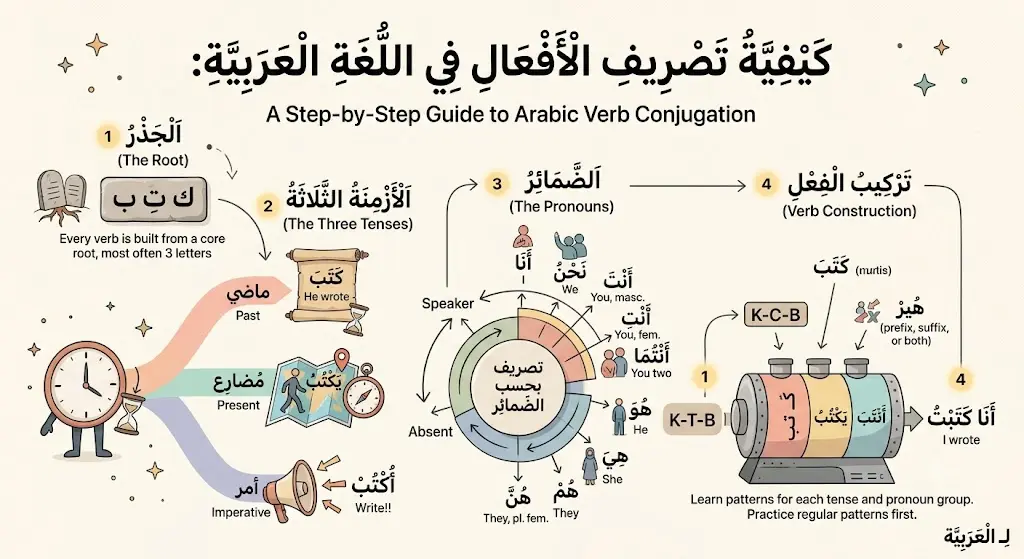
To conjugate verbs in Arabic, you modify a three-letter root verb by attaching prefixes and suffixes that indicate who is performing the action, whether they are male or female, and whether one, two, or more people are involved.
Every Arabic verb follows this pattern, making conjugation a learnable, rule-governed skill rather than a collection of exceptions.
Step 1: Understand the Three-Letter Root Before Conjugating Any Verb
Arabic verb conjugation is built on a foundation you must grasp first: nearly every Arabic verb derives from a three-letter root (الجذر الثلاثي — al-jithr al-thulāthī). These three consonants carry the core meaning, and conjugation patterns are applied on top of that root consistently.
Take the root ك – ت – ب (k-t-b), meaning “to write.” From this single root, Arabic produces:
- كَتَبَ (kataba) — he wrote
- يَكْتُبُ (yaktubu) — he writes
- كِتَابٌ (kitāb) — a book
- كَاتِبٌ (kātib) — a writer
Understanding the root means you can recognize and produce dozens of related words once you learn one conjugation pattern.
This is why Buruj Academy’s Arabic Grammar Course teaches root identification before introducing any verb tables — it gives students a framework instead of a list.
Understand the Arabic Grammar with Buruj’s free trial lesson
Why Does the Root System Matter for Conjugation in Arabic?
When you conjugate ذَهَبَ (dhahaba, “to go”) or شَرِبَ (shariba, “to drink”), you apply the same prefix-and-suffix system to each. The root stays intact; the surrounding letters signal who is doing the action. This predictability is your greatest asset as a learner.
| Root | Core Meaning | Example Verb Form |
| ك – ت – ب | writing | كَتَبَ (he wrote) |
| ذ – ه – ب | going | ذَهَبَ (he went) |
| ش – ر – ب | drinking | شَرِبَ (he drank) |
| ف – ت – ح | opening | فَتَحَ (he opened) |
| د – ر – س | studying | دَرَسَ (he studied) |
For a deeper grounding in how Arabic grammar is structured, our guide on Arabic sentence structure explains how verbs fit into the broader system of Arabic syntax.
Step 2: Learn the Arabic Pronoun System That Drives Conjugation
Arabic conjugation is pronoun-driven — before you write a single verb form, you need to know which pronoun you are conjugating for. Arabic has twelve distinct pronoun categories, compared to English’s seven, because Arabic tracks gender and has a dual form for exactly two people.
The twelve Arabic subject pronouns are:
| Pronoun | Arabic | Transliteration | Meaning |
| 1st singular | أَنَا | anā | I |
| 2nd singular masculine | أَنْتَ | anta | you (m.) |
| 2nd singular feminine | أَنْتِ | anti | you (f.) |
| 3rd singular masculine | هُوَ | huwa | he |
| 3rd singular feminine | هِيَ | hiya | she |
| 1st plural | نَحْنُ | naḥnu | we |
| 2nd dual | أَنْتُمَا | antumā | you two (m.) |
| 2nd dual | أَنْتُمَا | antumā | you two (f.) |
| 3rd dual masculine | هُمَا | humā | they two (m.) |
| 3rd dual feminine | هُمَا | humā | they two (f.) |
| 2nd plural masculine | أَنْتُمْ | antum | you all (m.) |
| 2nd plural feminine | أَنْتُنَّ | antunna | you all (f.) |
| 3rd plural masculine | هُمْ | hum | they (m.) |
| 3rd plural feminine | هُنَّ | hunna | they (f.) |
In our experience at Buruj Academy, students who memorize this pronoun table before touching verb conjugation progress significantly faster.
The pronouns themselves are rarely spoken aloud in Arabic sentences — the verb ending carries that information — but knowing them internally is the map you navigate with.
Read also:Understanding Cases in Arabic Grammar
Step 3: Conjugate Past Tense Arabic Verbs Using Suffixes Only
The past tense in Arabic (الفعل الماضي — al-fi’l al-māḍī) is the simplest conjugation to learn and the starting point for all verb study. Past tense conjugation uses suffixes only — no prefixes are added. The base form of the verb (he did / فَعَلَ) is modified by attaching endings that signal the subject.
Using كَتَبَ (kataba — to write) as our model:
| Pronoun | Arabic Verb | Transliteration | Meaning |
| هُوَ (he) | كَتَبَ | kataba | he wrote |
| هِيَ (she) | كَتَبَتْ | katabat | she wrote |
| أَنْتَ (you m.) | كَتَبْتَ | katabta | you wrote (m.) |
| أَنْتِ (you f.) | كَتَبْتِ | katabti | you wrote (f.) |
| أَنَا (I) | كَتَبْتُ | katabtu | I wrote |
| نَحْنُ (we) | كَتَبْنَا | katabnā | we wrote |
| هُمْ (they m.) | كَتَبُوا | katabū | they wrote (m.) |
| هُنَّ (they f.) | كَتَبْنَ | katabna | they wrote (f.) |
| أَنْتُمْ (you pl. m.) | كَتَبْتُمْ | katabtum | you all wrote (m.) |
| أَنْتُنَّ (you pl. f.) | كَتَبْتُنَّ | katabtunna | you all wrote (f.) |
| هُمَا (they two) | كَتَبَا | katabā | they two wrote |
| أَنْتُمَا (you two) | كَتَبْتُمَا | katabtumā | you two wrote |
Practice Exercise — Past Tense
Conjugate دَرَسَ (darasa — to study) for the following pronouns: أَنَا / هِيَ / نَحْنُ / أَنْتُمْ
Answers: دَرَسْتُ / دَرَسَتْ / دَرَسْنَا / دَرَسْتُمْ
For more on the past tense specifically, our detailed guide on Arabic past tense covers additional patterns and practice examples.
Read also: Arabic Possessive Pronouns
Step 4: Conjugate Present Tense Arabic Verbs Using Prefixes and Suffixes Together
The present tense (الفعل المضارع — al-fi’l al-muḍāri’) is more complex than the past because it uses both prefixes and suffixes. Four prefixes mark the present tense conjugation: أَ، تَ، يَ، نَ — and suffixes are then added to indicate gender and number.
The present tense covers both present (he writes) and future meaning in standard Arabic.
Using يَكْتُبُ (yaktubu) as our model:
| Pronoun | Arabic Verb | Transliteration | Meaning |
| هُوَ (he) | يَكْتُبُ | yaktubu | he writes |
| هِيَ (she) | تَكْتُبُ | taktubu | she writes |
| أَنْتَ (you m.) | تَكْتُبُ | taktubu | you write (m.) |
| أَنْتِ (you f.) | تَكْتُبِينَ | taktubīna | you write (f.) |
| أَنَا (I) | أَكْتُبُ | aktubu | I write |
| نَحْنُ (we) | نَكْتُبُ | naktubu | we write |
| هُمْ (they m.) | يَكْتُبُونَ | yaktubūna | they write (m.) |
| هُنَّ (they f.) | يَكْتُبْنَ | yaktubna | they write (f.) |
| أَنْتُمْ (you pl. m.) | تَكْتُبُونَ | taktubūna | you all write (m.) |
| أَنْتُنَّ (you pl. f.) | تَكْتُبْنَ | taktubna | you all write (f.) |
| هُمَا (they two m.) | يَكْتُبَانِ | yaktubāni | they two write (m.) |
| هُمَا (they two f.) | تَكْتُبَانِ | taktubāni | they two write (f.) |
Notice that هُوَ and أَنْتَ share the prefix تَ but carry different subject meaning — context makes the distinction clear. Our dedicated article on the Arabic present tense explores this in further detail.
Practice Exercise — Present Tense
Conjugate يَذْهَبُ (yadhhabu — to go) for: هِيَ / أَنَا / أَنْتِ / نَحْنُ
Answers: تَذْهَبُ / أَذْهَبُ / تَذْهَبِينَ / نَذْهَبُ
Read also:Understanding Arabic Future Tense Conjugation
Discover the Buruj Academy Difference
Step into our virtual classrooms and see how our expert instructors make learning Quran and Arabic intuitive and clear. We focus on overcoming the specific hurdles non-native speakers face, building your confidence and connection with the Quran.
Master the Arabic Language
Join our expert-led courses and build a strong foundation in Classical and Modern Arabic.
Get Your Free TrialStep 5: Form the Arabic Future Tense by Adding سَـ or سَوْفَ
The future tense in Arabic (المستقبل — al-mustaqbal) does not require learning a new conjugation pattern. You simply take the present tense form and add the prefix سَـ (sa-) directly to the verb, or the separate word سَوْفَ (sawfa) before it. Both mean “will.”
سَـ is the shorter, more conversational option. سَوْفَ is more emphatic and formal.
| Present | Future (with سَـ) | Future (with سَوْفَ) | Meaning |
| يَكْتُبُ | سَيَكْتُبُ | سَوْفَ يَكْتُبُ | he will write |
| تَدْرُسُ | سَتَدْرُسُ | سَوْفَ تَدْرُسُ | she will study |
| أَذْهَبُ | سَأَذْهَبُ | سَوْفَ أَذْهَبُ | I will go |
| نَفْتَحُ | سَنَفْتَحُ | سَوْفَ نَفْتَحُ | we will open |
This is one of the most elegant features of Arabic verb conjugation — the future is not an entirely new paradigm but a simple extension of present tense forms. For a complete breakdown, our article on the Arabic future tense walks through the full range of examples.
Through Buruj Academy’s Arabic Online Classes, our instructors introduce the future tense immediately after the present — because students already know 90% of the work needed.
Book your FREE Arabic trial online Arabic class at Buruj

Step 6: Apply Gender Agreement Consistently in Every Conjugation
Gender agreement is one of the most consistent — and most overlooked — features of Arabic verb conjugation. Every Arabic verb must agree in gender with its subject. Masculine subjects take masculine verb forms; feminine subjects take feminine forms. This applies across all three tenses.
In practice, this means:
- أَحْمَدُ كَتَبَ (Aḥmadu kataba) — Ahmad wrote (masculine verb form)
- فَاطِمَةُ كَتَبَتْ (Fāṭimatu katabat) — Fatima wrote (feminine verb form adds -at)
- الأُسْتَاذُ يَشْرَحُ (al-ustādhu yashraḥu) — The (male) teacher explains
- الأُسْتَاذَةُ تَشْرَحُ (al-ustādhatu tashraḥu) — The (female) teacher explains
The feminine marker in the past tense is always the suffix ـَتْ (-at). In the present tense, feminine forms use the تَـ prefix combined with specific suffixes. Mastering this distinction early prevents a whole category of grammatical errors.
Our article on masculine and feminine nouns in Arabic provides essential background for understanding why gender shapes so much of Arabic verb behavior.
Common Gender Agreement Mistakes to Avoid
| Error | Correction | Note |
| مَرْيَمُ كَتَبَ | مَرْيَمُ كَتَبَتْ | Feminine subject needs feminine verb |
| الطَّالِبَةُ يَفْهَمُ | الطَّالِبَةُ تَفْهَمُ | Present tense feminine needs تَـ prefix |
| هِيَ ذَهَبَ | هِيَ ذَهَبَتْ | Pronoun هِيَ always takes feminine form |
Read also:Understanding Hollow Verbs in Arabic
Step 7: Practice Conjugation with High-Frequency Verbs
Knowing the system theoretically is only half the work — fluency comes from applying conjugation patterns to verbs you actually use. Below is a practice table with eight high-frequency Arabic verbs across all three tenses, using the هُوَ (he) form as the base.
| Verb (He Form) | Root | Meaning | She Wrote | I Will Write | We Write |
| ذَهَبَ | ذ-ه-ب | to go | ذَهَبَتْ | سَأَذْهَبُ | نَذْهَبُ |
| أَكَلَ | أ-ك-ل | to eat | أَكَلَتْ | سَآكُلُ | نَأْكُلُ |
| شَرِبَ | ش-ر-ب | to drink | شَرِبَتْ | سَأَشْرَبُ | نَشْرَبُ |
| فَتَحَ | ف-ت-ح | to open | فَتَحَتْ | سَأَفْتَحُ | نَفْتَحُ |
| دَرَسَ | د-ر-س | to study | دَرَسَتْ | سَأَدْرُسُ | نَدْرُسُ |
| سَمِعَ | س-م-ع | to hear | سَمِعَتْ | سَأَسْمَعُ | نَسْمَعُ |
| فَهِمَ | ف-ه-م | to understand | فَهِمَتْ | سَأَفْهَمُ | نَفْهَمُ |
| رَجَعَ | ر-ج-ع | to return | رَجَعَتْ | سَأَرْجِعُ | نَرْجِعُ |
Practice Exercise — Mixed Tenses
Translate into Arabic:
- She drank (past)
- We will understand (future)
- You (m.) study (present)
- They (m.) opened (past)
Answers: شَرِبَتْ / سَنَفْهَمُ / تَدْرُسُ / فَتَحُوا
For guidance on building your Arabic vocabulary alongside these conjugation patterns, our article on tips and tricks for mastering Arabic vocabulary will help you expand the verb bank you practice with.
Read also: Quranic Arabic
What Are Irregular Verbs in Arabic and How Do You Conjugate Them?
Not every Arabic verb follows the standard three-letter root pattern cleanly. Irregular verbs are those whose roots contain a weak letter (الحروف العلة) — namely و (waw), ي (yā’), or أ (hamza) — or which have a doubled letter (مضعّف). These letters cause predictable modifications in the verb’s vowel patterns during conjugation.
There are three main categories of irregular Arabic verbs:
| Category | Arabic Name | Root Feature | Example Verb |
| Assimilated (المثال) | al-Mithāl | First letter is و or ي | وَجَدَ (to find) |
| Hollow (الأجوف) | al-Ajwaf | Middle letter is و or ي | قَالَ (to say) |
| Defective (الناقص) | al-Nāqiṣ | Last letter is و or ي | دَعَا (to call/invite) |
For example, the hollow verb قَالَ (qāla — he said) loses its middle vowel in certain conjugations: قُلْتُ (qultu — I said) rather than the expected *قَوَلْتُ. This contraction is regular within its category — once you know the hollow verb pattern, it applies consistently.
Our dedicated article on irregular verbs in Arabic covers each category with full conjugation tables and practical examples.
We recommend mastering the regular verb paradigm thoroughly before moving to irregular patterns — the contrast between them becomes the learning tool itself.
Master Arabic Verb Conjugation with Buruj Academy’s Expert Instructors
Arabic verb conjugation rewards systematic study — and consistent practice with expert correction closes the gap between knowing the rules and applying them naturally.
At Buruj Academy, our Arabic Grammar Course teaches conjugation the way it sticks: root-first, pattern-based, with immediate application in real sentences.
Our instructors are Al-Azhar University graduates with 12+ years of experience teaching non-native speakers, and every session is personalized 1-on-1 with real-time feedback.
Book your free trial Arabic class and see the difference structured, expert-led instruction makes from the very first lesson.
Begin your transformation today by choosing the path that fits your goals:
- Online Arabic Classes (General & Comprehensive)
- Arabic Course for Beginners
- Arabic Alphabet Learning Course
- Online Arabic Classes for Kids
- Arabic Classes for Adults
- Arabic Grammar Course (Nahw & Sarf)
- Intermediate Arabic Course (B1/B2)
- Arabic Speaking Course (Conversational Fluency)
- Arabic Reading Course (Literary Excellence)
- Learn Arabic Writing Course (Calligraphy & Composition)
Ready to speak with confidence? Join the global community at Buruj Academy and book your free placement interview today!
Master the Arabic Language
Join our expert-led courses and build a strong foundation in Classical and Modern Arabic.
Get Your Free TrialConclusion
Arabic verb conjugation is not an obstacle — it is a system, and systems can be learned. The three-letter root gives you a stable foundation; the prefix-and-suffix patterns give you a reliable engine. Once you internalize the twelve pronoun categories, gender agreement rules, and the past-present-future structure, every new verb you encounter slots into a framework you already understand.
The students who progress fastest at Buruj Academy are those who practice conjugation daily with a small set of high-frequency verbs before expanding their range. Depth before breadth, always.
Start with كَتَبَ, ذَهَبَ, and دَرَسَ — master them across all twelve pronoun forms — and the rest of Arabic verb conjugation will open naturally from there.
Frequently Asked Questions About Arabic Verb Conjugation
How many verb forms does a single Arabic verb have?
A single Arabic verb has up to thirteen conjugated forms across one tense when you account for all pronoun categories — singular, dual, and plural in masculine and feminine. Across all three tenses, this means over thirty forms per verb. However, several forms share the same ending, reducing the effective memorization load significantly.
What is the difference between a regular and irregular verb in Arabic?
A regular Arabic verb maintains its three root letters intact across all conjugations. An irregular verb contains a weak letter (و، ي، ا) or a doubled consonant in its root, causing predictable sound changes during conjugation. Hollow verbs like قَالَ and defective verbs like دَعَا are the most commonly encountered irregular types.
Do Arabic verbs always need a subject pronoun stated separately?
No — and this is one of Arabic’s elegant features. The verb ending itself carries full subject information, so pronouns are often dropped in natural speech and writing. كَتَبْتُ alone means “I wrote” without needing أَنَا. Subject pronouns are added for emphasis or clarity, not grammatical necessity.