 Arabic
| Key Takeaways |
| Quranic Arabic is Classicinal Arabic fixed in the 7th century, distinct in some ways from Modern Standard Arabic in vocabulary and register. |
| The Quranic Arabic alphabet contains 29 letters, each with unique articulation points (makharij) that differ meaningfully from everyday spoken sounds. |
| Quranic Arabic phonology includes short and long vowels, sukoon, shadda, and tanwin — diacritical systems absent from most modern Arabic texts. |
| Nouns in Quranic Arabic carry three grammatical cases (raf’, nasb, jarr) marked by diacritics that directly affect recitation accuracy and meaning. |
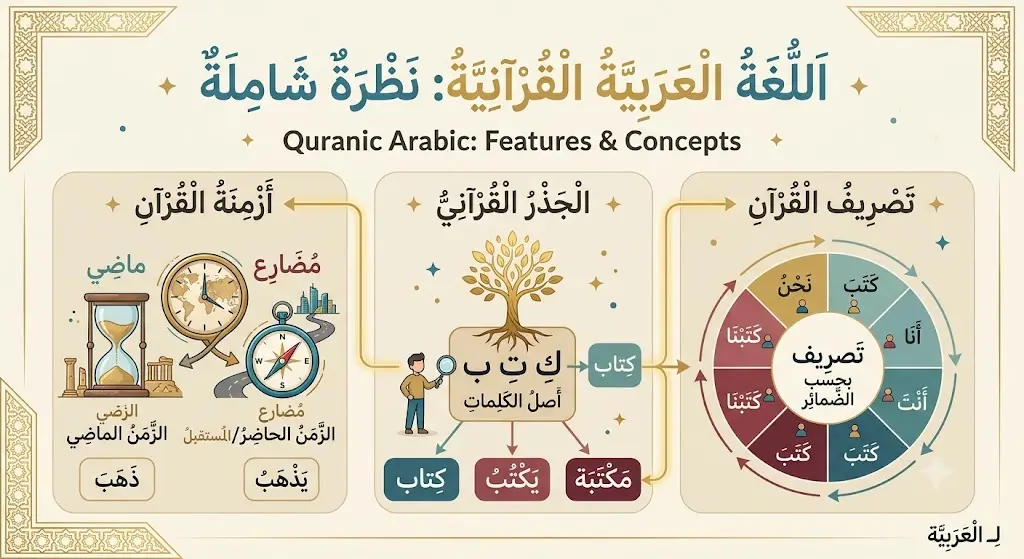
| Quranic Arabic verbs follow root-pattern morphology — mastering trilateral roots allows students to decode hundreds of Quranic words systematically. |
Millions of Muslims recite the Quran daily without understanding a single word — not from lack of devotion, but from lack of the right starting point. Quranic Arabic is the specific classical language of the Quran, and learning it changes your relationship with every verse you recite.
This guide covers everything you need to know: the Quranic Arabic’s alphabet, phonology, grammar, and where to begin learning it properly.
Table of Contents:
What Is Quranic Arabic?
Quranic Arabic is the Classical Arabic of the Quran, preserved without alteration since its revelation in the 7th century CE. It is a formal, highly structured language governed by precise grammatical rules, rich morphological patterns, and a fixed vocabulary — distinct from any spoken Arabic dialect and different in important ways even from Modern Standard Arabic (MSA).
Its significance goes beyond linguistics. Every diacritical mark in the Quran affects meaning. A single vowel change can shift a sentence from praise to condemnation.
When the Prophet ﷺ said, as recorded in Sahih al-Bukhari 5027, that the one who reads the Quran skillfully is with the noble, recording angels — that “skillfulness” includes phonetic and grammatical precision that only comes from understanding the language itself.
Allah’s choice of language was itself a statement of clarity and purpose. Consider this verse from Surah Yusuf:
إِنَّآ أَنزَلْنَٰهُ قُرْءَٰنًا عَرَبِيًّا لَّعَلَّكُمْ تَعْقِلُونَ
Innā anzalnāhu qur’ānan ʿarabiyyan laʿallakum taʿqilūn
“Indeed, We have sent it down as an Arabic Quran that you might understand.” (Yusuf 12:2)
The Quran was sent in Arabic so that its audience could reason and understand — not simply recite sounds.
The word تَعْقِلُونَ (you may reason/comprehend) comes from the root ع-ق-ل, related to the Arabic word for the mind’s faculty of rational comprehension. The Quran itself is inviting engagement with its language, not passive recitation.
In our Quranic Arabic Classes at Buruj Academy, we consistently observe that students who understand even basic Quranic Arabic grammar — the three grammatical cases, common verb patterns, key prepositions — experience a profound shift.
Recitation moves from mechanical sound production to conscious communication with the text.
Begin Understanding Quranic Arabic with a FREE Lesson
What Are the Quranic Arabic Alphabet and Letters?
The Quranic Arabic alphabet consists of 29 letters, written right to left, each representing a consonant. Arabic is an abjad writing system — the consonantal skeleton carries primary meaning, while vowels are indicated through diacritical marks added above and below the letters.
The 29 Letters in the Quranic Arabic Alphabet with Pronunciation
| Letter | Name | Transliteration |
| ا | Alif | aa |
| ب | Baa | b |
| ت | Taa | t |
| ث | Thaa | th |
| ج | Jeem | j |
| ح | Haa | ḥ (deep H) |
| خ | Khaa | kh |
| د | Daal | d |
| ذ | Dhaal | dh |
| ر | Raa | r |
| ز | Zayn | z |
| س | Seen | s |
| ش | Sheen | sh |
| ص | Saad | ṣ (emphatic S) |
| ض | Daad | ḍ (emphatic D) |
| ط | Taa | ṭ (emphatic T) |
| ظ | Dhaa | ẓ (emphatic DH) |
| ع | ‘Ayn | ‘ (pharyngeal) |
| غ | Ghayn | gh |
| ف | Faa | f |
| ق | Qaaf | q (deep K) |
| ك | Kaaf | k |
| ل | Laam | l |
| م | Meem | m |
| ن | Noon | n |
| ه | Haa | h |
| و | Waaw | w / ū |
| ي | Yaa | y / ī |
| ء | Hamza | ‘ (glottal stop) |
Each letter changes shape depending on its position — isolated, initial, medial, or final. Mastering these four positional forms is the first milestone in reading the Quran correctly.
How Do Letters Change Meaning?
The power of individual letters becomes clear when we see how the alphabet constructs Quranic meaning at the root level. Consider the opening of Surah Al-Ikhlas — four verses, each built from recognizable letter combinations:
قُلْ هُوَ ٱللَّهُ أَحَدٌ
Qul huwa llāhu aḥad
“Say, He is Allah, the One.” (Al-Ikhlas 112:1)
أَحَدٌ (One/Unique) is built from the root أ-ح-د. The letters ح and د are two of the most distinctly Arabic consonants — ح is a deep pharyngeal H that English has no equivalent for, and د is a dental D.
Students who approximate أَحَدٌ as a simple English “ahad” lose the phonetic identity of the word entirely.
The ح must emerge from the middle of the throat with friction and breath — this is one of the first sounds our instructors correct.
ٱللَّهُ ٱلصَّمَدُ
Allāhu ṣ-ṣamad
“Allah, the Eternal Refuge.” (Al-Ikhlas 112:2)
الصَّمَدُ contains ص — one of the four emphatic letters. When students replace ص with a regular س, the word sounds like السَّمَد, which is meaningless.
The emphatic quality of ص is not stylistic — it is what makes the word phonetically correct. This is precisely why the alphabet must be learned with proper makharij from the beginning.
How Does the Pronunciation of Quranic Letters Work?
The pronunciation of Quranic Arabic letters is governed by Makharij al-Huruf — the articulation points from which each letter physically originates. This is not optional phonetic detail; it is the foundation of valid recitation.
Our Al-Azhar-trained instructors at Buruj Academy teach all 29 letters according to the Makharij al-Huruf framework, which organizes every letter under five primary regions: the throat (halq), the tongue (lisaan), the two lips (shafataan), the nose (khayshoom), and the chest (jawf).
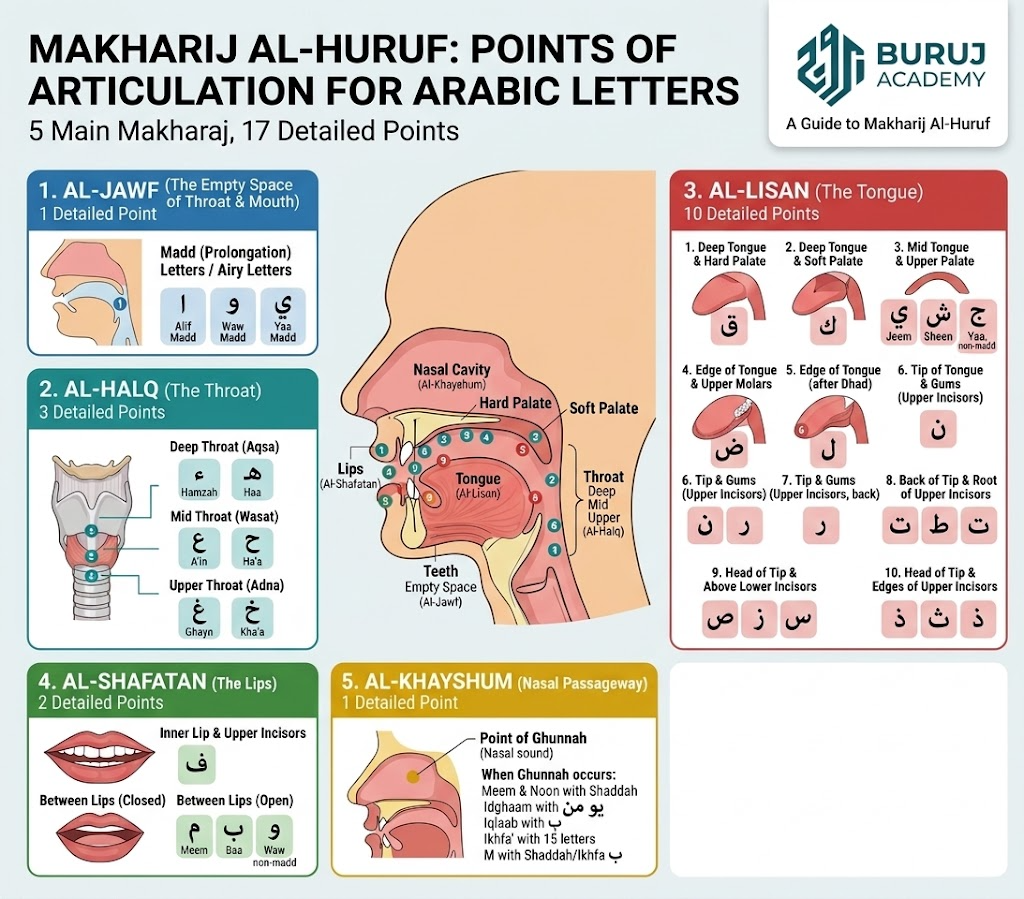
Several Quranic letters have no equivalent in English. The letter ع (‘Ayn) originates from deep in the throat — a constricted, voiced pharyngeal sound that English speakers consistently substitute with a vowel.
The letter ح (Haa) is a voiceless pharyngeal fricative, distinct from the softer ه (Haa).
Why Makharij Errors Change Quranic Meaning Directly
The stakes of mispronunciation become concrete in Surah Al-Fatihah — the surah recited in every unit of every prayer. Look at verse 7:
صِرَٰطَ ٱلَّذِينَ أَنْعَمْتَ عَلَيْهِمْ غَيْرِ ٱلْمَغْضُوبِ عَلَيْهِمْ وَلَا ٱلضَّآلِّينَ
Ṣirāṭa lladhīna anʿamta ʿalayhim ghayri l-maghḍūbi ʿalayhim wa lā ḍ-ḍāllīn
“The path of those upon whom You have bestowed favor, not of those who have earned anger, nor of those who are astray.” (Al-Fatihah 1:7)
This single verse contains three of the most commonly mispronounced letters among non-Arabic speakers. ص in صِرَاطَ — emphatic, not a regular S. ض in الْمَغْضُوبِ — the heaviest letter in Arabic, articulated from the side edge of the tongue against the upper molars. ض in الضَّآلِّينَ — again, with full emphasis and the accompanying Shadda doubling the letter.
Students who have not learned makharij recite three different sound errors in a single verse, seventeen times a day. This is why our Online Tajweed Classes begin with makharij before any rule is introduced.
For students who want structured support with these distinctions, our Tajweed for Beginners course addresses makharij systematically from the very first lesson.
Book Your FREE Trial Lesson to Begin Your Tajweed Journey
Quranic Arabic Phonology: Vowels, Consonants, and Diacritical Marks
Quranic Arabic phonology is more precise and rule-governed than any spoken Arabic dialect. The written Quran uses a complete diacritical system that marks every vowel, every lengthening, and every phonological feature — making it the most fully-annotated Arabic text in existence.
1. Consonants in Quranic Arabic
Quranic Arabic consonants divide into two major categories based on a property called Tafkhim (heaviness) and Tarqeeq (lightness). Heavy letters — such as خ, ص, ض, ط, ظ, غ, ق — are pronounced with the back of the tongue raised, producing a full, resonant sound.
Light letters are pronounced with the tongue in a neutral or forward position, producing a thinner, cleaner sound.
This distinction has direct recitation consequences. You can read more about these distinctions in our guide on heavy and light letters in Tajweed.
2. Vowels in Quranic Arabic
| Diacritic | Name | Sound | Example in Quran |
| َ | Fatha | Short “a” | رَبِّ (Rabbi) |
| ِ | Kasra | Short “i” | بِسْمِ (Bismi) |
| ُ | Damma | Short “u” | قُلْ (Qul) |
| ـَا | Fatha + Alif | Long “aa” | كِتَابٌ (Kitāb) |
| ـِي | Kasra + Yaa | Long “ee” | فِي (Fī) |
| ـُو | Damma + Waaw | Long “oo” | نُورٌ (Nūr) |
| ْ | Sukoon | No vowel | مِنْ (Min) |
| ّ | Shadda | Doubled consonant | رَبِّ (Rabbi) |
| ً ٍ ٌ | Tanwin | Final “n” sound | كِتَابًا (Kitāban) |
3. How Diacritics Shape Meaning in the Quranic Arabic
The most recited phrase in the Quran demonstrates the entire diacritical system in five words:
بِسْمِ ٱللَّهِ ٱلرَّحْمَٰنِ ٱلرَّحِيمِ
Bismi llāhi r-raḥmāni r-raḥīm
“In the name of Allah, the Entirely Merciful, the Especially Merciful.” (Al-Fatihah 1:1)
Diacritical analysis: بِ — Kasra under Baa, meaning “in/with.” اسْمِ — Kasra on the Meem (final letter), placing “name” in the Jarr/genitive case because it follows the preposition بِ. اللَّهِ — also Jarr case, Kasra on the final ه, meaning “of Allah” — it is the owner of the name. الرَّحْمَٰنِ — again Jarr case, following the noun it describes. الرَّحِيمِ — again Jarr case for the same reason.
Every single case ending here is Kasra because every noun is in a genitive chain.
Remove the diacritics and you lose the grammatical logic entirely — which is why the fully-vowelled Uthmani text is essential for learners.
4. How Vowels Affect Meaning in the Quranic Arabic
The difference between a Fatha and a Damma is not a matter of accent — it can be the difference between two entirely different words. In Surah Al-Kawthar:
إِنَّ شَانِئَكَ هُوَ ٱلْأَبْتَرُ
Inna shāni’aka huwa l-abtar
“Indeed, your enemy is the one cut off.” (Al-Kawthar 108:3)
شَانِئَكَ contains a Fatha on شَـ, a long ā vowel after it, then a Kasra on نِ, then a Fatha on ئَ. Each vowel is load-bearing. The word means “your enemy/the one who hates you.”
Alter a single vowel and the word structure collapses into meaninglessness. This precision is what makes Quranic Arabic phonology inseparable from Quranic meaning.
The long vowels — ā, ī, ū — are governed by Madd (elongation) rules in Tajweed. The natural Madd (Madd Asli) extends these vowels for two counts (harakaat) in standard recitation.
For a detailed breakdown of the phonological rules triggered by sukoon, see our guides on Ikhfa letters and Idgham rules.
Quranic Arabic Nouns: The Three-Case System
Quranic Arabic nouns operate within a three-case grammatical system — called I’rab — that marks each noun’s grammatical function through diacritical changes on its final letter.
This system is one of the most important features distinguishing Quranic Arabic from modern spoken Arabic, where case endings have largely disappeared.
| Case | Name in Arabic | Diacritic | Grammatical Function |
| Nominative | رَفْع (Raf’) | Damma (ُ) | Subject of a sentence |
| Accusative | نَصْب (Nasb) | Fatha (َ) | Object, adverbial role |
| Genitive | جَرّ (Jarr) | Kasra (ِ) | After prepositions; possessive |
Case Endings Example: The Name of Allah in Al-Fatihah
ٱلْحَمْدُ لِلَّهِ رَبِّ ٱلْعَٰلَمِينَ
Alḥamdu lillāhi rabbi l-ʿālamīn
“All praise is due to Allah, Lord of the worlds.” (Al-Fatihah 1:2)
Case analysis:
الْحَمْدُ — Damma on دُ — Raf’ case; this noun is the subject (mubtada’).
لِلَّهِ — The لِ preposition triggers Jarr; hence اللَّهِ ends with Kasra. The praise belongs to Allah — the preposition establishes possession/attribution.
رَبِّ — Kasra on بِّ — this is also Jarr, because رَبِّ is a badal (substitute/appositive) for اللَّهِ — it is further describing the same noun, so it inherits its case.
الْعَالَمِينَ — Kasra on نِ — Jarr case, because it is the mudaf ilayh (second term in a possessive construction), owned by رَبِّ.
This is a cascading grammatical chain — each word’s case is determined by its relationship to the word before it. This is Quranic Arabic grammar operating at its most elegant.
In our experience, students who study Quranic Arabic grammar formally develop reading confidence significantly faster. The case system gives them a logical framework for every diacritic they encounter.
Read also:The Best Quranic Arabic Courses
Discover the Buruj Academy Difference
Step into our virtual classrooms and see how our expert instructors make learning Quran and Arabic intuitive and clear. We focus on overcoming the specific hurdles non-native speakers face, building your confidence and connection with the Quran.
Excel in Your Quranic Studies
Join Buruj Academy and master the Quran with our structured, professional curriculum.
Book Your Free TrialQuranic Arabic Verbs and the Root System
Quranic Arabic verbs are built on trilateral roots — three-letter consonantal cores that carry a family of related meanings. From a single root, dozens of words are formed through predictable patterns.
This root-pattern system (called Wazn or morphological scales) is the most powerful tool for vocabulary acquisition in Quranic Arabic.
How the Root System Works in Practice
| Root | Meaning Family | Verb Form | Noun Form | Participial Form |
| ك-ت-ب | Writing | كَتَبَ (kataba) — he wrote | كِتَابٌ (kitāb) — book | كَاتِبٌ (kātib) — writer |
| ع-ل-م | Knowledge | عَلِمَ (ʿalima) — he knew | عِلْمٌ (ʿilm) — knowledge | عَالِمٌ (ʿālim) — scholar |
| ن-ز-ل | Descending | نَزَلَ (nazala) — he descended | نُزُولٌ (nuzūl) — descent | مُنَزِّلٌ (munazzil) — one who sends down |
The Root ع-ل-م Across Quranic Verses
The root ع-ل-م is one of the highest-frequency roots in the entire Quran — appearing in hundreds of forms across every surah. Seeing it in context reveals how one root unlocks multiple verses simultaneously:
وَعَلَّمَ ءَادَمَ ٱلْأَسْمَآءَ كُلَّهَا
Wa ʿallama Ādama l-asmā’a kullahā
“And He taught Adam the names of all things.” (Al-Baqarah 2:31)
عَلَّمَ is Form II of the root ع-ل-م. Form II (pattern: فَعَّلَ) characteristically adds an intensifying or causative meaning — here, “to cause to know” = “to teach.”
The subject is Allah; Adam is the object in Nasb case (ءَادَمَ, Fatha on final letter); الأسماء (the names) is the second direct object, also Nasb.
A student who knows this root will immediately recognize يَعْلَمُ (He knows), عَلِيمٌ (All-Knowing), and عُلَمَاءُ (scholars) as belonging to the same family.
إِنَّمَا يَخْشَى ٱللَّهَ مِنْ عِبَادِهِ ٱلْعُلَمَٰٓؤُاْ
Innamā yakhsha llāha min ʿibādihi l-ʿulamāʾ
“Only those fear Allah, from among His servants, who have knowledge.” (Fatir 35:28)
الْعُلَمَاءُ — the plural of عَالِم (scholar/one who knows) — is built directly from the same root ع-ل-م. The pattern فُعَلَاء is a standard Arabic plural pattern for words on the فَاعِل pattern.
A student who has learned the root immediately understands this word without having memorized it separately.
Understanding these patterns allows students to decode unfamiliar words through structural logic rather than memorization alone — a methodology central to Buruj Academy’s Quranic Arabic course, where we apply the context-before-abstraction approach from the very first lesson.
Begin Understanding Quranic Arabic with a FREE Lesson
Quranic Arabic vs Modern Arabic
Quranic Arabic differs from Modern Standard Arabic (MSA) in ways that matter practically for learners. Understanding these differences prevents the common mistake of pursuing MSA as a route to Quran comprehension.
| Feature | Quranic Arabic | Modern Standard Arabic |
| Case endings (I’rab) | Fully present and marked | Fully present |
| Vocabulary | Classical; some words unique to Quran | Updated with modern terminology |
| Verb forms used | All ten forms, regularly | Forms VII–X are rarer |
| Register | Sacred, formal, unchanged | Administrative, journalistic |
| Diacritical marking | Complete (fully vowelled) | Usually absent in modern texts |
A Vocabulary Difference Between Quranic Arabic and Modern Arabic
Some Quranic vocabulary has no direct MSA equivalent — or carries a different semantic weight. The word تَقْوَى (taqwa) is a prime example. In MSA, “fear” is typically rendered خَوْف (khawf).
But the Quran uses تَقْوَى for a concept that encompasses reverence, God-consciousness, protective awe — a much richer meaning than simple fear.
يَٰٓأَيُّهَا ٱلنَّاسُ ٱتَّقُواْ رَبَّكُمُ
Yā ayyuhā n-nāsu ttaqū rabbakum
“O mankind, fear your Lord.” (An-Nisa 4:1)
اتَّقُواْ is from the root و-ق-ي — meaning “to protect, to guard.” The imperative form here literally means “place a protective barrier between yourselves and your Lord’s punishment” — i.e., guard yourself through awareness of Him.
An MSA learner who knows only خَوْف for “fear” would entirely miss this depth. رَبَّكُمُ — “your Lord” — is in Nasb case (Fatha on بَّ) as the direct object of the command.)**
At Buruj Academy, we teach Quranic Arabic as its own discipline. Our Al-Azhar University graduates bring deep familiarity with classical grammatical texts, ensuring students learn the language in its authentic, Quranic context.
Book a FREE trial session with one of Buruj’s Azhari Quran tutors

Does Anyone Still Speak Quranic Arabic Today?
Quranic Arabic as a spoken vernacular is not used in daily conversation anywhere in the world. Quranic Arabic is a liturgical and scholarly language — preserved in the Quran, classical tafsir literature, hadith collections, and traditional Islamic scholarship. No native community speaks it as a mother tongue.
However, this does not mean it is inaccessible. The Quran itself asserts its accessibility directly:
وَلَقَدْ يَسَّرْنَا ٱلْقُرْءَانَ لِلذِّكْرِ فَهَلْ مِن مُّدَّكِرٍ
Wa laqad yassarnā l-qurʾāna lidh-dhikri fahal min muddakir
“And We have certainly made the Quran easy for remembrance, so is there any who will remember?” (Al-Qamar 54:17)
This verse is repeated four times in Surah Al-Qamar — at verses 17, 22, 32, and 40 — each time as a direct challenge and invitation. The verb يَسَّرْنَا is Form II of the root ي-س-ر (ease, facility) — “We have made easy.”
The object الْقُرْءَانَ is in Nasb case (Fatha) as the direct object. The question at the end — فَهَلْ مِن مُّدَّكِرٍ — “Is there any who will take heed?” — uses the Form VIII active participle of the root ذ-ك-ر (remembrance).
The Quran is telling us, four times, that it was designed to be accessible. Quranic Arabic study is the practical path to fulfilling that invitation.)**
For Muslims seeking Quran comprehension, the goal is not conversational fluency — it is the ability to recognize grammatical structures, understand core vocabulary, and follow the meaning of verses as they are recited.
For students ready to begin, our Quranic Arabic course for beginners provides a structured path from first principles to functional comprehension.
Begin Understanding Quranic Arabic with a FREE Lesson
Where to Learn Quranic Arabic?
Quranic Arabic is best learned through structured, teacher-guided instruction — not self-study apps alone. The language requires grammatical explanation, pronunciation correction, and contextual application that automated tools cannot reliably provide.
The most effective learning approach combines three elements: formal grammar instruction (covering I’rab, verb patterns, and morphology), direct Quranic application (analyzing actual verses, not isolated textbook sentences), and consistent review tied to daily recitation.
For students building their recitation foundation simultaneously, pairing Quranic Arabic study with a structured Quran Reading course accelerates both skills significantly.
Book your Free trial lesson and start reading the Quran
What to Look for in a Quranic Arabic Teacher
- Formal training in Arabic linguistics or Islamic sciences — ideally from an Al-Azhar University background
- Experience teaching non-native speakers starting from zero
- Curriculum built around the Quran itself, not generic Arabic textbooks
- Ability to explain grammar rules clearly in English, without assuming prior linguistic knowledge
What Is the Best App to Learn Quranic Arabic?
Kalaam (also available on Google Play) is a vocabulary-first Quranic Arabic app built specifically for learners who have never studied Arabic before. Its onboarding test immediately tells you what percentage of the Quran you currently understand, then builds a personalised daily lesson plan from that baseline.
The app uses active recall with spaced repetition — the same retention method used in medical school training — to ensure vocabulary sticks long-term.
Each new word is presented with its Quranic context, a visual image reinforcing meaning, and audio pronunciation.
Kalaam also includes grammar lessons framed as simple mathematical patterns — covering the 92 most common Quranic grammar structures that account for over 95% of what appears in the text.
In our instructors’ experience at Buruj Academy, this pattern-first approach to grammar is one of the most effective methods for non-Arabic speaking adults, because it removes the intimidation of classical Arabic grammar books immediately.
Available in: 80+ languages including Bengali, Urdu, Punjabi, Tamil, and more — making it genuinely accessible for the global Muslim community.
Pros:
- Completely free to use
- Personalised starting point via onboarding assessment
- Grammar taught through recognisable logic, not rote memorisation
- Leaderboards and friend challenges for accountability
Cons:
- Some users have reported occasional app-opening bugs on Android
- Deep grammar explanations become more limited at advanced levels
- No live recitation correction or Tajweed component
Start Understanding the Quran with Buruj Academy’s Quranic Arabic Course
Quranic Arabic is learnable — with the right instruction, the right curriculum, and consistent practice. Our Quranic Arabic course at Buruj Academy is designed specifically for non-Arabic speaking Muslims who want to connect with the Quran through genuine understanding.
Here is what students gain through our program:
- Ijazah-certified instructors and Al-Azhar University graduates who specialize in teaching non-native speakers
- The Buruj Method: context-before-abstraction — real Quranic sentences before abstract grammar tables
- Personalized 1-on-1 sessions with flexible 24/7 scheduling
- Structured progression from alphabet and phonology through full grammatical analysis of Quranic verses
- Real-time correction and individualized learning plans
Book your free trial lesson today and experience the difference structured, expert instruction makes.
Begin your journey of understanding by enrolling in a specialized track today:
- Quranic Arabic Classes (General & Immersive)
- Quranic Arabic Course for Kids (Interactive & Engaging)
- Quranic Arabic Course for Beginners (Foundation Building)
- Quranic Arabic Grammar Course (Syntax & Morphology)
Are you ready to understand what you recite? Join Buruj Academy today and book your free introductory session to begin your journey of discovery!
Excel in Your Quranic Studies
Join Buruj Academy and master the Quran with our structured, professional curriculum.
Book Your Free TrialConclusion
Every Quranic verse carries layers of meaning communicated not just through vocabulary, but through grammar, vowels, root patterns, and letter articulation. The case ending on a single noun, the form of a single verb, the emphasis of a single consonant — all of these are part of the message Allah intended.
Quranic Arabic is not a separate study from the Quran — it is the Quran, understood from the inside. With the right teacher, the right method, and the patience to build systematically from letters to grammar to verse analysis, every Muslim can access this language. The Quran itself declares it has been made easy for those who seek it — and that invitation is open to you.
Frequently Asked Questions About Quranic Arabic
What Is the Difference Between Quranic Arabic and Modern Standard Arabic?
Quranic Arabic is Classical Arabic fixed at the time of revelation, with complete case endings (I’rab), classical vocabulary, and a liturgical register. Modern Standard Arabic is a contemporary formal register with simplified grammar and updated vocabulary. They share the same alphabet and grammatical skeleton but differ in precision, vocabulary depth, and application — a student fluent in MSA news Arabic will still struggle with detailed Quranic grammatical analysis without additional classical training.
How Long Does It Take to Learn Quranic Arabic?
Most non-Arabic speaking adults reach functional Quranic comprehension — understanding the general meaning of verses and recognizing grammatical structures — within 12 to 18 months of consistent structured study, averaging four to five hours per week. Basic vocabulary and alphabet recognition typically develop within the first two to three months. Individual timelines vary based on prior linguistic background and consistency of practice.
Do I Need to Learn Arabic to Read the Quran?
No — you can learn to read the Quran correctly without understanding Arabic, through focused Tajweed and recitation training. However, learning Quranic Arabic grammar and vocabulary significantly deepens your connection with the text. Both skills are valuable and can be developed simultaneously or sequentially depending on your goals. Our Quran recitation course addresses recitation, while Quranic Arabic addresses comprehension.