 Arabic
| Key Takeaways |
| Arabic possessive pronouns are suffixes (not separate words) attached directly to the end of a noun. |
| There are 12 possessive pronoun suffixes in Arabic, covering singular, dual, and plural forms for both genders. |
| Feminine nouns retain the taa marbuta (ة) but it changes pronunciation to a regular “t” sound before a suffix. |
| Arabic distinguishes grammatically between masculine and feminine second-person possessives (your — أنتَ vs. أنتِ). |
Ownership in Arabic is not expressed through a separate word like the English “my” or “your.” Instead, Arabic attaches short possessive suffixes directly onto the noun itself — turning one word into a complete possessive phrase.
Arabic possessive pronouns are pronominal suffixes that merge with nouns to express belonging. All 12 forms cover first, second, and third person in singular, dual, and plural, and they apply consistently across all noun types — making them one of the most learnable and most rewarding systems in Arabic grammar.
Table of Contents:
What Are Arabic Possessive Pronouns?
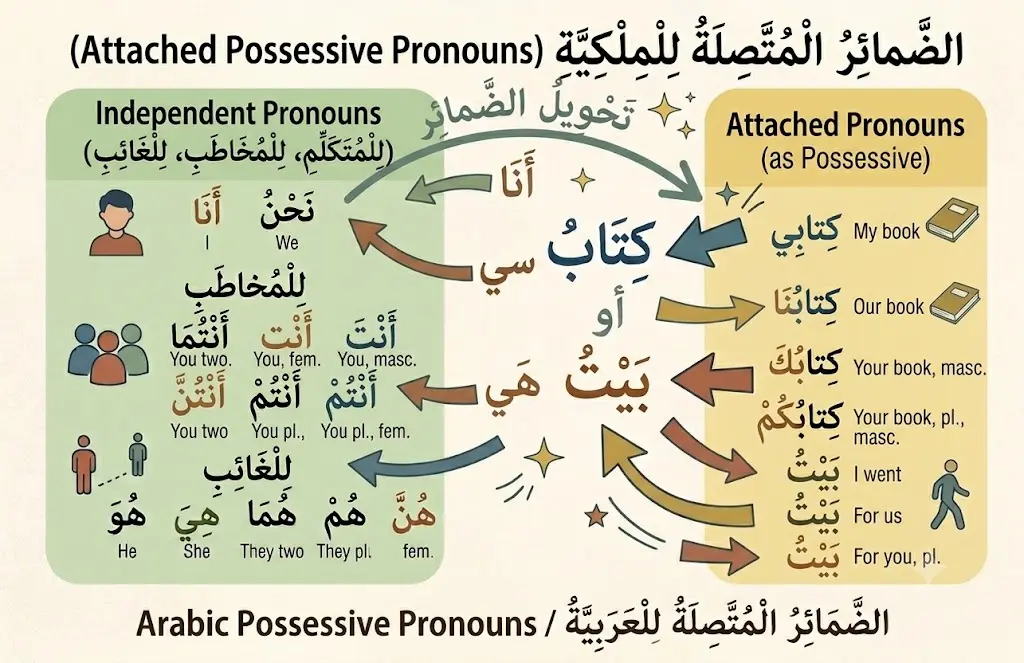
Arabic possessive pronouns are short suffixes — called ضمائر الملكية (Damaa’ir al-Milkiyya) — that attach to the end of a noun to indicate who owns or is associated with it. Unlike English, which uses separate words (“my,” “your,” “his”), Arabic fuses the possessor directly onto the possessed noun in a single written and spoken unit.
The noun that receives a possessive suffix also changes its grammatical state: it moves into the genitive/construct state (المضاف إليه). This is why understanding possessive pronouns connects directly to understanding Arabic sentence structure.
Why Possessive Suffixes Matter for Fluency
Every Arabic noun you already know can immediately generate 12 new forms once you master possessive suffixes. The word كتاب (kitaab — book) becomes كتابي (my book), كتابُكَ (your book, m.), كتابُها (her book), and so on. This is vocabulary multiplication — one of the most efficient patterns in the entire language.
At Buruj Academy, our students in the Arabic Grammar Course are consistently amazed that within a single lesson on possessive suffixes, they can suddenly express ownership across dozens of words they already know.
Understand the Arabic Grammar with Buruj’s free trial lesson

The Complete Arabic Possessive Pronouns Chart
Arabic possessive pronouns include 12 distinct suffixes, organized by person, number, and gender. The table below presents all 12 forms with their Arabic suffix, transliteration, and English meaning.
| Person | Gender | Suffix (Arabic) | Transliteration | English Meaning |
| 1st person singular | m/f (shared) | ـي | -ī | my |
| 2nd person singular | masculine | ـكَ | -ka | your (m. sing.) |
| 2nd person singular | feminine | ـكِ | -ki | your (f. sing.) |
| 3rd person singular | masculine | ـهُ | -hu | his |
| 3rd person singular | feminine | ـها | -hā | her |
| 1st person dual | m/f (shared) | ـنا | -nā | our |
| 2nd person dual | masculine | ـكُما | -kumā | your (m. dual) |
| 2nd person dual | feminine | ـكُما | -kumā | your (f. dual) |
| 3rd person dual | masculine | ـهُما | -humā | their (m. dual) |
| 3rd person dual | feminine | ـهُما | -humā | their (f. dual) |
| 2nd person plural | masculine | ـكُم | -kum | your (m. pl.) |
| 2nd person plural | feminine | ـكُنَّ | -kunna | your (f. pl.) |
| 3rd person plural | masculine | ـهُم | -hum | their (m. pl.) |
| 3rd person plural | feminine | ـهُنَّ | -hunna | their (f. pl.) |
| 1st person plural | m/f (shared) | ـنا | -nā | our |
Note: The dual forms for masculine and feminine are identical in both the second and third person. Context determines gender in those cases.
Read also:How Subject and Object Pronouns Work in Arabic
How Do Possessive Pronouns Attach to Masculine Nouns?
Masculine nouns in Arabic attach possessive suffixes directly to the final letter of the noun, with no alteration to the noun’s root spelling. This is the most straightforward attachment pattern and the best starting point for practice.
Arabic Possessive Pronoun Examples with Masculine Nouns
Take the masculine noun بيت (bayt — house) as a full working example:
| Possessive Form | Arabic | Transliteration | English |
| My house | بَيْتِي | baytī | my house |
| Your house (m.) | بَيْتُكَ | baytuka | your house (m.) |
| Your house (f.) | بَيْتُكِ | baytuki | your house (f.) |
| His house | بَيْتُهُ | baytuhu | his house |
| Her house | بَيْتُها | baytuhā | her house |
| Our house | بَيْتُنا | baitunā | our house |
| Their house (m. pl.) | بَيْتُهُم | baytuhum | their house (m.) |
| Their house (f. pl.) | بَيْتُهُنَّ | baytuhunna | their house (f.) |
The Special Rule for the First-Person Suffix ـي
When the suffix ـي (-ī, meaning “my”) attaches to a noun, the final vowel of the noun is dropped and replaced by a kasra (ِ) beneath the last letter, followed by the yaa’. So كتاب + ي = كتابي (kitaabī — my book). This pattern is consistent and applies to all noun types.
How Do Arabic Possessive Pronouns Work with Feminine Nouns?
Feminine nouns introduce one critical spelling adjustment: the taa marbuta (ة) at the end of most feminine nouns changes to a regular taa (ت) before any possessive suffix is attached. This change affects spelling and pronunciation but does not change the suffix itself.
Read also: Arabic Pronouns Explained
Arabic Possessive Pronoun Examples with Feminine Nouns
The noun مدرسة (madrasa — school) demonstrates this rule clearly:
| Possessive Form | Arabic | Transliteration | English |
| My school | مَدْرَسَتِي | madrasatī | my school |
| Your school (m.) | مَدْرَسَتُكَ | madrasatuka | your school (m.) |
| Your school (f.) | مَدْرَسَتُكِ | madrasatuki | your school (f.) |
| His school | مَدْرَسَتُهُ | madrasatuhu | his school |
| Her school | مَدْرَسَتُها | madrasatuhā | her school |
| Our school | مَدْرَسَتُنا | madrasatunā | our school |
This taa marbuta → taa conversion is one of the most common points of error we see among newer students at Buruj Academy.
Students who have studied masculine and feminine nouns in Arabic adapt to this rule most quickly, because they already understand how taa marbuta functions as a feminine marker. Once the pattern clicks, it applies without exception.
For students who prefer structured, step-by-step practice with immediate feedback, our Arabic Classes for Beginners covers possessive pronouns, verb conjugations, and noun cases in a fully sequenced curriculum.
Begin learning Arabic at Buruj with a FREE trial lesson

More Feminine Noun Examples in Context
Additional feminine noun examples reinforce the taa marbuta conversion rule:
| Noun (Indefinite) | Meaning | With ـهُ (his) | With ـها (her) |
| غُرفة (ghurfa) | room | غُرفَتُهُ (his room) | غُرفَتُها (her room) |
| سيارة (sayyāra) | car | سيارَتُهُ (his car) | سيارَتُها (her car) |
| جامعة (jāmi’a) | university | جامعَتُهُ (his university) | جامعَتُها (her university) |
Read also: Arabic Verbs
How Do Arabic Possessive Pronouns Work with Plural Nouns?
Arabic plural nouns follow the same suffix attachment rules, but the plural itself must first be correctly formed before the suffix attaches. This is where students encounter real complexity — not in the suffix system, but in Arabic’s plural patterns.
Sound masculine plurals (جمع المذكر السالم) — formed by adding ـون / ـين — drop the final ن before a possessive suffix attaches. For example: معلمون (teachers) → معلموكَ (your teachers, m. sing.).
Sound feminine plurals (جمع المؤنث السالم) — ending in ـات — attach the suffix directly: طالبات (female students) → طالباتُهُم (their female students).
Broken plurals (جمع التكسير) are treated exactly like singular nouns for suffix attachment purposes: كتب (books) → كتبُهُ (his books). The irregularity of Arabic plural forms makes vocabulary building essential alongside grammar study.
| Plural Type | Example | With ـنا (our) | Translation |
| Sound masculine plural | معلمون | معلمونا | our teachers |
| Sound feminine plural | طالبات | طالباتُنا | our female students |
| Broken plural | كتب | كتبُنا | our books |
Discover the Buruj Academy Difference
Step into our virtual classrooms and see how our expert instructors make learning Quran and Arabic intuitive and clear. We focus on overcoming the specific hurdles non-native speakers face, building your confidence and connection with the Quran.
Master the Arabic Language
Join our expert-led courses and build a strong foundation in Classical and Modern Arabic.
Get Your Free TrialHow Do Arabic Possessive Pronouns Attach to Dual Nouns?
Dual nouns in Arabic end in ـان (nominative) or ـيْن (accusative/genitive). Before a possessive suffix, the ن of the dual ending is dropped. This mirrors the same rule that applies to sound masculine plurals.
The noun كتابان (two books) in the genitive becomes كتابَيْ — and then the suffix attaches:
| Suffix | Arabic Form | Transliteration | English |
| ـي (my) | كتابَيَّ | kitābayya | my two books |
| ـكَ (your, m.) | كتابَيْكَ | kitābayka | your two books (m.) |
| ـهُ (his) | كتابَيْهِ | kitābayhi | his two books |
| ـها (her) | كتابَيْها | kitābayhā | her two books |
| ـنا (our) | كتابَيْنا | kitābaynā | our two books |
The drop of the final ن before possessive suffixes is a consistent grammatical rule — consistent rules are always good news for learners.
What Are the Most Common Mistakes English Speakers Make with Arabic Possessive Pronouns?
English speakers bring specific interference patterns from their mother tongue when learning Arabic possessive pronouns. Identifying these patterns early prevents fossilized errors.
Mistake 1 — Treating possession as a separate word
English speakers instinctively want to say “my + noun” as two separate elements. In Arabic, the suffix and noun are one word. Writing أنا + كتاب to mean “my book” is a grammatical error — the correct form is simply كتابي.
Mistake 2 — Ignoring gender in second-person pronouns
English “your” is gender-neutral. Arabic distinguishes ـكَ (your, addressing a male) from ـكِ (your, addressing a female). This distinction must become automatic.
Mistake 3 — Forgetting the taa marbuta conversion
Writing مدرسةُهُ instead of مدرستُهُ is the most frequent spelling error we see. The ة must become ت before any suffix.
Mistake 4 — Keeping the ن on dual and sound masculine plural before suffixes.
Students write كتابانِهُ instead of كتابَيْهِ. The ن is always dropped before possessive suffixes.
Understanding these errors connects directly to broader Arabic grammar fundamentals that English speakers need to explicitly unlearn from their L1 habits.
Practice Exercises for Arabic Possessive Pronouns
Active production — not passive recognition — is what builds real grammatical competence. These exercises are structured progressively, from controlled substitution to open-ended production.
Exercise 1: Suffix Substitution Table
Fill in the missing possessive forms for the noun قلم (qalam — pen). Use the chart above for reference.
| Suffix Meaning | Arabic Form | Transliteration |
| My pen | قَلَمِي | qalamī |
| Your pen (m.) | _________ | _________ |
| Your pen (f.) | _________ | _________ |
| His pen | _________ | _________ |
| Her pen | _________ | _________ |
| Our pen | _________ | _________ |
| Their pen (m. pl.) | _________ | _________ |
Answer key: قَلَمُكَ / qalamuka — قَلَمُكِ / qalamuki — قَلَمُهُ / qalamuhū — قَلَمُها / qalamuhā — قَلَمُنا / qalaminā — قَلَمُهُم / qalamuhum
Exercise 2: Taa Marbuta Conversion Practice
Convert the following feminine nouns to their correct form before adding the given suffix.
| Noun | Suffix to Add | Correct Form |
| حقيبة (bag) | ـي (my) | _________ |
| نافذة (window) | ـهُ (his) | _________ |
| قصة (story) | ـنا (our) | _________ |
| لغة (language) | ـكِ (your, f.) | _________ |
Answer key: حقيبَتِي — نافذَتُهُ — قصَّتُنا — لغَتُك
Exercise 3: Translate into Arabic
Translate the following possessive phrases into Arabic, choosing the correct suffix and noun form.
- His car (سيارة — sayyāra)
- Our teacher (معلم — mu’allim)
- Your (f.) room (غرفة — ghurfa)
- Their (m. pl.) school (مدرسة — madrasa)
- My two books (كتابان — kitābān)
Answer key:
- سيارَتُهُ
- معلمُنا
- غُرفَتُكِ
- مدرسَتُهُم
- كتابَيَّ
These exercises cover the core Arabic tenses and noun patterns that any serious Arabic student needs to internalize.
Read also: How to Conjugate Verbs in Arabic
Master Arabic Grammar with Buruj Academy’s Online Arabic Classes
Possessive pronouns are one pillar of Arabic grammar — but they connect to verb conjugations, sentence structure, and noun cases that all reinforce each other. Expert-guided instruction builds these connections systematically.
Buruj Academy’s Online Arabic Classes offer:
- Al-Azhar University graduates and instructors with 12+ years teaching non-native speakers
- The Buruj Method: Context-before-abstraction — you use Arabic grammar in real sentences before memorizing rule tables
- Personalized 1-on-1 sessions with real-time correction
- Flexible 24/7 scheduling for global students at every level
- Clear progression from the Arabic for Beginners course through advanced grammar mastery
Book your free trial lesson today and learn Arabic from instructors who have guided thousands of non-native speakers to genuine fluency.
Begin your transformation today by choosing the path that fits your goals:
- Online Arabic Classes (General & Comprehensive)
- Arabic Course for Beginners
- Arabic Alphabet Learning Course
- Online Arabic Classes for Kids
- Arabic Classes for Adults
- Arabic Grammar Course (Nahw & Sarf)
- Intermediate Arabic Course (B1/B2)
- Arabic Speaking Course (Conversational Fluency)
- Arabic Reading Course (Literary Excellence)
- Learn Arabic Writing Course (Calligraphy & Composition)
Ready to speak with confidence? Join the global community at Buruj Academy and book your free placement interview today!
Master the Arabic Language
Join our expert-led courses and build a strong foundation in Classical and Modern Arabic.
Get Your Free TrialConclusion
Arabic possessive pronouns are not a complicated system — they are a remarkably consistent one. Twelve suffixes, one set of attachment rules, and one taa marbuta conversion cover every noun in the language. What takes time is not memorizing the forms but building the automatic reflex to produce them accurately in real speech and writing.
The students who progress fastest are those who practice production, not just recognition. Use the exercises above regularly, build your possessive forms with every new noun you learn, and the pattern will become second nature. Insha’Allah, this guide gives you the foundation to do exactly that.
Frequently Asked Questions About Arabic Possessive Pronouns
What is the difference between possessive pronouns in Arabic and English?
English possessive pronouns are standalone words placed before the noun (“my book,” “her car”). Arabic possessive pronouns are suffixes — short endings attached directly to the noun itself. This means a possessed noun and its possessor are written as a single word in Arabic, which is both efficient and grammatically elegant once learned.
How many possessive pronouns are there in Arabic?
Arabic has 12 possessive pronoun suffixes, covering first, second, and third person in singular, dual, and plural forms, with gender distinctions in the second and third person. The dual forms for masculine and feminine are identical in both second and third person, so the chart has 14 rows but 12 distinct suffix shapes.
Do Arabic possessive pronouns change based on whether the noun is masculine or feminine?
The suffixes themselves do not change based on noun gender. What changes is the noun: feminine nouns with taa marbuta (ة) must convert that ending to a regular taa (ت) before the suffix attaches. The suffix ـهُ (his), for example, attaches identically to masculine and feminine nouns — only the noun’s final letter behaves differently.
Related Articles
Arabic