 Arabic
| Key Takeaways |
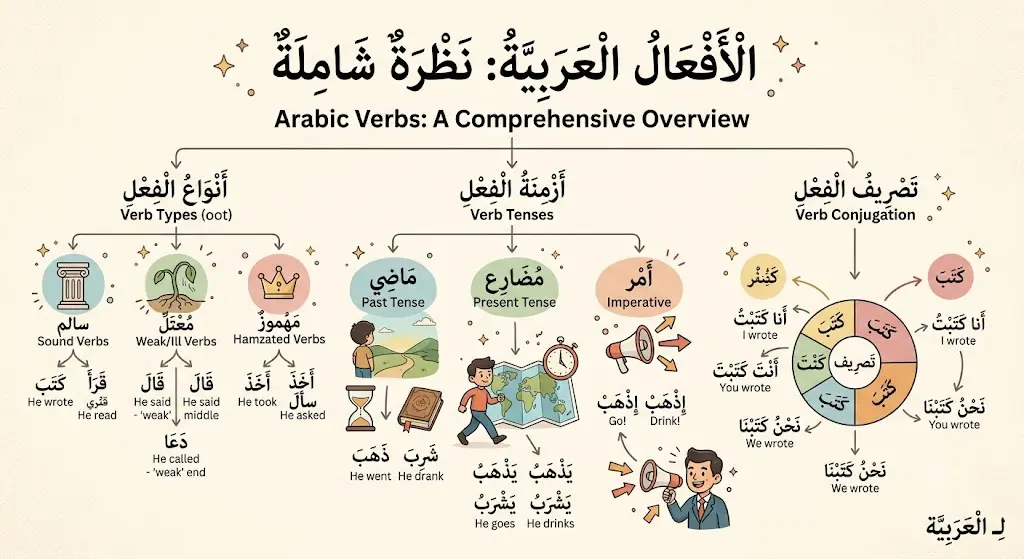
| Arabic verbs are built on three-letter roots, and understanding these roots allows learners to decode thousands of words systematically. |
| Arabic has three tenses — past (ماضي), present (مضارع), and future (مستقبل) — each formed through consistent prefix and suffix patterns. |
| Every Arabic verb changes its form based on who is performing the action, including gender and number distinctions absent in English. |
| The three main types of verbs in Arabic are sound verbs (سالم), weak verbs (معتل), and doubled verbs (مضعَّف), each with distinct conjugation rules. |
Arabic verbs are the engine of every sentence — without them, even the richest vocabulary stalls. Yet for English speakers, verb behavior in Arabic can feel disorienting at first: verbs change shape depending on who is speaking, how many people are involved, and whether the speaker is male or female.
The good news is that Arabic verbs follow logical, learnable patterns. Once you grasp the three-letter root system and the core conjugation rules, verbs in Arabic become one of the most systematic — and satisfying — parts of the language to master.
Table of Contents:
What Are Arabic Verbs?
Arabic verbs are action or state words derived from a trilateral root (جذر ثلاثي) — three consonants that carry a core meaning. Almost every Arabic verb is built on this foundation. From the root ك-ت-ب (k-t-b), meaning “writing,” you get كَتَبَ (he wrote), يَكْتُبُ (he writes), مَكْتَبٌ (desk/office), and كِتَابٌ (book) — all from the same three letters.
This root system is what makes Arabic so internally consistent. Unlike English, where “go” becomes “went” in the past tense with no logical connection, Arabic verbs change through predictable prefixes and suffixes applied to the same root.
The other major difference is agreement. Arabic verbs must agree with their subject in three ways: person (first, second, or third), gender (masculine or feminine), and number (singular, dual, or plural).
This means one English verb like “you wrote” can correspond to four different Arabic forms depending on who “you” refers to.
At Buruj Academy, our Arabic Grammar Course addresses exactly this root-system logic from the first session — building the pattern recognition that makes conjugation feel intuitive rather than like endless memorization.
Understand the Arabic Grammar with Buruj’s free trial lesson
What Are the Types of Verbs in Arabic?
Arabic verbs divide into three primary categories based on their root letters. Each type follows its own conjugation behavior, and knowing which category a verb belongs to tells you how it will change across all tenses and subjects.
1. Sound Verbs (الفعل السالم)
Sound verbs contain no weak letters (و, ي, or ء) in their root and no doubled consonants. They follow the most regular conjugation patterns and are the best starting point for beginners.
Examples: كَتَبَ (kataba — he wrote), دَرَسَ (darasa — he studied), خَرَجَ (kharaja — he left).
2. Weak Verbs (الفعل المعتل)
Weak verbs contain at least one weak letter (و or ي) in the root. They undergo sound or spelling changes during conjugation. There are four subtypes: Mithal (weak first letter), Ajwaf (weak middle letter), Naqis (weak final letter), and Lafif (two weak letters).
Example: قَالَ (qala — he said) is an Ajwaf verb whose middle و contracts in several conjugated forms.
We cover irregular verbs in Arabic separately in our blog for learners who want to go deeper into these patterns.
3. Doubled Verbs (الفعل المضعَّف)
Doubled verbs have an identical second and third root letter. In some conjugated forms, these two letters merge into one with a shadda (ّ).
Example: مَدَّ (madda — he stretched/extended), from the root م-د-د.
| Verb Type | Arabic Name | Key Feature | Example |
| Sound | سالم | No weak letters, no doubling | كَتَبَ (he wrote) |
| Weak | معتل | Contains و or ي in root | قَالَ (he said) |
| Doubled | مضعَّف | 2nd and 3rd root letters identical | مَدَّ (he stretched) |
| Hamzated | مهموز | Contains ء in root | أَكَلَ (he ate) |
Sound verbs are the gateway to understanding all other types — master them first, and the logic for weak and doubled verbs becomes far clearer.
Arabic Verbs with Meaning in the Past Tense (الماضي)
The past tense in Arabic is the dictionary form of the verb — the form you will find if you look any verb up. It describes a completed action and is formed using suffixes added to the three-letter root. The base form is always third-person masculine singular (he), making it the anchor from which all other past-tense forms derive.
The past-tense suffix pattern for sound verbs follows this structure:
| Subject | Suffix | Example (root: د-ر-س) | Meaning |
| He (هو) | — | دَرَسَ | He studied |
| She (هي) | ـَتْ | دَرَسَتْ | She studied |
| You masc. (أنتَ) | ـْتَ | دَرَسْتَ | You studied (m.) |
| You fem. (أنتِ) | ـْتِ | دَرَسْتِ | You studied (f.) |
| I (أنا) | ـْتُ | دَرَسْتُ | I studied |
| They masc. (هم) | ـُوا | دَرَسُوا | They studied (m.) |
| We (نحن) | ـْنَا | دَرَسْنَا | We studied |
Notice that the suffix changes are completely regular across all sound verbs — once you learn this table for دَرَسَ, you can apply the identical suffixes to كَتَبَ, فَهِمَ, خَرَجَ, and hundreds of others.
Practice Exercise 1: Cover the “Meaning” column. Read each Arabic form aloud and recall its English meaning. Then reverse: read the English and write the Arabic form from memory.
In our sessions at Buruj Academy, we find that students who drill the past tense suffixes for just two verbs — one فَعَلَ pattern and one فَعِلَ pattern — unlock the entire past-tense system within a week of consistent daily practice.
Arabic Verbs with the Present Tense (المضارع)
The present tense in Arabic expresses an ongoing, habitual, or incomplete action. Unlike the past tense, which uses only suffixes, the present tense uses both prefixes and suffixes simultaneously. The prefix carries the tense marker; the suffix marks the subject.
The four present-tense prefixes are: أَ (I), تَ (you / she), يَ (he / they masc.), نَ (we).
| Subject | Form | Example (root: ك-ت-ب) | Meaning |
| He (هو) | يَفْعُلُ | يَكْتُبُ | He writes |
| She (هي) | تَفْعُلُ | تَكْتُبُ | She writes |
| You masc. (أنتَ) | تَفْعُلُ | تَكْتُبُ | You write (m.) |
| You fem. (أنتِ) | تَفْعُلِينَ | تَكْتُبِينَ | You write (f.) |
| I (أنا) | أَفْعُلُ | أَكْتُبُ | I write |
| We (نحن) | نَفْعُلُ | نَكْتُبُ | We write |
| They masc. (هم) | يَفْعُلُونَ | يَكْتُبُونَ | They write (m.) |
The middle vowel of the present-tense stem — the vowel on the second root letter — is not always predictable from the past tense. You need to learn it with the verb. For كَتَبَ, it is ُ (damma), giving يَكْتُبُ. For جَلَسَ (he sat), it is ِ (kasra), giving يَجْلِسُ. For فَتَحَ (he opened), it is َ (fatha), giving يَفْتَحُ.
This is why we always teach verbs in paired form at Buruj Academy: past + present together, so learners internalize both stems from the start. Our Online Arabic Classes build this paired-verb habit from the earliest beginner lessons.
Practice Exercise 2: Take these three verbs — ذَهَبَ (he went), فَهِمَ (he understood), شَرِبَ (he drank) — and conjugate each in the present tense for: he, she, I, and we. Check your answers against the prefix-suffix table above.
For a deeper look at how Arabic tenses interact, our article on Arabic tenses is the natural next step after this guide.
Book your FREE Arabic trial online Arabic class at Buruj

How Do You Form the Future Tense in Arabic?
The future tense in Arabic is the simplest tense to form — it is built directly from the present tense.
Add the prefix سَـ (sa-) directly to the present-tense verb for the near future, or the separate word سَوْفَ (sawfa) before it for a slightly more emphatic or distant future.
| Present | Near Future (سَـ) | Meaning |
| يَكْتُبُ | سَيَكْتُبُ | He will write |
| تَدْرُسُ | سَتَدْرُسُ | She will study |
| أَذْهَبُ | سَأَذْهَبُ | I will go |
| نَتَعَلَّمُ | سَنَتَعَلَّمُ | We will learn |
Because the future tense derives directly from the present, mastering present-tense conjugation gives you the future tense for free. Our full breakdown of the Arabic future tense explains the nuances between سَـ and سَوْفَ in detail.
Read also: How to Conjugate Verbs in Arabic
Discover the Buruj Academy Difference
Step into our virtual classrooms and see how our expert instructors make learning Quran and Arabic intuitive and clear. We focus on overcoming the specific hurdles non-native speakers face, building your confidence and connection with the Quran.
Master the Arabic Language
Join our expert-led courses and build a strong foundation in Classical and Modern Arabic.
Get Your Free TrialHow Do Arabic Verbs Change Based on Subject?
One area that surprises English speakers is the Arabic dual form — a dedicated grammatical number for exactly two people or things, distinct from both singular and plural.
This means Arabic verbs have more conjugated forms than English verbs, covering singular, dual, and plural for both masculine and feminine.
| Subject | Past Form | Present Form | Meaning |
| He (هو) | كَتَبَ | يَكْتُبُ | He wrote / writes |
| They two masc. (هما) | كَتَبَا | يَكْتُبَانِ | They two wrote / write |
| They masc. (هم) | كَتَبُوا | يَكْتُبُونَ | They wrote / write |
| She (هي) | كَتَبَتْ | تَكْتُبُ | She wrote / writes |
| They two fem. (هما) | كَتَبَتَا | تَكْتُبَانِ | They two wrote / write |
| They fem. (هن) | كَتَبْنَ | يَكْتُبْنَ | They (f.) wrote / write |
The dual forms — ending in ـَا in the past and ـَانِ in the present — are regular across all sound verbs. In everyday Modern Standard Arabic (MSA), the dual is genuinely used.
In spoken dialects, it appears less frequently, but for reading Arabic newspapers, literature, or Quranic text, recognizing dual verb forms is non-negotiable.
Understanding how verbs interact with masculine and feminine nouns in Arabic is essential here — verb gender agreement follows noun gender, so both systems need to be learned together.
The Most Common Arabic Verbs Beginners Should Learn First
Frequency-first vocabulary learning is one of the most evidence-backed strategies in language acquisition. The following verbs cover the highest-frequency actions in both spoken MSA and written Arabic. Learning these verbs in both their past and present forms gives beginners a working foundation for real sentences immediately.
| Arabic (Past) | Arabic (Present) | Transliteration | English Meaning |
| ذَهَبَ | يَذْهَبُ | dhahaba / yadhhabu | to go |
| جَاءَ | يَجِيءُ | jāʾa / yajīʾu | to come |
| أَكَلَ | يَأْكُلُ | akala / yaʾkulu | to eat |
| شَرِبَ | يَشْرَبُ | shariba / yashrabu | to drink |
| قَالَ | يَقُولُ | qāla / yaqūlu | to say |
| فَهِمَ | يَفْهَمُ | fahima / yafhamu | to understand |
| عَمِلَ | يَعْمَلُ | ʿamila / yaʿmalu | to work |
| رَأَى | يَرَى | raʾā / yarā | to see |
| كَتَبَ | يَكْتُبُ | kataba / yaktubu | to write |
| قَرَأَ | يَقْرَأُ | qaraʾa / yaqraʾu | to read |
| فَتَحَ | يَفْتَحُ | fataha / yaftahu | to open |
| سَمِعَ | يَسْمَعُ | samiʿa / yasmaʿu | to hear |
These twelve verbs span three stem-vowel patterns — فَعَلَ/يَفْعُلُ, فَعِلَ/يَفْعَلُ, and the weak verb فَعَلَ/يَفْعَلُ — giving beginners exposure to the main behavioral categories from the start.
Practice Exercise 3: Write three sentences for each verb — one in the past tense (he), one in the present tense (she), and one in the future tense (I). This three-sentence drill for each verb locks in form, meaning, and tense simultaneously.
Pairing verb learning with mastering Arabic vocabulary is the most efficient path to functional reading and speaking ability.
Our Arabic for Beginners course structures exactly this — high-frequency verbs and nouns together, always inside real sentences from day one.
Begin learning Arabic at Buruj with a FREE trial lesson

How Do Arabic Verbs Fit Into Sentence Structure?
Arabic sentence structure differs fundamentally from English in one key way: the verb can — and often does — come first. A verbal sentence (الجملة الفعلية) begins with the verb, followed by the subject, followed by the object or complement. An example: ذَهَبَ الطَّالِبُ إِلَى الْمَدْرَسَةِ — “The student went to school” — but literally structured as “went the-student to the-school.”
This verb-first order is not always obligatory. Arabic also allows subject-first nominal sentences (الجملة الاسمية), and word order can shift for emphasis. But the verbal sentence pattern is the dominant structure in formal written Arabic, news media, and classical texts.
Understanding where verbs sit in a sentence, and how they relate to subjects and objects, is the foundation of Arabic sentence structure — a topic worth studying directly alongside verb conjugation rather than after it.
Read also: Arabic Possessive Pronouns
Master Arabic Verbs with Buruj Academy’s Expert Arabic Instructors
Arabic verbs follow logical, root-based patterns — but navigating those patterns accurately requires a teacher who can give you real-time feedback before wrong habits solidify.
Buruj Academy’s Online Arabic Classes are taught by Al-Azhar University graduates with 12+ years of experience teaching non-native speakers. We use the Buruj Method — Context-before-abstraction — meaning you practice verbs inside real sentences from day one, not in isolation.
Every student receives a personalized learning plan, 1-on-1 flexible scheduling, and immediate correction.
Whether you are a complete beginner or working toward fluency, our Arabic Grammar Course will accelerate your progress.
Book your free trial lesson today.
Begin your transformation today by choosing the path that fits your goals:
- Online Arabic Classes (General & Comprehensive)
- Arabic Course for Beginners
- Arabic Alphabet Learning Course
- Online Arabic Classes for Kids
- Arabic Classes for Adults
- Arabic Grammar Course (Nahw & Sarf)
- Intermediate Arabic Course (B1/B2)
- Arabic Speaking Course (Conversational Fluency)
- Arabic Reading Course (Literary Excellence)
- Learn Arabic Writing Course (Calligraphy & Composition)
Ready to speak with confidence? Join the global community at Buruj Academy and book your free placement interview today!
Master the Arabic Language
Join our expert-led courses and build a strong foundation in Classical and Modern Arabic.
Get Your Free TrialConclusion
Arabic verbs are demanding at first glance — gendered, numbered, and tense-layered in ways English simply does not require. But that complexity is built on a consistent internal logic: three-letter roots, predictable suffixes, and rule-governed prefixes that repeat across thousands of verbs.
Once those patterns click, Arabic stops feeling like memorization and starts feeling like decoding. Start with sound verbs, drill the twelve high-frequency verbs above with their paired past and present forms, and build from there — one root at a time.
Frequently Asked Questions About Arabic Verbs
What Is the Basic Structure of a Verb in Arabic?
Arabic verbs are built on a trilateral root — three consonants carrying a core meaning. Prefixes and suffixes are added to this root to mark tense, subject, gender, and number. The past-tense third-person masculine singular form (e.g., كَتَبَ — he wrote) is the dictionary form and the starting point for all conjugations.
How Many Types of Verbs Are There in Arabic?
Arabic verbs are classified into four main types: sound verbs (سالم), weak verbs (معتل), doubled verbs (مضعَّف), and hamzated verbs (مهموز). Sound verbs follow the most regular conjugation patterns and are taught first. Weak verbs undergo root-letter changes in certain conjugated forms and require additional attention from intermediate learners.
Do Arabic Verbs Change Based on Gender?
Yes — Arabic verbs must agree with their subject in gender. “She wrote” is كَتَبَتْ (with a ـَتْ suffix), while “he wrote” is كَتَبَ. In the present tense, “she writes” is تَكْتُبُ and “he writes” is يَكْتُبُ. This gender distinction applies across all tenses and is one of the most important features of Arabic verb agreement.
What Is the Difference Between the Past and Present Tense in Arabic?
The Arabic past tense (ماضي) uses only suffixes added to the root and expresses completed actions. The present tense (مضارع) uses both prefixes and suffixes and expresses ongoing or habitual actions. The four present-tense prefixes — أَ, تَ, يَ, نَ — identify the subject, while the suffixes distinguish gender and number within that subject category.