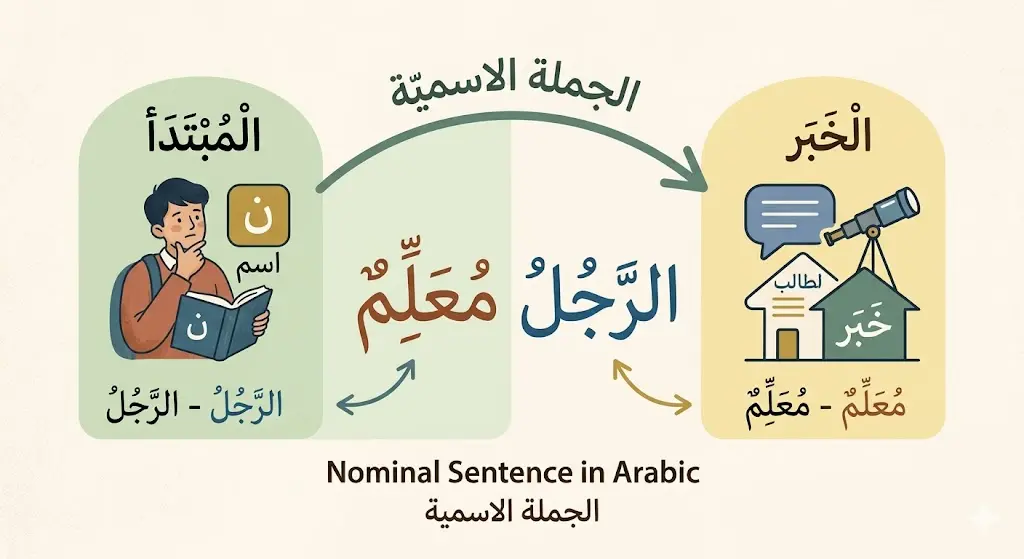
 Arabic
| Key Takeaways |
| Arabic script is always written in a connected, cursive-like style — there is no separate “print” and “cursive” mode. |
| All 28 Arabic letters change shape depending on their position: initial, medial, final, or isolated form. |
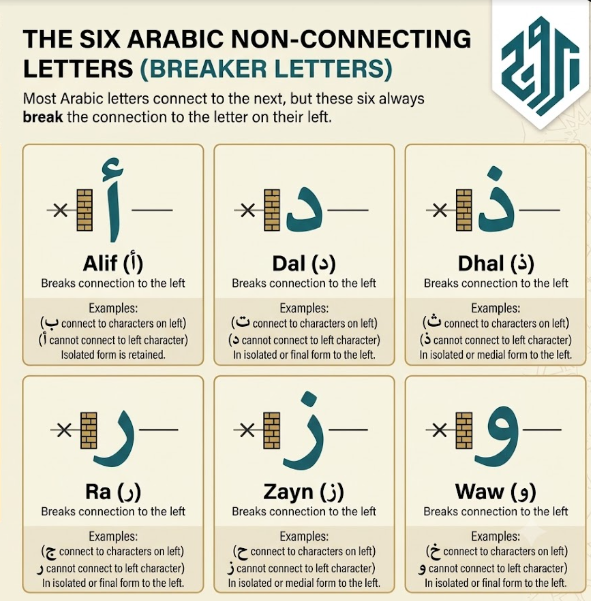
| Six letters (و، ز، ر، ذ، د، ا) never connect to the following letter, creating natural visual breaks within words. |
| Mastering Arabic cursive requires learning four positional forms per letter before attempting full word writing. |
| Daily 15–20 minute tracing and copying practice builds muscle memory faster than studying letter charts alone. |
Arabic writing stops many beginners before they even begin. The flowing, connected script looks impossibly complex — letters shifting shapes, words running right to left, no obvious separation between letters. That visual unfamiliarity is one of the most common barriers we see in new students.
Here is the reassuring truth: Arabic does not have a cursive mode you switch into. Every Arabic letter is always written in connected form.
Once you understand the system governing those connections — four positional shapes, six non-connecting letters, and consistent stroke patterns — the script becomes logical, learnable, and even beautiful to write.
Table of Contents:
Is Arabic Always Cursive?
Arabic is always written in a connected script, regardless of whether the context is formal typography, handwriting, or digital text. Unlike English, which distinguishes between print and cursive as two separate writing styles, Arabic has only one script system — and that system is inherently connective.
Every letter in Arabic attaches to the letter before it (with six specific exceptions). This is not a stylistic choice; it is the structural foundation of the writing system itself.

When you see Arabic text — in a newspaper, on a sign, in a textbook — the letters are always joined.
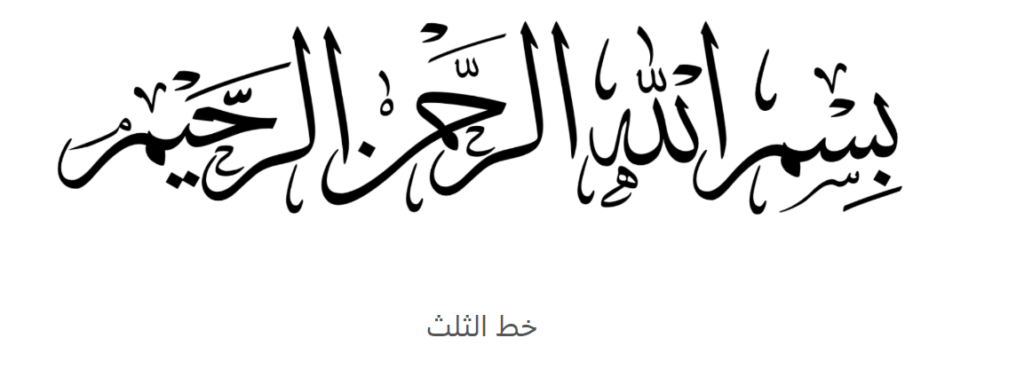
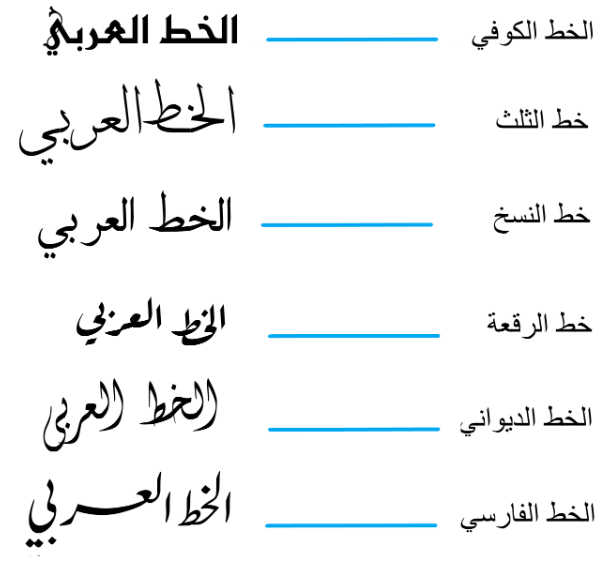
The variation you might notice between different samples of Arabic writing is not print versus cursive; it is differences in calligraphic style (such as Naskh, Ruq’ah, or Thuluth) or in how tightly or loosely a writer forms their strokes.
For learners, this means one important thing: you do not need to learn two systems. You learn Arabic letters once, in their connective forms, and that is the complete writing system.
What Is the Arabic Alphabet Cursive Definition?
“Arabic alphabet cursive” refers to the standard connected writing system of the Arabic script, in which letters join one another within a word according to fixed positional rules. It is the default and only mode of written Arabic — not an alternative style.
The term “cursive” is borrowed from English to describe Arabic’s flowing appearance to Western learners.
In linguistic terms, Arabic is a connected script (خط متصل), meaning letters are designed structurally to link with their neighbors.
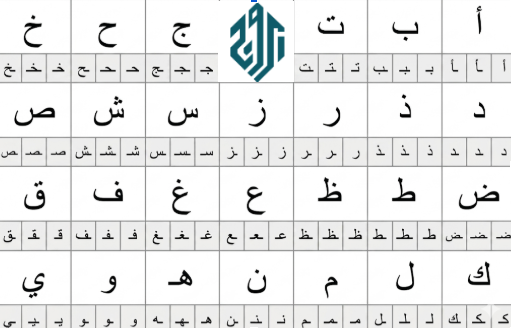
Each of the 28 Arabic letters has up to four positional forms: isolated (مُفردة), initial (أولية), medial (وسطى), and final (نهائية). The shape a letter takes depends entirely on where it falls within a word.
Understanding this four-form system is the actual foundation of reading and writing Arabic. If you are building from zero, our guide on how to learn the Arabic alphabet and our Arabic Alphabet course provides the foundational framework before you begin joining letters together.
Get a free trial now in Buruj’s Alphabet course
The Four Positional Forms Every Arabic Letter Takes
Arabic letters are not fixed, single shapes. Each letter adapts its form based on its position within a word — and recognizing this adaptation is what makes connected reading and writing possible.
| Position | Description | Example Letter: ع |
| Isolated | Letter stands alone, not connected | ع |
| Initial | Letter begins a word, connects to the right | عَ (as in عَلَم) |
| Medial | Letter is in the middle, connects on both sides | ـعـ (as in مَعَك) |
| Final | Letter ends a word, connects only to the left | ـع (as in مَوضِع) |
The shape changes are not random — they follow consistent internal logic. The core of each letter (its distinguishing feature, such as dots or curves) is preserved across all four forms. Only the connecting strokes change.
How the Letter ب (Ba) Changes Across Positions
Take ب (Ba) as a clear example of how positional shifting works in practice:
- Isolated: بَ — full baseline letter with dot below
- Initial: بَيت — opens to the right, connecting forward into the word (house)
- Medial: كَتَبَ — shortened baseline, connecting both left and right (he wrote)
- Final: ذَهَبَ — returns to a fuller curve, closed on the left (he went)
The dot below ب appears in all four positions. What changes is the horizontal baseline extension — it stretches or contracts based on what the letter needs to connect to.
Practicing this single letter across all four positions before moving to the next is the method our instructors at Buruj Academy recommend from day one.
Which Six Arabic Letters Never Connect to the Following Letter?
Six Arabic letters are non-connectors (الحروف غير المتصلة) — they connect to the letter before them (on their right) but never to the letter after them (on their left). This creates a natural visual break within a word without any space being inserted.
| Letter | Name | Sound |
| ا | Alif | /aː/ |
| د | Dal | /d/ |
| ذ | Dhal | /ð/ |
| ر | Ra | /r/ |
| ز | Zayn | /z/ |
| و | Waw | /w/ or /uː/ |
A Practical Example: The Word بَاب (Bab — Door)
بَاب contains ب + ا + ب. Because Alif (ا) does not connect forward, the first ب connects to ا, but ا disconnects from the final ب. The result looks like two separate clusters: بَا — ب. You do not leave a space; the break is structural, caused by Alif’s non-connecting nature.
Knowing these six letters removes a major source of confusion. When you see an apparent gap within an Arabic word, check whether the letter preceding the gap is one of these six. In nearly every case, it will be.
Arabic Alphabet Words and Examples: Seeing Cursive in Context
The best way to internalize positional forms is through high-frequency vocabulary words that contain multiple letter-joining patterns. Below are carefully chosen examples with letter-by-letter breakdowns.
| Arabic Word | Transliteration | Meaning | Letters Used | Connection Pattern |
| كَتَبَ | kataba | He wrote | ك + ت + ب | All connect — full cursive chain |
| بَيت | bayt | House | ب + ي + ت | All connect |
| وَلَد | walad | Boy/child | و + ل + د | و disconnects; ل connects to د |
| دَرَسَ | darasa | He studied | د + ر + س | د and ر disconnect; breaks within word |
| مَدرَسَة | madrasa | School | م+د+ر+س+ة | م connects to د; then breaks at د and ر |
| قَلَم | qalam | Pen | ق + ل + م | All connect — clean cursive chain |
Breaking Down مَدرَسَة (Madrasa — School)
This word is excellent for practice because it contains two non-connectors (د and ر), producing three visible clusters within a single five-letter word: مَ — دْ — رَ — سَة.
A beginner unfamiliar with non-connectors might read this as three separate words. Knowing the six disconnectors resolves that confusion immediately.
If you want to build vocabulary alongside your script practice, our resource on mastering Arabic vocabulary pairs well with this structural approach.
How to Learn Arabic Cursive Writing?
Learning Arabic cursive writing follows a fixed sequence: letter recognition, isolated form mastery, positional form learning, word building, and then sentence-level practice.
Skipping steps — especially jumping to words before mastering individual positional forms — is the most common reason adult learners plateau early.
At Buruj Academy, our Arabic Writing Course structures this exact progression, with Al-Azhar-trained instructors providing real-time stroke correction in personalized 1-on-1 sessions.
For learners who want a structured path rather than self-study, this removes the guesswork entirely.
Book your free trial to start writing Arabic
Step 1: Learn Arabic Letters in Thematic Groups, Not Alphabetical Order
Arabic’s 28 letters share structural families. Letters that look similar (sharing the same base shape but differing in dot count) are learned most efficiently together.
| Group | Letters | Shared Feature |
| Ba Family | ب ت ث | Same baseline shape; 1, 2, 3 dots respectively |
| Jim Family | ج ح خ | Same curved body; differs in dot placement |
| Ayn Family | ع غ | Same open-loop body; غ has dot above |
| Sad Family | ص ض | Same bulging body; ض has dot above |
| Ra Family | ر ز | Same tail; ز adds a dot above |
Learning by family reduces memorization load by approximately 40%, since you are learning one base shape and then adding dot variations rather than 28 entirely distinct forms.
Step 2: Practice Each Arabic Letter Through All Four Positions Before Moving On
For each letter group, write the letter in isolation first, then trace how it transforms at the beginning, middle, and end of a word. Do not move to the next group until you can write all four forms from memory without reference.
A practical drill: write the word كَتَبَ (kataba) ten times, saying aloud the position of each letter as you write it — “Kaf: initial form… Ta: medial form… Ba: final form.” This verbal reinforcement embeds the positional logic alongside the muscle memory.
Read also: How to Speak Arabic?
Step 3: Use Dotted Tracing Sheets Before Free-Form Writing
Tracing is not a children’s technique — it is a legitimate method for building motor pathways.
In our experience, adult learners who spend two weeks on tracing before free writing consistently produce cleaner letter forms and connect letters more naturally than those who attempt free writing from week one.
Effective tracing practice involves:
- Following letter strokes in correct directional order (Arabic strokes have a specific direction sequence)
- Tracing full words, not isolated letters, to build connection flow
- Writing from right to left with consistent pen angle (approximately 45°)
Discover the Buruj Academy Difference
Step into our virtual classrooms and see how our expert instructors make learning Quran and Arabic intuitive and clear. We focus on overcoming the specific hurdles non-native speakers face, building your confidence and connection with the Quran.
Master the Arabic Language
Join our expert-led courses and build a strong foundation in Classical and Modern Arabic.
Get Your Free TrialStep 4: Build Words from Learned Letters Before Introducing New Ones
Once you have mastered one letter group, build as many real words as possible using only those letters plus letters you already know. This creates meaningful repetition without overwhelming the learner with new shapes simultaneously.
Example progression after learning ب، ت، ث، ك، ل، م:
- بَيت (bayt — house)
- كَتَبَ (kataba — he wrote)
- كِتاب (kitab — book)
- مَكتَب (maktab — desk/office)
All four words use the same letter pool. Each repetition of ك and ب in new combination contexts strengthens positional form recognition.
The Most Common Mistakes of Arabic Alphabet Cursive for Beginners
Beginners make predictable errors when learning Arabic cursive. Identifying these in advance helps you self-correct before wrong habits solidify.
In our Arabic classes for beginners at Buruj Academy, the three mistakes we see most consistently among adult beginners learning Arabic script are: writing letters in isolated form even within words (failing to switch to positional forms), leaving gaps before non-connector letters, and writing from left to right by instinct before the right-to-left direction becomes automatic.
Begin learning Arabic at Buruj with a FREE trial lesson

Mistake 1: Using Isolated Forms Inside Words
Many beginners learn letters in isolation and then simply place those isolated forms next to each other, without switching to the appropriate connecting form. This produces text that looks like a string of disconnected letters rather than a flowing word.
Fix: Before writing any word, mentally preview which letters are initial, medial, and final. Write the word in “position slots” — initial slot, middle slots, final slot — then fill in the correct form for each.
Mistake 2: Adding Spaces Before Non-Connector Letters
Because non-connectors create a visual break, some learners instinctively insert a space to “explain” the gap. This breaks the word into apparent separate units.
Fix: Remember that the break is structural, not spatial. The letter after a non-connector begins immediately — no gap, no space. The word دَرَسَ (darasa) looks like three clusters but is written in a continuous rightward flow without any spacing.
Mistake 3: Inconsistent Stroke Direction
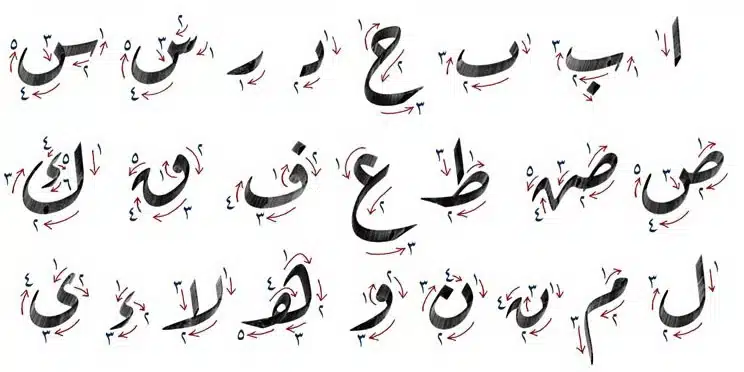
Arabic letters are drawn with specific stroke directions. Writing strokes in the wrong direction (especially for letters like ع، س، ن) produces malformed letters that a native reader cannot recognize easily.
Fix: Learn the stroke order for each letter explicitly, not just the final shape. Many learners copy the shape correctly but use the wrong stroke sequence, which shows in the unevenness of their letterforms.
Practical Exercises to Build Arabic Cursive Writing Fluency
These exercises are designed for systematic practice that builds genuine fluency — not just recognition, but production.
Exercise 1 — The Four-Form Drill
Choose one letter. Write it in all four forms in a horizontal row, labeling each:
ب (isolated) — بَ (initial) — ـبـ (medial) — ـب (final)
Repeat five rows daily for one week per letter group.
Exercise 2 — Word Decomposition Practice
Take a simple Arabic word and break it into its component letters with their positional labels before reassembling it. For example:
مَكتَب (office/desk): → م (initial) + كـ (medial) + تـ (medial) + ـب (final) → Now write the whole word in one connected stroke.
Exercise 3 — Copy and Label
Take 10 common Arabic words. Write each one, then underneath label every letter with its positional form. This slows you down purposefully and forces conscious engagement with the connection rules.
| Word | Meaning | Letter Labels |
| كَتَبَ | He wrote | ك initial / ت medial / ب final |
| بَيت | House | ب initial / ي medial / ت final |
| وَلَد | Boy | و isolated (non-connector) / ل initial / د final |
| كِتاب | Book | ك initial / ت medial / ا non-connector / ب final |
| مَدرَسَة | School | م initial / د non-connector / ر non-connector / س initial / ة final |
Exercise 4 — Dictation Practice
Have someone read a short Arabic word aloud (or use an audio resource). Write it from sound alone. Then check the spelling. This Arabic dictation approach trains the ear-to-hand pathway that fluent writers use automatically.
Exercise 5 — Speed Progression
Write the same five words slowly and carefully on Day 1. On Day 7, write the same words aiming for 25% faster production without losing legibility. This gradual speed increase mimics how natural writing fluency develops.
Improving your pronunciation alongside writing accelerates overall Arabic acquisition. Our guide on Arabic pronunciation addresses the sound-production side that complements written practice.
Can You Write Cursive in Arabic?
Yes — and beyond standard script, Arabic has a rich tradition of calligraphic styles, each with distinct visual character.
For learners, the most important style to master first is Naskh (النسخ), the standard style used in most printed Arabic text, textbooks, and digital media.
| Style | Arabic Name | Character | Common Use |
| Naskh | النسخ | Clear, upright, balanced | Books, newspapers, digital text |
| Ruq’ah | الرقعة | Simplified, fast, informal | Everyday handwriting |
| Thuluth | الثلث | Ornate, extended verticals | Decorative, mosque inscriptions |
| Diwani | الديواني | Elaborate, looping | Formal documents, certificates |
| Kufi | الكوفي | Angular, geometric | Architectural ornamentation |
For practical language learning, focus on Naskh for reading comprehension and Ruq’ah for handwriting speed.
Ruq’ah is what native Arabic speakers use in everyday note-taking — it simplifies certain letterforms for faster production without sacrificing legibility.
The Arabic script you encounter in Modern Standard Arabic (MSA) contexts — news broadcasts, formal writing, literature — uses Naskh as its standard typographic form.
Learning to write in Naskh first means your handwritten Arabic aligns with the text you read in learning materials.
Read also: Non-Connecting Letters in Arabic
How to Learn Arabic for Beginners Beyond Cursive Script?
Script mastery is the entry point, but Arabic literacy expands into reading fluency, grammar, and eventually speaking. Once your letter recognition and writing mechanics are established, the next structured steps are vowel marking (short vowels, or harakat), word segmentation, and then grammar fundamentals.
Our complete guide on how to learn Arabic for beginners maps the full progression from alphabet to conversational competence.
Understanding Arabic vowels is particularly important — the short vowel markers written above and below Arabic letters are what make text fully readable for beginners before they develop vocabulary-based recognition.
As your reading develops, grammar becomes the next layer. Understanding Arabic sentence structure shows you how written words combine into meaningful, grammatically correct statements — moving you from tracing letters to constructing language.
Master Arabic Writing with Buruj Academy’s Expert Instructors
Arabic cursive writing is a skill that responds directly to quality instruction and consistent practice. Buruj Academy’s Learn Arabic Writing Course provides exactly that — systematic, structured writing instruction from Al-Azhar University graduates with 12+ years of experience teaching non-native speakers.
Our instructors use the Buruj Method — context-before-abstraction, patience-before-performance — to guide each student through positional forms, connection rules, and stroke technique at a pace matched to their individual level.
Every session is personalized 1-on-1, with real-time correction and flexible 24/7 scheduling.
Book your free trial lesson today and write your first Arabic word correctly — from day one.
Begin your transformation today by choosing the path that fits your goals:
- Online Arabic Classes (General & Comprehensive)
- Arabic Course for Beginners
- Arabic Alphabet Learning Course
- Online Arabic Classes for Kids
- Arabic Classes for Adults
- Arabic Grammar Course (Nahw & Sarf)
- Intermediate Arabic Course (B1/B2)
- Arabic Speaking Course (Conversational Fluency)
- Arabic Reading Course (Literary Excellence)
- Learn Arabic Writing Course (Calligraphy & Composition)
Ready to speak with confidence? Join the global community at Buruj Academy and book your free placement interview today!
Master the Arabic Language
Join our expert-led courses and build a strong foundation in Classical and Modern Arabic.
Get Your Free TrialConclusion
Arabic cursive is not an optional style — it is the script itself. Every letter connects, every letter adapts its form by position, and six specific letters create natural visual breaks that follow consistent rules. Once you internalize the four positional forms, identify the six non-connectors, and practice through deliberate exercises, what once looked like flowing mystery becomes a structured, learnable system.
The path forward is patient, sequential practice: letter groups, then positional forms, then words, then sentences. That sequence — not shortcuts — is what builds lasting fluency in Arabic writing.
Frequently Asked Questions About Arabic Alphabet Cursive
Is Arabic always written in cursive, or is there a print version?
Arabic is always written in its connected, cursive-like form — there is no separate print version. The distinction between print and cursive exists in Latin scripts like English but not in Arabic. All Arabic text, whether typed digitally or handwritten, uses the same connective script system with positional letter forms.
How many letter forms do I need to learn in Arabic?
Each of the 28 Arabic letters has up to four forms: isolated, initial, medial, and final. However, some letters share nearly identical forms across positions, reducing the practical memorization load. With the six non-connecting letters, certain forms collapse into fewer variations, making the total number of distinct shapes closer to 60–70 in practice.
What is the best writing style for Arabic beginners to learn first?
Naskh (النسخ) is the most appropriate calligraphic style for beginners. It is the standard style used in textbooks, printed materials, and digital Arabic text. Once Naskh is established, learners can transition to Ruq’ah (الرقعة) for faster everyday handwriting, as most native speakers use Ruq’ah informally.
Why do some Arabic words appear to have gaps within them?
Gaps within Arabic words occur because six letters — ا، د، ذ، ر، ز، و — never connect to the following letter. They connect to the letter before them on the right but leave a structural break before the next letter. These breaks are not spaces; they are caused by the non-connecting nature of specific letters and are entirely normal features of Arabic text.