 Arabic
| Key Takeaways |
| A nominal sentence (الجملة الاسمية) begins with a noun or pronoun, not a verb, and requires no copula in the present tense. |
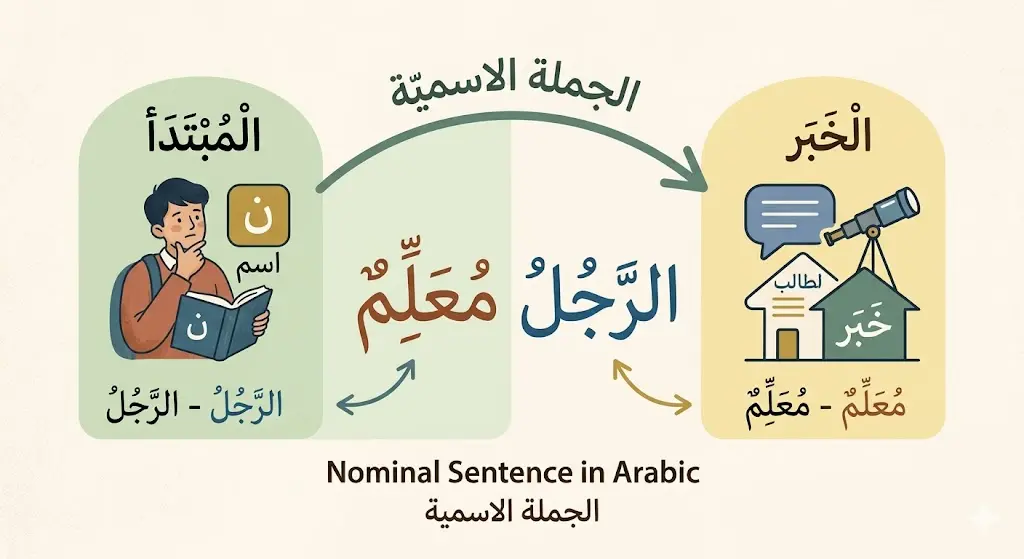
| Every nominal sentence consists of two parts: the mubtada (subject) and the khabar (predicate), both typically in the nominative case. |
| The khabar can be a single word, a prepositional phrase, a full sentence, or even a verb phrase depending on complexity. |
Starting to build sentences in Arabic can feel like a wall you cannot see over — until you discover that Arabic lets you make complete, meaningful statements without a single verb. That is not a beginner’s shortcut; it is standard Arabic grammar used in newspapers, literature, conversation, and the Quran.
A nominal sentence (الجملة الاسمية — al-jumlah al-ismiyyah) is any Arabic sentence that begins with a noun or pronoun rather than a verb. It consists of two required parts — the mubtada (subject) and the khabar (predicate) — and in present-tense statements, no form of “to be” is needed. Once you internalize this structure, you gain the key to hundreds of real Arabic sentences immediately.
Table of Contents:
What Is a Nominal Sentence in Arabic?
A nominal sentence in Arabic (الجملة الاسمية) is a complete sentence that opens with a noun or pronoun and makes a statement without requiring a verb. The present-tense meaning of “is” or “are” is implied, not written. This makes Arabic nominal sentences structurally leaner than their English equivalents while carrying the same communicative weight.
In our Online Arabic Grammar Course at Buruj Academy, this is typically the first sentence type we teach — and for good reason.
Students who understand the nominal sentence framework can begin reading and constructing real Arabic within their first few weeks of structured study, because so much of everyday Arabic follows this exact pattern.
Understand the Arabic Grammar with Buruj’s free trial lesson

Consider these immediate examples before we go deeper:
| Arabic | Transliteration | English |
| البيتُ كبيرٌ | al-baytu kabīrun | The house is big. |
| المعلمُ مجتهدٌ | al-muʿallimu mujtahidun | The teacher is diligent. |
| الطفلةُ سعيدةٌ | al-ṭiflatu saʿīdatun | The girl is happy. |
Notice that none of these sentences contains a verb. The subject and predicate sit side by side, and the tanwin (nunation) at the end of each word signals grammatical case — something we will return to shortly.
What Are the Parts of an Arabic Nominal Sentence?
Every nominal sentence is built from two grammatical pillars: the mubtada (المبتدأ) and the khabar (الخبر). Understanding what each one does — and what case it carries — is the foundation of all further Arabic grammar work, including what you will study in our Arabic grammar beginner’s guide.
What Is the Mubtada (المبتدأ)?
The mubtada is the subject of the nominal sentence — what the sentence is about. It always carries the nominative case (الرفع — al-rafʿ), marked by a ḍammah (ُ) or its tanwin equivalent (ٌ). The mubtada is almost always a definite noun (with ال) or a pronoun.
| Type | Example | Meaning |
| Definite noun | الكتابُ | The book |
| Pronoun | هوَ | He |
| Proper noun | محمدٌ | Muhammad |
A mubtada that is an indefinite noun requires a special condition — its khabar must come first. We address this below under nominal sentence formulas.
What Is the Khabar (الخبر)?
The khabar is the predicate — it completes the statement about the mubtada. It also carries the nominative case (ḍammah/tanwin ٌ) in its simplest form. The khabar answers: what about the subject?
| Khabar Type | Example | Meaning |
| Single adjective | الجوُّ باردٌ | The weather is cold. |
| Single noun | أحمدُ طالبٌ | Ahmad is a student. |
| Prepositional phrase | الكتابُ على المكتبِ | The book is on the desk. |
| Sentence (jumlah) | الطفلُ أبوهُ طبيبٌ | The child — his father is a doctor. |
This variety in khabar types is where many English-speaking learners get surprised. Arabic grammar is far more flexible than it first appears, and the khabar’s form tells you a great deal about the sentence’s meaning and structure.
If you are building your vocabulary alongside grammar, our resource on mastering Arabic vocabulary works well alongside this study.
What Are the Main Types of Khabar in Arabic Nominal Sentences?
The khabar is not always a single descriptive word — Arabic grammar recognizes four distinct types, each carrying different structural rules.
Knowing these types allows you to read and construct far more sophisticated sentences than the basic “noun + adjective” pattern.
1. Khabar Mufrad (الخبر المفرد) — Single-Word Predicate
This is the most common type for beginners. The khabar is a single noun or adjective in the nominative case.
- السماءُ زرقاءُ — al-samāʾu zarqāʾu — The sky is blue.
- الأستاذُ عادلٌ — al-ustādhu ʿādilun — The professor is just.
- البنتُ ذكيةٌ — al-bintu dhakiyyatun — The girl is intelligent.
2. Khabar Shibh al-Jumlah (خبر شبه الجملة) — Quasi-Sentence Predicate
Here, the khabar is a prepositional phrase (جار ومجرور) or an adverbial phrase (ظرف). This type is extremely common in both Modern Standard Arabic and classical texts.
- الأولادُ في الحديقةِ — al-awlādu fī al-ḥadīqati — The children are in the garden.
- الكتابُ فوقَ الطاولةِ — al-kitābu fawqa al-ṭāwilati — The book is on top of the table.
- المعلمُ أمامَ الفصلِ — al-muʿallimu amāma al-faṣli — The teacher is in front of the classroom.
Read also:A Guide to Arabic Sentence Structure
3. Khabar Jumlah (خبر جملة) — Full-Sentence Predicate
When the khabar is itself a complete sentence (verbal or nominal), Arabic grammar requires a ḍamīr al-rabiṭ — a pronoun linking the khabar back to the mubtada.
- الطالبُ أبوهُ مهندسٌ — al-ṭālibu abūhu muhandisun — The student — his father is an engineer.
- المرأةُ ابنُها يدرسُ الطبَّ — al-marʾatu ibnahā yadrusu al-ṭibba — The woman — her son studies medicine.
The bold pronoun هُ (hu) in each example is the linking pronoun that makes the sentence grammatically complete.
How Is a Nominal Sentence Different from a Verbal Sentence in Arabic?
A nominal sentence begins with a noun or pronoun; a verbal sentence (الجملة الفعلية — al-jumlah al-fiʿliyyah) begins with a verb.
This distinction is not merely positional — it carries real grammatical consequences, particularly around subject-verb agreement and emphasis. You can explore Arabic sentence structure in full detail in our dedicated guide.
| Feature | Nominal Sentence | Verbal Sentence |
| Begins with | Noun / Pronoun | Verb |
| Verb “to be” | Implied (present) | Present as inflected verb |
| Emphasis | Subject is foregrounded | Action is foregrounded |
| Example | البنتُ تكتبُ | كتبتِ البنتُ |
| Translation | The girl writes (subject focus) | The girl wrote (action focus) |
In Arabic rhetoric, choosing a nominal sentence over a verbal one signals that the speaker wants to emphasize who or what is performing or being described — not the action itself.
This is why news headlines, philosophical statements, and characterizations in Arabic literature so frequently use the nominal structure.
At Buruj Academy, our native Arabic instructors in the Arabic course for beginners spend dedicated time helping students feel this distinction intuitively — not just memorize it as a rule — because that intuition is what allows students to eventually think in Arabic rather than translate from English.
Begin learning Arabic at Buruj with a FREE trial lesson

What Are the Most Important Nominal Sentence Formulas to Know?
Arabic has several standard nominal sentence formulas that recur constantly in everyday Modern Standard Arabic.
Learning these formulas as patterns — rather than translating word by word — dramatically accelerates reading fluency. This connects directly to what we cover in our guide on how to learn Arabic for beginners.
Formula 1 — Definite Noun + Adjective
Structure: ال + noun (mubtada) + indefinite adjective (khabar)
| Arabic | Transliteration | English |
| البيتُ واسعٌ | al-baytu wāsiʿun | The house is spacious. |
| الدرسُ سهلٌ | al-darsu sahlun | The lesson is easy. |
| المدينةُ جميلةٌ | al-madīnatu jamīlatun | The city is beautiful. |
Formula 2 — Pronoun + Noun/Adjective
Structure: Pronoun (mubtada) + indefinite noun or adjective (khabar)
| Arabic | Transliteration | English |
| هوَ طبيبٌ | huwa ṭabībun | He is a doctor. |
| هيَ أستاذةٌ | hiya ustādhátun | She is a professor. |
| أنا طالبٌ | anā ṭālibun | I am a student. |
Read also: Understanding Dammah in Arabic
Formula 3 — Inverted Nominal Sentence (Khabar Muqaddam)
When the mubtada is indefinite, the khabar moves to the front. This is called khabar muqaddam (الخبر المقدم) and mubtada muʾakhkhar (المبتدأ المؤخر).
| Arabic | Transliteration | English |
| في البيتِ رجلٌ | fī al-bayti rajulun | In the house is a man. |
| على المكتبِ كتابٌ | ʿalā al-maktabi kitābun | On the desk is a book. |
| في الفصلِ طلابٌ | fī al-faṣli ṭullābun | In the classroom are students. |
This inversion is mandatory in Arabic when the mubtada is indefinite — not optional. Missing this rule is one of the most consistent errors we see from English-speaking students in their first year of Arabic study.
Read also: Interrogative Particles in Arabic
Discover the Buruj Academy Difference
Step into our virtual classrooms and see how our expert instructors make learning Quran and Arabic intuitive and clear. We focus on overcoming the specific hurdles non-native speakers face, building your confidence and connection with the Quran.
Master the Arabic Language
Join our expert-led courses and build a strong foundation in Classical and Modern Arabic.
Get Your Free TrialPractice Exercises: Build Your Nominal Sentence Skills
Good grammar instruction requires practice inside the lesson itself — not just explanation. Work through these exercises, then check your answers against the answer key below.
Exercise 1 — Identify the Mubtada and Khabar
Read each sentence and label the mubtada (M) and khabar (K):
| Sentence | Transliteration | |
| 1 | الطقسُ حارٌّ | al-ṭaqsu ḥārrun |
| 2 | هيَ مريضةٌ | hiya marīḍatun |
| 3 | المكتبةُ قريبةٌ | al-maktabatu qarībatun |
| 4 | في الغرفةِ سريرٌ | fī al-ghurfati sarīrun |
Answer Key:
- الطقسُ (M) — حارٌّ (K)
- هيَ (M) — مريضةٌ (K)
- المكتبةُ (M) — قريبةٌ (K)
- سريرٌ (M — muʾakhkhar) — في الغرفةِ (K — muqaddam)
Exercise 2 — Construct Your Own Sentences
Using the formulas above, build a nominal sentence for each prompt:
- “The school is far.” (المدرسة — school / بعيدة — far)
- “He is a teacher.” (هو — he / مدرّس — teacher)
- “In the bag is a pen.” (في الحقيبة — in the bag / قلم — pen)
Model Answers:
- المدرسةُ بعيدةٌ
- هوَ مدرِّسٌ
- في الحقيبةِ قلمٌ
Exercise 3 — Translation Challenge
Translate these Arabic nominal sentences into English, paying attention to the khabar type:
- السيارةُ أمامَ البيتِ (khabar shibh al-jumlah)
- الرجلُ ابنُهُ طبيبٌ (khabar jumlah)
- القاهرةُ مدينةٌ كبيرةٌ (khabar mufrad — two-word)
Model Answers:
- The car is in front of the house.
- The man — his son is a doctor.
- Cairo is a large city.
For structured practice with a teacher who corrects your output in real time, Buruj Academy’s Arabic Grammar Course offers 1-on-1 sessions with Al-Azhar-trained instructors who specialize in teaching Arabic grammar to English speakers.
Understand the Arabic Grammar with Buruj’s free trial lesson

What Mistakes Do English Speakers Make with Arabic Nominal Sentences?
In our sessions at Buruj Academy, English-speaking students consistently make three errors with nominal sentences that are worth addressing directly — because awareness is the first step to correction.
Mistake 1 — Adding “يكون” (yakūnu) for present tense
English speakers instinctively want to insert a verb for “is/are.” In Arabic, يكون belongs in the future or in formal subjunctive structures, not in simple present-tense nominal sentences.
Mistake 2 — Forgetting case endings
The mubtada and khabar both take ḍammah (nominative). When students ignore diacritics, they lose track of sentence structure. Our guide on Arabic vowels explains how harakat govern grammatical function.
Understanding these three points eliminates the majority of nominal sentence errors we see across beginner and intermediate levels.
For a fuller picture of how sentences work in Arabic, our post on Arabic sentence structure and our Arabic tenses overview both provide valuable parallel context.
Read also: The Verbal Sentence in Arabic
Start Mastering Arabic Grammar with Buruj Academy’s Expert Instructors
The nominal sentence is the foundation of Arabic grammatical thinking — and learning it well from the start shapes everything that follows. Grammar rules learned in isolation rarely stick; grammar understood through live correction and real examples becomes instinct.
Buruj Academy’s Arabic Grammar Course is taught by Al-Azhar University graduates with 12+ years of experience teaching non-native Arabic speakers.
Every session is 1-on-1, personalized to your level, and scheduled around your availability. Our Context-before-abstraction method means you build sentences before memorizing paradigms — the way language actually works.
Book your free trial lesson and start constructing real Arabic sentences with an expert by your side.
Begin your transformation today by choosing the path that fits your goals:
- Online Arabic Classes (General & Comprehensive)
- Arabic Course for Beginners
- Arabic Alphabet Learning Course
- Online Arabic Classes for Kids
- Arabic Classes for Adults
- Arabic Grammar Course (Nahw & Sarf)
- Intermediate Arabic Course (B1/B2)
- Arabic Speaking Course (Conversational Fluency)
- Arabic Reading Course (Literary Excellence)
- Learn Arabic Writing Course (Calligraphy & Composition)
Ready to speak with confidence? Join the global community at Buruj Academy and book your free placement interview today!
Master the Arabic Language
Join our expert-led courses and build a strong foundation in Classical and Modern Arabic.
Get Your Free TrialConclusion
The nominal sentence is not a beginner’s training wheel — it is one of Arabic’s most powerful and frequently used grammatical structures. Once you internalize the mubtada-khabar relationship, recognize the four khabar types, and apply the key formulas, you gain the ability to read and construct a wide range of real Arabic sentences with confidence.
Grammar becomes permanent when it is practiced, corrected, and built upon systematically. The exercises above are a strong start; guided instruction takes that foundation further. Insha’Allah, your Arabic will grow sentence by sentence — and the nominal sentence is exactly where that growth begins.
Frequently Asked Questions About Nominal Sentences in Arabic
What Is a Nominal Sentence Example in Arabic?
A nominal sentence in Arabic consists of a noun or pronoun followed by a predicate, with no verb required in the present tense. A clear example is البيتُ كبيرٌ (al-baytu kabīrun), meaning “The house is big.” Here, البيتُ is the mubtada (subject) and كبيرٌ is the khabar (predicate), both in the nominative case marked by ḍammah.
What Is the Difference Between a Nominal and Verbal Sentence in Arabic?
A nominal sentence (الجملة الاسمية) begins with a noun or pronoun, foregrounding the subject. A verbal sentence (الجملة الفعلية) begins with a verb, foregrounding the action. The choice between them is grammatically significant: كتبَ الطالبُ (the student wrote) emphasizes the act of writing, while الطالبُ كتبَ (the student — he wrote) emphasizes the student.
Does a Nominal Sentence Always Need a Verb in Arabic?
No — in present-tense nominal sentences, Arabic does not require any form of “to be.” The meaning of “is” or “are” is implied by the sentence structure itself. The verb يكون (yakūnu) appears in future constructions or specific grammatical contexts, not in standard present-tense statements. This is one of the defining features that makes Arabic nominal sentences structurally distinct from English equivalents.
What Case Do the Mubtada and Khabar Take?
Both the mubtada and the khabar carry the nominative case (مرفوع — marfūʿ) in a standard nominal sentence. This is marked by a ḍammah (ُ) on single words or tanwin ḍammah (ٌ) on indefinite nouns. Maintaining correct case endings is essential for grammatical accuracy and for distinguishing sentence roles when diacritics are present in formal Arabic texts.
Can the Khabar Come Before the Mubtada in Arabic?
Yes — when the mubtada is an indefinite noun, Arabic grammar requires the khabar to come first. This construction is called khabar muqaddam (predicate-first) with a mubtada muʾakhkhar (delayed subject). The sentence في الفصلِ طلابٌ (in the classroom are students) is grammatically correct precisely because طلابٌ — the indefinite mubtada — follows the prepositional khabar. Reversing the order would violate Arabic grammatical rules.