 Arabic
| Key Takeaways |
| Arabic sentence structure has two core types: verbal sentences (فعلية) starting with a verb, and nominal sentences (جملة اسمية) starting with a noun or pronoun. |
| Arabic word order is highly flexible — meaning is carried by grammatical case endings (إعراب), not by fixed subject-verb-object position like English. |
| The nominal sentence uses a subject (المبتدأ) and predicate (الخبر) without a linking verb; Arabic has no equivalent of the English verb “to be” in present tense. |
| Arabic verbal sentences typically follow Verb-Subject-Object (VSO) order, which is the reverse of English’s Subject-Verb-Object (SVO) default. |
| Case endings (الحركات الإعرابية) — nominative ضمة, accusative فتحة, genitive كسرة — tell you the role of every word regardless of its position in the sentence. |
Arabic sentence structure surprises most English-speaking learners because it works on completely different logic. Where English locks meaning into word order, Arabic encodes it directly into word endings — freeing the sentence to flex in ways English simply cannot.
Understanding Arabic sentence structure means learning two core sentence types and one foundational principle: case endings (الإعراب) carry grammatical meaning, not position. Once that clicks, the entire system becomes logical, not arbitrary.
Table of Contents:
What Makes Arabic Sentence Structure Different from English?
Arabic sentence structure differs from English primarily in two ways: it offers two distinct sentence types with different word-order rules, and it relies on case endings rather than fixed word position to show each word’s grammatical role.
This means that الولدُ أكلَ التفاحةَ and أكلَ الولدُ التفاحةَ both mean “The boy ate the apple” — the word endings, not the order, carry the meaning.
English is an SVO (Subject-Verb-Object) language. You cannot move words around without changing — or destroying — the meaning. “The boy ate the apple” cannot become “The apple ate the boy” without reversing who did what.
Arabic gives you genuine flexibility. A skilled Arabic writer can arrange words for emphasis, rhythm, or stylistic effect while keeping the meaning intact. This is only possible because the case system (الإعراب) marks every noun’s function directly on the word itself.
If you’re just beginning to understand how Arabic grammar operates at a structural level, our guide on how to learn Arabic grammar easily gives you the foundational framework before tackling sentence construction.
What Are the Types of Arabic Sentence Structure?
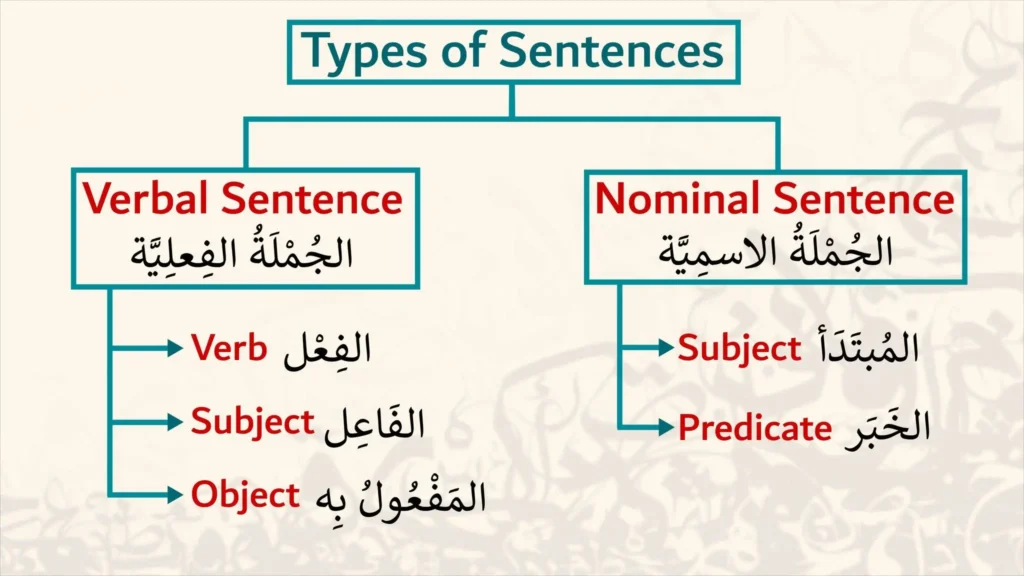
Arabic has two sentence types: the جملة اسمية (nominal sentence), which begins with a noun or pronoun, and the جملة فعلية (verbal sentence), which begins with a verb.
Every Arabic sentence — simple or complex — belongs to one of these two categories, and each has its own internal grammar rules.
| Feature | Nominal Sentence (جملة اسمية) | Verbal Sentence (جملة فعلية) |
| Starts with | Noun or pronoun | Verb |
| Core elements | مبتدأ (subject) + خبر (predicate) | فعل (verb) + فاعل (subject) + مفعول (object) |
| English equivalent | “The book is interesting” | “He read the book” |
| Verb “to be” | Not expressed in present tense | Always present (the verb itself) |
| Typical use | Describing states, identities, qualities | Describing actions and events |
Knowing which sentence type you are reading — or building — is the first decision you make every time you write or speak in Arabic.
Read also: How Verbal Sentences Work in Arabic
How Does the Arabic Nominal Sentence (الجملة الاسمية) Work?
The nominal sentence in Arabic consists of two mandatory parts: the مبتدأ (mubtada’ — the subject) and the خبر (khabar — the predicate). The مبتدأ is always nominative (مرفوع), marked by a ضمة (u-vowel) ending. The خبر also carries a ضمة and completes the meaning of the subject.
The most important feature: Arabic omits the present-tense verb “to be.” Where English says “The student is hardworking,” Arabic says:
الطالبُ مجتهدٌ
Al-tālibu mujtahidun
“The student (is) hardworking.”
No verb. The ضمة on both words confirms they are subject and predicate.
Three Common Patterns for الخبر (Predicate)
The خبر is not always a single adjective. It can take three forms, which significantly expands what you can say in a nominal sentence:
| Predicate Type | Arabic Example | Translation |
| Single adjective (مفرد) | البيتُ كبيرٌ | The house is big |
| Prepositional phrase (شبه جملة) | الكتابُ على الطاولةِ | The book is on the table |
| Full verbal sentence (جملة فعلية) | الطالبُ يدرسُ كثيراً | The student studies a lot |
In our Online Arabic Classes, students typically spend two to three weeks practising these three predicate patterns alone before moving to more complex structures — because getting the predicate form wrong is the single most common error we see from beginners writing their first Arabic paragraphs.
Book your FREE Arabic trial online Arabic class at Buruj

Practice Exercise 1 — Build Nominal Sentences
Translate these into Arabic nominal sentences. Check that both مبتدأ and خبر carry a ضمة:
- The teacher is busy. (المعلمُ مشغولٌ)
- The door is open. (البابُ مفتوحٌ)
- The car is in the street. (السيارةُ في الشارعِ)
- The girl is studying. (البنتُ تدرسُ)
How Does the Arabic Verbal Sentence (الجملة الفعلية) Work?
The verbal sentence opens with a conjugated verb, followed by the subject (فاعل), then the object (مفعول به) if the verb is transitive. This produces a VSO order — Verb-Subject-Object — which is the reverse of English default. The verb that opens the sentence always appears in its singular masculine form, regardless of the subject’s actual gender or number.
كَتَبَ الطالبُ الدرسَ
Kataba al-tālibu al-darsa
“The student wrote the lesson.”
Notice: كَتَبَ is singular masculine even if “the students” (الطلابُ) were the subject. The verb at the start always defaults to singular. The subject that follows then specifies the real number and gender.
كَتَبَ الطلابُ الدرسَ
“The students wrote the lesson.” (Same verb, plural subject follows.)
This rule trips up a high proportion of our intermediate students. They learn verb conjugation tables and then apply them to verbal sentences as if the verb comes after the subject — which is the nominal sentence pattern. Mixing the two is one of the most persistent errors we correct in our Arabic Grammar Course.
Understand the Arabic Grammar with Buruj’s free trial lesson
Verbal Sentence Word Order: Case Endings Make Flexibility Possible
The real power of Arabic structure shows here. Because case endings mark grammatical roles, word order can shift for emphasis without changing meaning:
| Arrangement | Arabic | Meaning | Emphasis |
| VSO (standard) | أكلَ الولدُ التفاحةَ | The boy ate the apple | Neutral |
| SVO (topical) | الولدُ أكلَ التفاحةَ | The boy — he ate the apple | Subject emphasized |
| OVS (rare, dramatic) | التفاحةَ أكلَ الولدُ | The apple — the boy ate it | Object emphasized |
The فتحة (a-vowel) on التفاحةَ tells you it is the object in every single arrangement above.
Read also: Arabic Adverbs Explained
Discover the Buruj Academy Difference
Step into our virtual classrooms and see how our expert instructors make learning Quran and Arabic intuitive and clear. We focus on overcoming the specific hurdles non-native speakers face, building your confidence and connection with the Quran.
Master the Arabic Language
Join our expert-led courses and build a strong foundation in Classical and Modern Arabic.
Get Your Free TrialPractice Exercise 2 — Identify Verb, Subject, Object
Analyse each sentence. Label الفعل، الفاعل، المفعول به:
- شَرِبَ الرجلُ الماءَ (The man drank the water.)
- فَتَحَت البنتُ البابَ (The girl opened the door.)
- قَرَأَ المعلمُ الكتابَ (The teacher read the book.)
Why Case Endings (الإعراب) Are the Foundation of Arabic Sentence Structure
Arabic case endings are the grammatical system that assigns roles to words — subject, object, possessive — through short vowels attached to word endings. Without الإعراب, Arabic sentence structure cannot be read correctly, and ambiguity becomes a serious problem. The three core cases are nominative (الرفع — ضمة), accusative (النصب — فتحة), and genitive (الجر — كسرة).
| Case | Name | Marker | Function |
| Nominative | الرفع | ـُ (ضمة) | Subject of sentence, مبتدأ, خبر |
| Accusative | النصب | ـَ (فتحة) | Direct object, adverbs of manner/time |
| Genitive | الجر | ـِ (كسرة) | After prepositions, second noun in possessive |
A practical example showing all three in one sentence:
ذَهَبَ الطالبُ إلى المدرسةِ بالسيارةِ
Dhahaba al-tālibu ilā al-madrasati bil-sayyārati
“The student went to the school by car.”
الطالبُ → nominative (subject of verb ذَهَبَ) المدرسةِ → genitive (after preposition إلى) السيارةِ → genitive (after preposition ب)
For a structured guide to Arabic tense and verb forms that connect directly to these case patterns, see our detailed article on Arabic tenses.
Practice Exercise 3 — Case Ending Identification
Add the correct case ending to the word in brackets:
- أكلَ [الولد] التفاحةَ. → الولدُ (nominative — subject)
- شَرِبَتِ البنتُ [الماء]. → الماءَ (accusative — direct object)
- ذَهَبَ الرجلُ إلى [البيت]. → البيتِ (genitive — after إلى)
How Arabic Sentence Structure Compares to English: Key Contrasts
Arabic and English sentence structure differ in four fundamental ways that directly affect how beginners make errors. Understanding the contrast analytically — rather than just memorising rules — produces faster correction and more confident production.
| Feature | English | Arabic |
| Sentence types | One core type (SVO) | Two types: اسمية / فعلية |
| Word order | Fixed (changing = error) | Flexible (changing = style) |
| “To be” in present tense | Always required | Omitted entirely |
| Grammatical role marker | Word position | Case ending on the word |
| Verb-subject agreement | Always required | Verb defaults to singular in VSO order |
| Adjective position | Before noun (“big house”) | After noun (بيتٌ كبيرٌ) |
The adjective placement difference (last row) generates its own category of writing errors. English speakers instinctively write the adjective before the noun.
In Arabic, the adjective follows and must match in gender, number, and definiteness — three agreement features English adjectives do not have at all.
بيتٌ كبيرٌ → a big house (indefinite, masculine, singular) البيتُ الكبيرُ → the big house (definite, masculine, singular — both noun and adjective take ال) بيوتٌ كبيرةٌ → big houses (indefinite, masculine, broken plural)
For learners exploring how masculine and feminine nouns change agreement patterns throughout the sentence, our article on masculine and feminine nouns in Arabic covers this directly.
Arabic Sentence Structure Examples
The best way to consolidate sentence structure is through graduated examples — moving from the simplest nominal sentence to a complex verbal sentence with modifiers. Work through each level before moving to the next.
1. Examples of Simple Nominal Sentences
| Arabic | Transliteration | Translation |
| الجوُّ حارٌّ | Al-jawwu ḥārrun | The weather is hot |
| المدينةُ جميلةٌ | Al-madīnatu jamīlatun | The city is beautiful |
| أنا طالبٌ | Anā ṭālibun | I am a student |
2. Examples of Simple Verbal Sentences
| Arabic | Transliteration | Translation |
| يكتبُ المعلمُ الدرسَ | Yaktubu al-muʿallimu al-darsa | The teacher writes the lesson |
| أكلَت البنتُ الخبزَ | Akalat al-bintu al-khubza | The girl ate the bread |
| يفهمُ الطلابُ القواعدَ | Yafhamu al-ṭullābu al-qawāʿida | The students understand the rules |
3. Examples of Arabic Sentences with Prepositional Phrases and Adjectives
| Arabic | Transliteration | Translation |
| ذَهَبَ الطالبُ المجتهدُ إلى المكتبةِ | Dhahaba al-ṭālibu al-mujtahidu ilā al-maktabati | The hardworking student went to the library |
| تسكنُ الأسرةُ الكبيرةُ في بيتٍ واسعٍ | Taskunu al-usratu al-kabīratu fī baytin wāsiʿin | The large family lives in a spacious house |
Practice Exercise 4 — Translation Challenge
Translate into Arabic. Choose the correct sentence type (اسمية or فعلية) and apply correct case endings:
- The lesson is easy. (الدرسُ سهلٌ — nominal)
- The children played in the garden. (لَعِبَ الأطفالُ في الحديقةِ — verbal)
- My friend is a doctor. (صديقي طبيبٌ — nominal)
- The engineer built a beautiful house. (بَنَى المهندسُ بيتاً جميلاً — verbal)
Read also: Interrogative Particles in Arabic
Master Arabic Sentence Structure with Buruj Academy’s Personalised Classes
Arabic sentence structure is learnable — but the gap between understanding the rules and actually producing correct sentences requires consistent practice with real-time correction.
Buruj Academy’s Online Arabic Classes are built around exactly that gap, guided by Al-Azhar University graduates with 12+ years of experience teaching non-native speakers.
Here’s what makes our approach different:
- Al-Azhar-trained instructors with deep Arabic linguistics expertise
- The Buruj Method: context-before-abstraction — you speak and write before drilling grammar terminology
- Personalised 1-on-1 sessions with real-time sentence correction
- Flexible scheduling for working adults and parents
- Clear progression from basic sentence types to complex clause embedding
Book your free trial lesson today and write your first correct Arabic sentence within the session.
Begin your transformation today by choosing the path that fits your goals:
- Online Arabic Classes (General & Comprehensive)
- Arabic Course for Beginners
- Arabic Alphabet Learning Course
- Online Arabic Classes for Kids
- Arabic Classes for Adults
- Arabic Grammar Course (Nahw & Sarf)
- Intermediate Arabic Course (B1/B2)
- Arabic Speaking Course (Conversational Fluency)
- Arabic Reading Course (Literary Excellence)
- Learn Arabic Writing Course (Calligraphy & Composition)
Ready to speak with confidence? Join the global community at Buruj Academy and book your free placement interview today!
Master the Arabic Language
Join our expert-led courses and build a strong foundation in Classical and Modern Arabic.
Get Your Free TrialConclusion
Arabic sentence structure is not more complex than English — it is differently logical. Once you understand that meaning lives in case endings rather than word order, the system opens up. The two sentence types, الجملة الاسمية and الجملة الفعلية, each follow clear internal rules, and the practice exercises above give you a direct route from theory to production.
Work through them repeatedly, pay attention to case endings, and your ability to read, write, and eventually speak Arabic sentences with confidence will follow — Insha’Allah.
For your next step, explore how Arabic past tense and present tense verbs connect to the verbal sentence structure you’ve studied here.
Frequently Asked Questions About Arabic Sentence Structure
What Is the Basic Arabic Sentence Structure?
Arabic has two basic sentence structures: the nominal sentence (جملة اسمية), which starts with a noun or pronoun and contains a subject (مبتدأ) and predicate (خبر), and the verbal sentence (جملة فعلية), which starts with a verb followed by a subject and object. Both types use case endings to mark grammatical roles rather than relying on fixed word order.
What Is the Difference Between Arabic and English Sentence Structure?
English uses fixed SVO (Subject-Verb-Object) order to convey meaning, while Arabic uses case endings to mark each word’s role, allowing flexible word order. Arabic also omits the present-tense verb “to be,” and verbal sentences follow VSO order by default. Additionally, adjectives in Arabic follow the noun and must agree in gender, number, and definiteness.
Does Arabic Always Follow Verb-Subject-Object Order?
No. Arabic verbal sentences default to VSO order, but word order can shift for emphasis or stylistic effect without changing core meaning, because case endings identify each word’s role. A subject can be fronted for topical emphasis, or an object moved to the beginning for dramatic stress — all while remaining grammatically correct.
What Are Case Endings in Arabic?
Case endings (الإعراب) are short vowels added to word endings to mark grammatical function. The ضمة (u-sound) marks subjects and predicates, the فتحة (a-sound) marks objects, and the كسرة (i-sound) marks words after prepositions or in possessive constructions. Without case endings, many Arabic sentences become ambiguous because word order alone cannot distinguish subject from object.
How Do I Know Whether to Use a Nominal or Verbal Sentence in Arabic?
Choose a nominal sentence (جملة اسمية) when describing a state, quality, identity, or location — anything that would use “to be” in English. Choose a verbal sentence (جملة فعلية) when describing an action or event. If your sentence naturally starts with what something is, use اسمية. If it starts with what something does, use فعلية.