 Arabic
| Key Takeaways |
| A verbal sentence in Arabic (الجملة الفعلية) begins with a verb, followed by its subject, making verb-first word order its defining feature. |
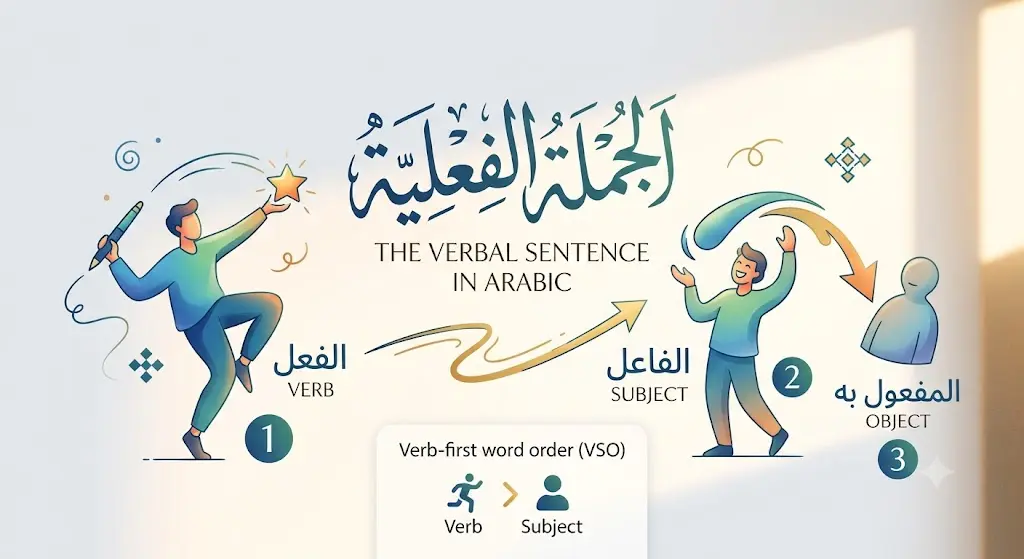
| Arabic verbal sentences follow the pattern Verb + Subject + Object (VSO), unlike English sentences that follow Subject-Verb-Object order. |
| The verb in a verbal sentence must agree with its subject in gender, while number agreement has a specific rule: singular verb form is used even with plural subjects. |
| Arabic verbal sentences operate across three tenses — past (الماضي), present (المضارع), and future (المستقبل) — each built from the same root with different patterns. |
Arabic sentence structure works differently from English in one fundamental way: the verb does not always wait its turn. In English, we say “The student studied.” In Arabic, the verb often leads — and that single shift changes how you read, write, and understand the entire language.
A verbal sentence in Arabic (الجملة الفعلية) is any sentence that opens with a verb. This structure is not a stylistic choice — it is a grammatical category with its own rules of agreement, word order, and case endings. Mastering it is essential for anyone learning to read Arabic texts, whether classical literature, news media, or the Quran itself.
Table of Contents:
What Is a Verbal Sentence in Arabic?
A verbal sentence (الجملة الفعلية) in Arabic is a sentence whose first word is a conjugated verb. The standard order is: Verb (فعل) → Subject (فاعل) → Object (مفعول به) — commonly written as VSO. The subject of the sentence is always in the nominative case (مرفوع), marked by a damma (ـُ) or its equivalent.
This verb-first structure is one of the two main sentence types in Arabic grammar. The second is the nominal sentence (الجملة الاسمية), which begins with a noun or pronoun.
At Buruj Academy, students enrolled in our Arabic Grammar Course consistently tell us that the moment they understood the verbal sentence category, Arabic texts suddenly became far more readable.
The distinction is not abstract — it appears in every paragraph of every Arabic text they will ever encounter.
Understand the Arabic Grammar with Buruj’s free trial lesson
What Is the Core Structure of a Verbal Sentence in Arabic?
The core structure of an Arabic verbal sentence is Verb + Subject + Object, where the verb is conjugated to match its subject in gender, and where the subject carries the nominative case (damma). This structure holds whether the sentence is two words or twenty.
1. The Verb (الفعل)
The verb must be conjugated for gender. If the subject is feminine, the verb takes a feminine form. If the subject is masculine, the verb takes a masculine form.
Crucially, when the subject comes after the verb — as it always does in a verbal sentence — the verb stays in its singular form, regardless of whether the subject is plural.
This is one of the most misunderstood rules among learners. The singular verb before a plural subject is not an error — it is the rule.
| Sentence | Verb form | Subject | Correct? |
| ذَهَبَ الطُّلَّابُ | Singular masculine past | Plural masculine | ✅ Correct |
| ذَهَبُوا الطُّلَّابُ | Plural masculine past | Plural masculine | ❌ Incorrect |
| كَتَبَتِ الطَّالِبَاتُ | Singular feminine past | Plural feminine | ✅ Correct |
2. The Subject (الفاعل)
The subject follows the verb directly and carries a damma (ـُ) in its final case marking. It is always مرفوع (nominative). If the noun is definite (carries ال), the damma appears on the final letter of the noun.
3. The Object (المفعول به)
The object, when present, follows the subject and carries a fatha (ـَ) — it is always in the accusative case (منصوب). Not all verbal sentences require an object; intransitive verbs (like ذَهَبَ — “went”) form complete sentences without one.
Read also:A Complete Guide to Arabic Verb Conjugation
Verbal Sentence Examples in Arabic with Detailed Explanations
Varied, real-language examples are the fastest path to genuine understanding. The following examples cover different verb types, tenses, and subjects so that the pattern becomes intuitive rather than mechanical.
1. Past Tense Verbal Sentence Examples in Arabic
كَتَبَ الوَلَدُ الدَّرْسَ
Kataba l-waladu l-darsa
The boy wrote the lesson.
- فعل: كَتَبَ (wrote — masculine singular past)
- فاعل: الوَلَدُ (the boy — nominative, damma)
- مفعول به: الدَّرْسَ (the lesson — accusative, fatha)
أَكَلَتِ البِنْتُ التُّفَّاحَةَ
Akalati l-bintu t-tuffāḥah.
The girl ate the apple.
- فعل: أَكَلَت (ate — feminine singular past)
- فاعل: البِنْتُ (the girl — nominative)
- مفعول به: التُّفَّاحَةَ (the apple — accusative)
فَتَحَ المُعَلِّمُ الكِتَابَ
Fataḥa l-muʿallimu l-kitāba
The teacher opened the book.
Note the masculine verb form فَتَحَ before the masculine subject المُعَلِّمُ. This agreement in gender, with a singular verb before the noun, is the standard verbal sentence pattern.
Read also:A Guide to Arabic Nominal Sentences
2. Present Tense Verbal Sentence Examples in Arabic
يَدْرُسُ الطَّالِبُ العَرَبِيَّةَ
Yadrusu ṭ-ṭālibu l-ʿarabiyyah
The student studies Arabic.
تَقْرَأُ الأُمُّ القِصَّةَ
Taqraʾu l-ummu l-qiṣṣah
The mother reads the story.
Notice: the present tense feminine verb تَقْرَأُ is used before the feminine subject الأُمُّ. The subject still follows the verb, and the verb remains singular despite the subject’s potential plurality.
3. Intransitive Verbal Sentence Examples (No Object) in Arabic
Not every verbal sentence requires an object. Intransitive verbs form complete, grammatically correct sentences on their own:
ذَهَبَ الرَّجُلُ
The man went.
جَاءَتِ المَرْأَةُ
The woman came.
These two-element sentences (Verb + Subject) are among the most common in Arabic prose, news writing, and classical texts.
Our guide on Arabic tenses explains how each of these verb forms is built from the root system — an essential companion skill to understanding verbal sentences.
How Does Verb-Subject Agreement Work in Verbal Sentences?
In an Arabic verbal sentence, the verb agrees with its subject in gender only when the subject follows the verb. Number agreement — singular, dual, or plural — is suspended for the verb when it precedes the subject; the verb always appears in its singular form in this position.
This rule applies consistently across all tenses. The table below summarizes the gender agreement patterns:
| Subject Type | Past Verb Form | Present Verb Form | Example Subject |
| Masculine singular | فَعَلَ | يَفْعَلُ | الوَلَدُ |
| Feminine singular | فَعَلَتْ | تَفْعَلُ | البِنْتُ |
| Masculine plural | فَعَلَ | يَفْعَلُ | الرِّجَالُ |
| Feminine plural | فَعَلَتْ | تَفْعَلُ | النِّسَاءُ |
| Masculine dual | فَعَلَ | يَفْعَلُ | الوَلَدَانِ |
| Feminine dual | فَعَلَتْ | تَفْعَلُ | البِنْتَانِ |
In our sessions at Buruj Academy, the agreement rule for plural subjects consistently causes learners to second-guess correct sentences.
A student sees ذَهَبَ الرِّجَالُ and assumes the singular verb form is wrong because the subject is plural. It is not wrong — it is precisely correct.
Building comfort with this pattern takes deliberate practice, which is why we embed agreement drilling into every unit of our Online Arabic Classes.
Book your FREE Arabic trial online Arabic class at Buruj

How Does Tense Shape Verbal Sentences in Arabic?
Arabic verbal sentences operate across three tenses, each using the same root letters in different patterns. Understanding tense does not require memorizing separate vocabularies — it requires learning how root patterns shift.
For a full breakdown of how each tense is formed, our dedicated guides on Arabic past tense, Arabic present tense, and Arabic future tense cover the conjugation mechanics in depth.
The table below shows the same verbal sentence across all three tenses using the root ك-ت-ب (to write):
| Tense | Arabic Sentence | Transliteration | English |
| Past (الماضي) | كَتَبَ الطَّالِبُ الدَّرْسَ. | Kataba ṭ-ṭālibu d-darsa. | The student wrote the lesson. |
| Present (المضارع) | يَكْتُبُ الطَّالِبُ الدَّرْسَ. | Yaktub ṭ-ṭālibu d-darsa. | The student writes/is writing the lesson. |
| Future (المستقبل) | سَيَكْتُبُ الطَّالِبُ الدَّرْسَ. | Sa-yaktub ṭ-ṭālibu d-darsa. | The student will write the lesson. |
The prefix سَـ (or سَوْفَ in more formal writing) marks the future tense on a present-tense verb. No new verb form is required — the present form carries both present and future meaning depending on the prefix.
Discover the Buruj Academy Difference
Step into our virtual classrooms and see how our expert instructors make learning Quran and Arabic intuitive and clear. We focus on overcoming the specific hurdles non-native speakers face, building your confidence and connection with the Quran.
Master the Arabic Language
Join our expert-led courses and build a strong foundation in Classical and Modern Arabic.
Get Your Free TrialHow Does a Verbal Sentence Differ from a Nominal Sentence in Arabic?
A verbal sentence begins with a verb; a nominal sentence begins with a noun or pronoun. This distinction is not merely positional — it determines the grammatical roles of every element that follows, and it affects I’rab (case endings) throughout the sentence.
The table below shows the contrast clearly:
| Feature | Verbal Sentence (جملة فعلية) | Nominal Sentence (جملة اسمية) |
| First word | Verb (فعل) | Noun or pronoun (اسم / ضمير) |
| Subject role | فاعل (after the verb) | مبتدأ (the subject itself opens) |
| Predicate | مفعول به or adverb | خبر (complement) |
| Example | ذَهَبَ الطَّالِبُ | الطَّالِبُ مُجْتَهِدٌ |
| English equivalent | “The student went.” | “The student is diligent.” |
In our experience teaching Arabic classes for beginners, the most common confusion is assuming that Arabic sentence order mirrors English.
It does not. Once learners accept that Arabic grammar is category-driven — not position-driven — progress accelerates noticeably.
Begin learning Arabic at Buruj with a FREE trial lesson

Practice Exercises for Verbal Sentences in Arabic
Active practice is how grammar rules move from recognition to production. The following exercises are structured progressively — from identification to construction to full composition.
Exercise 1: Identify the Verbal Sentence
Read the following sentences and mark which are verbal sentences (V) and which are nominal sentences (N):
| # | Sentence | Type |
| 1 | ذَهَبَ الوَلَدُ إِلَى المَدْرَسَةِ. | ? |
| 2 | البَيْتُ كَبِيرٌ. | ? |
| 3 | كَتَبَتِ المُعَلِّمَةُ الدَّرْسَ. | ? |
| 4 | المُدِيرُ مَشْغُولٌ. | ? |
| 5 | يَأْكُلُ الأَطْفَالُ الخُبْزَ. | ? |
Answer Key: 1-V, 2-N, 3-V, 4-N, 5-V
Exercise 2: Correct the Verb Agreement Error
Each sentence below contains a verb-subject agreement error. Identify and correct it:
1. ذَهَبُوا الطُّلَّابُ إِلَى الفَصْلِ.
Correction: ذَهَبَ الطُّلَّابُ إِلَى الفَصْلِ. (Singular verb before plural subject)
2. كَتَبَ البِنْتُ الرِّسَالَةَ.
Correction: كَتَبَت البِنْتُ الرِّسَالَةَ. (Verb must agree with feminine subject)
3. أَكَلَتَ الوَلَدُ التُّفَّاحَةَ.
Correction: أَكَلَ الوَلَدُ التُّفَّاحَةَ. (Verb must agree with masculine subject)
Exercise 3: Build Your Own Verbal Sentences
Using the elements below, construct grammatically correct verbal sentences. Apply correct gender agreement and case endings:
| Verb | Subject | Object |
| فَتَحَ / فَتَحَتْ | المُدِيرُ (m) | البَابَ |
| شَرِبَ / شَرِبَتْ | الأُمُّ (f) | المَاءَ |
| قَرَأَ / قَرَأَتْ | الطُّلَّابُ (m.pl) | الكِتَابَ |
Sample answers:
- فَتَحَ المُدِيرُ البَابَ.
- شَرِبَتِ الأُمُّ المَاءَ.
- قَرَأَ الطُّلَّابُ الكِتَابَ. (singular verb, plural subject — correct)
Building this habit of checking gender agreement before finalizing any verbal sentence is one of the most effective self-correction skills a learner can develop.
For further vocabulary to use in your own constructed sentences, our resource on mastering Arabic vocabulary provides a practical bank of words organized by category.
Master Arabic Grammar with Buruj Academy’s Personalized Classes
Verbal sentences are one pillar of Arabic grammar — and a strong pillar requires a structured approach, not isolated rule memorization.
Buruj Academy’s Arabic Grammar Course teaches verbal and nominal sentences, verb conjugation, and I’rab systematically, connecting each rule to real reading and writing practice.
Our instructors are Al-Azhar University graduates with 12+ years of experience teaching non-native Arabic speakers worldwide.
We use the Buruj Method — context-before-abstraction — meaning every rule is taught through meaningful examples before abstract explanation.
Sessions are 1-on-1, fully online, and scheduled flexibly around your life. Whether you are an absolute beginner or building on existing foundations, our Arabic for Beginners course provides the right starting point.
Book your free trial lesson today and experience the difference structured, expert-led Arabic instruction makes.
Begin your transformation today by choosing the path that fits your goals:
- Online Arabic Classes (General & Comprehensive)
- Arabic Course for Beginners
- Arabic Alphabet Learning Course
- Online Arabic Classes for Kids
- Arabic Classes for Adults
- Arabic Grammar Course (Nahw & Sarf)
- Intermediate Arabic Course (B1/B2)
- Arabic Speaking Course (Conversational Fluency)
- Arabic Reading Course (Literary Excellence)
- Learn Arabic Writing Course (Calligraphy & Composition)
Ready to speak with confidence? Join the global community at Buruj Academy and book your free placement interview today!
Master the Arabic Language
Join our expert-led courses and build a strong foundation in Classical and Modern Arabic.
Get Your Free TrialConclusion
The verbal sentence is not a grammar technicality — it is the operating system of Arabic writing. Once a learner can identify the verb, locate the subject, confirm gender agreement, and read the case endings, Arabic prose opens up in ways that self-study without structure rarely achieves.
The pattern is consistent, the rules are learnable, and the practice exercises above are the right place to start building that confidence. Insha’Allah, with consistent effort and the right guidance, verbal sentences will become second nature.
Frequently Asked Questions About Verbal Sentences in Arabic
What Is the Difference Between a Verbal Sentence and a Nominal Sentence in Arabic?
A verbal sentence (الجملة الفعلية) begins with a conjugated verb, while a nominal sentence (الجملة الاسمية) begins with a noun or pronoun. This opening word determines the grammatical role of every element that follows, including case endings and subject-predicate relationships throughout the sentence.
Does the Verb Always Come First in an Arabic Verbal Sentence?
In classical and Modern Standard Arabic, the default word order for verbal sentences is Verb-Subject-Object (VSO). The verb precedes the subject. However, Arabic allows some word order flexibility for emphasis — but altering that order may shift the sentence into a nominal sentence category, which changes its grammatical analysis entirely.
How Do I Know Which Verb Form to Use for Gender Agreement?
If the subject is masculine, use the masculine verb form. If the subject is feminine, use the feminine form. In past tense, feminine verbs add ـَتْ to the masculine base: كَتَبَ (m) → كَتَبَتْ (f). In present tense, feminine verbs use the prefix تَـ: يَكْتُبُ (m) → تَكْتُبُ (f). This two-prefix and one-suffix system covers the majority of gender agreement cases you will encounter.
Related Articles
Arabic