 Tajweed
| Key Takeaways |
| Tajweed is the set of pronunciation rules governing correct Quran recitation; Qirat are the ten authenticated transmission systems of the Quran. |
| Every Qirat has its own Tajweed rules; Tajweed principles are applied within whichever Qiraat tradition a student follows. |
| The most widely taught Qiraat globally is Hafs ‘an ‘Asim, which forms the basis for most Tajweed instruction outside the Arab world. |
| Qirat differences involve variations in vowels, elongations, and certain words — but never alter the Quran’s core meaning or message. |
| A student can master Tajweed without studying all ten Qirat, but cannot study any Qiraat correctly without grounding in Tajweed. |
Many students arrive at Buruj Academy having heard both terms — Tajweed and Qirat — without knowing exactly how they relate or differ. The confusion is completely understandable, since both concern Quranic recitation and are often discussed together by scholars.
Tajweed refers to the science of correct pronunciation in Quran recitation — the rules governing how each letter is produced, elongated, assimilated, or stopped.
Qirat, by contrast, refers to the ten authenticated systems of Quranic transmission, each representing a slightly different but equally valid recitation tradition traced back to the Prophet Muhammad ﷺ through an unbroken chain of narrators.
Table of Contents:
1. Tajweed Is the Science of Pronunciation Rules; Qirat Are Authenticated Recitation Traditions
Tajweed (تجويد) comes from the Arabic root j-w-d, meaning to make something excellent or perfect. As a discipline, it defines how each Arabic letter should be articulated — specifying the precise articulation point (makhraj), the sound characteristics (sifat), the rules for nasalization (ghunnah), and the correct lengths of elongation (madd).
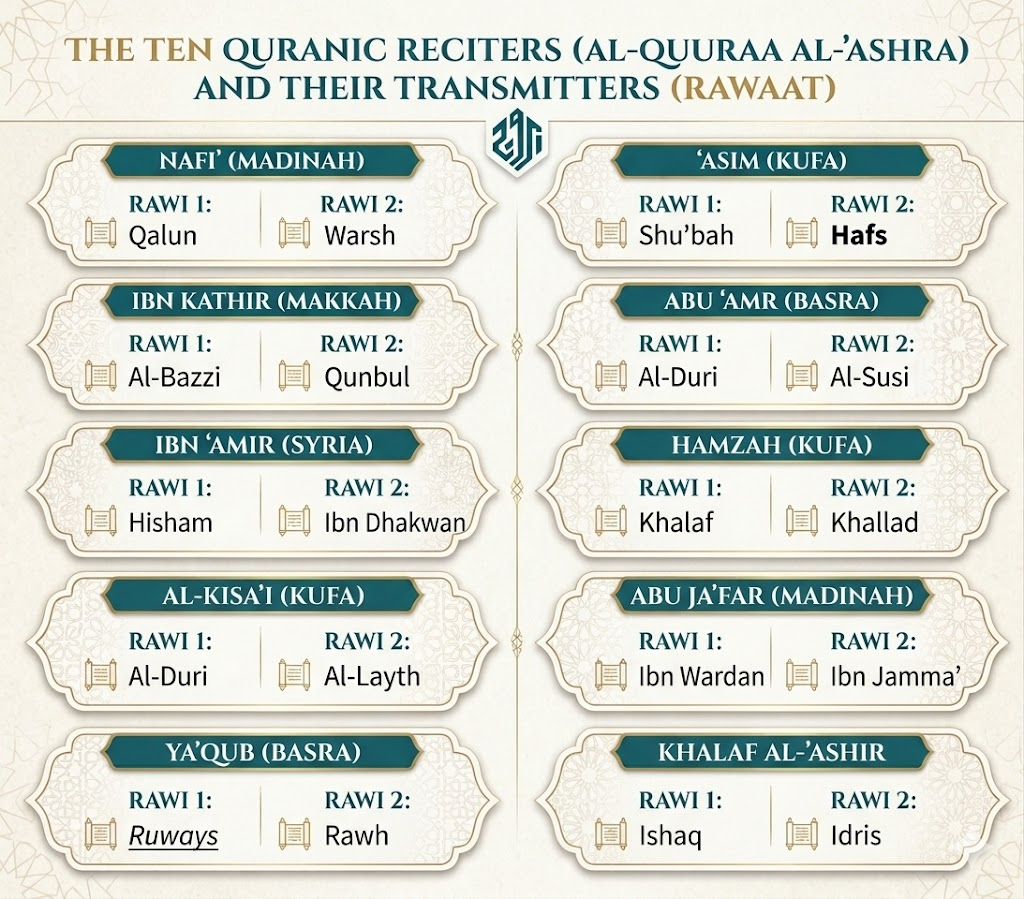
Qirat (قراءات), the plural of Qiraa’ah (قراءة), refers to the ten well-known systems of Quranic transmission, each attributed to a specific Imam of recitation — such as Nafi’, Ibn Kathir, Abu Amr, and Asim. Each Qiraat was transmitted through two narrators (rawis), giving us pairs like Hafs ‘an ‘Asim and Warsh ‘an Nafi’.
Tajweed is the grammar of recitation. Qirat are the dialects that grammar applies to. You cannot properly recite any Qiraat without Tajweed — but Tajweed alone does not define which Qiraat you are reciting.
At Buruj Academy, our Online Tajweed Classes ground students in the Hafs ‘an ‘Asim tradition — the most widely used Qiraat globally — before introducing the broader concept of Qirat variations for advanced students.
Book Your FREE Trial Lesson to Begin Your Tajweed Journey

2. Tajweed Rules Are Universal Within a Qiraat; Qirat Variations Are Fixed Transmission Differences
One of the clearest distinctions we help students grasp is this: Tajweed rules within a given Qiraat are prescriptive — you must follow them. Qirat differences are transmitted — they were not invented by scholars but received through chains going back to the Prophet ﷺ himself.
For example, the rule of Ikhfa — concealing a noon sakinah or tanween before one of fifteen specific letters — applies equally in Hafs, Warsh, and every other Qiraat. No Qiraat exempts you from proper Tajweed application.
However, a difference like the elongation of the word مَالِكِ (Maalik) in Surah Al-Fatihah — where Warsh ‘an Nafi’ recites it differently from Hafs ‘an ‘Asim — is a Qiraat-level variation. It is not a Tajweed error in either tradition; it is an authenticated difference in transmission.
This distinction matters practically: a student reciting Warsh is not making a Tajweed mistake when their recitation sounds different from a Hafs student. They are following a different — equally valid — transmission.
Read also: Tajweed and Makhraj – Full Guide
3. The Scope of Tajweed Is Narrower Than Qirat; Qirat Encompasses Tajweed and More
Tajweed is a component within the study of Qirat — not a separate competing discipline. Understanding their hierarchical relationship clarifies everything:
| Dimension | Tajweed | Qirat |
| Definition | Rules of correct pronunciation | Authenticated transmission systems |
| Origin | Derived from the Prophet’s ﷺ recitation | Transmitted via chains of narrators (sanad) |
| Scope | Pronunciation, articulation, elongation | Vowels, letters, words, elongation lengths |
| Number | One unified rule system per Qiraat | Ten major Qirat, each with two rawis |
| Who studies it | All Quran students at foundational level | Advanced students pursuing specific traditions |
| Requirement | Obligatory for correct recitation | Obligatory if pursuing a specific Qiraat |
| Variability | Fixed rules within each Qiraat | Legitimate variation between Qirat |
The table above captures what takes students months to internalize. Tajweed operates within Qirat — it is the mechanism of correct sound production. Qirat operates at a higher level, defining the specific version of the text and its transmitted sound patterns.
At Buruj Academy, our Online Qirat Course connects students with Ijazah-certified instructors who hold authenticated chains of transmission in multiple Qirat.
Book your FREE trial lesson in your path to reciting with Qiraat

4. Tajweed Has Rules That Apply Consistently; Qirat Differences Are Specific and Confined
When students first encounter Qirat variations, they sometimes worry: does this mean the Quran differs between traditions? The answer requires precision.
Qirat differences are confined to specific, documented points — particular words, vowel markings, elongation measures, or hamzah treatments.
These differences were all present during the Prophet’s ﷺ lifetime, revealed as legitimate variations (the ahruf tradition), and preserved with complete scholarly documentation.
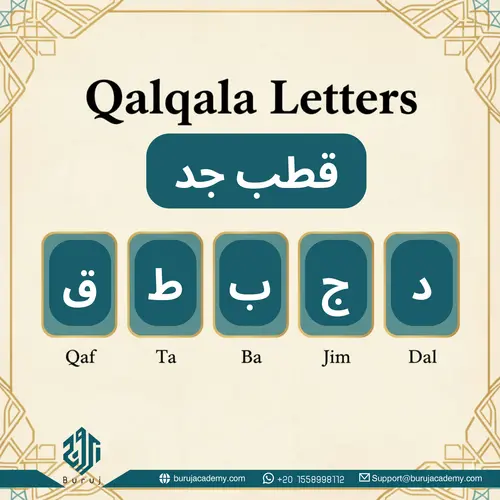
Tajweed rules, by contrast, govern how you produce sound — and these apply consistently. Rules like Idgham,Qalqalah, and Ghunnah apply in every Qiraat — though the specific letters or measures may vary slightly between traditions.
For example, the madd (elongation) measures in Warsh are often longer than in Hafs — but the concept of madd exists in both.
This is why learning Tajweed for beginners must precede any study of Qirat differences. Without a firm grasp of pronunciation rules, a student cannot even begin to appreciate what is varying between traditions.
Excel in Your Quranic Studies
Join Buruj Academy and master the Quran with our structured, professional curriculum.
Book Your Free Trial5. Tajweed Can Be Learned by Every Student; Qirat Mastery Requires Ijazah-Level Training
This is one of the most practically important differences — and one we address directly with students at Buruj Academy who ask about pursuing multiple Qirat.
Tajweed is an obligatory foundation for every Muslim who recites the Quran. Scholars broadly agree that reciting the Quran without Tajweed — in a way that distorts meaning or mispronounces letters — is prohibited (haram).
This makes Tajweed study an obligation accessible to every student, regardless of their level.
Qirat, however, is a specialized advanced discipline. To formally study and transmit a Qiraat, a student must receive it through an authorized teacher holding an Ijazah — a formal certificate of transmission — in that specific Qiraat.
You cannot simply read a book about Warsh and begin reciting Warsh. The transmission must be oral, continuous, and certified.
Our Online Hifz Ijazah Course and Quran Ijazah Program are designed precisely for students who want to pursue this level of certified recitation. Both are taught by Ijazah-holding instructors with authenticated chains of transmission in Hafs ‘an ‘Asim.
Book your FREE trial lesson in your path to Ijazah
Hafs ‘an ‘Asim Is the Most Common Qiraat
If you have ever studied Tajweed — or if you are reading a standard printed Quran — you are almost certainly engaging with Hafs ‘an ‘Asim.
This is the Qiraat transmitted through the narrator Hafs from the Imam ‘Asim of Kufa, and it dominates Quran education globally, particularly in Egypt, the broader Arab world, and among non-Arabic speaking Muslim communities worldwide.
When Tajweed textbooks discuss rules like the Madd Asli (natural elongation of two counts), the Ikhfa letters, or the heavy and light letters (Tafkhim and Tarqiq), they are typically presenting these rules as they apply within Hafs ‘an ‘Asim.
Other Qirat — such as Warsh ‘an Nafi’ (common in North and West Africa) — have their own Tajweed specifications.
In Warsh, for instance, certain elongations extend to six counts where Hafs uses two. A student moving between Qirat must relearn specific Tajweed applications for each tradition.
In our teaching experience, students who first master the Tajweed of Hafs ‘an ‘Asim adapt to other Qirat significantly faster — because the foundational principles of sound production remain constant even as applications vary.
Read also: How to Read the Quran Correctly?
Discover the Buruj Academy Difference
Step into our virtual classrooms and see how our expert instructors make learning Quran and Arabic intuitive and clear. We focus on overcoming the specific hurdles non-native speakers face, building your confidence and connection with the Quran.
A Comparison Chart: Difference Between Tajweed and Qirat
| Feature | Tajweed | Qirat |
| Arabic term | تجويد | قراءات |
| Literal meaning | To make excellent / beautify | Recitations / readings |
| Nature | A science of rules | A system of authenticated transmissions |
| Number | One system per Qiraat tradition | Ten major Qirat (with two rawis each = twenty narrations) |
| Primary focus | Correct letter articulation, sound rules | Variations in words, vowels, elongations |
| Who must study it | Every reciting Muslim | Students pursuing specific Qirat traditions |
| Mode of learning | Can be learned through structured classes | Must be received orally through Ijazah chain |
| Relationship | Applied within each Qiraat | The container that Tajweed operates inside |
| Examples | Ghunnah, Ikhfa, Idgham, Qalqalah | Hafs, Warsh, Qalun, Ibn Kathir, Shu’bah |
| Obligation level | Obligatory to avoid meaning distortion | Obligatory only when formally transmitting a Qiraat |
| Variation | Fixed within each Qiraat | Legitimate variation between Qirat |
| Entry requirement | Foundational level | Advanced — requires prior Tajweed mastery |
This chart represents the clearest structural summary of both disciplines. Students who internalize these twelve distinctions rarely confuse the two terms again.
What is the Difference Between Qirat and Maqamat?
A related source of confusion worth addressing: some students hear the word “Qirat” and think of melodic recitation styles — the beautiful melodic patterns used by reciters like Sheikh Mishary Rashid or Sheikh Abdul Basit. These melodic patterns are called Maqamat (مقامات) — not Qirat.
| Concept | What It Is | Examples |
| Tajweed | Rules of pronunciation and articulation | Ghunnah, Ikhfa, Madd, Qalqalah |
| Qirat | Authenticated transmission systems | Hafs, Warsh, Qalun, Ibn Kathir |
| Maqamat | Melodic modes for beautiful recitation | Bayati, Hijaz, Rast, Saba, Nahawand |
Maqamat are not obligatory. They are a form of vocal art that reciters develop to beautify the sound of recitation. They operate completely separately from both Tajweed rules and Qirat traditions. A reciter can use Maqam Bayati while reciting in Hafs — or in Warsh.
Understanding this three-way distinction prevents a very common category error we see regularly in new students beginning their reading the Quran for the first time.
Begin Your Recitation Studies with Buruj Academy’s Certified Instructors
Mastering the difference between Tajweed and Qirat in theory is only the beginning — applying it in recitation requires structured, expert-guided practice.
Buruj Academy offers:
- Ijazah-certified instructors and Al-Azhar University graduates with 12+ years teaching non-Arabic speakers
- The Buruj Method: Sound-before-rules, ensuring correct pronunciation before rule memorization
- Specialized Tajweed for Beginners and advanced Online Tajweed Classes for every level
- Personalized 1-on-1 online sessions with flexible 24/7 scheduling
- A verified Quran Recitation course grounded in authenticated Hafs ‘an ‘Asim transmission
Join a supportive learning environment tailored to your pace and lifestyle. Start your journey toward excellence by enrolling in one of our specialized tracks:
- Online Tajweed Classes
- Tajweed Classes for Beginners
- Tajweed Classes for Adults
- Tajweed Classes for Sisters
- Tajweed Classes for Kids
- Advanced Tajweed Course
- Amli Tajweed Course (Practical Application)
Book your free trial lesson today and recite with the confidence of knowing your foundation is correct.
Excel in Your Quranic Studies
Join Buruj Academy and master the Quran with our structured, professional curriculum.
Book Your Free TrialConclusion
Tajweed and Qirat are deeply connected — but they are not the same thing, and conflating them leads to real gaps in a student’s understanding of Quranic recitation. Tajweed provides the pronunciation framework; Qirat provides the authenticated transmission tradition within which that framework operates.
For the vast majority of students, mastering the Tajweed of Hafs ‘an ‘Asim is both the immediate goal and the gateway to any future Qirat study.
Every rule you learn — from Izhar to Madd — builds the foundation that makes advanced Qiraat study possible.
Pursue Tajweed first, with qualified guidance. The Qirat will follow, Insha’Allah.
Frequently Asked Questions About the Difference Between Tajweed and Qirat
Is Tajweed the Same in All Ten Qirat?
The foundational principles of Tajweed — correct articulation from the makhraj, proper sifat application, and nasalization — are consistent across all ten Qirat. However, specific rules such as elongation measures and hamzah treatment vary between traditions. A student must learn the Tajweed specifications particular to whichever Qiraat they are studying.
Can a Beginner Study Qirat Without First Learning Tajweed?
No. Every recognized Qiraat tradition requires correct Tajweed application as a prerequisite. Attempting to study Qirat variations without a firm Tajweed foundation produces errors in both disciplines simultaneously. Classical scholars universally taught Tajweed before introducing Qirat, and this sequence remains the standard in accredited institutions today.
How Many Qirat Are There and Which Is Most Common?
There are ten authenticated Qirat, each transmitted through two narrators, giving twenty recognized narrations. The most globally widespread is Hafs ‘an ‘Asim, used across Egypt, the Arabian Peninsula, South Asia, and most of the non-Arabic speaking Muslim world. Warsh ‘an Nafi’ is most common in North and West Africa.
Does Learning One Qiraat Mean My Recitation Differs From Other Muslims?
Legitimate Qirat differences are authenticated and do not represent errors or contradictions. The differences occur in specific words, vowel lengths, and pronunciation details — never in the core meaning. Muslims following different Qirat are all reciting the Quran correctly. The variation was present during the Prophet’s ﷺ lifetime and preserved through unbroken scholarly chains.
Do Tajweed Rules Apply Differently for Children Than Adults?
The rules of Tajweed are the same regardless of age — there is no simplified version of Ghunnah or Ikhfa for children. What differs is the teaching method. At Buruj Academy, our Tajweed for Children course uses age-appropriate pacing, shorter sessions, and reinforcement games — while maintaining full rule accuracy from the very first lesson.