 Quran
Quran
| Key Takeaways |
| Starting with a structured Noorani Qaida foundation prevents pronunciation errors that become increasingly difficult to correct later. |
| Learning Tajweed from an Ijazah-certified instructor ensures recitation accuracy that self-study apps cannot reliably provide. |
| Consistent daily sessions of 20–30 minutes outperform irregular longer sessions in both retention and pronunciation development. |
| Live 1-on-1 online classes with qualified teachers provide real-time correction that recorded video lessons cannot replace. |
The abundance of apps, YouTube videos, and free PDFs creates the illusion of a clear path to learn Quran online—but without proper sequence and qualified correction, most learners plateau within weeks.
The best way to learn Quran online combines a qualified teacher, a structured curriculum that progresses from foundational letter recognition through applied Tajweed, and a consistent daily practice rhythm.
Live, personalized instruction with real-time feedback remains the single non-negotiable element that separates genuine progress from stagnation.
Table of Contents:
1. Begin with Proper Letter Foundations Before Attempting to Read
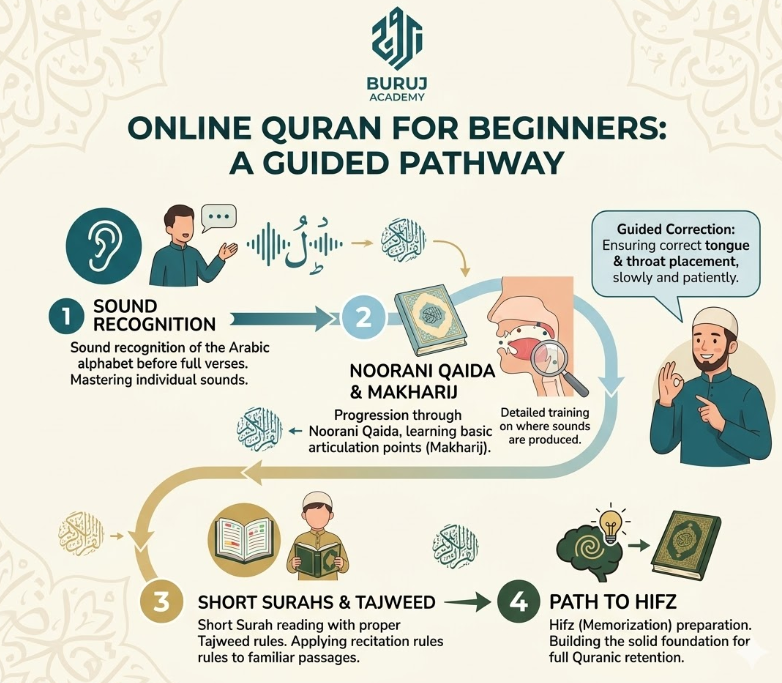
The most effective online Quran learning starts not with the Quran itself, but with mastering the Arabic alphabet through a structured foundational program like the Noorani Qaida.
This step is non-negotiable for non-Arabic speakers, because mispronounced letters at the foundational stage become deeply ingrained habits.
In our experience at Buruj Academy, students who skip this stage and jump directly into Quran reading almost always develop Makharij errors — particularly with letters like ع (Ayn), ح (Ha), and غ (Ghain) — that require months of remedial work to correct. Starting right means starting slow.
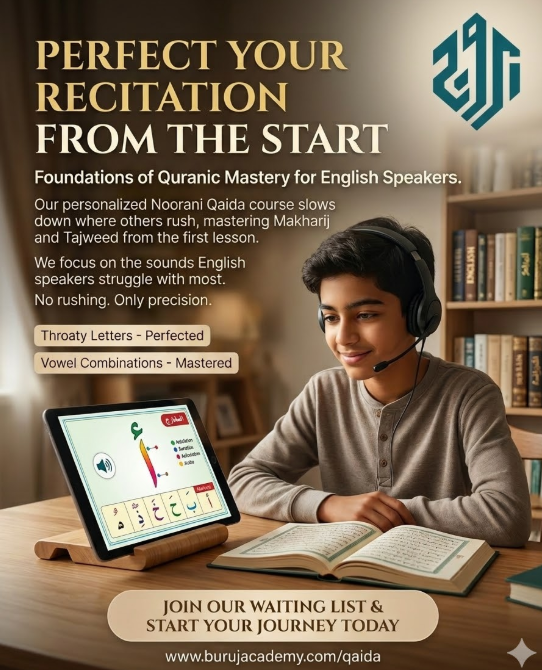
Buruj Academy’s Noorani Qaida Online Course introduces every letter from its correct articulation point (Makhraj), trains the ear before the tongue, and builds reading fluency systematically before a single Quranic word is attempted.
Book your FREE trial lesson in the Noorani Qaida course
What Does the Noorani Qaida Teach Specifically?
The Noorani Qaida covers isolated letter recognition, joined letter forms, vowel marks (Harakat), Tanween, Shaddah, Sukoon, and basic elongation rules.
Students progress from single letters to syllables to short words — all before opening the Mushaf. This sequence exists for a pedagogical reason: the Arabic reading system requires pattern recognition, and patterns must be built in the correct order.
2. Choose Live Online Classes Over Apps or Video Lessons
Live 1-on-1 online Quran classes with a qualified teacher are categorically more effective than apps, AI recitation tools, or pre-recorded video courses. The difference is real-time correction — something no algorithm currently replicates for Arabic phonetics.
When a student mispronounces ق (Qaf) as ك (Kaf), or softens ض (Dad) into a د (Dal), only a trained human ear catches it immediately and corrects it with the right technique. Apps provide feedback based on approximate sound matching — not Makhraj accuracy.
| Learning Method | Real-Time Correction | Makhraj Feedback | Personalized Pacing | Tajweed Application |
| Qualified online teacher | ✅ Yes | ✅ Yes | ✅ Yes | ✅ Yes |
| Quran app | ❌ No | ❌ No | Partial | ❌ No |
| Pre-recorded video | ❌ No | ❌ No | ❌ No | ❌ No |
| Group online class | Partial | Partial | ❌ No | Partial |
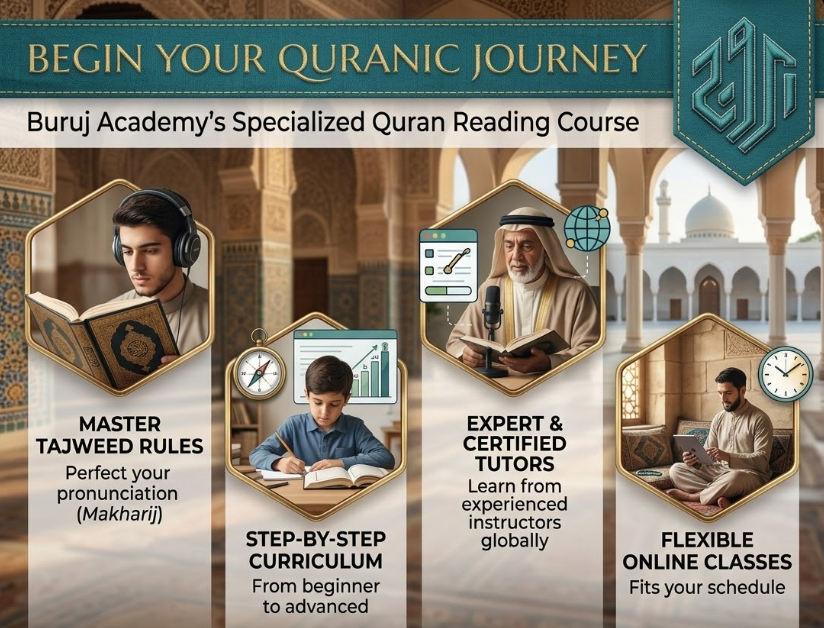
Buruj Academy’s Quran Reading Course operates entirely on live 1-on-1 sessions, scheduled flexibly around the student’s time zone. Every session includes direct instructor correction, ensuring no error is left to solidify into habit.
Book your Free trial lesson and start reading the Quran
3. Learn Tajweed Rules Systematically, Not Randomly
Tajweed is not a set of optional beautification rules — it is the obligatory standard of Quranic recitation established by the Prophet ﷺ and preserved through an unbroken chain of oral transmission. Every Muslim is required to recite with at least basic Tajweed accuracy.
The correct online approach to Tajweed learning follows a specific sequence: Noon Sakinah and Tanween rules (Ikhfa, Idgham, Iqlab, Izhar) → Meem Sakinah rules → Madd (elongation) rules → Qalqalah → Tafkhim and Tarqiq → Waqf and Ibtida. Jumping between rules without this sequence produces confusion, not competence.
Our instructors at Buruj Academy follow this exact progression in our Tajweed for Beginners course, taught by Ijazah-certified instructors and Al-Azhar University graduates who have spent 12+ years teaching non-Arabic speakers these precise distinctions.
Why Does Tajweed Sequence Matter So Much?
Rules interact with each other. A student who learns Ikhfa before understanding Noon Sakinah has no conceptual framework to apply the rule correctly.
Similarly, understanding Ghunnah — the nasal resonance held for two counts — is a prerequisite for correctly applying both Ikhfa and Idgham. Sequence is not academic preference; it is pedagogical necessity.
For those just beginning, our detailed guide on Tajweed for beginners explains the full rule structure in accessible terms before any formal class begins.
Book Your FREE Trial Lesson to Begin Your Tajweed Journey
4. Build a Consistent Daily Practice Schedule That You Can Actually Keep
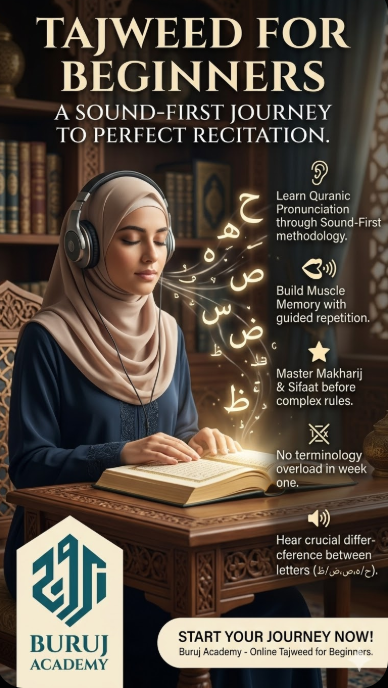
Consistency at a modest level permanently outperforms intensity at an irregular level. Twenty minutes of focused Quran reading or Tajweed practice every single day produces more measurable progress than two hours on weekends.
The neuroscience behind language acquisition supports this: spaced repetition of phonetic patterns over consistent intervals embeds correct pronunciation at the level of muscle memory.
This is why the Prophet ﷺ is reported to have said, as recorded in Sahih al-Bukhari 6464: “The most beloved deeds to Allah are those done consistently, even if they are small.”
Read also: Can I Learn Quran by Myself?
| Student Profile | Recommended Daily Minimum | Weekly Session with Teacher |
| Beginner (Qaida stage) | 15–20 minutes | 3–4 sessions |
| Intermediate (Quran reading) | 20–30 minutes | 2–3 sessions |
| Tajweed student | 25–30 minutes | 2–3 sessions |
| Hifz student | 45–60 minutes | 3–5 sessions |
At Buruj Academy, we help every student build a personalized practice schedule during the first session — because a schedule that fits real life is one that actually gets followed.
Excel in Your Quranic Studies
Join Buruj Academy and master the Quran with our structured, professional curriculum.
Book Your Free Trial5. Start Memorization Only After Reading Fluency Is Established
One of the most common mistakes we observe is students attempting to memorize Quran before they can read it fluently with correct Tajweed.
Memorizing incorrect pronunciation means memorizing error — and unlearning memorized patterns is significantly harder than learning them correctly from the start.
The correct sequence is: Letter foundations → Fluent reading → Basic Tajweed → Memorization.
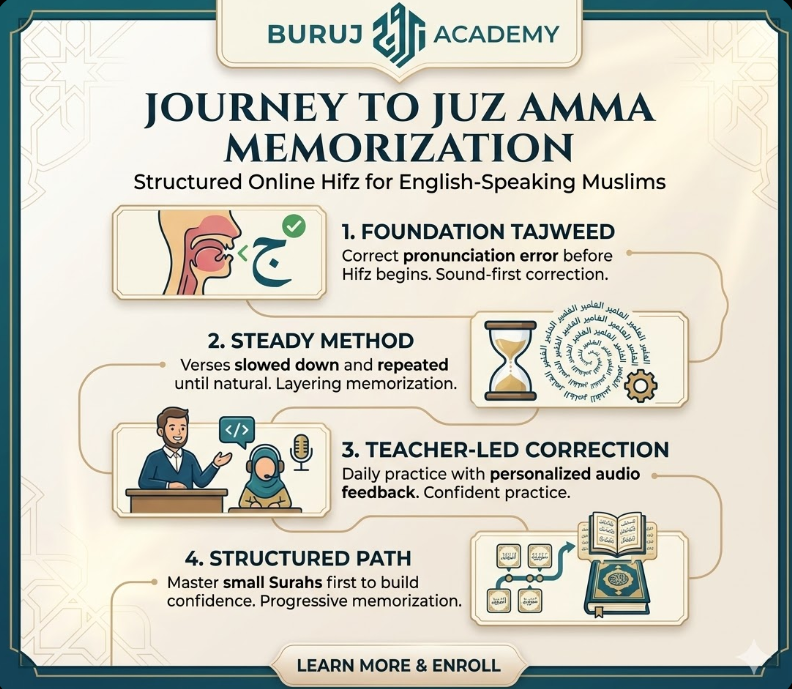
Only when a student can read a passage accurately without hesitation is that passage ready to be memorized. This principle guides every student in Buruj Academy’s Online Hifz Program.
For those whose goal is shorter-term memorization of commonly recited surahs, our Juz 30 Memorization Course offers a structured entry point that builds both memorization skills and reading confidence simultaneously.
Book Your Kid’s First Session in Buruj’s Juz 30 Memorization Course
How Should Memorization Sessions Be Structured Online?
Each online memorization session should begin with revision of previously memorized material (Muraja’ah), followed by new material introduction in small portions — typically 3–5 ayat for beginners.
The instructor listens to the new portion, corrects Tajweed in real time, and confirms retention before the session closes.
Our guide on how to memorize Quran faster covers the retention techniques our instructors apply across age groups — from children to working adults.
6. Select a Qualified Teacher with Verified Credentials
Not every online Quran teacher provides the same standard of instruction. The qualification markers that genuinely matter for authentic Quran teaching are specific: an Ijazah (a certified chain of transmission from teacher to student back to the Prophet ﷺ), graduation from a recognized Islamic institution such as Al-Azhar University, and documented experience teaching non-Arabic speakers.
A teacher who memorized Quran in childhood in an Arabic-speaking country but lacks formal pedagogical training in teaching non-native speakers will struggle to identify why an English speaker cannot produce ع (Ayn) — because they have never had to learn it consciously themselves.
All instructors at Buruj Academy hold verified Ijazah certifications in Hafs ‘an ‘Asim recitation, graduate credentials from Al-Azhar University, and 12+ years of specialized experience with non-Arabic speaking students globally. You can review our teaching team directly at Buruj Academy’s teacher profiles.
Book a FREE trial session with one of Buruj’s Azhari Quran tutors

7. Track Progress with Clear Milestones, Not Just Time Spent
Measuring “hours studied” without assessing actual skill acquisition is one of the main reasons online learners feel like they are not progressing. Effective online Quran learning uses specific, assessable milestones at every stage.
| Stage | Milestone Markers |
| Noorani Qaida | Reads all 28 letters correctly from Makhraj; identifies all Harakat |
| Quran Reading | Reads any page of Juz Amma without hesitation; applies basic Tajweed |
| Tajweed | Correctly applies all Noon Sakinah rules in live recitation without prompting |
| Hifz | Recites memorized portion fluently with correct Tajweed without visual reference |
At Buruj Academy, we build milestone checkpoints into every student’s learning plan. Progress is not abstract — it is assessed, recorded, and communicated clearly so students and parents always know exactly where the learner stands.
Discover the Buruj Academy Difference
Step into our virtual classrooms and see how our expert instructors make learning Quran and Arabic intuitive and clear. We focus on overcoming the specific hurdles non-native speakers face, building your confidence and connection with the Quran.
8. Use a Structured Curriculum Designed for Non-Arabic Speakers
General Arabic teaching materials and Quran curricula designed for native Arabic-speaking children do not transfer well to adult non-Arabic learners. The phonetic challenges are entirely different — English speakers carry specific interference patterns from their mother tongue that require targeted correction strategies.
The Buruj Method addresses this directly through three core principles: Sound-before-rules (students hear and produce correct sounds before any rule is named), Context-before-abstraction (rules are introduced through real Quranic examples, not theoretical tables), and Consistency-before-speed (accuracy is always prioritized over reading pace).
This pedagogical framework, developed and refined over 12+ years of teaching non-Arabic speakers at Buruj Academy, produces measurably different outcomes than standard curricula — particularly for adult beginners who struggle with Arabic phonetics. Beginners can explore this approach through our Quran course for beginners.
Begin Learning Quran With a FREE Trial Lesson
9. Complement Online Classes with Authentic Self-Study Resources
Online classes with a qualified teacher are the core of effective Quran learning — but what students do between sessions determines how quickly they progress. Authentic self-study resources used correctly compound the instructor’s work rather than undo it.
Verified resources for self-study include the standard Uthmani rasm Mushaf for reading practice, reliable Tajweed color-coded editions for visual rule reinforcement, and structured revision of previously taught material.
Our blog provides detailed, instructor-written guides — including deep-dives into specific rules like Idgham rules in Tajweed and Ikhfa letters — that students use between sessions at Buruj Academy to consolidate what they have been taught in class.
Self-study should reinforce correct learning — never introduce new material without teacher verification. The risk of practicing an error independently is always greater than the benefit of the extra practice time.
Read also: What Are the Benefits of Learning Quran Online?
Begin Your Quran Learning with Buruj Academy’s Expert Instructors
Learning Quran online with the right structure and qualified guidance is one of the most rewarding commitments a Muslim can make — and Buruj Academy exists to make that path clear, structured, and accessible for every learner.
Buruj Academy provides:
- Ijazah-certified instructors and Al-Azhar University graduates with 12+ years of experience
- The Buruj Method: Sound-before-rules, Context-before-abstraction, Consistency-before-speed
- Personalized 1-on-1 live sessions with 24/7 flexible scheduling
- Real-time pronunciation correction and individualized progress tracking
- Structured pathways from complete beginner to advanced recitation and memorization
Book your free trial lesson today and experience the Buruj Academy approach firsthand — with no commitment required.
Take the next step in your learning journey today by enrolling in one of our specialized programs:
- Online Quran Classes
- Online Quran Classes for Beginners
- Online Quran Classes for Adults
- Online Quran Classes for Ladies
- Online Quran Classes for Kids
- Quran Reading Course
- Quran Recitation Course
- Online Ijazah Course
- Online Qirat Course
Don’t wait to transform your relationship with the Holy Quran. Join our global community of students and book your free evaluation session now!
Excel in Your Quranic Studies
Join Buruj Academy and master the Quran with our structured, professional curriculum.
Book Your Free TrialConclusion
Learning Quran online effectively is not about finding the most popular app or the cheapest subscription — it is about following the right sequence with the right teacher.
Beginning from correct letter foundations, progressing through structured Tajweed, building a sustainable daily practice, and tracking real milestones are what separate genuine Quran literacy from the illusion of progress.
The path is clear when you follow it in order. At Buruj Academy, we have walked this path with thousands of students across dozens of countries — and the results consistently confirm what classical Islamic pedagogy has always taught: qualified instruction, consistent practice, and proper sequence produce recitation that honors the Quran as it deserves. Insha’Allah, your step forward starts today.
Frequently Asked Questions About Learning Quran Online
Can a Complete Beginner Learn Quran Online with No Arabic Background?
Yes — in our experience at Buruj Academy, complete beginners with zero Arabic background consistently achieve fluent Quran reading within 6–12 months of structured online classes. The key is starting with a proper Noorani Qaida foundation taught by a qualified instructor, not attempting to read the Mushaf directly without letter mastery first.
How Long Does It Take to Learn to Read Quran with Tajweed Online?
Most non-Arabic speaking adults achieve functional Tajweed reading — applying Noon Sakinah, Meem Sakinah, and basic Madd rules accurately — within 12–18 months of consistent 1-on-1 online classes. Students who practice 20–30 minutes daily between sessions reach this milestone significantly faster than those who rely on class time alone.
Is It Permissible to Learn Quran from a Female Teacher Online?
Yes — female students learning from female teachers online is entirely permissible and is, in fact, the preferred arrangement for many sisters. Buruj Academy specifically provides qualified female instructors for all subjects, including Quran reading, Tajweed, and Hifz, through structured online platforms with complete privacy and a secure learning environment.
How Do I Know If My Online Quran Teacher Is Qualified?
A qualified online Quran teacher should hold a verified Ijazah in the recitation of Hafs ‘an ‘Asim with a traceable sanad (chain of transmission), and ideally hold formal credentials from a recognized Islamic institution. Ask directly for their Ijazah documentation and educational background. At Buruj Academy, all instructor credentials are verified at the institutional level before any teacher begins teaching students.