 Quran
Quran

| Key Takeaways |
| You can begin learning the Quran independently using structured resources, but a qualified teacher is essential for correcting Tajweed before errors become habits. |
| Starting with the Arabic alphabet and Noorani Qaida before attempting full Quran reading dramatically increases long-term progress speed for non-Arabic speakers. |
| Platforms like Quran.com and Quranic Audio provide free, verified recitation audio to train your ear before your tongue. |
| Self-study works best as a complement to guided instruction — not a permanent replacement — especially for Tajweed accuracy and memorization retention. |
| Consistent daily sessions of 20–30 minutes outperform occasional long sessions for both reading fluency and memorization at every learning stage. |
Many Muslims living in the West feel the gap keenly — no local teacher, no Arabic-speaking family members, and a sincere desire to connect with the Quran meaningfully. That gap has never been easier to bridge than it is today.
Yes, self-study of the Quran is genuinely possible and rewarding for non-Arabic speakers. Self-study can build a strong foundation in reading, comprehension, and even basic recitation.
However, knowing exactly where self-study is powerful, and where it has limits, will determine whether your efforts produce lasting results.
Table of Contents:
Can I Learn Quran by Myself?
Yes — you can learn the Quran by yourself — to a meaningful degree. You can learn the Arabic alphabet, build basic reading fluency, understand verse meanings, and even begin memorization independently using the right structured resources.
The key limitation of pure self-study is Tajweed — the precise rules governing correct recitation.
Mispronunciations that go uncorrected solidify into habits within weeks, which is why pairing self-study with even occasional qualified feedback produces far better outcomes than self-study alone. That said, structured independent learning remains a powerful starting point.
How to Learn the Quran by Yourself?
The most effective self-study approach for adults combines daily audio listening with structured reading practice.
Spend 10 minutes listening to a verified reciter on Quran.com before your reading session, follow a progression starting from Juz 30, and limit new material to what you can recite accurately — depth over quantity every time.
1. Begin with the Arabic Alphabet Before Touching the Quran
Before attempting to read a single Quranic verse, every self-study learner needs to master Arabic letter recognition, letter forms, and basic vowel marks (harakaat: Fathah, Kasrah, Dammah). Skipping this step is the single most common reason self-study efforts stall early.
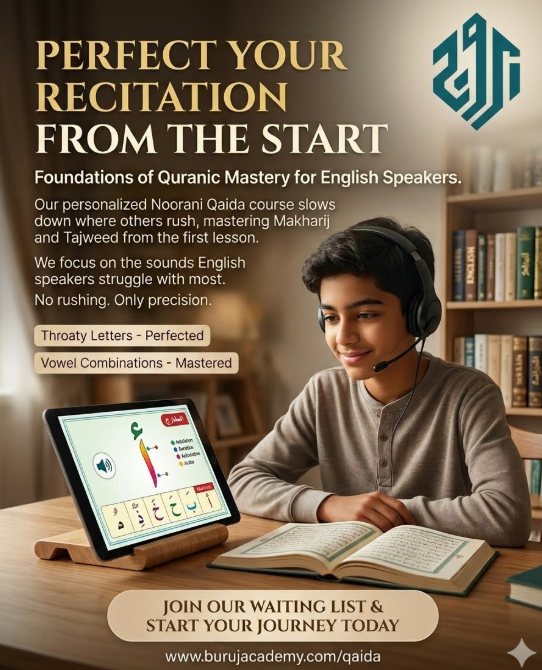
The Noorani Qaida is the traditionally accepted starting resource for exactly this purpose. It systematically takes a complete beginner from individual letter recognition through joined letters, tanween, sukoon, and basic Tajweed application — all before page one of the Mushaf.
In our experience at Buruj Academy, students who complete a structured Qaida program read the Quran confidently within two to three months, while those who skip it often struggle to decode new words a year later.
If you prefer guided structure, Buruj Academy’s Noorani Qaida Online Course takes you through this exact foundation with an Al-Azhar-trained instructor at your own pace.
Book your FREE trial lesson in the Noorani Qaida course
2. Train Your Ear with Verified Recitation Audio Daily
One of the most underused tools in self-study is consistent, daily listening to expert reciters.
Classical Arabic pedagogy has always emphasized sama’ (listening) before tilawah (recitation), and modern research in language acquisition confirms the same principle: your ear must recognize the correct sound before your mouth can reproduce it.
Quranic Audio provides a free, extensive library of authenticated recitations from world-renowned Qaris including Sheikh Mahmoud Khalil Al-Husary, whose slow, pedagogical recitation (Mu’allim style) was recorded specifically for learners. Use it as a daily listening resource before your reading practice begins.
Quran.com pairs the Uthmani-script text with synchronized audio, multiple translations, and transliteration — making it an ideal reading-alongside-audio tool for beginners. Both platforms are free and authentic.

3. Follow a Structured Reading Progression, Not Random Surahs
Self-study fails most frequently when learners jump straight to longer surahs or follow no logical sequence. A structured progression protects you from building bad habits by controlling the difficulty level of what you practice.
A proven self-study reading sequence looks like this: begin with Juz 30 (the final section of the Quran), as it contains shorter surahs with familiar vocabulary. From there, progress to Juz 29, then Juz 1, before moving through the Quran chronologically.
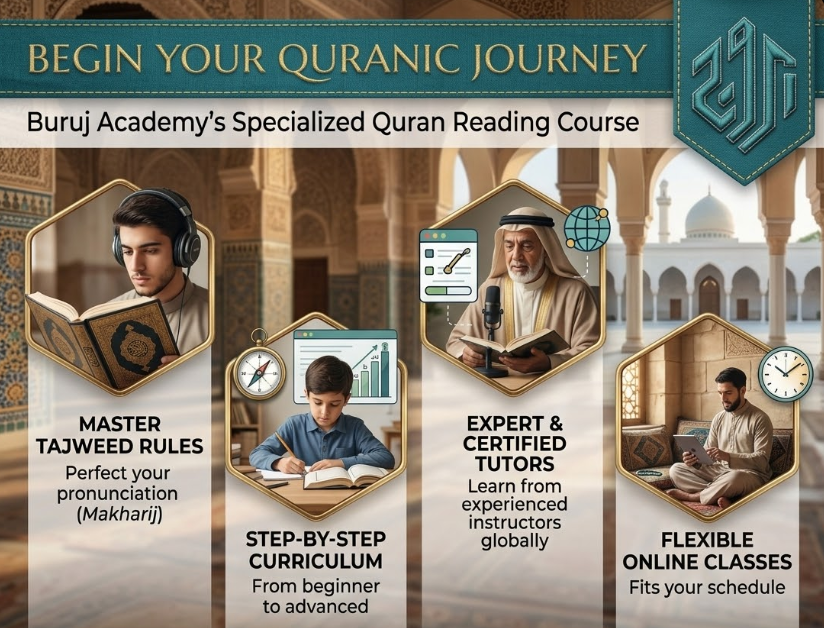
This mirrors the approach our instructors use in Buruj Academy’s Quran Reading course for absolute beginners.
For guidance on how to approach your first reading sessions with proper technique, our detailed resource on reading the Quran for the first time walks through the process step by step.
Book your Free trial lesson and start reading the Quran
4. Learn Core Tajweed Rules — But Understand Their Limits in Self-Study
This is where honest guidance matters. Tajweed — the science of correct Quranic recitation — can be studied theoretically through self-study, and that theoretical knowledge is genuinely valuable. Understanding the rules of Ikhfa,Idgham,Ghunnah, and Qalqalah can significantly improve your awareness during recitation.
The limitation is application. Tajweed rules involve precise makharij (articulation points) and sifat (letter attributes) that require an experienced ear to evaluate.
A self-study learner reading about Tafkhim (heaviness) and Tarqiq (lightness) cannot independently verify whether their own pronunciation is correct.
For a thorough understanding of Tajweed rules and how they work, our Tajweed for beginners guide is an excellent reference.
Excel in Your Quranic Studies
Join Buruj Academy and master the Quran with our structured, professional curriculum.
Book Your Free Trial| Tajweed Area | Self-Study Effectiveness | Why |
| Rule recognition | High | Reading and pattern recognition — no real-time feedback needed |
| Ghunnah duration | Medium | Can be trained with audio comparison |
| Makharij accuracy | Low | Requires trained ear for correction |
| Heavy/light letters | Low | Subtle phonetic distinctions need live feedback |
Read also: What Is the Best Way to Learn Quran Online?
5. Use These Apps and Websites to Learn Quran by Yourself
Several verified digital tools genuinely support independent Quran learning when used with clear purpose.
Quran.com — The most reliable free platform for reading the Quran with text, translation, transliteration, and synchronized audio. Ideal for daily reading practice and verse-by-verse study.
Quranic Audio — A dedicated library of authentic recitations from major Qaris. The Mu’allim recitation by Husary is specifically recommended for beginners learning to read.
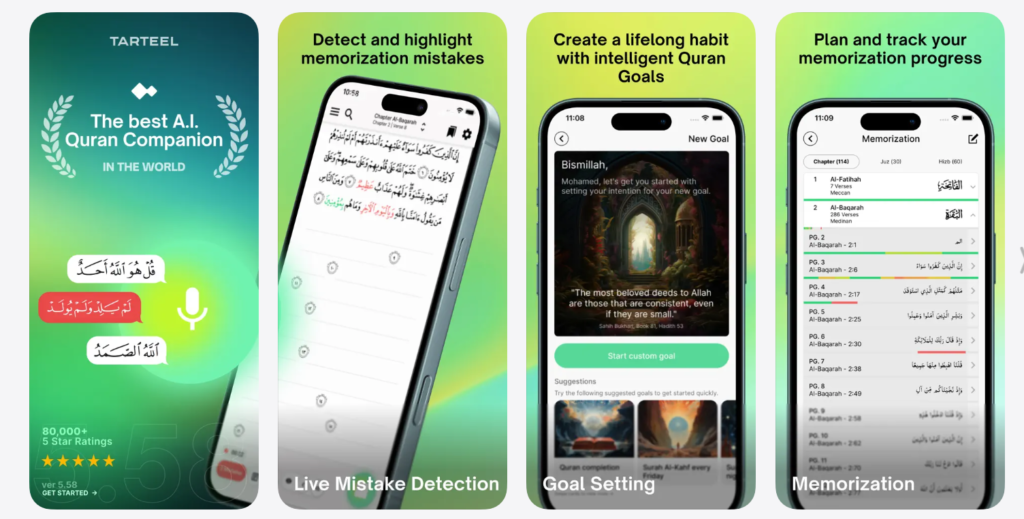
Tarteel AI — An AI-powered application that listens to your recitation in real time, detecting word-level mistakes and tracking your progress. Particularly useful for memorization review. Note that Tarteel provides mechanical error detection, not Tajweed correction at the level of a qualified teacher, but it remains a strong revision companion.
Quranic App — A gamified platform focused on Quranic Arabic vocabulary acquisition. Excellent for building word recognition and understanding verse meanings progressively.
6. Build a Realistic Daily Memorization System If You Plan to Memorize
Can you memorize Quran without a teacher? The honest answer is: memorization of individual surahs is achievable independently, especially for Juz 30. Full Hifz (complete Quran memorization) without any teacher carries significant risks to accuracy and long-term retention.
For self-directed memorization, the most effective system involves three components: new memorization (a small, fixed daily portion — 3 to 5 verses maximum for beginners), same-day review (reciting that day’s new verses repeatedly), and cumulative revision (reviewing all previously memorized material in a consistent cycle).
For a detailed breakdown of how to build this system, our guides on how to memorize Quran faster and the best Quran memorization schedule offer practical frameworks.
Timing matters significantly. Our instructors consistently observe that learners who memorize immediately after Fajr — when the mind is clear — retain material noticeably better than those who memorize at other times of day.
Discover the Buruj Academy Difference
Step into our virtual classrooms and see how our expert instructors make learning Quran and Arabic intuitive and clear. We focus on overcoming the specific hurdles non-native speakers face, building your confidence and connection with the Quran.
7. Know When Self-Study Needs a Teacher to Move Forward
How to self-study the Quran effectively means knowing your ceiling. Self-study produces real results in alphabet recognition, basic reading fluency, verse understanding, and short surah memorization.
It reaches its limit in Tajweed application, advanced memorization retention, and pronunciation accuracy — areas where a qualified teacher’s live feedback is irreplaceable.
A useful benchmark: if you have been reading independently for three or more months and remain uncertain whether your recitation is correct, that uncertainty is itself the signal to seek verified feedback.
Buruj Academy’s Al-Azhar-certified instructors offer flexible 1-on-1 online sessions with real-time correction — a single assessment session alone can identify and correct the most persistent errors.
For those ready for a structured path, our Quran Recitation course builds on whatever foundation self-study has established.
As the Prophet ﷺ said regarding the people of the Quran, verified in Sahih al-Bukhari 5027:
“The best among you are those who learn the Quran and teach it.”
That tradition of transmission — learning from a qualified teacher — has preserved the Quran’s recitation across fourteen centuries without a single sound change.
Book your first FREE recitation lesson
Start Your Quran Learning Journey with Buruj Academy’s Expert Instructors
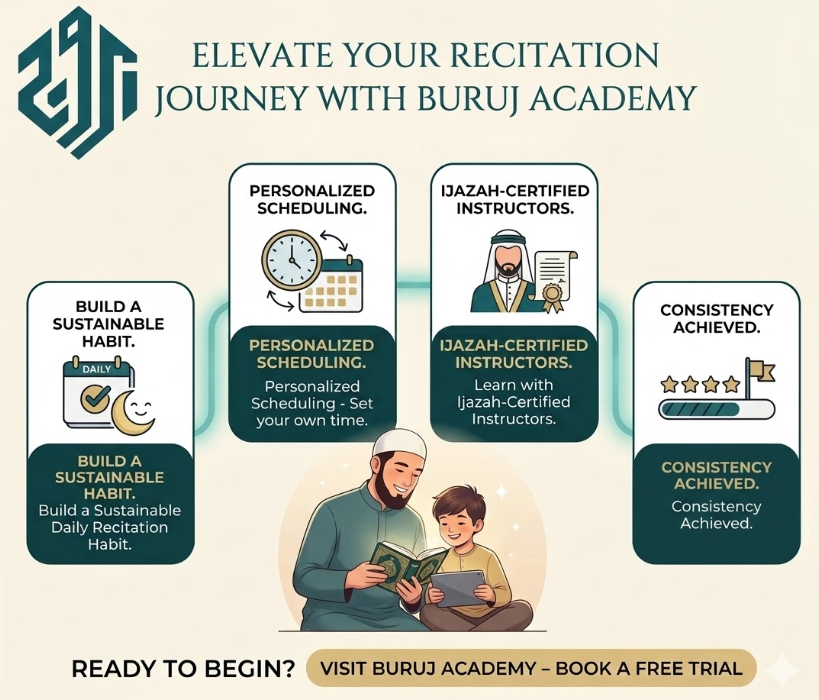
Self-study builds a foundation — qualified instruction perfects it. Buruj Academy’s Ijazah-certified instructors and Al-Azhar University graduates offer personalized 1-on-1 online sessions designed to meet you exactly where your self-study has brought you.
Whether you need a complete Quran for Beginners course or targeted Tajweed correction, the Buruj Method — Sound-before-rules, Consistency-before-speed — ensures lasting accuracy.
With flexible 24/7 scheduling for global students and real-time pronunciation feedback, expert guidance has never been more accessible.
Book your free trial lesson today and take your Quran connection from independent effort to verified mastery.
Take the next step in your learning journey today by enrolling in one of our specialized programs:
- Online Quran Classes
- Online Quran Classes for Beginners
- Online Quran Classes for Adults
- Online Quran Classes for Ladies
- Online Quran Classes for Kids
- Quran Reading Course
- Quran Recitation Course
- Online Ijazah Course
- Online Qirat Course
Don’t wait to transform your relationship with the Holy Quran. Join our global community of students and book your free evaluation session now!
Excel in Your Quranic Studies
Join Buruj Academy and master the Quran with our structured, professional curriculum.
Book Your Free TrialConclusion
Learning the Quran by yourself is not only possible — it is a spiritually meaningful act of seeking that Allah rewards regardless of your starting point.
The path works best when self-study is treated as a structured, disciplined practice: building the alphabet first, training the ear daily, following a logical reading sequence, and understanding both the power and the honest limits of independent work.
Tajweed accuracy and memorization retention ultimately benefit from qualified human feedback, which today is available online for any learner anywhere in the world. Alhamdulillah, the tools have never been better — and the door is open for every sincere heart.
Read also: What Are the Benefits of Learning Quran Online?
Frequently Asked Questions About Learning Quran by Yourself
Can You Learn the Quran on Your Own Without Any Prior Arabic Knowledge?
Yes, you can begin from absolute zero. Starting with the Arabic alphabet and a structured Noorani Qaida program allows complete beginners to build reading foundations independently. Most adult learners with no prior Arabic can reach basic Quranic reading within three to four months of consistent daily practice using structured resources.
Can You Memorize Quran Without a Teacher?
Complete Quran memorization (full Hifz) without any teacher carries real risks to accuracy and long-term retention. A teacher provides correction for errors that self-assessment cannot detect and holds the chain of authentic transmission the Quran requires. See our full resource on the best way to memorize Quran for structured guidance.
How Long Does It Take to Learn to Read the Quran by Yourself?
With consistent daily sessions of 20–30 minutes, most non-Arabic speaking adults can read basic Quranic text — with harakat — within four to six months of structured self-study. Fluent reading without harakat and with Tajweed application takes considerably longer and typically requires guided correction to achieve genuine accuracy.
What Is the Best Free Website to Learn the Quran by Yourself?
Quran.com is the most versatile free platform, offering text, synchronized recitation audio, translations, and transliteration in one clean interface. For dedicated recitation training, Quranic Audio provides an authenticated library of reciters including pedagogical slow-recitation recordings ideal for learners.