 Arabic
| Key Takeaways |
| Arabic’s trilateral root system generates hundreds of semantically connected words from a single three-letter base. |
| Arabic has over 50 words for “love” and hundreds of terms describing states of nature with no English equivalents. |
| Arabic’s 28-letter alphabet produces sounds — like ع (ayn) and غ (ghayn) — absent in nearly all other languages. |
| Arabic is among the most grammatically complete languages, with a dual number form absent from English. |
Arabic is a beautiful language not simply by reputation but by measurable linguistic design. Its sound system, morphological architecture, and extraordinary vocabulary depth place it among the most structurally rich languages in human history — and for anyone considering learning it, understanding why it is beautiful is the most compelling place to begin.
Table of Contents:
What Makes Arabic a Beautiful Language?
Arabic is beautiful because its structure is inherently poetic — every word is built from a root, every sound is precisely placed, and the language carries emotional and conceptual depth that regularly exceeds what translation can capture.
Several features combine to produce this effect. Arabic possesses a phonological richness — sounds produced from deep in the throat and along the full arc of the mouth — that gives spoken Arabic a resonance unlike European languages.
Arabic grammar is highly systematic, meaning that once a learner understands a pattern, it applies with remarkable consistency.
And Arabic vocabulary contains words that describe emotional states, natural phenomena, and human experiences for which other languages have no single equivalent.
At Buruj Academy, our instructors — Al-Azhar University graduates with over 12 years of experience teaching non-native speakers — see the same reaction repeatedly: students who begin our Online Arabic Classes expecting a difficult code discover, within weeks, that the language has an internal logic that feels almost engineered for clarity. That discovery is where the beauty becomes real.
Book your FREE Arabic trial online Arabic class at Buruj

Is Arabic a Beautiful Language Compared to Other World Languages?
Arabic is one of the most beautiful languages in the world, and the comparison holds across both phonetic and structural dimensions. Among major world languages, Arabic stands out for combining tonal richness, morphological depth, and grammatical precision in a single system.
Languages like Italian and French are often praised for their melody. Arabic offers something different: a gravity.
The pharyngeal consonants — sounds like ع (ayn) and ح (ha) — produce a resonance that is physically felt, not just heard. Spanish has a fluid rhythm; Arabic has architectural rhythm, built from patterns that repeat at the level of the root, the word, and the sentence.
How Does Arabic Sound Compare to Other Languages?
Arabic contains sounds that exist in very few other world languages. The letter ع (ayn) is a voiced pharyngeal fricative — produced by constricting the throat — with no equivalent in English, French, Spanish, or most European languages.
The letter خ (kha) mirrors a sound found in Arabic, Farsi, and some Semitic languages but is absent from the Romance family entirely.
Phonetic uniqueness contributes directly to perceived beauty — the sounds are unfamiliar enough to captivate, and structured enough to feel intentional.
Our instructors in the Arabic speaking course note that students who struggle most with Arabic pronunciation in the first two weeks are often the ones most struck by the language’s sound by the end of the first month. The effort of acquisition heightens the appreciation.
Book your free trial to start speaking Arabic fluently

Why the Arabic Sound System Is Phonetically Distinctive
Arabic’s phonetic beauty rests on a 28-letter alphabet in which every letter represents a precise, consistent sound — no silent letters, no ambiguous vowel combinations, and no letters that change pronunciation based on neighboring characters without a governing rule. What you see is, with training, exactly what you say.
The alphabet organizes sounds across the full anatomy of the human vocal tract. Letters are articulated at the lips (ba, meem, fa), at the teeth, at the alveolar ridge, at the palate, at the back of the mouth, and deep in the throat.
The Role of Short Vowels in Arabic’s Musical Quality
Arabic uses a diacritical vowel system — fatha, kasra, and damma — that sits above or below consonants rather than between them. This keeps the consonantal skeleton of the word visually intact while the vowels add rhythm and melody on top.
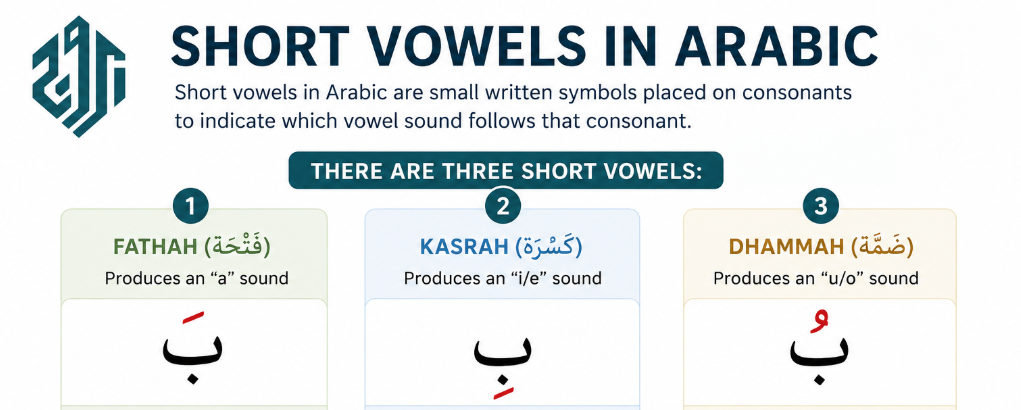
Classical Arabic poetry exploited this system to produce verse with precise metrical patterns across 16 classical metres (buhoor).
For learners beginning with the Arabic alphabet, understanding how Arabic letters connect and flow is the first step toward hearing — and eventually feeling — the phonetic logic that underlies the language’s beauty.
Arabic Morphology: One Root Produces Hundreds of Words
Arabic’s trilateral root system is one of the most structurally elegant features of any human language. Nearly every Arabic word descends from a three-letter root (الجذر, al-jidhr) that carries a core semantic meaning. By inserting different vowel patterns and adding prefixes or suffixes around that root, the language generates entire families of related words.
The root ك-ت-ب (k-t-b) carries the meaning of writing. From it comes:
| Arabic Word | Transliteration | Meaning |
| كَتَبَ | kataba | He wrote |
| كِتَاب | kitaab | Book |
| مَكْتَبَة | maktaba | Library |
| كَاتِب | kaatib | Writer |
| مَكْتُوب | maktoob | Written / letter |
| كِتَابَة | kitaaba | The act of writing |
This is not a feature of isolated words — it is the structural grammar of the entire language. Once a learner internalizes a root and its pattern, they can decode and produce words they have never seen before.
This is why students in our Arabic Grammar Course frequently describe a tipping point — the moment the root system clicks — as one of the most intellectually satisfying experiences in language learning.
Understanding patterns like Arabic tenses and verb conjugations becomes far more manageable once the root system is internalized, because the verb forms themselves are simply root + pattern.
Understand the Arabic Grammar with Buruj’s free trial lesson
Is Arabic the Most Complete Language in the World?
Arabic is among the most grammatically complete languages ever documented, with structural features that allow degrees of precision unavailable in most other major languages.
Arabic distinguishes not just singular and plural — it has a dual form (المثنى, al-muthanna) that specifically addresses exactly two of any noun or verb.
English requires “two books” to make this distinction; Arabic encodes it directly into the word kitaabaan.
This affects nouns, verbs, adjectives, and pronouns simultaneously, giving Arabic a grammatical granularity that allows highly precise expression.
Master the Arabic Language
Join our expert-led courses and build a strong foundation in Classical and Modern Arabic.
Get Your Free TrialHow Arabic Grammar Achieves Exceptional Precision
Arabic’s case system (الإعراب, al-i’rab) marks the grammatical role of every noun in a sentence through short vowel endings — nominative, accusative, and genitive. This means Arabic word order can be flexible without sacrificing clarity, because the case ending tells you the noun’s function regardless of where it appears in the sentence.
Arabic also maintains a grammatical distinction between masculine and feminine for all nouns, pronouns, and verb forms — a system explored in depth in Buruj Academy’s guide to masculine and feminine nouns in Arabic.
This gender system interacts with number and case to create a highly specified grammar. The result is a language capable of encoding complex relational meaning in very few words.
Arabic Vocabulary Depth That No Translation Can Fully Capture
Arabic possesses a vocabulary depth in specific semantic domains that regularly surpasses the capacity of any single translation. This is not literary exaggeration — it is a structural reality of how Arabic developed over millennia as a language of poetry, law, theology, and science.
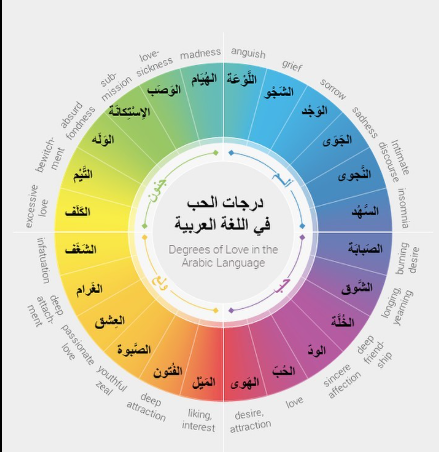
The Arabic lexical tradition documents over 50 words for different states of love, ranging from hawa (هوى) — the first inclination of the heart — to walah (وَلَه) — a love so intense it produces distraction and confusion.
Similarly, classical Arabic documented hundreds of words for rain at different intensities, for camel types by age and temperament, and for states of desert terrain.
This lexical richness is one reason classical Arabic literature — particularly the Mu’allaqat, the seven pre-Islamic odes — is studied alongside Greek and Latin classics in comparative literary traditions.
Read also:12 Fascinating Facts About Arabic
Why Is Arabic a Good Language to Learn?
Arabic is a good language to learn for reasons that are simultaneously practical, intellectual, and cultural. It is the official language of over 22 countries, spoken natively by over 450 million people, and understood — at the liturgical level — by approximately 1.8 billion Muslims worldwide.
From a career perspective, Arabic proficiency is in high demand across diplomacy, international development, journalism, business in the Gulf and MENA regions, and academic Islamic studies.
The language’s geographic reach spans from Morocco to the Gulf, covering some of the world’s most significant economic zones.
From a cognitive standpoint, the root system and case grammar make Arabic one of the most analytically engaging languages to learn.
Learners who master Arabic consistently report that the structural discipline it requires improves their understanding of grammar in general — including English.
For those beginning from zero, our guide to how to learn Arabic for beginners maps out the clearest path forward. And for anyone wondering about realistic timelines, how long it takes to learn Arabic depends heavily on consistency and the method of instruction — two variables that structured learning addresses directly.
Through Buruj Academy’s Arabic Speaking Course, students move from structural knowledge to active use — developing the conversational confidence that turns appreciation for Arabic’s beauty into lived fluency.
Book your free trial to start speaking Arabic fluently

Discover the Buruj Academy Difference
Step into our virtual classrooms and see how our expert instructors make learning Quran and Arabic intuitive and clear. We focus on overcoming the specific hurdles non-native speakers face, building your confidence and connection with the Quran.
Start Learning Arabic with Buruj Academy’s Expert Instructors
Arabic’s beauty is not an abstraction — it becomes real in the moment a learner produces their first correct sentence, hears a root they recognize in an unfamiliar word, or reads a passage of classical prose and feels its rhythm. That moment is available to anyone willing to learn systematically.
Buruj Academy offers:
- Al-Azhar University graduates and Ijazah-certified instructors with 12+ years teaching non-native speakers
- The Buruj Method: Context-before-abstraction for natural Arabic acquisition
- Personalized 1-on-1 online sessions with flexible 24/7 scheduling
- Customized learning plans from complete beginner to advanced fluency
- Real-time feedback and pronunciation correction every session
Book your free trial lesson and experience the structure behind the beauty firsthand.
Begin your transformation today by choosing the path that fits your goals:
- Online Arabic Classes (General & Comprehensive)
- Arabic Course for Beginners
- Arabic Alphabet Learning Course
- Online Arabic Classes for Kids
- Arabic Classes for Adults
- Arabic Grammar Course (Nahw & Sarf)
- Intermediate Arabic Course (B1/B2)
- Arabic Speaking Course (Conversational Fluency)
- Arabic Reading Course (Literary Excellence)
- Learn Arabic Writing Course (Calligraphy & Composition)
Ready to speak with confidence? Join the global community at Buruj Academy and book your free placement interview today!
Master the Arabic Language
Join our expert-led courses and build a strong foundation in Classical and Modern Arabic.
Get Your Free TrialConclusion
Arabic is beautiful because its beauty is structural — built into the roots, the sounds, the grammar, and the vocabulary in ways that reward every hour of study. Unlike languages whose beauty is primarily aesthetic, Arabic offers a logical architecture that becomes more impressive the deeper a learner goes.
Arabic phonetic richness, morphological precision, and vocabulary depth combine to produce a language that genuinely earns its reputation. Starting that study, with the right guidance, is one of the most intellectually and spiritually rewarding decisions a language learner can make.
Frequently Asked Questions About the Beauty of the Arabic Language
Is Arabic Really Considered One of the Most Beautiful Languages?
Arabic is among the most beautiful languages in the world by linguists and language enthusiasts alike. Its phonetic depth — particularly the pharyngeal and emphatic consonants — produces a sonic texture unlike any European language. Combined with its poetic heritage and morphological elegance, Arabic earns its reputation not by convention but by measurable structural design.
What Makes Arabic Different from Other Semitic Languages?
Arabic shares the trilateral root system with Hebrew, Aramaic, and Amharic, but developed the largest documented classical vocabulary of the Semitic family. Its case system (i’rab), dual number form, and the preservation of its classical form — Modern Standard Arabic — across 22 countries also distinguish it structurally from related languages, which underwent more significant grammatical simplification over time.
Is Arabic a Good Language for Non-Native Speakers to Learn?
Arabic is genuinely learnable for non-native speakers who approach it with a structured method. Its root system, once internalized, accelerates vocabulary acquisition significantly. The greatest challenges — new sounds and a new script — are typically resolved within the first several weeks of consistent study. Our instructors at Buruj Academy find that non-Arabic speakers with no prior exposure regularly achieve confident reading within three to four months of structured instruction.
Why Does Arabic Sound So Different from European Languages?
Arabic engages articulation points — particularly the pharynx and uvula — that European languages do not use. Letters like ع (ayn), ح (ha), خ (kha), and غ (ghayn) are produced in the back of the throat and have no phonetic equivalent in English, French, Spanish, or Italian. This is precisely what gives Arabic its distinctive resonance and is one of the first things new learners notice.
Related Articles
Arabic