 Arabic

Living in Qatar means juggling long work hours, Qatar’s heat-driven schedule shifts, and a genuine desire to understand Arabic beyond greetings and market phrases. Many residents start searching, then stall at the same question: where do I actually begin?
Learning Arabic in Qatar today is most effectively done through structured online Arabic classes that combine phonetic training, grammar sequencing, and consistent speaking practice — rather than scattered apps or unstructured self-study. This approach works whether you’re a working professional, a parent, or new to Qatar entirely.
Table of Contents:
Why Are Qatar Residents Turning to Online Arabic Classes?
Qatar’s expatriate and professional population faces a specific constraint: rotating shift schedules, frequent travel, and summer heat that limits in-person commuting to physical language centers. Online classes remove that friction entirely by bringing the instructor to any schedule, any location within Qatar.
In our sessions with students based in Qatar and across the Gulf, we’ve consistently seen one pattern: learners who tried in-person group classes first often struggled with fixed time slots that clashed with work rotations.
Switching to 1-on-1 online sessions let them study at 6 AM before work or 9 PM after children were asleep — without losing momentum between lessons.
This flexibility matters because Arabic acquisition depends heavily on consistency rather than occasional immersion. A single two-hour class per week, common in physical centers, creates long gaps where new sounds and vocabulary fade before the next session.
At Buruj Academy, our Online Arabic Classes are built around this reality. Students in Qatar work directly with instructors through personalized scheduling, so a canceled meeting or a late shift doesn’t derail an entire week’s progress.
The Arabic for beginners course specifically addresses the zero-starting-point learner, building letter recognition and basic vocabulary before introducing grammar complexity.
Begin learning Arabic at Buruj with a FREE trial lesson

Are There Free Ways to Learn Arabic in Qatar?
Free and scholarship-based Arabic study in Qatar generally exists through university-affiliated language centers and government cultural initiatives, though availability, eligibility, and enrollment cycles vary significantly by institution and change year to year.
Several universities and cultural centers within Qatar have historically offered subsidized or free Arabic instruction for residents and students, often tied to specific enrollment periods, residency status, or academic affiliation.
Because these programs’ availability shifts — application windows open and close, funding changes, cohort sizes are limited — the details are best confirmed directly with the institution before assuming free access exists at any given time.
What stays constant is the need for genuine instructional structure, whether the source is free or paid. A scholarship seat still requires the same phonetic and grammatical groundwork any serious Arabic study needs.
This is where a free trial lesson becomes a practical middle ground. Rather than waiting on scholarship cycles or committing financially upfront, Buruj Academy’s free trial lets Qatar-based learners experience a structured, personalized session — testing whether the Buruj Method fits their learning style before any commitment.

What Are the First Building Blocks of Learning Arabic in Qatar?
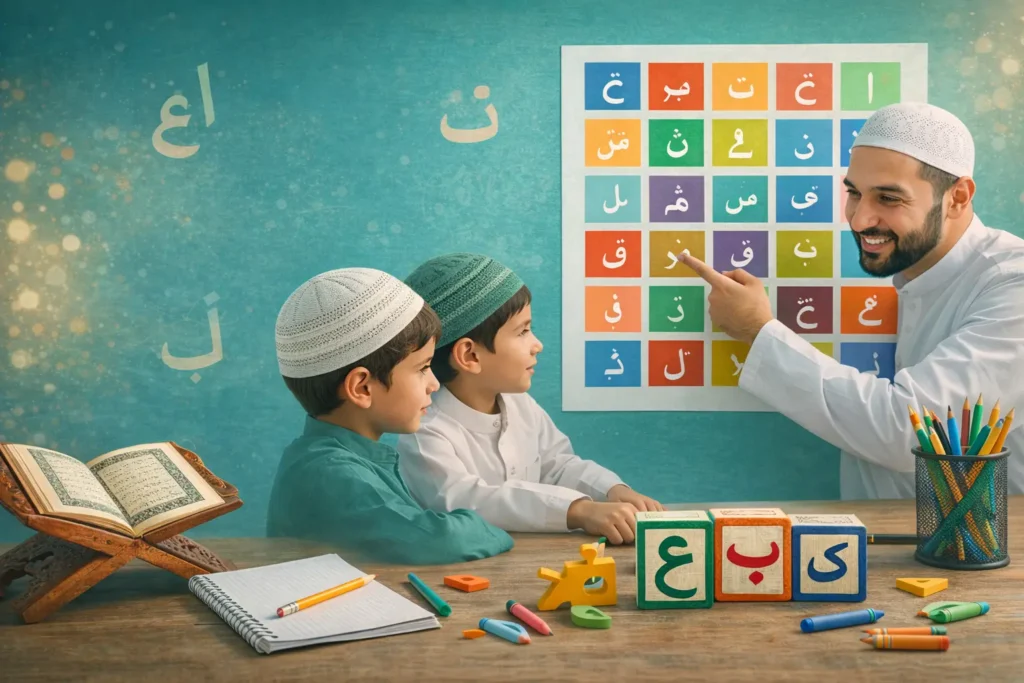
The Arabic alphabet consists of 28 letters, each with distinct sounds not found in English, plus short vowel marks called ḥarakāt that Arabic writing typically omits in everyday text. Mastering both is the non-negotiable starting point.
Unlike English, Arabic letters change shape depending on their position within a word — beginning, middle, end, or standalone.
This positional shifting confuses most new learners initially, but it follows entirely predictable patterns once practiced systematically.
Common Pronunciation Struggles for Non-Native Speakers Learning Arabic in Qatar
In our experience teaching non-Arabic speakers, three letters consistently cause the most difficulty: ع (‘ayn), ح (ḥaa), and ق (qaaf) — all produced from throat positions unfamiliar to English speakers. Students often substitute the nearest English-equivalent sound instead of training the correct articulation point.
| Letter | Common Mistake | Correct Approach |
| ع (‘ayn) | Silent or replaced with “a” | Constrict throat, voiced sound |
| ح (ḥaa) | Pronounced like English “h” | Sharper, from mid-throat |
| ق (qaaf) | Pronounced like “k” | Deeper, from back of throat |
Correcting these early prevents habits that become harder to unlearn later. This is precisely why Buruj Academy’s Arabic Alphabet learning course pairs each letter with guided audio repetition and live correction rather than passive listening alone.
Practice Exercise: Write out the Arabic alphabet in isolated form, then attempt writing your own name using the closest matching letters. Record yourself pronouncing each letter and compare against a native audio reference.
For a full visual breakdown of letter shapes and positions, our guide on how to learn the Arabic alphabet walks through each stage in sequence.
Read More: The Most Common Egyptian Arabic Words and Meanings
Get a free trial now in Buruj’s Alphabet course
How Should Beginners Learning Arabic in Qatar Approach Grammar Fundamentals?
Arabic grammar fundamentals for beginners center on three pillars: noun gender (masculine/feminine), plural formation, and basic sentence structure — each governing how words connect logically within a sentence. These three areas explain roughly 70% of early learner confusion.
Every Arabic noun carries grammatical gender, which affects adjective agreement, verb conjugation, and pronoun choice throughout a sentence. Most feminine nouns end in a distinct tāʼ marbūṭah (ة), though notable exceptions exist and must be memorized individually.
Plurals compound this complexity further. Arabic uses three plural categories — dual, sound plural, and broken plural — where broken plurals reshape the word entirely rather than adding a simple suffix.
Read also: The Differences Between Modern Standard Arabic and Egyptian Arabic
A Practical Gender and Plural Comparison
| Concept | Singular Example | Plural Pattern |
| Masculine regular | مُعَلِّم (teacher) | مُعَلِّمُونَ (sound plural) |
| Feminine regular | مُعَلِّمَة (teacher, f.) | مُعَلِّمَات (sound plural) |
| Broken plural | كِتَاب (book) | كُتُب (irregular reshaping) |
Broken plurals cannot be predicted from the singular form through any fixed rule, which is why we teach them as vocabulary items rather than grammar formulas in early Buruj Academy Arabic grammar course sessions.
Practice Exercise: Take five common nouns from your daily vocabulary (book, teacher, house, car, friend), identify their gender, then attempt their plural form before checking against a reference dictionary.
Our detailed breakdowns on masculine and feminine nouns in Arabic and dual nouns in Arabic expand on these patterns with additional examples.
Understand the Arabic Grammar with Buruj’s free trial lesson
Discover the Buruj Academy Difference
Step into our virtual classrooms and see how our expert instructors make learning Quran and Arabic intuitive and clear. We focus on overcoming the specific hurdles non-native speakers face, building your confidence and connection with the Quran.
Master the Arabic Language
Join our expert-led courses and build a strong foundation in Classical and Modern Arabic.
Get Your Free TrialRead also:Daily 5-Minute Arabic Practice for Beginners
How Can Qatar-Based Learners Build Speaking Confidence Faster?
Speaking confidence develops through structured output practice — actively producing sentences aloud — rather than passive listening or vocabulary memorization alone. Learners who only consume Arabic content without speaking it consistently plateau far earlier.
A common pattern we observe among Doha-based professional learners is treating Arabic study as reading comprehension rather than communication practice. They can recognize written sentences but freeze when asked to respond verbally in real time.
The Three-Step Daily Speaking Drill
Breaking this cycle requires deliberate output practice built into short daily sessions rather than occasional long study blocks.
- Shadow practice: Repeat native audio immediately after hearing it, matching rhythm and stress patterns exactly.
- Self-narration: Describe your immediate surroundings or daily actions aloud in simple Arabic sentences.
- Live correction: Practice with an instructor who corrects pronunciation and word choice in real time, not after the fact.
This third step is why self-study apps alone rarely produce confident speakers. Through Buruj Academy’s Arabic speaking course, students get immediate instructor feedback during live sessions, correcting habits before they solidify into permanent errors.
Practice Exercise: Choose three objects visible in your room right now. Construct a simple sentence describing each in Arabic, then say all three aloud without pausing to translate mentally first.
Our guide on how to improve Arabic speaking skills covers additional daily drills for sustained progress.
Book your free trial to start speaking Arabic fluently

What Does a Realistic Arabic Learning Timeline Look Like in Doha?
A realistic Arabic learning timeline for consistent Doha-based learners spans roughly three to six months to reach basic conversational ability, assuming 20–30 minutes of daily structured practice. Progress compounds significantly after the alphabet and core grammar are internalized.
Suggested Progression Structure
| Phase | Duration | Focus Area |
| Foundation | Weeks 1–4 | Alphabet, pronunciation, basic vocabulary |
| Structure | Weeks 5–12 | Grammar, sentence construction, plurals |
| Fluency Building | Weeks 13–24 | Speaking drills, conversation, comprehension |
These ranges reflect general instructional patterns rather than fixed guarantees, since individual pace varies with prior language background and session consistency. Learners who skip the foundation phase to rush into conversation typically develop pronunciation habits that require more correction later.r
Our detailed answer on how long it takes to learn Arabic breaks this down by learner type and weekly time investment.
Read More: Learn Arabic in Lebanon
How to Apply for a Learn Arabic in Qatar Scholarship?
To secure an Arabic scholarship in Qatar, applicants must submit academic transcripts, strong recommendation letters, and a compelling statement of purpose. These fully funded university programs typically cover tuition, accommodation, and provide a monthly stipend for intensive linguistic study.
Institutions such as Qatar university offer renowned programs specifically designed for non-native speakers. Admission is highly competitive, requiring candidates to demonstrate genuine dedication to mastering the language for academic, professional, or religious advancement.
Preparing a Competitive Application
Successful applicants usually possess a foundational understanding of the language before applying. Demonstrating basic reading and writing abilities signals to the admissions committee that the student is serious and prepared for rigorous daily instruction.
We advise our ambitious students to complete basic coursework beforehand. Familiarizing yourself with foundational texts and core grammatical concepts provides a distinct advantage during the rigorous selection and placement processes at Gulf universities.
| Application Stage | Typical Month | Key Action Required |
| Document Preparation | October – December | Gather transcripts and recommendations. |
| Online Submission | January – February | Submit the formal application portal. |
| Interview Phase | March – April | Prepare for basic Arabic assessments. |
| Final Acceptance | May – June | Process visas and travel documents. |
This timeline represents the standard academic cycle for major language scholarships in the region. Preparing documents well in advance prevents last-minute errors and ensures all administrative requirements are thoroughly fulfilled.
Learn Arabic in Qatar with Buruj Academy’s Personalized Online Classes
Learning Arabic in Qatar no longer requires fixed schedules or physical commutes — structured 1-on-1 online sessions now deliver the same rigor with far greater flexibility.
Buruj Academy’s Online Arabic Classes connect Qatar-based learners with instructors experienced in teaching non-native speakers, using the Buruj Method’s context-before-abstraction approach.
Sessions adapt to shift work, family schedules, and Qatar’s climate-driven routines.
Personalized learning plans adjust to your starting level, whether complete beginner or returning student. Real-time correction during live sessions prevents pronunciation errors from becoming permanent habits.
Book a free trial lesson today and experience a structured Arabic session built around your actual schedule — no commuting, no fixed class times, just consistent progress.
Begin your transformation today by choosing the path that fits your goals:
- Online Arabic Classes (General & Comprehensive)
- Arabic Course for Beginners
- Arabic Alphabet Learning Course
- Online Arabic Classes for Kids
- Arabic Classes for Adults
- Arabic Grammar Course (Nahw & Sarf)
- Intermediate Arabic Course (B1/B2)
- Arabic Speaking Course (Conversational Fluency)
- Arabic Reading Course (Literary Excellence)
- Learn Arabic Writing Course (Calligraphy & Composition)
Ready to speak with confidence? Join the global community at Buruj Academy and book your free placement interview today!
Master the Arabic Language
Join our expert-led courses and build a strong foundation in Classical and Modern Arabic.
Get Your Free TrialConclusion
Arabic fluency in Qatar comes down to consistency, not location. Whether scholarship seats are available this cycle or not, the same foundation applies: alphabet mastery, grammar sequencing, and daily speaking practice.
Structured online instruction removes the scheduling barriers that stall so many motivated learners in Qatar’s demanding work culture. Progress compounds once the fundamentals are internalized — the earlier that foundation is built correctly, the faster confident speaking follows.
Frequently Asked Questions About Learning Arabic in Qatar
Can I Learn Arabic Online While Living in Doha?
Yes, online Arabic classes work effectively for Doha residents since sessions adapt entirely to your time zone and schedule. 1-on-1 instruction eliminates the need for commuting to physical centers, making it practical for shift workers and busy professionals.
Is It Possible to Learn Arabic for Free in Qatar?
Some free or subsidized options may exist through university-affiliated centers or cultural initiatives in Qatar, though availability changes by year and enrollment cycle. A free trial lesson offers immediate access to structured instruction without waiting on scholarship timing.
How Long Does It Take to Become Conversational in Arabic?
Most consistent learners reach basic conversational ability within three to six months, given 20–30 minutes of daily structured practice. This timeline assumes steady progress through alphabet mastery, core grammar, and regular speaking drills without extended gaps.
What Is the Best Way to Start Learning Arabic as a Complete Beginner?
Complete beginners should start with alphabet recognition and pronunciation before introducing grammar or vocabulary memorization. Our Arabic for Beginners course sequences this deliberately, since rushing past pronunciation fundamentals creates habits requiring correction later.