 Arabic
| Key Takeaways |
| Modern Standard Arabic (MSA) is the formal written language used across all 22 Arab countries in education, media, and official contexts. |
| Egyptian Arabic is a spoken dialect understood by an estimated 400 million people due to Egypt’s dominant film and television output. |
| MSA shares closer grammatical structure with Classical Arabic and the Quran, making it essential for Islamic study and Quranic comprehension. |
| Egyptian Arabic differs from MSA in vocabulary, pronunciation, and grammar — including dropped case endings and unique consonant shifts like ق becoming a glottal stop. |
| Your learning goal determines which to prioritize: Quranic understanding demands MSA; daily conversation with Arab speakers makes Egyptian Arabic practical. |
Many Arabic learners face the same fork in the road: do they study the Arabic of books, news, and the Quran — or the Arabic people actually speak in the streets of Cairo? This question stops more beginners than almost any other decision in their learning path.
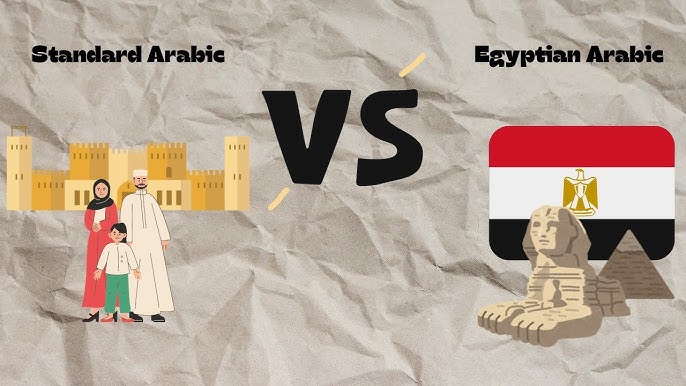
Modern Standard Arabic and Egyptian Arabic serve genuinely different purposes, and the difference between Egyptian Arabic and Modern Standard Arabic goes deeper than vocabulary.
Table of Contents:
What Is Modern Standard Arabic and How Does It Differ From Egyptian Arabic?
Modern Standard Arabic (MSA), known in Arabic as الفصحى (al-fusha), is the standardized, written form of Arabic derived directly from Classical Arabic. Egyptian Arabic (al-ammiyya al-masriyya) is a spoken regional dialect that evolved over centuries of Egyptian history.
MSA is understood across all Arab countries in written form; Egyptian Arabic is spoken natively by approximately 100 million Egyptians and passively understood by hundreds of millions more.
The core difference lies in function: MSA operates in formal, written, and pan-Arab contexts, while Egyptian Arabic operates in informal spoken life.
They share the same Arabic script and root system, but diverge significantly in grammar, vocabulary, and pronunciation.
| Feature | Modern Standard Arabic | Egyptian Arabic |
| Script | Arabic script | Arabic script (informal) |
| Case endings (I’rab) | Fully applied | Largely dropped |
| Formal use | Yes — universal | No |
| Spoken natively | No living native speakers | ~100 million speakers |
| Quranic proximity | Very close | More distant |
| Media reach | Pan-Arab news, official content | Films, TV, music |
This distinction matters enormously for learners. Our Al-Azhar-trained Arabic Egyptian instructors at Buruj Academy see students arrive with this confusion regularly — and addressing it early determines whether someone builds a durable skill or spins in circles for months.
Book a FREE trial session with one of Buruj’s Azhari Quran tutors

What Are the Main Grammatical Differences Between MSA and Egyptian Arabic?
MSA and Egyptian Arabic diverge most visibly in three grammatical areas: case endings, verb conjugation, and sentence structure. In MSA, nouns carry case endings (marfu’, mansub, majrur) that signal grammatical function. Egyptian Arabic drops these endings almost entirely in spoken use.
How Do Case Endings Work Differently in Each Variety?
In MSA, a sentence like “The student read the book” carries grammatical markers: الطالبُ قرأَ الكتابَ (al-talibu qara’a al-kitaba). Each word ending shifts based on its grammatical role. In Egyptian Arabic, the same idea becomes الطالب أرا الكتاب — endings simplified, verb conjugation adjusted, and the formal structure relaxed.
| Grammar Feature | MSA Example | Egyptian Arabic Equivalent |
| Subject marker | الطالبُ (-u ending) | الطالب (no ending) |
| Verb “read” (past) | قَرَأَ (qara’a) | أرَا (‘Aara) |
| Object marker | الكتابَ (-a ending) | الكتاب (no ending) |
| Negation | لا / لم | مش (mish) |
| Future marker | سـ / سوف | هـ (ha-) prefix |
Our instructors who teach the Arabic Grammar Course note that learners with MSA foundations adapt to Egyptian Arabic far more quickly than the reverse — because MSA grammar gives learners the underlying logic of the language.
Understand the Arabic Grammar with Buruj’s free trial lesson

Which Consonant and Pronunciation Differences Separate Egyptian Arabic from MSA?
Egyptian Arabic has two especially notable consonant shifts that distinguish it clearly from MSA pronunciation. The letter ق (qaf) in MSA produces a deep uvular stop sound from the back of the throat.
In Egyptian Arabic, this same letter is typically pronounced as a glottal stop — a brief pause in the throat, similar to the catch in the English expression “uh-oh.” So the MSA word قلب (qalb, heart) becomes something closer to ‘alb in Egyptian spoken Arabic.
The letter ج (jim) presents another clear divergence. MSA and most dialects pronounce it as a soft j sound (like “job”). Egyptian Arabic pronounces it as a hard g — so جميل (jamil, beautiful) becomes gamil in Egyptian speech.
Read also:A Complete Guide to Learning Egyptian Arabic
How Does Vocabulary Differ Between MSA and Egyptian Arabic?
Beyond pronunciation, vocabulary differences appear at the everyday level. Egyptian Arabic borrows significantly from Coptic, Turkish, French, and English — reflecting Egypt’s layered historical influences.
| Concept | MSA Word | Egyptian Arabic Word |
| Now | الآن (al-an) | دلوقتي (dilwa’ti) |
| Very | جداً (jiddan) | أوي (awi) |
| What? | ماذا (matha) | إيه (eh) |
| To go | ذهب (thahaba) | راح (rah) |
| House | منزل (manzil) / بيت (bayt) | بيت (beit) |
These differences are real but not insurmountable. Learners with a solid MSA vocabulary base recognize the root structures beneath the dialect — which is why our beginners’ guide to Modern Standard Arabic recommends root-based vocabulary learning from the start.
Read also: How to Learn Arabic Fusha?
Is MSA or Egyptian Arabic Better for Quranic Understanding?
Modern Standard Arabic is unquestionably better for Quranic study and Islamic scholarship. The Quran was revealed in Classical Arabic (al-arabiyya al-fusha), and MSA is directly descended from that classical register. Egyptian Arabic, by contrast, has diverged significantly in structure, vocabulary, and grammar over centuries of spoken evolution.
When a student reads the Quran, they encounter grammatical structures — case endings, dual forms, classical verb patterns — that MSA preserves and Egyptian Arabic has largely abandoned.
A student who learns MSA grammar first will encounter Quranic constructions with genuine recognition. A student who learns only Egyptian Arabic will frequently find the Quran’s language unfamiliar.
Our Quranic Arabic Classes at Buruj Academy are specifically designed to bridge MSA grammar and Quranic vocabulary — giving students the tools to understand what they are reciting, not just pronounce it. If your goal includes Quran comprehension or Islamic study, MSA is not optional — it is the foundation.
Begin Understanding Quranic Arabic with a FREE Lesson
What Dialect Is Closest to Modern Standard Arabic?
Among the regional Arabic dialects, Gulf Arabic (al-khaliji) and Levantine Arabic (al-shamiyya) are generally considered closest to MSA in vocabulary and some structural features.
However, no living spoken dialect is identical to MSA — the gap exists in all of them to varying degrees.
Egyptian Arabic sits at a moderate distance from MSA — not the farthest (Moroccan Darija diverges most significantly), but noticeably different in the features described above.
The reason Egyptian Arabic is often recommended to learners is not its proximity to MSA but its cultural reach: Egyptian films, television, and music have given it pan-Arab intelligibility that other dialects lack.
Master the Arabic Language
Join our expert-led courses and build a strong foundation in Classical and Modern Arabic.
Get Your Free Trial| Dialect | Closeness to MSA | Regional Reach |
| Gulf Arabic | High | Gulf countries |
| Levantine Arabic | Moderate-High | Syria, Lebanon, Jordan, Palestine |
| Egyptian Arabic | Moderate | Pan-Arab (media reach) |
| Iraqi Arabic | Moderate | Iraq region |
| Moroccan Darija | Low | Maghreb |
For learners whose priority is pan-Arab communication and they want a dialect, Egyptian Arabic remains the most practical choice. But if Quranic understanding drives the decision, MSA — specifically Quranic Arabic — is the right starting point.
Should You Learn MSA or Egyptian Arabic First?
Your goal determines your starting point — and being clear about that goal from day one saves significant time. This is one of the most consistent pieces of advice we give new students at Buruj Academy before they enroll.
Learn MSA First If You Want To:
- Understand or study the Quran and its meanings
- Read classical Islamic texts, Tafsir, or Hadith literature
- Communicate across multiple Arab countries in writing
- Watch Al Jazeera, read Arabic newspapers, or follow formal Arabic media
- Build a foundation that transfers to any dialect or Quranic study later
Learn Egyptian Arabic First If You Want To:
- Speak conversationally with Egyptian friends, family, or colleagues
- Travel to Egypt and communicate comfortably in daily life
- Understand Egyptian films, music, and television without subtitles
- Enter Arabic through spoken communication before tackling grammar
In our experience teaching non-Arabic speakers over 12+ years, students who start with MSA and then add Egyptian Arabic find the transition manageable and logical. Students who start with Egyptian Arabic and then try to study Quranic Arabic often struggle with the formal grammar they skipped.
This is why our Arabic for Beginners course sequences learning with MSA structure as the backbone, with practical spoken Arabic introduced progressively.
Begin learning Arabic at Buruj with a FREE trial lesson

How Quickly Can You Learn Each Variety?
Both MSA and Egyptian Arabic present real challenges for English speakers. The US Foreign Service Institute classifies Arabic (all varieties) as a Category IV language — among the most difficult for native English speakers — estimating approximately 2,200 hours of study for professional working proficiency.
However, Egyptian Arabic’s simplified grammar (no case endings, simplified verb conjugation) can allow for faster early conversational results.
A motivated beginner can hold basic conversations in Egyptian Arabic within 3–6 months of consistent daily study. MSA’s grammar takes longer to internalize — but the payoff is deeper comprehension and cross-dialectal literacy.
For students asking how long it takes to learn Arabic, the honest answer depends on starting goals, consistency, and whether learning happens with or without qualified instruction.
For more context on realistic difficulty expectations, our guide on how hard it is to learn Arabic breaks this down by skill area.
Discover the Buruj Academy Difference
Step into our virtual classrooms and see how our expert instructors make learning Quran and Arabic intuitive and clear. We focus on overcoming the specific hurdles non-native speakers face, building your confidence and connection with the Quran.
Start Learning Arabic Effectively with Buruj Academy’s Expert Instructors
Whether your goal is Quranic comprehension, spoken fluency, or both, the quality of your instruction determines how quickly you progress. Buruj Academy’s Online Arabic Classes are taught by Al-Azhar University graduates with 12+ years of experience teaching non-Arabic speakers worldwide.
- Ijazah-certified instructors and Al-Azhar graduates who know Arabic from the inside
- The Buruj Method: Context-before-abstraction for natural, lasting comprehension
- Personalized 1-on-1 sessions tailored to your level, goal, and schedule
- Flexible 24/7 scheduling for working professionals and busy parents
- Real-time pronunciation feedback and individualized correction
Book your free trial lesson today and let our team identify exactly which Arabic variety and learning path fits your goals.
Begin your transformation today by choosing the path that fits your goals:
- Online Arabic Classes (General & Comprehensive)
- Arabic Course for Beginners
- Arabic Alphabet Learning Course
- Online Arabic Classes for Kids
- Arabic Classes for Adults
- Arabic Grammar Course (Nahw & Sarf)
- Intermediate Arabic Course (B1/B2)
- Arabic Speaking Course (Conversational Fluency)
- Arabic Reading Course (Literary Excellence)
- Learn Arabic Writing Course (Calligraphy & Composition)
Ready to speak with confidence? Join the global community at Buruj Academy and book your free placement interview today!
Master the Arabic Language
Join our expert-led courses and build a strong foundation in Classical and Modern Arabic.
Get Your Free TrialConclusion
Modern Standard Arabic and Egyptian Arabic are not competitors — they are different tools for different purposes. MSA gives you access to the Quran, Islamic scholarship, formal Arabic media, and cross-Arab written communication. Egyptian Arabic gives you a spoken voice understood across the Arab world through the power of Egypt’s cultural output.
For most Muslim learners seeking Quranic connection and Islamic literacy, MSA is the essential foundation. Egyptian Arabic can be added meaningfully once that base is in place. Starting with clarity about your own goal — and learning from qualified instructors who understand both varieties — makes all the difference between years of confusion and genuine, purposeful progress.
Frequently Asked Questions About Modern Standard Arabic and Egyptian Arabic
Can You Understand Egyptian Arabic If You Learn MSA?
Partial understanding of Egyptian Arabic if you learn MSA, yes — full comprehension, not immediately. MSA and Egyptian Arabic share Arabic roots and core vocabulary, so MSA learners recognize a meaningful percentage of Egyptian Arabic words. However, pronunciation shifts like the qaf glottal stop, unique vocabulary, and dropped grammar markers create consistent gaps. Active listening exposure to Egyptian media alongside MSA study closes those gaps over time.
Is Egyptian Arabic Understood Across the Arab World?
Egyptian Arabic enjoys wider passive comprehension than any other regional dialect, largely because of Egypt’s dominant television, film, and music industry. Most Arabic speakers across the Arab world recognize and understand Egyptian Arabic at a conversational level, even if they do not speak it themselves. This pan-Arab intelligibility is the primary practical argument for choosing Egyptian Arabic as a spoken dialect.
Can You Learn Both MSA and Egyptian Arabic at the Same Time?
It is possible but not recommended for beginners. Simultaneously studying two varieties creates confusion in grammar, vocabulary, and pronunciation before either is sufficiently grounded. A more effective approach is establishing MSA grammar and core vocabulary first — typically 6–12 months of consistent study — then layering Egyptian Arabic spoken patterns on top of that structure.
Does Egyptian Arabic Use the Same Alphabet as MSA?
Yes. Egyptian Arabic in its informal written form uses the same Arabic alphabet as MSA. In digital communication, Egyptians sometimes write dialect informally in Arabic script, and occasionally in romanized Arabic (called “Arabizi”). Formal written Egyptian Arabic — in literature, media captions, or educational materials — defaults to MSA spelling conventions rather than dialect-specific phonetic spelling.
Which Arabic Variety Should Kids Learn First?
For Muslim children whose primary goal is Quran reading and Islamic education, MSA and Quranic Arabic provide the most durable foundation. Buruj Academy’s Online Arabic Classes for Kids are structured to introduce MSA vocabulary and sentence patterns through age-appropriate methods, building the linguistic base from which Quranic comprehension grows naturally. Dialect exposure can follow organically through media and cultural interaction.
Related Articles
Arabic