 Arabic
| Key Takeaways |
| Arabic body part nouns split into masculine and feminine forms, with most feminine terms ending in a taa marbuta (ة). |
| Paired body parts like eyes, hands, and ears follow the dual noun pattern, adding ان or ين instead of the plural. |
| Non-paired body parts use broken plurals (irregular internal vowel changes) rather than a simple added suffix. |
Standing in front of a mirror repeating “hand,” “eye,” “head” in Arabic feels awkward at first, but every non-Arabic speaker we have taught has needed exactly this kind of direct, physical vocabulary to move past textbook phrases.
Body part words are some of the most practical, high-frequency terms in the Arabic language, and mastering them early pays off in real conversations.
The main body parts in Arabic include رَأْس (head), عَيْن (eye), يَد (hand), قَلْب (heart), and رِجْل (leg), each carrying specific grammatical gender rules. Most body part nouns are feminine, particularly single organs, while several exceptions like أَنْف (nose) and قَلْب (heart) remain masculine despite common assumptions.
Table of Contents:
What Are the Names of Most Common Body Parts in Arabic?
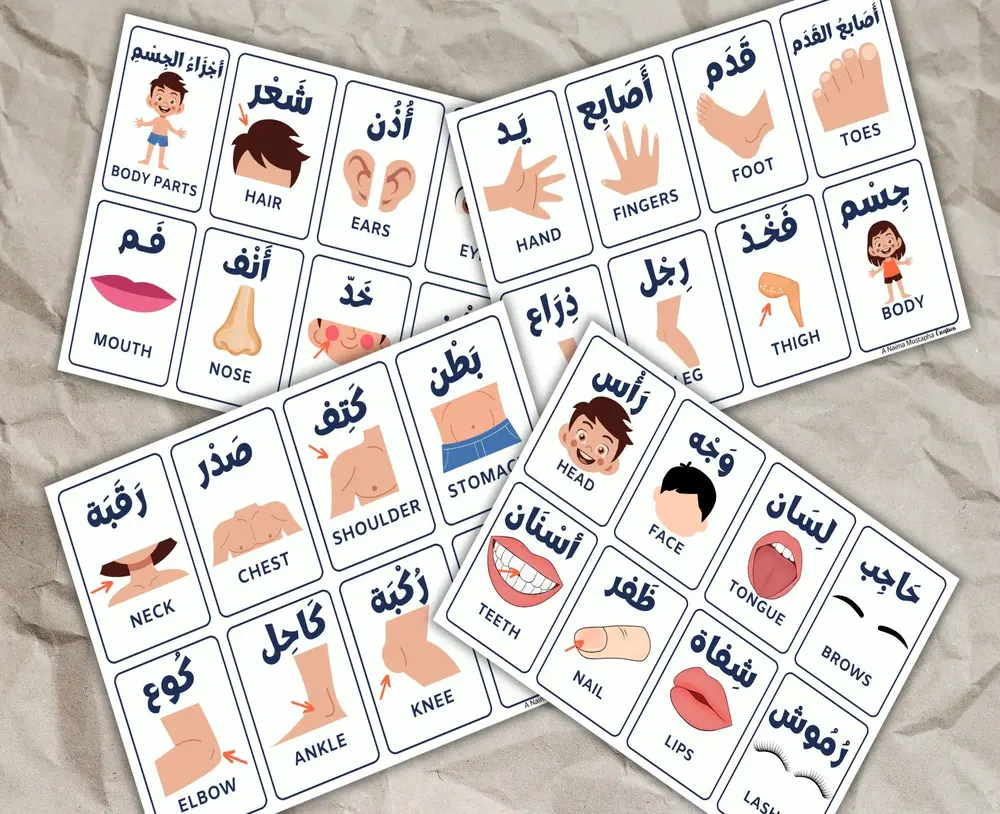
The most common body parts in Arabic cover the head, torso, and limbs, including رَأْس (head), وَجْه (face), يَد (hand), رِجْل (leg), and قَلْب (heart). These ten to fifteen terms form the essential vocabulary base every beginner needs before advancing to specialized anatomical terms.
In our sessions at Buruj Academy, we consistently see students memorize these words faster when they group them by body region rather than learning them alphabetically.
Region-based grouping mirrors how native speakers naturally organize physical vocabulary in conversation.
List of the fifteen most essential body parts in Arabic
| Arabic | Transliteration | English | Gender |
| رَأْس | Ra’s | Head | Masculine |
| وَجْه | Wajh | Face | Masculine |
| عَيْن | ‘Ayn | Eye | Feminine |
| أَنْف | Anf | Nose | Masculine |
| فَم | Fam | Mouth | Masculine |
| أُذُن | Uthun | Ear | Feminine |
| يَد | Yad | Hand | Feminine |
| رِجْل | Rijl | Leg/Foot | Feminine |
| قَلْب | Qalb | Heart | Masculine |
| ظَهْر | Dhahr | Back | Masculine |
| بَطْن | Batn | Stomach | Feminine |
| رَقَبَة | Raqabah | Neck | Feminine |
| كَتِف | Katif | Shoulder | Feminine |
| إِصْبَع | Isba’ | Finger | Feminine |
| شَعْر | Sha’r | Hair | Masculine |
Notice that gender in Arabic does not always match logical expectation — قَلْب (heart) is masculine despite referring to something often associated with emotion.
How Do You Say Head, Face, and Facial Features in Arabic?
The head and face contain the highest concentration of body part vocabulary in daily Arabic, including رَأْس (head), وَجْه (face), جَبْهَة (forehead), خَدّ (cheek), and ذَقْن (chin). These terms appear constantly in descriptions of appearance, illness, and emotional expression.
Facial vocabulary carries extra weight in Arabic because descriptions of beauty, tiredness, and emotion routinely reference specific facial features.
A student describing a headache needs رَأْس, while describing sadness might reference عَيْن (eye) welling with tears.
Facial Features Vocabulary Table
| Arabic | Transliteration | English |
| جَبْهَة | Jabhah | Forehead |
| حَاجِب | Hajib | Eyebrow |
| رُمْش | Rumsh | Eyelash |
| خَدّ | Khadd | Cheek |
| ذَقْن | Dhaqn | Chin |
| شَفَة | Shafah | Lip |
| لِسَان | Lisan | Tongue |
| سِنّ / أَسْنَان | Sinn / Asnan | Tooth / Teeth |
The word سِنّ demonstrates an important pattern: its plural أَسْنَان does not simply add a suffix but changes internally, a hallmark of Arabic’s broken plural system that we explain further below.
Practice Exercise: Describing a Face
Try translating this simple sentence using the vocabulary above: “My forehead is wide and my eyebrows are dark.”
In Arabic, this becomes جَبْهَتِي وَاسِعَة وَحَوَاجِبِي دَاكِنَة (Jabhati wasi’ah wa hawajibi daki’nah). Notice how جَبْهَة takes the possessive suffix ي (my) and shifts to جَبْهَتِي.
What Are the Body Parts Related to the Torso and Limbs?
Torso and limb vocabulary in Arabic includes صَدْر (chest), ظَهْر (back), بَطْن (stomach), ذِرَاع (arm), and رِجْل (leg), covering the main structural regions of the body.
These words appear frequently in fitness, health, and clothing-related conversations.
Limb vocabulary connects directly to action verbs since Arabic often pairs a body part with the verb performed by it. يَد (hand) pairs naturally with كَتَبَ (to write), while رِجْل (leg) pairs with مَشَى (to walk).
Torso and Limb Arabic Vocabulary List
| Arabic | Transliteration | English |
| صَدْر | Sadr | Chest |
| ظَهْر | Dhahr | Back |
| بَطْن | Batn | Stomach/Belly |
| خَصْر | Khasr | Waist |
| ذِرَاع | Dhira’ | Arm |
| كُوع | Ku’ | Elbow |
| مِعْصَم | Mi’sam | Wrist |
| فَخِذ | Fakhidh | Thigh |
| رُكْبَة | Rukbah | Knee |
| كَاحِل | Kahil | Ankle |
In our experience teaching adult beginners, the biggest confusion arises between ذِرَاع (arm, the full limb) and يَد (hand, often loosely used for the whole arm in casual speech).
We clarify this distinction early because it affects accuracy in medical or descriptive contexts.
Building this kind of precise vocabulary works best alongside structured grammar study.
Our online Arabic classes walk students through vocabulary like this in context, pairing new words with real sentence patterns rather than isolated memorization.
Book your FREE Arabic trial online Arabic class at Buruj

Read also: Animals in Arabic
How Do Arabic Body Parts Change in the Plural Form?
Arabic body parts pluralize through two distinct systems: dual forms for naturally paired organs and broken plurals for single or multiple-instance parts. A paired part like عَيْن (eye) becomes عَيْنَانِ (two eyes) using the dual suffix, not a standard plural.
This dual system exists because Classical Arabic grammar distinguishes between one, two, and three-or-more of anything — a three-way number system many Western languages lack entirely.
Understanding dual nouns in Arabic unlocks this pattern across the entire language, not just body parts.
Dual Forms for Paired Body Parts
| Singular | Dual (Two) | English |
| عَيْن | عَيْنَانِ / عَيْنَيْنِ | Two eyes |
| يَد | يَدَانِ / يَدَيْنِ | Two hands |
| أُذُن | أُذُنَانِ / أُذُنَيْنِ | Two ears |
| رِجْل | رِجْلَانِ / رِجْلَيْنِ | Two legs |
| كَتِف | كَتِفَانِ / كَتِفَيْنِ | Two shoulders |
The dual form shifts based on grammatical case: عَيْنَانِ appears in the nominative position, while عَيْنَيْنِ appears after prepositions or as an object.
Students often ask why both forms exist for the same word — this case-based shift is a core feature of formal Arabic sentence structure.
Discover the Buruj Academy Difference
Step into our virtual classrooms and see how our expert instructors make learning Quran and Arabic intuitive and clear. We focus on overcoming the specific hurdles non-native speakers face, building your confidence and connection with the Quran.
Master the Arabic Language
Join our expert-led courses and build a strong foundation in Classical and Modern Arabic.
Get Your Free TrialBroken Plurals for Body Parts Without Natural Pairs
Body parts that don’t come in natural pairs — like fingers, teeth, or bones — take broken plurals, where the internal vowel pattern changes rather than a suffix being added.
| Singular | Broken Plural | English |
| إِصْبَع | أَصَابِع | Fingers |
| سِنّ | أَسْنَان | Teeth |
| ظُفْر | أَظَافِر | Nails |
| عَظْم | عِظَام | Bones |
| قَدَم | أَقْدَام | Feet |
Broken plurals cannot be predicted through a fixed rule the way regular plurals can — each noun’s plural pattern must be learned individually.
This is one of the more challenging aspects of Arabic vocabulary acquisition for English speakers, since English pluralization relies almost entirely on adding “-s.”
Read also: Directions in Arabic
How Do You Practice Using Body Parts in Arabic Sentences?
Practicing body parts in Arabic sentences means combining vocabulary with possessive pronouns, adjectives, and common health-related phrases used in daily conversation.
A sentence like يَدِي تُؤْلِمُنِي (Yadi tu’limuni — “my hand hurts”) demonstrates the pattern most learners need first.
We recommend students build fluency through three exercise types: labeling, sentence construction, and dictation, moving from recognition to active production.
Exercise 1: Label and Match
Match each Arabic word to its English meaning without looking at the tables above: رَأْس, قَلْب, رِجْل, أُذُن, يَد.
Say each word aloud before checking your answer, since Arabic pronunciation accuracy depends on repeated verbal practice, not silent reading.
Exercise 2: Build a Sentence
Using the pattern [body part] + تُؤْلِمُنِي (hurts me), construct three original sentences describing minor aches.
For example: رَأْسِي يُؤْلِمُنِي (Ra’si yu’limuni — “my head hurts”). This pattern reinforces both vocabulary and possessive suffix attachment simultaneously.
Exercise 3: Dictation Practice
Have a study partner read five body part words aloud while you write them in Arabic script.
Dictation exposes gaps between hearing and spelling that silent study often hides completely.
Our guide on improving Arabic writing with dictation expands this exercise into a full weekly practice routine.
Students working through our Online Arabic Classes for Beginners course practice exactly this kind of applied vocabulary drilling during live 1-on-1 sessions, where instructors correct pronunciation in real time rather than after the fact.
Begin learning Arabic at Buruj with a FREE trial lesson

What Is the Difference Between Masculine and Feminine Body Parts in Arabic?
Masculine and feminine body parts in Arabic follow the general rule that nouns ending in taa marbuta (ة) are feminine, while most others default to masculine — though body part vocabulary includes notable exceptions. رَقَبَة (neck) and رُكْبَة (knee) are feminine by this rule, while قَلْب (heart) and أَنْف (nose) remain masculine without any visible marker.
This inconsistency trips up even motivated learners, because Arabic grammar assigns gender to many single body organs as feminine by convention, regardless of spelling. عَيْن (eye), يَد (hand), and رِجْل (leg) are all feminine despite lacking a ة ending — a pattern grammarians describe as “hidden feminine” nouns.
In our classes, we’ve found that students retain gender rules better when they practice adjective agreement immediately, saying يَدِي الْكَبِيرَة (my big hand, feminine adjective) rather than memorizing gender lists in isolation.
Applying gender in context cements the rule far faster than rote memorization.
Read also: Arabic Colors with Masculine and Feminine Forms
Master Arabic Vocabulary with Buruj Academy’s Expert Instructors
Body part vocabulary is just one building block within the larger structure of Arabic grammar, gender rules, and sentence construction that fluency requires.
At Buruj Academy, our Online Arabic Classes guide non-Arabic speakers through vocabulary, grammar, and pronunciation using the Buruj Method’s context-before-abstraction approach.
Taught by Al-Azhar University graduates with 12+ years of experience teaching non-native speakers, our instructors correct pronunciation and gender agreement errors in real time during flexible 1-on-1 sessions.
Whether you’re a complete beginner or refining advanced grammar, personalized learning plans meet you exactly where you are.
Book a free trial lesson today and start building practical Arabic vocabulary with expert guidance from day one.
Begin your transformation today by choosing the path that fits your goals:
- Online Arabic Classes (General & Comprehensive)
- Arabic Course for Beginners
- Arabic Alphabet Learning Course
- Online Arabic Classes for Kids
- Arabic Classes for Adults
- Arabic Grammar Course (Nahw & Sarf)
- Intermediate Arabic Course (B1/B2)
- Arabic Speaking Course (Conversational Fluency)
- Arabic Reading Course (Literary Excellence)
- Learn Arabic Writing Course (Calligraphy & Composition)
Ready to speak with confidence? Join the global community at Buruj Academy and book your free placement interview today!
Master the Arabic Language
Join our expert-led courses and build a strong foundation in Classical and Modern Arabic.
Get Your Free TrialConclusion
Mastering body parts in Arabic means more than memorizing a word list — it means internalizing gender assignment, dual noun patterns, and broken plurals that govern how these words behave in real sentences. Each table and exercise above builds toward using this vocabulary naturally in conversation, not just recognizing it on a page.
Consistent practice through labeling, sentence building, and dictation transforms passive recognition into active fluency.
Pairing vocabulary study with structured grammar instruction, such as our Arabic sentence structure guide, ensures these words integrate smoothly into everyday speech rather than remaining isolated flashcard terms.
Frequently Asked Questions About Body Parts in Arabic
How Many Body Parts Are There in Arabic Vocabulary?
Arabic vocabulary includes over 50 commonly taught body part terms, ranging from major organs like قَلْب (heart) to smaller features like رمش (eyelash). Beginners typically start with 15–20 core terms before expanding into detailed anatomical vocabulary.
Are Most Body Parts in Arabic Masculine or Feminine?
Many single body organs default to feminine gender in Arabic, including عَيْن (eye), يَد (hand), and رِجْل (leg), even without a ة ending. Exceptions like قَلْب (heart) and رَأْس (head) remain masculine, so each noun’s gender should be learned individually.
Why Do Some Arabic Body Parts Use Dual Instead of Plural Form?
Naturally paired body parts like eyes, ears, and hands use the dual noun form because Classical Arabic grammar distinguishes between one, two, and three-or-more of any noun. This dual system applies specifically to paired anatomy, not to single organs like the heart or nose.
What Is a Broken Plural in Arabic Body Part Vocabulary?
A broken plural changes a word’s internal vowel pattern instead of adding a simple suffix, as seen in سِنّ (tooth) becoming أَسْنَان (teeth). Body parts without natural pairs, like fingers and bones, typically follow this irregular pluralization pattern.