 Arabic
| Key Takeaways |
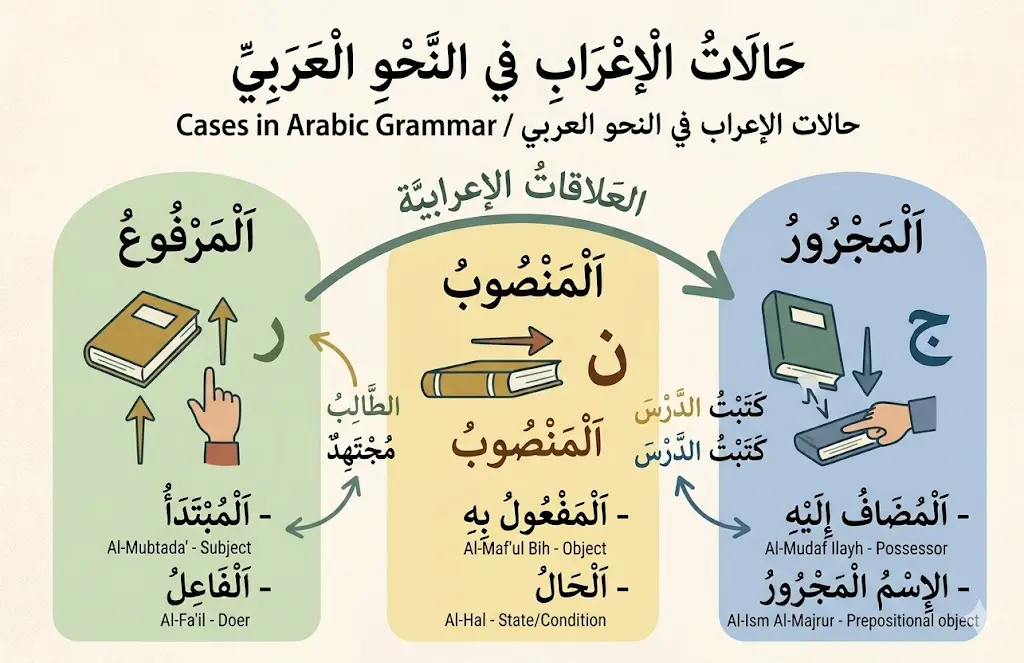
| Arabic i’rab has four states: nominative and accusative and genitive for nouns, plus jussive exclusively for verbs. |
| The nominative case (al-raf’) marks the subject of a sentence, signaled by a damma (ُ) or its grammatical equivalents. |
| The accusative case (al-nasb) marks direct objects, predicate complements, and adverbials, signaled by a fatha (َ) or its equivalents. |
| The genitive case (al-jarr) follows prepositions and marks possession in idafa structures, identified by a kasra (ِ) or equivalents. |
| The jussive mood (al-jazm) applies only to imperfect verbs in negation, commands, and conditionals, marked by sukoon or deletion of the final nun. |
Learners of Arabic often reach a point where they can recognize individual words but feel lost when endings shift unexpectedly. A word memorized as كِتَابٌ appears as كِتَابًا or كِتَابٍ, or a verb like يَذْهَبُ suddenly becomes يَذْهَبْ — and the meaning changes entirely. This is the system of i’rab at work, Arabic grammar’s most fundamental and elegant feature.
Arabic i’rab covers four grammatical states: three that apply to nouns — the nominative (al-raf’), accusative (al-nasb), and genitive (al-jarr) — and one that applies exclusively to verbs: the jussive (al-jazm).
Table of Contents:
What Are Cases in Arabic Grammar?
Grammatical cases in Arabic are a system of short vowel endings added to the final letter of nouns, pronouns, and adjectives to show their role within a sentence. Arabic grammar calls this system i’rab (الإعراب).
What is I’rab?
I’rab (الإعراب) is the system of grammatical inflection in Arabic — the set of vowel endings and suffixes added to the final letter of a word to show its role within a sentence. I’rab applies to nouns, adjectives, pronouns, and verbs, though the specific states available differ between nouns and verbs.
This is what separates Arabic structurally from English. English relies almost entirely on word order to show grammatical relationships.
Arabic encodes those relationships directly onto the word itself through i’rab endings — which is why Arabic word order can be flexible without losing meaning.
In our Arabic Grammar Course at Buruj Academy, i’rab is the first structural framework we introduce — because students who internalize it early find every subsequent grammar topic significantly more manageable.
If you are learning Arabic grammar as a beginner, this is your most important foundation.
Understand the Arabic Grammar with Buruj’s free trial lesson
How Many Grammatical States Does Arabic I’rab Have?
Arabic i’rab has four grammatical states: two for nouns and verbs, one for nouns only and one for verbs only. It is important to understand from the outset that al-jazm (the jussive) never applies to nouns, and al-jarr (the genitive) never applies to verbs. Each state belongs to its own grammatical domain.
| State | Arabic Name | Applies To | Primary Marker | Core Function |
| Nominative | الرَّفْع (al-raf’) | Nouns, adjectives | Damma ( ُ ) | Subject, predicate |
| Accusative | النَّصْب (al-nasb) | Nouns, adjectives, verbs | Fatha ( َ ) | Object, adverbial, subjunctive verb |
| Genitive | الجَرّ (al-jarr) | Nouns, adjectives only | Kasra ( ِ ) | After prepositions, possession |
| Jussive | الجَزْم (al-jazm) | Verbs only | Sukoon ( ْ ) | Commands, negation, conditionals |
One practical note worth stating clearly: the accusative state (al-nasb) appears in both nouns and verbs, but with different functions and triggers in each — which we cover fully in its dedicated section below.
1. The Nominative Case (Al-Raf’) in Arabic
The nominative case marks the subject of a verbal or nominal sentence, the predicate of a nominal sentence, and any noun functioning as the grammatical entry point of the sentence. Its primary marker is the damma (ُ) on the final letter, appearing as tanwin damm (ٌ) in indefinite nouns.
Core Nominative Examples
| Arabic | Transliteration | English | Why Nominative? |
| الطَّالِبُ يَدْرُسُ | Al-ṭālibu yadrusu | The student studies | Subject of verbal sentence |
| مُحَمَّدٌ مُعَلِّمٌ | Muḥammadun muʿallimun | Muhammad is a teacher | Subject and predicate, nominal sentence |
| البَيْتُ كَبِيرٌ | Al-baytu kabīrun | The house is big | Subject + adjectival predicate |
| وَصَلَت المَرْأَةُ | Waṣalati l-marʾatu | The woman arrived | Subject following its verb |
In the nominal sentence مُحَمَّدٌ مُعَلِّمٌ, both words carry tanwin damm — because both the subject (mubtada’) and predicate (khabar) are nominative.
For dual nouns, the nominative marker is the suffix ـَانِ (-āni): طَالِبَانِ (two students).
For sound masculine plurals, it is ـُونَ (-ūna): المُعَلِّمُونَ (the teachers).
Understanding these variants becomes much clearer once you study dual nouns in Arabic alongside the singular forms.
2. The Accusative Case (Al-Nasb) in Arabic
The accusative state is the most functionally varied in Arabic i’rab — it operates across both nouns and verbs, though with entirely different triggers and meanings in each domain.
Al-Nasb in Nouns: Direct Objects and More
For nouns and adjectives, the accusative marker is the fatha (َ), appearing as tanwin fath (ً) in indefinite nouns — uniquely written with an extra alif: كِتَابًا. Al-nasb marks the direct object of a verb, the noun after إِنَّ and its sisters, the predicate of كَانَ and its sisters, and adverbials of time and manner.
| Arabic | Transliteration | English | Why Accusative? |
| قَرَأَ الوَلَدُ كِتَابًا | Qaraʾa l-waladu kitāban | The boy read a book | Direct object |
| رَأَيْتُ المُعَلِّمَ | Raʾaytu l-muʿallima | I saw the teacher | Direct object (definite) |
| إِنَّ المَسْجِدَ قَرِيبٌ | Inna l-masjida qarībun | Indeed the mosque is near | Noun after إِنَّ |
| كَانَ الجَوُّ بَارِدًا | Kāna l-jawwu bāridan | The weather was cold | Predicate of كَانَ |
| سَافَرْتُ صَبَاحًا | Sāfartu ṣabāḥan | I traveled in the morning | Adverbial of time |
Read also:How to Conjugate the Arabic Present Tense
Al-Nasb in Verbs: The Subjunctive Mood
When al-nasb applies to an imperfect verb (المضارع), it produces what Arabic grammarians call the subjunctive mood (المضارع المنصوب). The marker remains the fatha — but it now appears on the final letter of the verb rather than a noun.
Al-nasb is triggered on verbs by specific particles called nawasib (نَوَاصِب), the most common being: أَنْ (that), لَنْ (will not / never), كَيْ (in order to), and لِـ (so that).
| Arabic | Transliteration | English | Particle Causing Al-Nasb |
| أُرِيدُ أَنْ أَذْهَبَ | Urīdu an adhhaba | I want to go | أَنْ |
| لَنْ يَفْعَلَ ذَلِكَ | Lan yafʿala dhālika | He will never do that | لَنْ |
| جِئْتُ كَيْ أَتَعَلَّمَ | Jiʾtu kay ataʿallama | I came in order to learn | كَيْ |
| اجْتَهَدَ لِيَنْجَحَ | Ijtahada li-yanjaḥa | He worked hard so that he succeeds | لِـ |
Note that for verbs ending in a nun — such as the sound masculine plural conjugation يَذْهَبُونَ — al-nasb is marked by deletion of the final nun: يَذْهَبُوا. This is one of the most important patterns to internalize for reading fluent Arabic.
Our guide on Arabic tenses covers the imperfect verb forms that interact directly with these nasb triggers.
At Buruj Academy, our Online Arabic Classes address this dual role of al-nasb — in nouns and verbs — as a single connected concept, rather than teaching them as isolated grammar rules, which is how our Al-Azhar-trained instructors help students avoid the confusion this topic typically creates.
Book your FREE Arabic trial online Arabic class at Buruj

3. The Genitive Case (Al-Jarr) in Arabic
The genitive case applies exclusively to nouns and adjectives — never to verbs. It marks any noun following an Arabic preposition, as well as the second noun in an idafa (possessive) construction. Its marker is the kasra (ِ), appearing as tanwin kasr (ٍ) in indefinite nouns.
Common Prepositions That Trigger Al-Jarr
| Preposition | Meaning | Example | Translation |
| فِي | in | فِي البَيْتِ | in the house |
| مِنْ | from | مِنَ المَدْرَسَةِ | from the school |
| إِلَى | to | إِلَى المَسْجِدِ | to the mosque |
| عَلَى | on | عَلَى الطَّاوِلَةِ | on the table |
| بِـ | with / by | بِالقَلَمِ | with the pen |
| لِـ | for / belonging to | لِلطَّالِبِ | for the student |
Read also: The Verbal Sentence in Arabic
Idafa: Genitive Through Possession
The idafa construction (الإضافة) connects two nouns to show possession or relationship. The second noun is always genitive, and the first noun loses its tanwin and definite article.
- كِتَابُ الطَّالِبِ — kitābu l-ṭālibi — the student’s book
- بَابُ البَيْتِ — bābu l-bayti — the door of the house
- قَلَمُ الأُسْتَاذِ — qalamu l-ustādhi — the teacher’s pen
Understanding idafa is also essential for reading Arabic sentence structure accurately, since genitive constructions appear in nearly every paragraph of formal Arabic text.
Discover the Buruj Academy Difference
Step into our virtual classrooms and see how our expert instructors make learning Quran and Arabic intuitive and clear. We focus on overcoming the specific hurdles non-native speakers face, building your confidence and connection with the Quran.
Master the Arabic Language
Join our expert-led courses and build a strong foundation in Classical and Modern Arabic.
Get Your Free Trial4. The Jussive Mood (Al-Jazm) in Arabic
Al-jazm (الجَزْم) is the fourth and final state of Arabic i’rab. It applies exclusively to imperfect verbs — never to nouns or adjectives. This distinction is non-negotiable in Arabic grammar: there is no “jussive noun.” Al-jazm produces what is called the jussive mood (المضارع المجزوم) and its primary marker is sukoon (ْ) on the final letter of the verb.
Read also:Arabic Past Tense Conjugation
What Triggers Al-Jazm?
Al-jazm is triggered by specific particles and constructions called jawāzim (جَوَازِم). The most important categories are negation with لَمْ, prohibition with لَا النَّاهِيَة, conditional sentences, and the lam of command (لَامُ الأَمْر).
| Trigger | Arabic | Transliteration | English |
| لَمْ (did not) | لَمْ يَذْهَبْ | Lam yadhhab | He did not go |
| لَا النَّاهِيَة (do not) | لَا تَكْذِبْ | Lā takdhib | Do not lie |
| لَامُ الأَمْر (let / should) | لِيَدْرُسْ | Li-yadrus | Let him study |
| إِنْ (if) — conditional | إِنْ تَجْتَهِدْ تَنْجَحْ | In tajtahid tanjaḥ | If you work hard, you will succeed |
How Al-Jazm Markers Work Across Conjugations
For most verb forms, al-jazm adds a sukoon to the final letter. However, for verb forms ending in a long vowel or a nun, al-jazm works differently:
| Verb Form | Default (Raf’) | After Jazm Particle | Change |
| He goes | يَذْهَبُ | يَذْهَبْ | Damma → sukoon |
| You (m.) go | تَذْهَبُ | تَذْهَبْ | Damma → sukoon |
| They (m.pl.) go | يَذْهَبُونَ | يَذْهَبُوا | Deletion of nun |
| You (f.) go | تَذْهَبِينَ | تَذْهَبِي | Deletion of nun |
| Both of them go | يَذْهَبَانِ | يَذْهَبَا | Deletion of nun |
In our experience teaching at Buruj Academy, the deletion-of-nun pattern is where most intermediate students make errors — particularly in conditional sentences where both the condition verb and the result verb must carry al-jazm.
For example: إِنْ تَجْتَهِدُوا تَنْجَحُوا becomes إِنْ تَجْتَهِدُوا → تَجْتَهِدُوا with nun deleted: إِنْ تَجْتَهِدُوا تَنْجَحُوا. Seeing these patterns applied to irregular verbs in Arabic is an important next step once the jazm concept is secure. Arabic for Beginners course available for complete starters
Begin learning Arabic at Buruj with a FREE trial lesson

Practice Exercises: Apply All Four I’rab States
Exercise 1: Identify the I’rab State
For each underlined word, identify its i’rab state and explain why.
- ذَهَبَ الوَلَدُ إِلَى المَدْرَسَةِ. (The boy went to the school.)
- لَمْ يَكْتُبْ الطَّالِبُ الدَّرْسَ. (The student did not write the lesson.)
- أُرِيدُ أَنْ أَتَعَلَّمَ العَرَبِيَّةَ. (I want to learn Arabic.)
- جَلَسَتْ عَلَى الكُرْسِيِّ. (She sat on the chair.)
- إِنَّ العِلْمَ نُورٌ. (Indeed, knowledge is light.)
Answer Key:
| # | Word | I’rab State | Reason |
| 1 | الوَلَدُ | Nominative (raf’) | Subject of the verbal sentence |
| 2 | يَكْتُبْ | Jussive (jazm) | Follows لَمْ, marked by sukoon |
| 3 | أَتَعَلَّمَ | Accusative/Subjunctive (nasb) | Follows أَنْ, marked by fatha |
| 4 | الكُرْسِيِّ | Genitive (jarr) | Follows the preposition عَلَى |
| 5 | العِلْمَ | Accusative (nasb) | Noun after إِنَّ |
Exercise 2: Correct the Error
Each sentence below contains one i’rab error. Identify and correct it.
- ❌ لَمْ يَذْهَبُ أَحْمَدُ إِلَى السُّوقِ.
- ❌ أُرِيدُ أَنْ أَدْرُسُ العَرَبِيَّةَ.
- ❌ كِتَابُ الطَّالِبُ عَلَى المَكْتَبِ.
Corrections:
- ✅ لَمْ يَذْهَبْ أَحْمَدُ — يَذْهَبُ must become يَذْهَبْ after لَمْ (jazm requires sukoon)
- ✅ أُرِيدُ أَنْ أَدْرُسَ — يَدْرُسُ must become أَدْرُسَ after أَنْ (nasb requires fatha)
- ✅ كِتَابُ الطَّالِبِ — the second noun of an idafa must be genitive (kasra), not nominative
Read also: Nominal Sentence in Arabic
Master Arabic Grammar with Buruj Academy’s Expert Instructors
Arabic i’rab — across all four states — becomes intuitive far faster with an instructor correcting your endings in real time than through self-study alone.
Buruj Academy’s Online Arabic Classes are taught by Al-Azhar University graduates with 12+ years of experience teaching non-native speakers.
Our Arabic Grammar Course covers the complete i’rab system — nominative, accusative, genitive, and jussive — using the Buruj Method’s context-before-abstraction approach.
- Personalized 1-on-1 sessions with flexible scheduling
- Real-time correction of i’rab errors during reading and writing
- Structured progression from foundational to advanced grammar
- Arabic for Beginners course available for complete starters
Book your free trial lesson today.
Begin your transformation today by choosing the path that fits your goals:
- Online Arabic Classes (General & Comprehensive)
- Arabic Course for Beginners
- Arabic Alphabet Learning Course
- Online Arabic Classes for Kids
- Arabic Classes for Adults
- Arabic Grammar Course (Nahw & Sarf)
- Intermediate Arabic Course (B1/B2)
- Arabic Speaking Course (Conversational Fluency)
- Arabic Reading Course (Literary Excellence)
- Learn Arabic Writing Course (Calligraphy & Composition)
Ready to speak with confidence? Join the global community at Buruj Academy and book your free placement interview today!
Master the Arabic Language
Join our expert-led courses and build a strong foundation in Classical and Modern Arabic.
Get Your Free TrialConclusion
Arabic i’rab is a unified system — four grammatical states, each with a precise domain and a precise marker. The nominative establishes who or what drives the sentence. The accusative shows what receives the action, what follows certain particles, and — in verbs — what follows subjunctive triggers.
The genitive binds nouns to prepositions and to each other through possession. And the jussive brings imperfect verbs into commands, negation, and conditional logic. Master these four states and you hold the structural key to reading, writing, and understanding Arabic at every level, Insha’Allah.
Frequently Asked Questions About Cases in Arabic Grammar
What Are the Four States of I’rab in Arabic?
Arabic i’rab has four states: nominative (al-raf’), marked by damma; accusative (al-nasb), marked by fatha; genitive (al-jarr), marked by kasra; and jussive (al-jazm), marked by sukoon. The first three apply to nouns and adjectives. Al-jazm applies exclusively to imperfect verbs in specific grammatical contexts such as negation, prohibition, and conditional sentences.
What Is the Difference Between Al-Nasb in Nouns and Al-Nasb in Verbs?
In nouns, al-nasb marks grammatical roles such as direct object, complement of إِنَّ, or adverbial. In verbs, al-nasb produces the subjunctive mood, triggered by particles like أَنْ, لَنْ, and كَيْ. The marker in both cases is the fatha — but the grammatical meaning and triggers are entirely different, making context essential for correct identification.
What Is the Difference Between Al-Jazm and Al-Jarr?
Al-jazm applies only to imperfect verbs and is triggered by particles like لَمْ, لَا النَّاهِيَة, and إِنْ. Its marker is sukoon. Al-jarr applies only to nouns and adjectives and is triggered by prepositions or the idafa construction. Its marker is kasra. The two states never overlap — they operate in entirely separate grammatical domains.
Is the I’rab System Used in Spoken Arabic?
I’rab endings are standard in Modern Standard Arabic (MSA), classical texts, and Quranic Arabic. Most spoken dialects drop case endings in everyday conversation. Learning the full i’rab system remains essential for reading, writing, formal speaking, and understanding the Quran — a foundational skill for anyone learning Arabic for beginners through to advanced levels.
Related Articles
Arabic