 Quran
Quran

| Key Takeaways |
| The Shafi’i and Hanbali schools permit reading from the Mushaf in both obligatory and voluntary prayers without conditions. |
| The Maliki school permits Mushaf reading in voluntary prayer from the start but considers it disliked in obligatory prayers. |
| The Hanafi school holds that reading from the Mushaf in prayer invalidates it due to excessive unnecessary movement. |
| Reading from a phone during prayer carries the same ruling as the Mushaf and may offer practical advantages over it. |
| Memorizing and reciting from heart remains the stronger Sunnah, with Mushaf use permitted when memorization is insufficient. |
Many Muslims — especially those newer to prayer or leading long Tarawih nights — face a real dilemma: the recitation they know by heart runs out, but they want to continue praying correctly and reverently.
The good news is that classical Islamic scholarship directly addresses this question. Whether reading from a physical Mushaf or a phone screen during prayer is permitted depends on your madhab (school of jurisprudence), the type of prayer, and the circumstances — and the scholarly majority leans toward permissibility with conditions.
Table of Contents:
Is It Permissible to Read from the Mushaf While Praying?
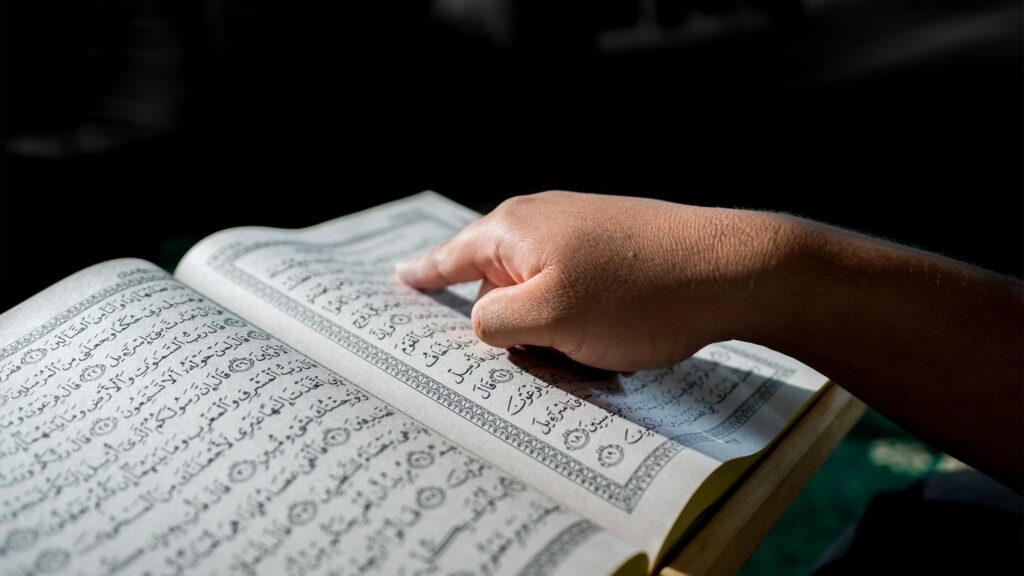
Reading from the Mushaf during prayer is permissible according to the majority of scholars, including the Shafi’i and Hanbali schools, for both obligatory (fard) and voluntary (nafl) prayers.
The evidential basis comes from a report preserved in Sahih al-Bukhari, transmitted with a decisive form (ta’liq bi-sighat al-jazm), that Dhakwan — the freed slave of Sayyidah Aisha (may Allah be pleased with her) — used to lead her in prayer reading directly from the Mushaf.
This foundational report has shaped the position of the majority. At the same time, all scholars agree that reciting from memory (‘an zhahri qalb) is the stronger Sunnah and the normative practice of the Prophet ﷺ and his Companions.
If you are working on strengthening your recitation, our Quran Recitation course at Buruj Academy — taught by Ijazah-certified instructors — builds your memorized repertoire systematically, so that reaching for the Mushaf during prayer becomes less and less necessary over time.
Book your first FREE recitation lesson

What Did the Four Schools of Islamic Law Rule on Reading from the Mushaf While Praying?
The four major madhabs do not all agree on this issue, and understanding each position helps you follow your own school with clarity.
| Madhab | Ruling in Obligatory Prayer | Ruling in Voluntary Prayer |
| Shafi’i | Permissible | Permissible |
| Hanbali | Permissible (relied-upon opinion) | Permissible |
| Maliki | Disliked (makruh) | Permissible if begun from the start |
| Hanafi | Invalidates the prayer | Invalidates the prayer |
Each position rests on a coherent legal rationale, and we will examine each one briefly below.
Why Do the Shafi’i and Hanbali Schools Permit Reading from the Mushaf While Praying?
The Shafi’i and Hanbali schools hold that holding and reading from the Mushaf does not introduce an action severe enough to nullify prayer. They cite the report of Dhakwan as direct evidence and reason that if a man as pious and knowledgeable as a freed slave of Aisha led prayer from the Mushaf with her approval, this constitutes a valid precedent from the era of the Companions.
Both schools also apply the principle that the benefit of correct recitation — continuing the prayer with proper Quranic words — outweighs the minor distraction of holding the Mushaf.
Why Do the Malikis Consider Reading from the Mushaf While Praying Disliked in Obligatory Prayer?
The Maliki school draws a line between obligatory and voluntary prayers, applying greater strictness to the fard. Their reasoning is that holding the Mushaf, turning its pages, and glancing at the text constitutes a form of preoccupation (ishtighal) that is unbecoming in obligatory worship.
However, in voluntary prayer — particularly long night prayers — they permit it without dislike, provided the worshipper begins the prayer with the Mushaf in hand from the outset. If someone starts a voluntary prayer without the Mushaf and picks it up midway, the Malikis still consider this disliked because the mid-prayer act of fetching it is itself a distraction.
Read also:Can You Read the Quran While It Is on Your Lap?
Why Do the Hanafis Rule That Reading from the Mushaf While Praying Invalidates the Prayer?
The Hanafi school holds that carrying the Mushaf, looking into it repeatedly, and turning its pages constitutes ‘amal kathir — excessive action that is foreign to the prayer’s nature and therefore invalidates it. Their position is not that reading itself is sinful, but that the physical acts surrounding Mushaf use during salah cross the threshold of permissible incidental movement.
This is also the stated position of Ibn Hazm from the Dhahiri school, who similarly ruled the prayer invalid on the grounds of excessive extraneous action.
Can You Pray Reading from the Quran on Your Phone?
Yes, you can pray reading from the Quran on your phone. Reading from a Quran app on your phone during prayer carries the same ruling as reading from a physical Mushaf, based on the legal principle that the ruling follows the substance of the act rather than its medium.
Since all the classical arguments for and against Mushaf reading apply equally to a phone screen, scholars applying the permissive position extend it to phones without restriction.
Beyond equivalence in ruling, there are practical reasons why reading from a phone may actually be more convenient than a physical Mushaf in several situations.
Read also: Can the Quran Touch the Floor?
Discover the Buruj Academy Difference
Step into our virtual classrooms and see how our expert instructors make learning Quran and Arabic intuitive and clear. We focus on overcoming the specific hurdles non-native speakers face, building your confidence and connection with the Quran.
Excel in Your Quranic Studies
Join Buruj Academy and master the Quran with our structured, professional curriculum.
Book Your Free TrialAdvantages of Reading the Quran from a Phone During Prayer Instead of a Mushaf
Consider the following comparison:
| Practical Factor | Physical Mushaf | Phone |
| Weight and handling | Heavier, especially large-print editions | Lighter and easier to grip |
| Clarity of text | Small Mushafs can be difficult to read | Adjustable font size on screen |
| Page turning | Requires two hands, can disrupt movement | Single swipe or auto-scroll |
| Returning to a page | Requires physical navigation | Bookmark or chapter jump in one tap |
| Placement during sujood | Large Mushafs placed on the floor risk disrespect | Phone placed without the same concern |
| Lighting | Requires external light | Self-illuminated screen |
The last point is particularly relevant for Tarawih prayers. We have seen students in our classes mention that when electricity suddenly cuts out mid-prayer, those reading from a physical Mushaf are left completely in the dark — sometimes abandoning the long surah they were reciting mid-verse. A phone screen continues illuminating the text regardless of room lighting.
At Buruj Academy, our Online Hifz Program works with students specifically on building a memorized repertoire so that reliance on the Mushaf — or phone — during prayer becomes a temporary bridge rather than a permanent dependency.
Start Hifz today with a FREE trial session

Is It Better to Read from Memory or from the Mushaf During Prayer?
Reciting from memory is unquestionably better and remains the Sunnah standard that every Muslim should aspire toward. Allah (glorified and exalted be He) praises those who carry His Book in their hearts:
بَلْ هُوَ آيَاتٌ بَيِّنَاتٌ فِي صُدُورِ الَّذِينَ أُوتُوا الْعِلْمَ
Bal huwa āyātun bayyinātun fī ṣudūril-ladhīna ūtul-‘ilm
“Rather, it is distinct verses preserved in the breasts of those who have been given knowledge.” (Al-‘Ankabut 29:49)
The Prophet ﷺ also established memorization as the primary criterion for leading prayer. As recorded in Sahih al-Bukhari:
“Let the one among you who knows the most Quran lead the prayer.”
The Arabic word used — aqra’ — refers to the one most proficient in recitation by heart, not the one with the largest Mushaf.
Read also: What Happens If You Fart While Reading the Quran?
When Is Using the Mushaf or Phone During Prayer the Right Choice?
Using the Mushaf or phone becomes appropriate when two conditions converge: the worshipper lacks sufficient memorized material, and the prayer involves extended recitation — such as Tarawih, Tahajjud, or voluntary night prayers where long passages are desired.
In these circumstances, reaching for the Mushaf or phone is not a weakness — it is a considered choice to prioritize correct, reverent recitation over a silence or stumbling that would be more disruptive. The goal of prayer is presence and precision before Allah, and if a Mushaf or phone facilitates that, the permissive ruling of the majority provides a sound basis for its use.
If you are building your reading foundation to reach this level of recitation, explore our Quran Reading course — structured specifically for students who want to read the Quran correctly and confidently.
Book your Free trial lesson and start reading the Quran

Strengthen Your Recitation with Buruj Academy’s Expert Instructors
Reading from the Mushaf or phone is a valid bridge — but the goal every Muslim strives toward is confident recitation from the heart.
Buruj Academy’s Online Quran Recitation course and Online Hifz Program are taught by Ijazah-certified, Al-Azhar University graduates with 12+ years of experience guiding non-Arabic speakers globally.
Our approach uses the Buruj Method — Consistency-before-speed — so students build real, lasting recitation skills through personalized 1-on-1 sessions, flexible 24/7 scheduling, and real-time correction.
Whether you are memorizing Juz Amma or pursuing full Hifz, we build a plan around your life.
Book your free trial lesson today.
Take the next step in your learning journey today by enrolling in one of our specialized programs:
- Online Quran Classes
- Online Quran Classes for Beginners
- Online Quran Classes for Adults
- Online Quran Classes for Ladies
- Online Quran Classes for Kids
- Quran Reading Course
- Quran Recitation Course
- Online Ijazah Course
- Online Qirat Course
Don’t wait to transform your relationship with the Holy Quran. Join our global community of students and book your free evaluation session now!
Excel in Your Quranic Studies
Join Buruj Academy and master the Quran with our structured, professional curriculum.
Book Your Free TrialConclusion
Reading from the Mushaf — or a phone — during prayer is a question that classical Islamic scholarship answers with nuance, not a simple yes or no. The Shafi’i and Hanbali schools permit it freely; the Malikis allow it in voluntary prayers while discouraging it in obligatory ones; and the Hanafis consider it invalidating due to the physical actions involved. In all cases, reciting from memory remains the stronger practice and the Sunnah standard.
Understanding where you stand and why matters. It turns a moment of uncertainty at prayer time into a grounded, intentional decision. And for those who want to reach the point where the Mushaf stays closed during salah — the path there is consistent, guided memorization and recitation practice.
Frequently Asked Questions About Reading from the Mushaf While Praying
Does holding the Mushaf during prayer break wudu or invalidate it for other reasons?
Holding the Mushaf does not break wudu. The question of validity relates to ‘amal kathir (excessive movement) in the Hanafi school, not to ritual purity. According to the majority of scholars — Shafi’i and Hanbali — carrying and reading from the Mushaf introduces no action that invalidates the prayer itself.
Is it ok to read Quran from your phone while praying Tarawih?
Yes, according to the Shafi’i and Hanbali schools, reading from a Quran app on your phone during Tarawih carries the same permissibility as reading from a physical Mushaf. Many scholars today note that a phone is lighter, easier to handle, and self-illuminated — making it a practical choice for long voluntary prayers like Tarawih.
Can you hold the mushaf while praying if you follow the Hanafi madhab?
According to the Hanafi school, reading from the Mushaf during prayer — whether obligatory or voluntary — invalidates the prayer. This is because the physical acts of holding, looking, and page-turning are classified as excessive extraneous action (‘amal kathir). Hanafi followers should focus on expanding their memorized portions to avoid this situation.
How much Quran should you memorize to avoid needing the Mushaf during daily prayers?
For the five daily prayers, memorizing Surah Al-Fatiha and approximately 20 short surahs from Juz Amma is sufficient for most people. This covers years of varied recitation in fard prayers. Our Juz 30 Memorization course at Buruj Academy guides students through this exact foundation with structured, achievable milestones.