 Quran
Quran
| Key Takeaways |
| Most scholars agree placing the Quran on a clean floor without disrespect is permissible, though elevating it remains preferred. |
| The Maliki and Shafi’i schools prohibit placing the Quran on the ground even without disrespect, citing obligatory reverence. |
| Scholars like Ibn Baz and Ibn Uthaymeen permit floor placement on a pure surface when genuine need exists during prayer. |
| Placing the Quran on a prayer mat before sujood al-tilawah is a common scenario scholars specifically addressed as permissible. |
Placing the Quran on a clean, pure floor without any intent of disrespect is permissible according to a number of major scholars, including Sheikh Ibn Baz and Sheikh Ibn Uthaymeen.
However, elevating the Quran above the floor remains the preferred and more cautious practice across all schools of thought.
Table of Contents:
Can the Quran Touch the Floor?
Placing the Quran on a clean, pure floor without any intent of disrespect is permissible according to a number of major scholars, including Sheikh Ibn Baz and Sheikh Ibn Uthaymeen. Both explicitly stated that floor placement for a genuine need — such as setting the Quran down before sujood during prayer — does not constitute degradation (imtihan) of Allah’s Book.
However, the Maliki and Shafi’i schools take a stricter position, considering floor placement prohibited even without contempt, and requiring the Quran to be raised — even slightly — as a matter of obligatory reverence (ta’dheem).
The point of complete scholarly agreement is this: placing the Quran on the floor with contempt or disrespect (istikhfaf) is a serious matter with no permissibility in any school of thought.
What is the Practical Guidance Most Scholars Recommend?
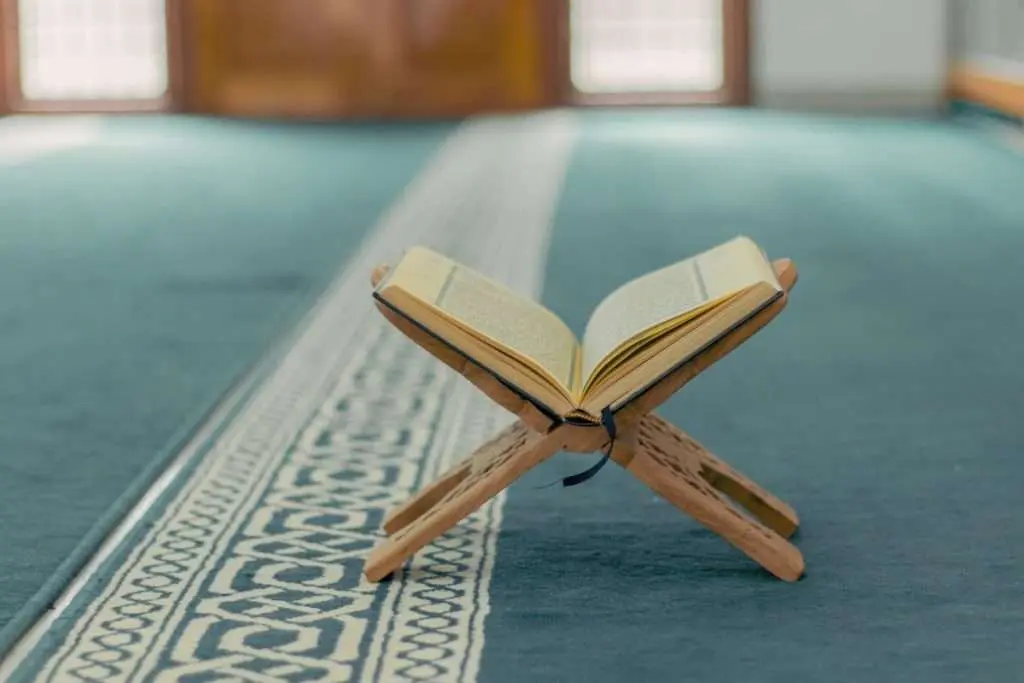
The practical guidance most scholars recommend: elevate the Quran on a stand, shelf, cushion, or chair whenever one is available. When no elevated surface is accessible and a genuine need exists, placing it on a clean, pure floor carries no prohibition — Insha’Allah.
What Did Sheikh Ibn Baz Say About the Quran Touching the Floor?
Sheikh ‘Abd al-‘Aziz ibn Baz (رحمه الله) offered a detailed and balanced response that many contemporary Muslims rely on. He stated clearly that placing the Quran on the floor carries no prohibition when done out of genuine need and without any intent of contempt, provided the surface is pure.
He drew on a known narration in which the Prophet ﷺ, when asked to verify the Torah’s ruling on stoning, requested that the Torah be brought and placed on a chair (kursi).
Sheikh Ibn Baz used this as evidence that elevating divine scripture is the Sunnah-informed practice — and that the Quran, being superior to the Torah, is even more deserving of elevation.
His conclusion: placing the Quran on a raised surface such as a chair, shelf, or folded garment is the preferred and more cautious practice. Placing it on a clean floor for a real need, however, is not prohibited.
What Did Sheikh Ibn Uthaymeen Say About the Quran Touching the Floor?
Sheikh Muhammad ibn Salih al-‘Uthaymeen addressed this question directly in his commentary on Riyad al-Salihin. His position is clear and practical: placing the Quran on a pure and clean floor is permissible and carries no prohibition.
His reasoning is grounded in the definition of imtihan — contempt or degradation. Since placing the Quran on the floor while praying, or setting it down momentarily before sujood al-tilawah, does not constitute contempt in any reasonable understanding, there is no basis for prohibition.
This is a scenario we encounter regularly in our sessions at Buruj Academy. Students learning to read from the Quran during prayer — especially beginners in our Online Quran Reading Course — often ask exactly this question. The reassurance from scholars like Ibn Uthaymeen provides genuine relief and removes unnecessary anxiety from a beautiful act of worship.
Book your Free trial lesson and start reading the Quran

What Happens If the Quran Touches the Floor Accidentally?
If the Quran touches the floor accidentally — it slips from a shelf, falls during movement, or is set down unintentionally — there is no sin and no required expiation (kaffarah). The unanimous position of scholars is that unintentional placement carries no religious consequence.
The key principle in Islamic jurisprudence here is qasd — intention. Actions without sinful intention do not attract the rulings that intentional acts do. What is required is simply that the person pick it up promptly and restore it to an honourable position.
| Situation | Ruling | Recommended Action |
| Accidental fall | No sin | Pick up immediately and restore to elevated position |
| Placed on clean floor for need | Permissible (Ibn Baz, Ibn Uthaymeen) | Elevate when possible |
| Placed on clean floor without need | Disliked (makruh) | Avoid; use a stand, chair, or shelf |
| Placed with contempt (istikhfaf) | Serious prohibition | Repent immediately; not a minor matter |
| Placed on impure surface | Impermissible | Never do this regardless of circumstance |
Can You Put the Quran on the Floor During Prayer?
This is one of the most frequently asked practical questions — and it has a clear scholarly answer. When a person is praying and wants to recite from the Quran, placing it on the floor in front of them before going into sujood (prostration) or sujood al-tilawah (prostration of recitation) is permissible.
Sheikh Ibn Uthaymeen specifically mentioned this exact scenario: a person praying who needs to set the Quran down in front of them to prostrate. He stated clearly this does not constitute degradation (imtihan) and is therefore without blame.
If you are building the habit of reciting from the Quran during qiyam al-layl or voluntary prayers — something we warmly encourage in our Quran Recitation course — this ruling removes a practical barrier many students face. Use a small Quran stand whenever available, but know that placing it on a clean prayer mat when prostrating is acceptable.
Book your first FREE recitation lesson

Is That Permissible to Put the Quran in a Bag on the Floor?
Scholars who permit floor placement of the Quran on the floor for need would permit this even more readily since the Quran inside a bag or case is further protected and not directly touching the ground. The reasoning follows the same principle: no contempt, no prohibition. The covering of the bag adds an additional layer of respectful distance.
However, it remains better practice to place the bag on a chair, shelf, or raised surface when one is easily available — not because the floor is impure, but because elevation (raf’) is an expression of the honour the Quran deserves.
Read also: What is the Difference Between Juz and Hizb in the Quran?
Discover the Buruj Academy Difference
Step into our virtual classrooms and see how our expert instructors make learning Quran and Arabic intuitive and clear. We focus on overcoming the specific hurdles non-native speakers face, building your confidence and connection with the Quran.
Excel in Your Quranic Studies
Join Buruj Academy and master the Quran with our structured, professional curriculum.
Book Your Free TrialDoes the Quran Have to Be on a Stand?
No, the Quran does not have to be placed on a stand. There is no obligatory ruling requiring a Quran stand (kursi al-Quran or rihal). Using one is a recommended practice (mustahabb) that reflects the ta’dheem — the reverence and elevation — that befits the Book of Allah.
The narration about the Prophet ﷺ requesting a chair for the Torah establishes a Sunnah-oriented preference for elevation, not an obligation.
That said, using a stand consistently is a beautiful habit, and it also improves the physical experience of reading — better posture, better visibility, and a dedicated space that signals to the mind that recitation time has begun.
| Option | Ruling | Notes |
| Quran stand (rihal) | Preferred Sunnah practice | Best option; reflects full ta’dheem |
| Pillow or cushion | Permissible and recommended | Widely used in traditional settings |
| Raised shelf or chair | Permissible | Ibn Baz’s explicitly endorsed option |
| Lap while seated | Permissible | Common and acceptable |
| Clean floor (no need) | Disliked by some scholars | Avoid when elevation is easy |
| Clean floor (genuine need) | Permissible per Ibn Baz and Ibn Uthaymeen | No prohibition when need exists |
Read also:Is It Permissible to Read the Quran After Passing Wind?
What Is the Ruling of Putting the Quran on a Prayer Mat While Praying?
Placing the Quran on a prayer mat while in the act of salah is permissible by the scholarly consensus discussed above. A prayer mat is a clean, dedicated surface — and the Quran resting on it while a person performs their prayer is not, by any measure, a sign of contempt.
This scenario falls squarely within what Sheikh Ibn Uthaymeen described: reciting from the Quran during prayer and setting it on the ground in front of you before sujood. The prayer mat actually represents a degree of cleanliness and intentionality that further supports the permissibility of this act.
For students who are reading the Quran for the first time and beginning to incorporate Quran recitation into their prayers, this is important reassurance. Focus on the beauty of what you are doing, not on anxiety about the Quran’s exact position.
Read also: Tajweed Rules Explained With Examples
How to Honour the Quran in Everyday Practical Situations?
Understanding the rulings is one part of the picture. Living them with mindfulness is another. These practical guidelines will help you act with both knowledge and reverence in daily life.
Place the Quran on a dedicated shelf, bookstand, or raised surface whenever one is available. This is the preferred practice and requires minimal effort in most home settings.
When travelling or praying without a stand available, set the Quran on your prayer mat, a cushion, a bag, or your folded garment. These are all acceptable surfaces that reflect care for the Quran even in the absence of a formal stand.
Never place the Quran directly on a floor that may be impure — near a bathroom entrance, on outdoor ground, or in an area of known najasah. This is a point of complete scholarly agreement.
Instilling these habits early is something we focus on in Buruj Academy’s Online Hifz Quran Classes for Kids — teaching children not just how to read, but how to hold, carry, and treat the Quran with the reverence it deserves. Adab with the Quran begins long before formal Tajweed study.
Start your child’s Hifz classes with a FREE session

Deepen Your Quran Connection with Buruj Academy’s Expert Instructors
Reverencing the Quran and reading it beautifully go hand in hand. Buruj Academy’s Online Tajweed Classes are designed for non-Arabic speakers who want to recite with proper pronunciation, correct rules, and genuine confidence — taught by Ijazah-certified instructors and Al-Azhar University graduates with 12+ years of experience.
- Ijazah-certified, Al-Azhar-trained instructors
- Personalized 1-on-1 online sessions
- Flexible 24/7 scheduling for any time zone
- The Buruj Method: Sound-before-rules, Consistency-before-speed
- Real-time correction and structured progression
Book your free trial lesson today and begin reciting the Quran the way it deserves to be recited — with knowledge, adab, and beauty.
Take the next step in your learning journey today by enrolling in one of our specialized programs:
- Online Quran Classes
- Online Quran Classes for Beginners
- Online Quran Classes for Adults
- Online Quran Classes for Ladies
- Online Quran Classes for Kids
- Quran Reading Course
- Quran Recitation Course
- Online Ijazah Course
- Online Qirat Course
Don’t wait to transform your relationship with the Holy Quran. Join our global community of students and book your free evaluation session now!
Excel in Your Quranic Studies
Join Buruj Academy and master the Quran with our structured, professional curriculum.
Book Your Free TrialConclusion
The question of whether the Quran can touch the floor is one where Islamic scholarship offers nuance, not a single blanket ruling. Strict positions from the Maliki and Shafi’i schools urge complete elevation as an expression of reverence. Contemporary scholars like Ibn Baz and Ibn Uthaymeen offer practical guidance: placement on a clean surface for genuine need is permissible, while elevation remains the ideal.
Frequently Asked Questions About the Quran Touching the Floor
Is it a sin if the Quran falls on the floor accidentally?
No, it is not a sin if the Quran falls accidentally. Islamic jurisprudence is clear that unintentional acts do not carry the ruling of intentional ones. Intention (qasd) is central to Islamic rulings. Simply pick up the Quran promptly, restore it to an elevated position, and continue. No expiation is required for an accidental fall.
Can I place the Quran on the floor in a mosque during prayer?
Yes, placing the Quran on a clean mosque floor during prayer — particularly before sujood or sujood al-tilawah — is permissible according to Sheikh Ibn Uthaymeen and Sheikh Ibn Baz. The mosque floor is considered pure, and setting the Quran down briefly during an act of worship does not constitute disrespect or degradation (imtihan).
What is the best way to store a Quran at home to show proper respect?
Store the Quran on a dedicated shelf, ideally higher than other books, or in a clean, dry cabinet. Many scholars and traditional scholars recommend keeping it on the highest shelf available as a mark of ta’dheem. Wrapping it in a clean cloth and ensuring it is stored above floor level are both widely recommended practices reflecting proper Islamic adab.
Does it matter what surface the Quran is placed on if not on a stand?
Yes, surface purity matters greatly. Placing the Quran on a clean prayer mat, cushion, chair, or garment is permissible and respectful. Placing it on an impure surface (najis) is impermissible regardless of intent. Scholars across all schools agree on the requirement of surface purity — the disagreement only concerns whether a pure floor is itself acceptable.