 Tajweed
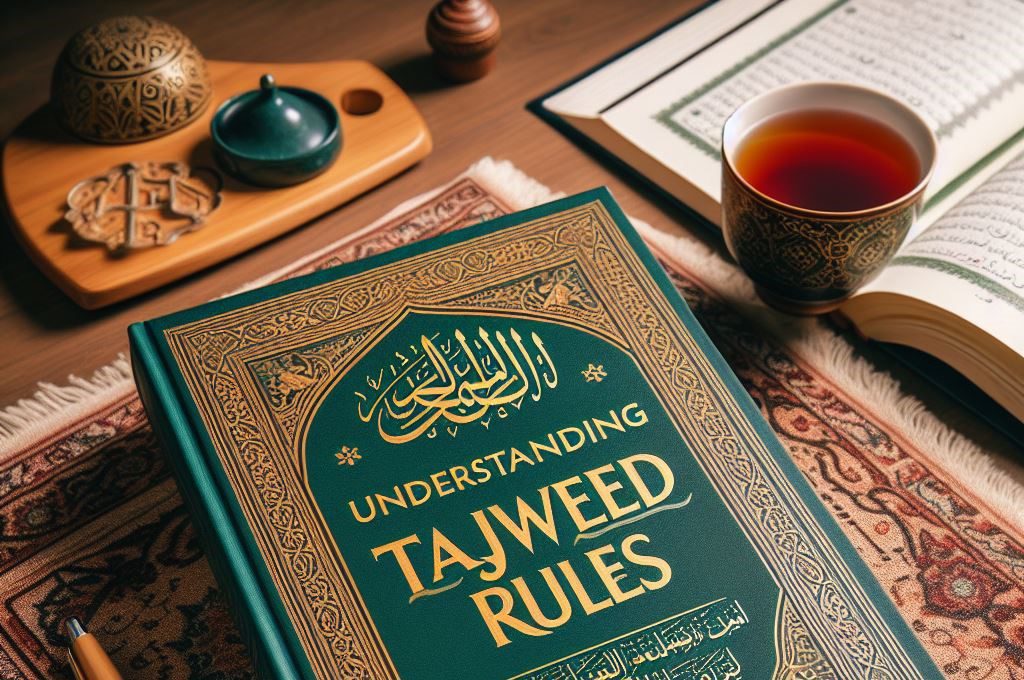
The best Tajweed book for you depends on one thing before all others: your current reading level. A complete beginner needs rule-introduction through examples; an intermediate student needs detailed coverage of Sifat al-huruf and Tafkheem-Tarqiq distinctions; an advanced student needs classical Arabic text with scholarly commentary.
Below, we rank the six most reliable options — all verified as real, purchasable books — mapped precisely to level, use case, and what they do better than anything else at their tier.
Table of Contents:
1. Tajweed Rules of the Quran (3-Volume Set) by Kareema Czerepinski
Tajweed Rules of the Quran (3-Volume Set) by Kareema Carol Czerepinski is the closest thing English-speaking Tajweed students have to a definitive textbook.
Published by Dar Al-Khair, the three-part series functions as an English-language commentary on the classical Jazariyyah poem, covering everything from Makharij al-huruf in Part 1 through Sifat, Tafkheem, Tarqiq, and Idgham rules in Part 2, to Waqf and Ibtida rules in Part 3.
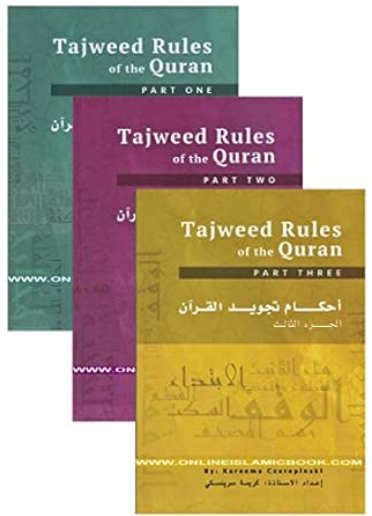
What makes it exceptional is its dual-language integration. Every Arabic rule name appears alongside its English translation, so students sitting in Arabic-medium classes and students in English-medium classes can both use it simultaneously.
Part 1 covers articulation points of all Arabic letters, the rules of Noon Saakinah, Meem Saakinah, and Lam Saakinah, all Mudood categories, and the Qalqalah mechanism — all in a compact 92 pages.
Who it is for: Students who can already read basic Arabic and need a systematic, progressive reference to study Hafs ‘an ‘Asim rules in depth. It is not a standalone self-study tool — the author herself states clearly that the book cannot replace recitation correction by a trained teacher.
In our sessions at Buruj Academy, we recommend the Czerepinski set as a companion reference once students have worked through the foundational sound-recognition phase of our Online Tajweed Classes. Students who try to start here without that prior foundation often memorize rule names without internalizing the sounds that anchor them.
Book Your FREE Trial Lesson to Begin Your Tajweed Journey

| Volume | Core Topics Covered | Level |
| Part 1 | Makharij, Noon/Meem Saakinah, Mudood, Qalqalah | Elementary–Beginner |
| Part 2 | Sifat al-huruf, Tafkheem, Tarqiq, Idgham categories, Hamzah al-Wasl | Intermediate |
| Part 3 | Waqf and Ibtida rules, special words in Hafs recitation, Rasm Uthmani | Advanced |
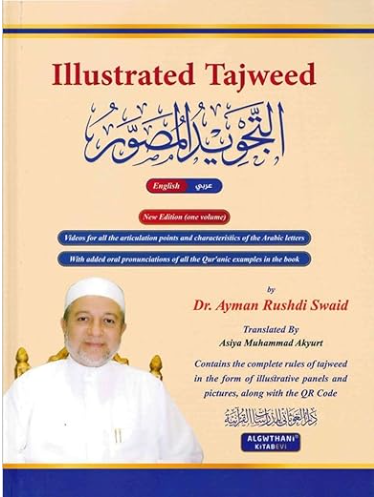
2. Illustrated Tajweed by Dr. Ayman Rushdi Swaid
Illustrated Tajweed (New Edition) by Dr. Ayman Rushdi Swaid brings together four decades of Tajweed research and teaching into a single 264-page hardback published by Al-Ghuthani House for Quranic Studies.
It is bilingual (Arabic/English) and uses anatomically precise diagrams of the speech organs, color-coding for rule distinction, and QR codes linking to audio examples recorded by the author himself.
What separates this book from anything else on this list is its treatment of Makharij al-huruf. Where most English books describe articulation points in general terms, Dr. Swaid’s work shows cross-section illustrations of the throat, tongue position, lips, and nasal passage that correspond to each Makhraj. This is the level of anatomical specificity that serious students need — and that most general Tajweed books skip entirely.
The book divides into two sections: theoretical Tajweed knowledge and practical recitation examples. It also includes chapters on the history of the Quranic script and an introduction to Hifz methodology, making it unusually broad in scope.
If you are serious about perfecting Makharij al-huruf, this book is the most reliable visual companion to live instructor correction available in English.
Our Tajweed for Kids course at Buruj Academy uses age-appropriate methods alongside structured classroom books to build correct recitation habits from the earliest stage.
Book your child’s free Tajweed trial lesson today
3. Tajweed Untangled by Learning Roots (Zaheer Khatri)
Tajweed Untangled by Learning Roots, authored by Zaheer Khatri, is a full-color A4 Tajweed book that genuinely reverses the traditional textbook approach.
Instead of stating a rule then asking students to find it in practice, each chapter opens with real Quranic examples first — students observe the rule in the actual text of the Quran before it is formally named or defined.
This inductive structure matters deeply for retention. Students who encounter Ghunnah through live examples from Surah Al-Baqarah before reading its definition are far less likely to misapply the rule in a new context.
Written tasks and practice lines follow each section, giving students immediate application without requiring a separate workbook.
What it covers: All foundational Tajweed rules at beginner-to-intermediate level, including Noon Saakinah rules (Izhaar, Idgham, Iqlab, Ikhfa), Meem Saakinah rules, all Madd categories, Qalqalah, Waqf basics, and Tafkheem-Tarqiq introductory rules. It does not cover advanced Sifat distinctions or Waqf wa Ibtida in depth — and it does not need to at this level.
At Buruj Academy, our Tajweed for Beginners course follows the same example-before-rules methodology that Tajweed Untangled uses — which is why students who bring this book to their sessions with our Ijazah-certified instructors tend to reinforce classroom learning more effectively than those using rule-heavy references.
For more on the specific rules covered at the beginner level, see our guide on Tajweed for beginners.
Book Your FREE Trial Lesson to Begin Your Tajweed Journey
read also: Tajweed Hafs – Full Guide
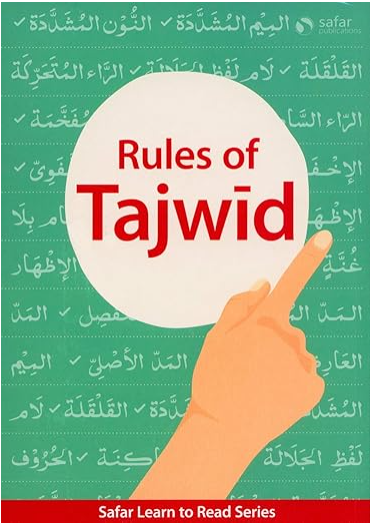
4. Safar Publications Rules of Tajwid (Learn to Read Series)
Safar Publications Rules of Tajwid, part of the comprehensive Safar Learn to Read Series produced by the UK-based Safar Academy, is a classroom-tested Tajweed curriculum book used in Islamic schools across Britain and beyond. It consists of seven progressive levels, designed to follow on from the Safar Qaida and to be used alongside Juz Amma recitation.
What makes it distinctive is its focus on applied Tajweed rather than theoretical memorization. The text uses 13-line Quran script imported directly from a widely used edition — critically, without color-coding — so students learn to identify and apply rules while reading standard black-and-white mushaf text rather than relying on color prompts as a reading aid.
Each of the seven levels targets one specific Tajweed feature, allowing teachers to progress students systematically without overwhelming multiple rules simultaneously. The book was developed through years of classroom teaching at Safar Academy, and it shows in the pacing.
Excel in Your Quranic Studies
Join Buruj Academy and master the Quran with our structured, professional curriculum.
Book Your Free Trial5. Tuhfat al-Atfal by Imam Sulayman al-Jamzuri
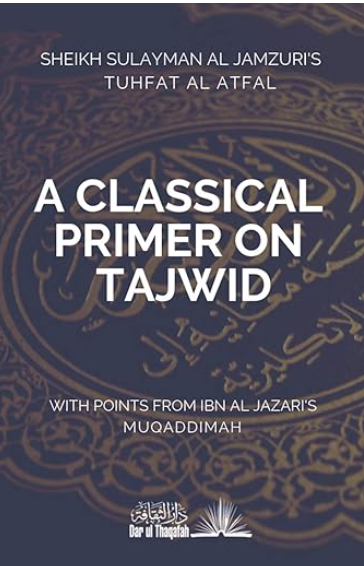
A Classical Primer on Tajwid: Tuhfat al-Atfal — Sheikh Sulayman al-Jamzuri’s 61-verse didactic poem composed in Egypt around 1198 AH — is the single most memorized Tajweed text in the Islamic world.
It covers Noon Saakinah rules, Tanween rules, Meem Saakinah rules, the types of Madd, and Lam Saakinah rules in verse form specifically designed for memorization, earning its name: “A Gift for Children.”
Why it matters for English speakers: The rhymed, metered format means that every rule is compressed into a memorable couplet that students carry in memory indefinitely. An intermediate student who memorizes Tuhfat al-Atfal has a permanent internal reference that no amount of textbook study can replicate.
The Amazon edition linked above includes Sheikh al-Jamzuri’s text with an annotated English translation and adds the Makharij section from Imam Ibn al-Jazari’s Muqaddimah — making it a compact but powerful scholarly pairing.
Discover the Buruj Academy Difference
Step into our virtual classrooms and see how our expert instructors make learning Quran and Arabic intuitive and clear. We focus on overcoming the specific hurdles non-native speakers face, building your confidence and connection with the Quran.
Understanding the classical rules of Ikhfa letters,Idgham, and Ghunnah as discussed in Tuhfat al-Atfal becomes significantly clearer with an Al-Azhar-trained instructor who can contextualize each verse within real Quranic recitation.
6. The Jazariyyah Simplified (Commentary on Al-Muqaddimah al-Jazariyyah)
The Al-Muqaddimah al-Jazariyyah by Imam Ibn al-Jazari (d. 833 AH) — the towering authority of Tajweed scholarship — is the classical text that advanced students and Ijazah candidates ultimately work toward.
It is deeper and more technical than Tuhfat al-Atfal, covering all Sifat al-huruf in detail, Makharij categories, the principles of Quranic recitation science (Uloom al-Qira’at), and the theoretical foundations of the discipline.
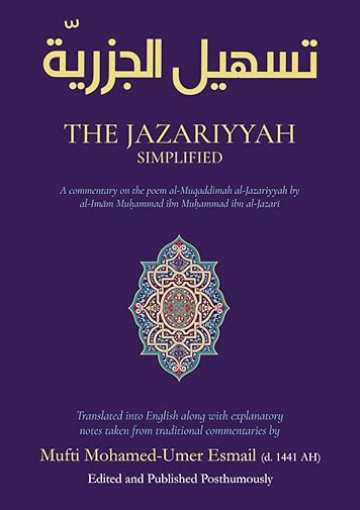
A reliable English-accessible edition is The Jazariyyah Simplified: A Commentary — which provides the Arabic text, transliteration, and explanatory commentary that makes the original poem navigable for non-native Arabic speakers.
What distinguishes Ibn al-Jazari’s work: The Jazariyyah defines 17 Sifat al-huruf (letter attributes), including both permanent attributes (Sifat lazimah) such as Hams, Jahr, Shiddah, Rikhawah, and Tawassut, and secondary attributes (Sifat ‘aridah) such as Ghunnah and Qalqalah. No other classical text covers this ground at the same level of precision.
For a grounding in the related rules before approaching this level, our guide to essential Tajweed rules and our article on Qalqalah letters provide the applied context this classical text assumes.
No book on this list is a replacement for a qualified teacher. Every author above states this explicitly. The book gives you the map — the teacher shows you whether your feet are on the right path.
read also: What is the Difference Between Tajweed and Tafseer?
Master Tajweed with Buruj Academy’s Ijazah-Certified Instructors
Books give you the theory. Correct recitation comes from expert ears hearing you in real time. At Buruj Academy, our Online Tajweed Classes are led by Ijazah-certified instructors and Al-Azhar University graduates with 12+ years of experience teaching non-Arabic speakers globally.
Our Tajweed program offers:
- The Buruj Method: Sound-before-rules — you hear and internalize correct pronunciation before rule names are introduced
- Personalized 1-on-1 sessions with real-time pronunciation correction
- Flexible 24/7 scheduling that fits working adults and parents
- Rigorous instructor selection — every teacher holds Ijazah in Hafs ‘an ‘Asim
Book your free trial lesson today and discover which Tajweed level you are at — and the exact path to where you want to be, Insha’Allah.
Join a supportive learning environment tailored to your pace and lifestyle. Start your journey toward excellence by enrolling in one of our specialized tracks:
- Online Tajweed Classes
- Tajweed Classes for Beginners
- Tajweed Classes for Adults
- Tajweed Classes for Sisters
- Tajweed Classes for Kids
- Advanced Tajweed Course
- Amli Tajweed Course (Practical Application)
Ready to transform your recitation? book your free assessment and start your path to Tajweed mastery today!
Excel in Your Quranic Studies
Join Buruj Academy and master the Quran with our structured, professional curriculum.
Book Your Free TrialConclusion
The best Tajweed book is not a single title — it is the right title at the right stage of your learning. Tajweed Untangled and the An-Nasiha series serve beginners and children well; the Czerepinski three-volume set and Illustrated Tajweed give intermediate students the depth their recitation needs; Tuhfat al-Atfal and the Jazariyyah open the door to traditional scholarship.
What every book on this list confirms, without exception, is that Tajweed cannot be fully learned from print alone. The science of Quranic recitation is passed from teacher to student through direct, corrected practice — and that has been true since the Quran was first revealed. Use these books as guides, Alhamdulillah, but invest in qualified instruction alongside them.
Frequently Asked Questions About the Best Tajweed Books
Can Adults Who Have Never Studied Tajweed Before Start Directly with the Czerepinski Three-Volume Set?
We would not recommend starting there without preparation. The Czerepinski set assumes the student can already read Arabic at a basic level. Adults who are complete beginners should start with Tajweed Untangled or enroll in a structured beginner course first, then use Czerepinski as a detailed reference once the foundational rules are in place.
Is It Possible to Learn from a Tajweed Book Without a Teacher?
Books alone are insufficient for correct Tajweed. The rules can be read and understood theoretically, but pronunciation errors — particularly in Makharij and Sifat — cannot be self-corrected. Every credible Tajweed author states this. A book plus a qualified teacher is the correct pairing. For a deeper look at the learning process, see our guide on how to read Quran with Tajweed.
What Is the Difference Between Tuhfat al-Atfaland Al-Muqaddimah al-Jazariyyah?
Both are classical Arabic poems on Tajweed science. Tuhfat al-Atfal (61 verses) by Imam al-Jamzuri is the introductory-to-intermediate text focused on Noon/Meem Saakinah, Madd, and Tanween rules. Al-Muqaddimah al-Jazariyyah by Imam Ibn al-Jazari is more advanced, covering all 17 Sifat al-huruf and the full Makharij system in greater theoretical depth. Students typically study Tuhfat al-Atfal before approaching the Jazariyyah.