 Arabic
| Key Takeaways |
| Arabic clothing vocabulary uses gendered nouns, so “shirt” and “dress” take different grammatical forms for men and women. |
| Common daily items like shirt (قَمِيص) and dress (فُسْتَان) follow predictable plural patterns non-native speakers can learn systematically. |
| Formal Arabic clothing terms differ from regional dialect words, and knowing both improves comprehension across Arabic-speaking countries. |
Standing in front of a closet and not knowing how to name a single item inside it is a frustration almost every Arabic learner remembers. Clothing vocabulary sits at the center of daily conversation, shopping, and simple descriptions of people around you.
This guide covers essential Arabic words for clothes, separated by gender and category, with pronunciation, example sentences, and practice exercises. Clothes in Arabic is مَلابِس (malaabis), the umbrella term covering every garment discussed below.
Table of Contents:
What Is the General Word for Clothes in Arabic?
مَلابِس (malaabis) is the standard Modern Standard Arabic word for “clothes,” functioning as a plural noun covering all garment types. Its singular form, مَلْبَس (malbas), is rarely used in daily speech since clothing is almost always discussed as a collective set.
We hear this word constantly in our Arabic sessions, especially when students describe what someone is wearing or discuss shopping plans.
مَلابِس also appears in compound phrases students encounter early. مَلابِس رِياضِية means “sportswear,” while مَلابِس رَسْمِية means “formal clothes.” Recognizing this root pattern helps learners decode new clothing phrases independently rather than memorizing each one separately.
Building this kind of foundational vocabulary works best through structured exposure rather than random word lists.
Our online Arabic classes introduce vocabulary through the context-before-abstraction method, so words like مَلابِس get anchored to real sentences from the first lesson.
Book your FREE Arabic trial online Arabic class at Buruj
What Are the Most Common Arabic Clothes Words for Men?
Arabic clothes for men include everyday items like shirts and trousers alongside traditional garments specific to Arab and Islamic dress. Below are the core terms every learner needs for describing men’s clothing accurately.
1. Shirt in Arabic
قَمِيص (qamees) means “shirt” and is one of the first clothing words most students learn, since it appears constantly in daily descriptions.
| Arabic | Transliteration | English |
| قَمِيص | qamees | shirt |
| قَمِيص قُطْنِي | qamees qutni | cotton shirt |
| قَمِيص كُم طَوِيل | qamees kumm taweel | long-sleeved shirt |
Example sentence: هَذَا القَمِيص جَمِيل — Hatha al-qamees jameel — “This shirt is beautiful.”
2. T-Shirt in Arabic
تِي شِيرْت (tee-sheert) is the common transliterated word used across most Arabic-speaking countries, though قَمِيص قَصِير الكُم (qamees qaseer al-kumm, literally “short-sleeved shirt”) is the more formal MSA equivalent.
In our experience teaching adult beginners, this is one of the clearest examples of how spoken Arabic borrows English words directly while formal writing prefers descriptive Arabic phrasing.
3. Trousers and Pants in Arabic
بَنْطَلُون (bantaloon) means “trousers” or “pants,” borrowed from French but fully naturalized into everyday Arabic across dialects. سِرْوَال (sirwaal) is the more classical MSA term, often used for traditional loose-fitting trousers rather than Western-style pants.
4. Traditional Men’s Garments
ثَوْب (thawb), sometimes written “thobe,” is the ankle-length robe worn traditionally by men across the Gulf and broader Arab world.
Students often ask us whether ثَوْب and جَلابِية (jalabiya) mean the same thing. They are similar but regionally distinct: جَلابِية is more common in Egypt and North Africa, while ثَوْب is the standard Gulf term.
غُتْرَة (ghutra) refers to the traditional head covering worn by men, often paired with the عِقَال (‘iqaal), the black cord that secures it in place.
Learning these distinctions matters for anyone engaging seriously with Arabic-speaking cultures, not just for vocabulary tests.
Our online Arabic classes for beginners cover exactly this kind of cultural-linguistic nuance early, so students avoid common confusion between formal and regional terms.
Begin learning Arabic at Buruj with a FREE trial lesson
What Are the Essential Arabic Clothes Words for Women?
Arabic women’s clothes vocabulary spans everyday garments and modest wear specific to many Muslim-majority contexts. These words appear frequently in daily conversation, shopping, and descriptions of appearance.
Dress in Arabic Word
فُسْتَان (fustaan) is the standard word for “dress” and one of the most frequently searched clothing terms among Arabic learners.
Beautiful dress in Arabic is commonly expressed as فُسْتَان جَمِيل (fustaan jameel) or, for something especially elegant, فُسْتَان رَائِع (fustaan raa’i’).
Example sentence: اِشْتَرَيْتُ فُسْتَانًا جَدِيدًا — Ishtaraytu fustaanan jadeedan — “I bought a new dress.”
Ladies’ Clothes in Arabic Categories
| Arabic | Transliteration | English |
| تَنُّورَة | tannoora | skirt |
| بِلُوزَة | bilooza | blouse |
| حِذَاء بِكَعْب | hitha’ bika’b | high heels |
| حِجَاب | hijaab | headscarf |
بِلُوزَة is borrowed from the word “blouse” and used widely in everyday speech, while تَنُّورَة is the fully Arabic term for “skirt” with no dialectal variation across most regions.
Read also: Body Parts in Arabic
Traditional and Modest Women’s Garments
عَبَايَة (‘abaaya) is the loose, flowing outer garment worn by many Muslim women, typically black, though colors vary by region and personal style.
نِقَاب (niqaab) refers to the face veil worn by some women in addition to the headscarf, distinct from the حِجَاب, which covers the hair only.
We consistently see new students confuse حِجَاب, نِقَاب, and خِمَار (khimaar, a longer headscarf covering the chest). Keeping these three terms separate early prevents mistranslation later, especially in religious or cultural contexts.
For learners focused specifically on this kind of practical, everyday vocabulary rather than classical texts, our online Arabic classes structure lessons around exactly these real-life categories.
Book your FREE Arabic trial online Arabic class at Buruj
How Do You Say Clothes in Arabic and English Together for Beginners?
Learning clothes in Arabic and English side by side accelerates recall because the brain links the new word directly to a familiar anchor rather than an abstract sound. This pairing method works especially well for high-frequency daily vocabulary like clothing.
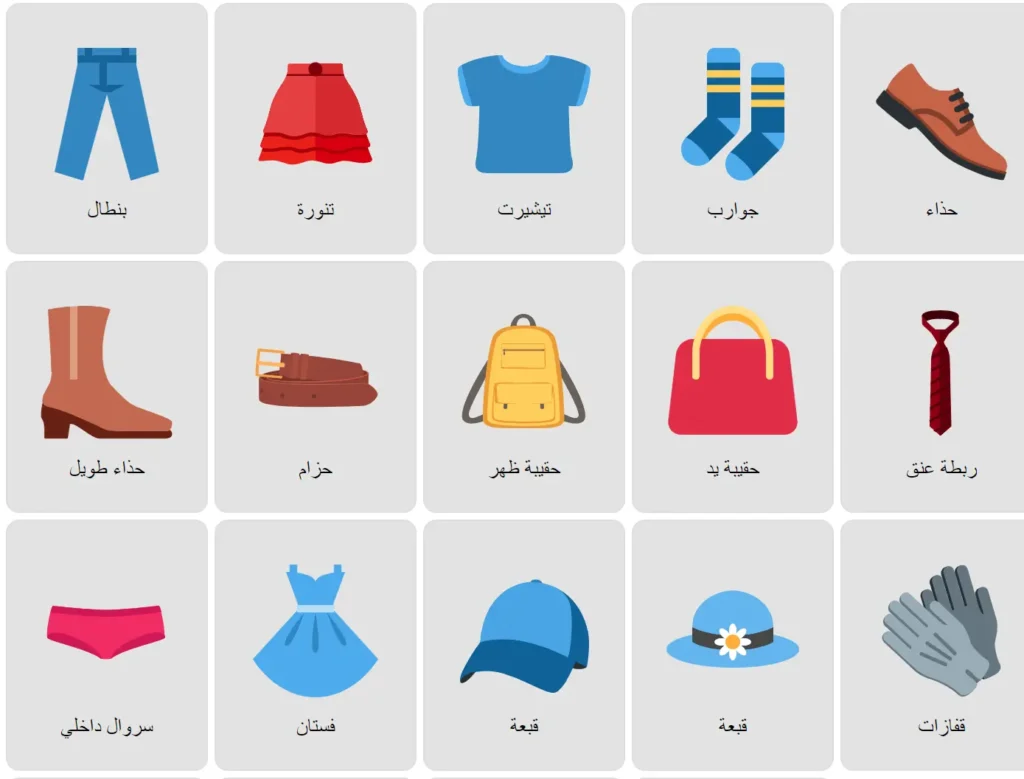
| English | Arabic | Transliteration |
| Shirt | قَمِيص | qamees |
| Dress | فُسْتَان | fustaan |
| Trousers | بَنْطَلُون | bantaloon |
| Shoes | حِذَاء | hitha’ |
| Jacket | جَاكِيت | jaakeet |
| Socks | جَوارِب | jawaarib |
Repetition across both languages, rather than isolated Arabic memorization, is a technique we consistently recommend to adult students juggling limited daily study time.
Discover the Buruj Academy Difference
Step into our virtual classrooms and see how our expert instructors make learning Quran and Arabic intuitive and clear. We focus on overcoming the specific hurdles non-native speakers face, building your confidence and connection with the Quran.
Master the Arabic Language
Join our expert-led courses and build a strong foundation in Classical and Modern Arabic.
Get Your Free TrialWhat Are Common Clothes in Arabic Words for Daily Wear?
Daily-wear vocabulary covers the items Arabic speakers mention most in ordinary conversation: shoes, jackets, undergarments, and accessories.
Mastering this category first gives learners the highest conversational return for the least memorization effort.
1. Shoes and Footwear in Arabic
حِذَاء (hitha’) means “shoes” in general, while صَنْدَل (sandal) refers specifically to sandals.
2. Outerwear in Arabic
جَاكِيت (jaakeet) is the common word for “jacket,” directly borrowed and adapted from English, used consistently across Arabic dialects.
مِعْطَف (mi’taf) is the more formal MSA term for “coat” or heavier outerwear, distinct from the lighter جَاكِيت.
3. Accessories in Arabic
حِزَام (hizaam) means “belt,” and قُبَّعَة (qubba’a) means “hat” or “cap.” Both appear frequently when describing outfits in detail.
Students who move past single-word memorization into full outfit descriptions retain vocabulary noticeably longer, based on what we observe across beginner cohorts.
Building sentences around these words, not just flashcards, is the difference between recognition and real fluency.
Read also: Directions in Arabic
How Do Arabic Clothes Words Change Between Male and Female Forms?
Arabic clothing adjectives change form based on the gender of the noun they describe, following the same masculine-feminine agreement rules that apply across Arabic grammar generally. A shirt described as “beautiful” uses a different adjective ending than a dress described the same way.
قَمِيص جَمِيل (“beautiful shirt”) uses the masculine adjective form, since قَمِيص is grammatically masculine.
فُسْتَان جَمِيل also stays masculine, since فُسْتَان is masculine despite referring to women’s clothing — grammatical gender in Arabic does not always match the gender of the wearer.
Compare this to تَنُّورَة جَمِيلَة (“beautiful skirt”), where the feminine noun تَنُّورَة requires the feminine adjective ending -َة.
This distinction confuses many new learners, since it separates grammatical gender from cultural or biological gender entirely. Understanding masculine and feminine nouns in Arabic early prevents this exact confusion from compounding across other vocabulary categories later.
How Do You Form Plurals for Clothing Items in Arabic?
Arabic clothing nouns form plurals through several irregular patterns rather than one consistent rule, which is why memorizing plurals item-by-item works better than applying a single formula. Some clothing plurals are predictable; many are not.
| Singular | Plural | Transliteration |
| قَمِيص (shirt) | قُمْصَان | qumsaan |
| فُسْتَان (dress) | فَسَاتِين | fasaateen |
| حِذَاء (shoe) | أَحْذِيَة | ahthiya |
| جَوْرَب (sock) | جَوارِب | jawaarib |
None of these plurals follow the simple “add a suffix” pattern common in English. This is standard behavior for what’s called broken plurals in Arabic, a feature that appears across countless noun categories, not just clothing.
Learners frustrated by the unpredictability of these forms are experiencing something completely normal in Arabic acquisition. Our guide on irregular verbs in Arabic covers a parallel challenge, and the same patient, exposure-based approach applies here.
Practical Exercises to Practice Clothes Vocabulary in Arabic
Active practice cements clothing vocabulary far more effectively than passive review, since production forces the brain to retrieve words rather than simply recognize them. The exercises below target the words covered throughout this guide.
Exercise 1: Fill in the Blank
Complete each sentence with the correct Arabic clothing word.
- اِشْتَرَيْتُ ___ جَدِيدًا لِلْعَمَل (I bought a new ___ for work) — Answer: قَمِيص
- هِيَ تَرْتَدِي ___ أَحْمَر (She is wearing a red ___) — Answer: فُسْتَان
- أَحْتَاجُ ___ لِلشِّتَاء (I need a ___ for winter) — Answer: مِعْطَف
Exercise 2: Translate the Sentence
Translate these short sentences into Arabic using vocabulary from this guide.
- “The shoes are new.” — الحِذَاء جَدِيد
- “I like this jacket.” — أُحِبُّ هَذَا الجَاكِيت
- “Her dress is beautiful.” — فُسْتَانُها جَمِيل
Exercise 3: Categorize the Words
Sort these words into “Men’s Clothing,” “Women’s Clothing,” or “Unisex”: ثَوْب، فُسْتَان، قَمِيص، عَبَايَة، حِذَاء، جَاكِيت
Answer: Men’s — ثَوْب. Women’s — فُسْتَان، عَبَايَة. Unisex — قَمِيص، حِذَاء، جَاكِيت.
Consistent practice like this, repeated across short daily sessions, is what we see separate students who retain vocabulary from those who forget it within weeks. Pairing structured exercises with guided feedback closes gaps a self-study app usually misses.
Read also: Seasons and Weather in Arabic
Learn Arabic Clothing Vocabulary with Buruj Academy’s Expert Instructors
Mastering clothes vocabulary in Arabic means moving beyond word lists into confident, natural sentence use — exactly what this guide has built toward.
At Buruj Academy, our Online Arabic Classes are taught by Al-Azhar University graduates with 12+ years of experience teaching non-Arabic speakers.
Using the Buruj Method’s context-before-abstraction approach, students learn vocabulary like clothing terms embedded in real conversation, not isolated flashcards.
Sessions are personalized 1-on-1, with flexible 24/7 scheduling and real-time pronunciation correction from instructors who understand common English-speaker mistakes.
Ready to build practical, lasting Arabic vocabulary? Book a free trial lesson with Buruj Academy today.
Begin your transformation today by choosing the path that fits your goals:
- Online Arabic Classes (General & Comprehensive)
- Arabic Course for Beginners
- Arabic Alphabet Learning Course
- Online Arabic Classes for Kids
- Arabic Classes for Adults
- Arabic Grammar Course (Nahw & Sarf)
- Intermediate Arabic Course (B1/B2)
- Arabic Speaking Course (Conversational Fluency)
- Arabic Reading Course (Literary Excellence)
- Learn Arabic Writing Course (Calligraphy & Composition)
Ready to speak with confidence? Join the global community at Buruj Academy and book your free placement interview today!
Master the Arabic Language
Join our expert-led courses and build a strong foundation in Classical and Modern Arabic.
Get Your Free TrialConclusion
Clothing vocabulary might seem like a small corner of the Arabic language, but it’s one of the fastest ways to move from textbook Arabic into real, spoken confidence. The gendered nouns, irregular plurals, and regional variations covered here all reflect broader patterns that show up across Arabic grammar as a whole.
What matters most now is repetition in context: naming what you’re wearing, describing what someone else has on, practicing the exercises above until they feel automatic. That consistency, more than any single word list, is what turns vocabulary into fluency.
Frequently Asked Questions About Clothes in Arabic
What Is the Difference Between Malabis and Libaas in Arabic?
مَلابِس (malaabis) is the standard plural noun for “clothes” used in everyday MSA. لِبَاس (libaas) is a more classical, singular collective term meaning “clothing” or “attire,” found more often in formal or literary contexts than daily speech.
How Do You Say “What Are You Wearing” in Arabic?
“What are you wearing” translates to مَاذَا تَرْتَدِي؟ (maatha tartadee?) when speaking to a male, or مَاذَا تَرْتَدِينَ؟ (maatha tartadeen?) when speaking to a female, reflecting standard verb-gender agreement.
Is Bantaloon an Arabic Word or a Loanword?
بَنْطَلُون (bantaloon) is a loanword, adapted from the French “pantalon,” fully naturalized into everyday spoken Arabic across most dialects despite its non-Arabic origin.
Do Clothing Words Differ Between Egyptian and Gulf Arabic?
Yes, several clothing words differ regionally. جَلابِية is the common Egyptian term for a traditional robe, while ثَوْب is the standard equivalent used across most Gulf countries for the same general garment type.
What Is the Best Way to Memorize Arabic Clothing Vocabulary?
Pairing each word with a full sentence, rather than isolated memorization, produces stronger recall. Practicing description exercises — naming what you or others are wearing daily — reinforces both vocabulary and grammatical gender agreement simultaneously.