 Islamic
Many parents search for short, rhyming poems that teach Islamic values without sounding like a lecture. A good children’s poem does double duty: it builds Arabic listening skills while planting a lasting lesson.
Below are three kids Islamic poems, covering the Quran, kindness, and honesty, each given in Arabic script, transliteration, and English translation, with a short meaning note parents can use to teach the poem’s lesson.
Table of Contents:
Why Short Poems Help Children Learn Islamic Values?
Short, rhyming poems work for children because rhythm and repetition make ideas stick in memory far longer than plain explanation does. A single well-written stanza can carry a value — honesty, kindness, love of the Quran — that a child will still recall years later, simply because it rhymed.
This is not a new idea in Islamic education. Poetry (nazm) has long been used to teach children Arabic vocabulary, Islamic manners, and foundational beliefs before they are old enough for formal lessons.
In our sessions at Buruj Academy, we find that children who first meet a concept through a short poem or rhyme grasp the formal lesson faster later on, because the vocabulary and rhythm already feel familiar to them.
Before reading the poems below, it helps to know a few transliteration basics, since Arabic sounds do not always map neatly onto English letters.
| Letter Combo | Sounds Like |
| kh | a raspy “h,” like the “ch” in the Scottish word “loch” |
| gh | a soft, throaty “g,” further back in the throat than a normal English “g” |
| ‘ (apostrophe) | a brief catch in the throat, used for hamza or ‘ayn |
| aa / ee / oo | a longer, held version of that vowel sound |
A short table like this is not a substitute for hearing the sounds recited aloud, so pairing these poems with an instructor’s live recitation remains the most reliable way for a child to learn correct pronunciation.
This is exactly the gap a structured program is built to close: Buruj Academy’s Islamic Studies Classes for Kids course pairs short, memorable content like this with a live instructor who models correct pronunciation and checks a child’s understanding in real time.
One honest note before the poems: these three pieces were shared with us as part of a family’s collection of children’s Islamic poetry.
We could not confirm a documented original author for any of them, so we present them here as commonly circulated pieces rather than attributing them to a named poet.
If a reader can point us to the original source, we are glad to update this article with proper credit.
The first session is free in Buruj’s Islamic Studies Classes for Kids
1. Islamic Poem for Kids About the Quran
This poem describes the Quran using several of its traditional titles and praises its role as guidance, healing, and daily protection. It draws on the Quran’s own self-description as Al-Furqan and Adh-Dhikr, and echoes the well-known teaching that the Quran heals hearts, stated directly in Surah Al-Isra.
Arabic Text
مَأْدُبَةُ الرَّحْمَٰنِ لِلْجِنِّ وَالْإِنْسَانِ
وَحَبْلُهُ الْمَتِينُ وَنُورُهُ الْمُبِينُ
يُسَمَّى بِالْقُرْآنِ وَالذِّكْرِ وَالْفُرْقَانِ
يَجِيءُ بِالشِّفَاءِ وَالْبُرْءِ وَالدَّوَاءِ
يَهْدِينَا لِلصَّوَابِ وَالْفَوْزِ بِالثَّوَابِ
نَتْلُوهُ كُلَّ صُبْحٍ لِنَلْقَى خَيْرَ رِبْحِ
كَذَاكَ عِنْدَ لَيْلٍ يَقِينَا شَرَّ وَيْلِ
Transliteration
Ma’dubatur-Rahmaani lil-jinni wal-insaan
Wa habluhul-mateenu wa nooruhul-mubeen
Yusammaa bil-Qur’aani waz-Zikri wal-Furqaan
Yajee’u bish-shifaa’i wal-bur’i wad-dawaa’
Yahdeenaa lis-sawaabi wal-fawzi bith-thawaab
Natlooh kulla subhin li-nalqaa khayra ribh
Kazaaka ‘inda laylin yaqeenaa sharra wayl
English Translation
A banquet from the Most Merciful, for jinn and mankind,
His firm rope, and His clear light.
It is called the Quran, the Reminder, and the Criterion,
It comes with healing, cure, and remedy.
It guides us to what is right and to the reward we seek.
We recite it every morning to gain the finest profit,
and likewise at night, it shields us from every calamity.
What This Poem About the Quran Teaches Children
The poem’s opening line calls the Quran a “banquet” — a description widely attributed to the companion Abdullah ibn Mas’ud, who described the Quran this way to encourage believers to take as much benefit from it as they could, the way a guest takes freely from a host’s table.
The names it uses next are not invented: الفرقان (Al-Furqan) and الذكر (Adh-Dhikr) are titles the Quran gives itself, confirmed in Surah Al-Furqan 25:1 and Surah Al-Hijr 15:9.
The line calling the Quran “His firm rope” reflects a common interpretation of Surah Aal-e-Imran 3:103, where believers are commanded to “hold firmly to the rope of Allah, all together.”
Many classical scholars explain that rope as the Quran itself. The poem’s mention of healing is not a loose metaphor either — Surah Al-Isra 17:82 states plainly that the Quran “is healing and mercy for the believers.”
This poem pairs naturally with a child’s first steps into daily recitation, which is also where many families start when they consider a structured program such as Buruj Academy’s Online Quran Classes for Kids course.
If your child enjoys this poem, our guide on how to make reading Quran fun for kids has more ideas in the same spirit.
Help your child start learning the Quran with a FREE trial
Discover the Buruj Academy Difference
Step into our virtual classrooms and see how our expert instructors make learning Quran and Arabic intuitive and clear. We focus on overcoming the specific hurdles non-native speakers face, building your confidence and connection with the Quran.
Expand Your Islamic Knowledge
Join our structured online courses led by qualified instructors to deepen your understanding of the Deen.
Join a Free Trial Class2. The Islamic Poem About Loving Good for Others
This poem is a child’s personal pledge to want good for himself, share what he has with friends, and never mock anyone with unkind nicknames. Its closing line is a direct echo of a Quranic command against name-calling, found in Surah Al-Hujurat.
Arabic Text
أُحِبُّ الْخَيْرَ يَأْتِينِي وَأَهْوَاهُ لِأَصْحَابِي
وَأَدْعُو اللهَ يَنْصُرُنِي مَعَ الْأَخْذِ بِأَسْبَابِ
وَإِخْوَانِي أُلَاقِيهِمْ بِأَشْوَاقٍ وَتَرْحَابِ
وَلَوْ فَضْلٌ بَقِيْ عِنْدِي سَأُعْطِي الْفَضْلَ أَحْبَابِي
وَأَقْضِي الْوَقْتَ بَيْنَهُمُ بِتَسْلِيَةٍ وَأَلْعَابِ
وَلَسْتُ بِسَاخِرٍ مِنْهُمْ فَأُؤْذِيهِمْ بِأَلْقَابِ
بِذَاكَ اللهُ أَوْصَانِي فَإِنِّي غَيْرُ عَيَّابِ
Transliteration
Uhibbul-khayra ya’teenee Wa ahwaahu li-as-haabee
Wa ad’oo Allaaha yansurunee Ma’al-akhzi bi-asbaab
Wa ikhwaanee ulaaqeehim Bi-ashwaaqin wa tarhaab
Wa law fadlun baqiya ‘indee Sa-u’til-fadla ahbaabee
Wa aqdil-waqta baynahum Bi-tasliyatin wa al’aab
Wa lastu bi-saakhirin minhum Fa-u’zeehim bi-alqaab
Bi-zaaka Allaahu awsaanee Fa-innee ghayru ‘ayyaab
English Translation
I love that good comes to me, and I want the same for my friends.
I call on Allah to help me, while still doing my part.
When I meet my brothers, I greet them with longing and welcome.
And if I have anything extra, I will give that extra to those I love.
I spend time with them in fun and games.
I do not mock them or hurt them with bad nicknames.
Allah commanded me to live this way, so I will not be one who finds fault in others.
Read also:12 Steps to Teach Your Child Salah
What This Poem About Loving Good for Others Teaches Children
The middle stanzas teach a practical balance many children need: make dua and rely on Allah, but still “take the means” — a phrase (بِالأَسْبَابِ) that reflects the broader Islamic principle of combining trust in Allah with real effort.
The final stanza is the poem’s clearest teaching moment. Its ban on hurtful nicknames is not the poet’s own idea — it directly reflects Surah Al-Hujurat 49:11, which instructs believers, “do not insult one another and do not call each other by offensive nicknames.” This is a concrete, memorable rule a child can apply the very same day at school or at home.
Poems built around a single clear command like this one work especially well for children who are just starting to connect Quranic teachings with everyday behavior, which is also the foundation of our Islamic Studies Classes for Kids course.
For more ways to build on this theme, see our article on pillars of good character kids can learn early.
3. The Islamic Poem for Children About Honesty
This is a longer nasheed-style poem built around a repeated refrain warning against lying. Each stanza offers new advice, then returns to the same call: speak the truth, speak what is right, and fear the punishment that follows persistent lying.
Arabic Text and Refrain
The refrain, repeated after every stanza, is:
قُولُوا الصِّدْقَ وَقُولُوا الْحَقَّ يَا هَوْلَ عَذَابِ الْجَبَّارْ يَا هَوْلَ عَذَابِ الْجَبَّارْ
Qooloos-sidqa wa qoolul-haqqa, yaa hawla ‘azaabil-jabbaar Yaa hawla ‘azaabil-jabbaar
“Speak the truth and speak what is right, how terrible is the punishment of the Almighty. How terrible is the punishment of the Almighty.”
Stanza 1:
يَا إِخْوَانِي يَا أَخْيَارْ يَا زُمَلائِي يَا أَبْرَارْ اسْمَعُوا نُصْحِي وَاتَّبِعُوهْ تَنْجُوا مِنْ لَسَعَاتِ النَّارْ
Yaa ikhwaanee yaa akhyaar, yaa zumalaa’ee yaa abraar Isma’oo nushee wattabi’ooh, tanjoo min lasa’aatin-naar
“O my brothers, O good ones, O my classmates, O righteous ones. Listen to my advice and follow it, you will be saved from the sting of the Fire.”
Stanza 2:
اصْدُقْ يَا خِلِّي لا تَكْذِبْ تَلْقَ الْحُبَّ مَعَ التَّقْدِيرْ وَابْعُدْ عَمَّنْ يَكْذِبُ دَوْمًا فَعِقَابُ اللَّهِ لَهُ النَّارْ
Isduq yaa khillee laa takzib, talqal-hubba ma’at-taqdeer Wab’ud ‘amman yakzibu dawman, fa-‘iqaabullaahi lahun-naar
“Be truthful, my friend, do not lie, you will find love along with respect. And stay away from one who always lies, for Allah’s punishment for him is the Fire.”
Stanza 3:
اُصْدُقْ.. إِنَّ الصِّدْقَ فَضِيلَهْ لا تَعْمِدْ أَبَدًا لِلْحِيلَهْ فَالْكَذِبُ فِي الْمَرْءِ رَذِيلَهْ تُدْنِيهِ مِنْ هَوْلِ النَّارْ
Usduq, innas-sidqa fadeelah, laa ta’mid abadan lil-heelah Falkazibu fil-mar’i razeelah, tudneehi min hawlin-naar
“Be truthful — truthfulness is a virtue, never resort to trickery. For lying is a vice in a person, drawing him closer to the terror of the Fire.”
Stanza 4:
مَا أَجْمَلَ أَنْ تَحْكِيَ صِدْقًا مَا أَكْمَلَ أَنْ تَنْطِقَ حَقًّا وَاهْرُبْ عَنْ كَذِبٍ يُؤْذِيكْ وَاحْذَرْ أَنْ تَمْسَسْكَ النَّارْ
Maa ajmala an tahkiya sidqan, maa akmala an tantiqa haqqaa Wahrub ‘an kazibin yu’zeek, wahzar an tamsasakan-naar
“How beautiful it is to speak truthfully, how complete it is to say what is right. Flee from a lie that harms you, and beware that the Fire should ever touch you.”
What This Poem About Honesty Teaches Children
This poem repeats one message on purpose: honesty is not optional, and lying carries real spiritual consequences. That repetition is itself a memorization tool — in our experience at Buruj Academy, children retain a refrain they hear four or five times in one sitting far better than a single line stated once.
The poem’s warning tone is grounded in an authentic, agreed-upon hadith. The Prophet ﷺ said, “Truthfulness leads to righteousness, and righteousness leads to Paradise… and falsehood leads to wickedness, and wickedness leads to the Fire” (Sahih al-Bukhari 6094). The poem’s repeated mention of the Fire is a simplified, child-friendly echo of this same warning.
Because this poem leans heavily on fear of punishment, it works best paired with the positive side of the same hadith: truthfulness also leads to love, respect, and Paradise, exactly as Stanza 2 says. Reading both halves together gives a child the full picture rather than only the warning.
Read More: Islamic Worksheets for Kids
How to Teach the Islamic Poems to Children at Home?
The right approach to teaching a poem changes with a child’s age. A four-year-old benefits from rhythm and repetition alone, while a ten-year-old is ready to discuss the meaning behind each line.
| Age Range | Recommended Approach | Focus |
| 4–6 years | Say short lines together, use clapping or a simple beat | Sound and rhyme, not full meaning |
| 7–10 years | Read the Arabic and translation side by side | Basic vocabulary and the poem’s main lesson |
| 11+ years | Discuss the meaning note and the connected Quran verse or hadith | Deeper understanding and real-life application |
For younger children especially, turning a poem into a short game — matching the Arabic line to its English meaning, or racing to complete the refrain — keeps the lesson from feeling like homework. Our article on the best Quranic games for kids has more activities in this style, and our guide on how to teach Islam to a child covers broader age-by-age strategies beyond poetry.
Poem memorization also builds a real skill children will use again later, when they move on to memorizing short surahs.
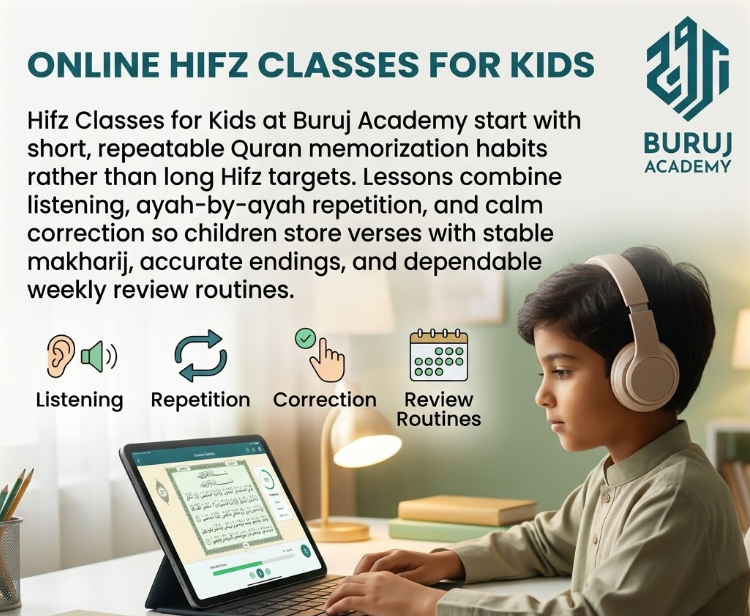
Buruj Academy’s Hifz for Kids course uses the same rhythm-first approach these poems rely on, guided by instructors who track each child’s pace individually.
If your child enjoys memorizing these poems, they are likely ready for our guide on the best age to memorize Quran.
Start your child’s Hifz classes with a FREE session
Build Your Child’s Islamic Foundation with Buruj Academy
These three poems offer a simple starting point, but a child’s Islamic education grows fastest with consistent, guided instruction behind it. Buruj Academy’s Islamic Studies Classes for Kids course was built for exactly this stage of learning.
Our instructors are Al-Azhar University graduates with 9+ years of Islamic studies education, delivering Quran, character, and foundational belief lessons in clear, age-appropriate English. Every child receives a personalized learning plan, flexible 1-on-1 online sessions, and real-time correction and feedback from a patient, qualified teacher — not a recorded lesson.
If your child already loves these poems, they are ready for the next step. Book a free trial course with Buruj Academy today.
Enroll your child in one of our specialized, kid-friendly tracks today:
- Online Quran Classes for Kids
- Tajweed Classes for Kids
- Hifz Classes for Kids
- Online Arabic Classes for Kids
- Quranic Arabic Course for Kids
- Noorani Qaida Course for Kids
- Islamic Studies Classes for Kids
Ready to watch your child grow in knowledge and character? Join the Buruj Academy family and book a free trial session for your child today!
Expand Your Islamic Knowledge
Join our structured online courses led by qualified instructors to deepen your understanding of the Deen.
Join a Free Trial ClassConclusion
Poems work as an entry point into Islamic learning precisely because children remember rhythm before they remember rules. A single stanza about honesty or kindness can outlast years of forgotten explanations, simply because it rhymed and repeated.
These three poems each open a door to something larger: the Quran’s own names for itself, a Quranic command against unkind words, and an authentic hadith on truthfulness. Used alongside real instruction, they become a foundation rather than a novelty — a first, memorable step toward lessons a child will keep building on for years.
Frequently Asked Questions About Kids Islamic Poems
Are Islamic Poems Appropriate for Young Muslim Children?
Yes, short Islamic poems are a traditional and age-appropriate way to introduce values like honesty, kindness, and love of the Quran. Parents should still preview any poem’s tone and content first, since styles and intensity vary widely between pieces.
What Is the Best Age to Start Teaching Kids Islamic Poems?
Children as young as four can enjoy the rhythm and repetition of a poem, even before they understand its full meaning. Around age seven or eight, most children are ready to discuss what each line actually teaches them.
Can Non-Arabic-Speaking Children Still Benefit from These Poems?
Yes, transliteration allows a non-Arabic-speaking child to say the Arabic words correctly, while the English translation lets them understand the meaning. Live pronunciation practice with a qualified instructor still improves accuracy fastest.
Where Can I Find More Islamic Poems for Kids with Translation?
Family collections, Islamic bookstores, and children’s Islamic education platforms are common sources, though authorship is not always documented. Always verify any religious content in a poem against a reliable Quran or hadith source before teaching it.
How Is a Kids’ Islamic Poem Different from a Nasheed?
A poem is typically recited or read aloud without music, while a nasheed usually adds vocal melody, and sometimes rhythm instruments, to similar Islamic content. Both can teach the same values; the difference is mainly in performance style.