 Tajweed

| Key Takeaways |
| Izhar requires pronouncing Noon Sakinah or Tanwin clearly before 6 throat letters with no nasal sound. |
| Idgham merges Noon Sakinah or Tanwin into the following letter, occurring only across two separate words. |
| Iqlab converts Noon Sakinah or Tanwin into a concealed Meem sound exclusively before the letter Ba. |
| Ikhfa produces a nasal sound held between full clarity and full merging before 15 specific Arabic letters. |
When students begin studying Tajweed, few topics cause as much confusion as the four rules governing Noon Sakinah and Tanwin. These rules appear constantly throughout the Quran, making them impossible to avoid — and impossible to recite correctly without understanding them precisely.
Izhar, Idgham, Iqlab, and Ikhfa are not interchangeable variations of the same concept. Each is a distinct ruling with its own letters, mechanism, and sound output. Mastering the difference between them is one of the first real milestones in Tajweed for beginners — and in this guide, we break each one down individually before showing you exactly how they compare.
Table of Contents:
What Is Noon Sakinah and Tanwin in Tajweed?
Noon Sakinah and Tanwin in Tajweed share the same four rulings because they share the same sound — a resting Noon. Noon Sakinah is the letter Noon written with a Sukoon, appearing in nouns, verbs, and particles, and it remains present in both written text and recitation. Tanwin is an unwritten Noon sound added to the end of indefinite nouns only in recitation, disappearing when you pause.
Classical Tajweed scholars established four rulings based on a single governing principle: how close or far the Noon sound’s articulation point is from the letter that follows it.
The closer the following letter’s makhraj (articulation point) is to the Noon, the more the Noon merges into it. The farther away, the clearer the Noon sounds. Ikhfa occupies the middle ground between these two extremes.
At Buruj Academy, our Al-Azhar-certified instructors teach these four rules as a connected system from day one in our Online Tajweed Classes. Understanding why the rules exist makes applying them far more intuitive than memorizing them in isolation.
Book Your FREE Trial Lesson to Begin Your Tajweed Journey

1. What Is Izhar?
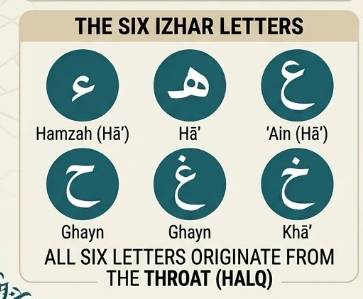
Izhar means clear, unobstructed pronunciation. When Noon Sakinah or Tanwin is followed by one of the six throat letters, the Noon must be pronounced with full clarity — no nasal resonance, no merging, no modification of any kind.
The Six Letters of Izhar
The six Izhar letters are all produced from the throat (Halq), which is why this ruling is called Izhar Halqi (throat clarity). They are:
| Arabic Letter | Transliteration | Example Word |
| ء | Hamza | يَنْأَوْنَ (Al-An’am 6:26) |
| هـ | Ha | مِنْهُمْ |
| ع | ‘Ain | أَنْعَمْتَ (Al-Fatihah 1:7) |
| ح | Ha (soft) | يَنْحِتُونَ (Al-Hijr 15:82) |
| غ | Ghain | فَسَيُنْغِضُونَ (Al-Isra’ 17:51) |
| خ | Kha | وَالْمُنْخَنِقَةُ (Al-Ma’idah 5:3) |
Why Does Izhar Apply to These Letters?
The Noon’s articulation point sits at the tip of the tongue near the upper front teeth. The throat letters are produced deep inside the vocal tract — the farthest possible distance from the Noon’s makhraj.
This great distance between the two articulation points makes merging physically impossible and natural clarity the only option.
The degree of clarity is not uniform across all six letters. Izhar is strongest before Hamza and Ha, moderate before ‘Ain and soft Ha, and at its lightest before Ghain and Kha.
Quranic Examples of Izhar with Tanwin
سَمِيعٌ عَلِيمٌ
Samee’un ‘Aleem
“All-Hearing, All-Knowing.” (Al-A’raf 7:200)
The Tanwin of سَمِيعٌ is pronounced with complete clarity before ‘Ain — no nasal blending.
عَلِيمٌ حَكِيمٌ
‘Aleemun Hakeem
“All-Knowing, All-Wise.” (An-Nisa’ 4:26)
Tanwin before soft Ha requires the clearest, most deliberate Noon sound.
2. What Is Idgham?
Idgham means merging. When Noon Sakinah or Tanwin is followed by one of six specific letters — but only when those letters begin a separate word — the Noon sound is absorbed into the following letter, which is then pronounced with Shaddah (doubling emphasis).
Critical condition: Idgham never occurs within a single word. If the Noon and the Idgham letter appear in the same word, Izhar applies instead.
This is why words like الدُّنْيَا (dunya) and صِنْوَانٌ (sinwan) use Izhar — merging the Noon there would create confusion with naturally doubled letters.
The Two Types of Idgham
Idgham divides into two categories based on whether the Ghunnah (nasal resonance) is preserved during the merge:
| Type | Arabic | Letters | Ghunnah? | Technical Name |
| Idgham with Ghunnah | إدغام بغنة | ي ن م و (YNMW) | Yes — held 2 counts | Idgham Naqis (incomplete) |
| Idgham without Ghunnah | إدغام بغير غنة | ل ر (L, R) | No | Idgham Kamil (complete) |
The four letters of Idgham with Ghunnah are collected in the mnemonic يَنْمُو (yanmu — meaning “it grows”): Yaa, Noon, Meem, Waw. When Noon Sakinah or Tanwin meets any of these, the Noon disappears into the following letter while a two-count nasal resonance remains audible.
It is called “incomplete” because the letter (Noon) disappears but its characteristic quality (Ghunnah) stays.
The two letters of Idgham without Ghunnah are Lam and Ra. Here, the merge is total — both the letter and its Ghunnah vanish entirely into the following letter. This complete disappearance earns it the name Idgham Kamil (complete merging).
Quranic Examples of Idgham with Ghunnah
مَنْ يَقُولُ
Man yaqool
“Whoever says.” (Al-Baqarah 2:8)
Noon of مَنْ merges into Yaa with a nasal resonance held for two counts.
عَذَابٌ مُقِيمٌ
‘Adhabun muqeem
“A lasting punishment.” (Al-Ma’idah 5:37)
Tanwin merges into Meem — a clear nasal merge across two words.
Quranic Examples of Idgham without Ghunnah
هُدًى لِّلْمُتَّقِينَ
Hudan lil-muttaqeen
“Guidance for the righteous.” (Al-Baqarah 2:2)
Tanwin merges completely into Lam — no nasal sound remains.
مِنْ رَّبِّهِمْ
Min rabbihim
“From their Lord.” (Al-Baqarah 2:26)
Noon merges entirely into Ra — the Noon vanishes without a trace.
In our sessions at Buruj Academy, we find that students consistently struggle with Idgham without Ghunnah — specifically with Ra. The instinct to hold a slight nasal sound is strong.
Our Ijazah-certified instructors train students to feel the complete absence of resonance by first exaggerating the Ra’s roll, then gradually softening it while keeping the Noon silent.
Book a FREE trial session with one of Buruj’s Azhari Quran tutors

3. What Is Iqlab?
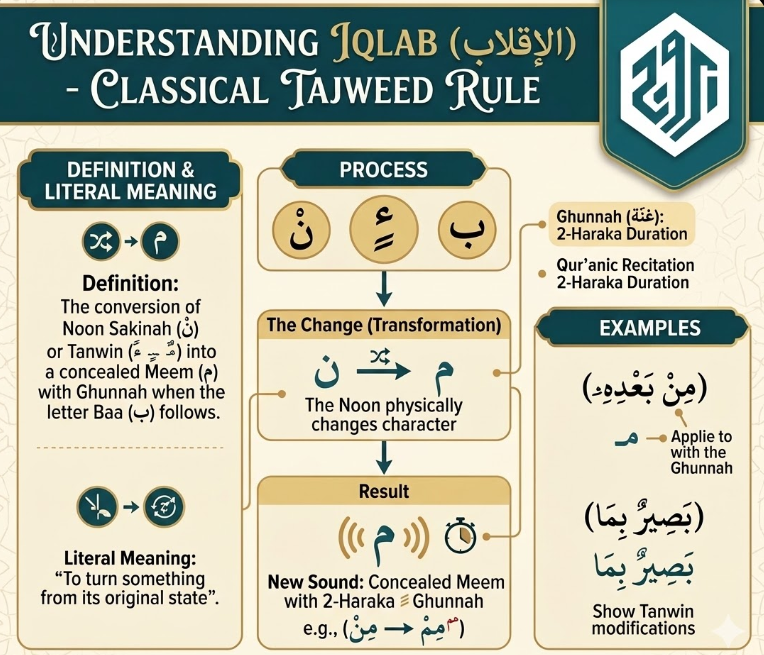
Iqlab means substitution or conversion. Iqlab letters in Tajweed have only one letter: Ba (ب). When Noon Sakinah or Tanwin is followed by Ba — whether in one word or across two words — the Noon sound is converted into a Meem sound, which is then held with Ikhfa (concealment) and Ghunnah for two counts before the Ba is pronounced.
The Meem is not written in the text. It exists only in recitation, which is why understanding Iqlab requires hearing it from a qualified teacher rather than reading about it.
Read also: What Is Madd Tamkeen?
Why Is Noon Converted to Meem Before Ba?
The classical Tajweed scholars identify three reasons. First, pronouncing Noon Sakinah with full Izhar before Ba is laborious — the Noon exits from the tongue tip while Ba requires both lips to close, creating an unnatural sequence.
Second, full Idgham is impossible because the Noon and Ba have different articulation points with insufficient proximity.
Third, Meem shares the same labial (lip-based) makhraj as Ba, making the Meem-then-Ba sequence smooth and natural.
The Ghunnah in Meem is also phonetically compatible with Ba in a way Noon’s Ghunnah is not.
Excel in Your Quranic Studies
Join Buruj Academy and master the Quran with our structured, professional curriculum.
Book Your Free TrialQuranic Examples of Iqlab
أَنْبِئْهُمْ
Ambi’hum
“Inform them.” (Al-Baqarah 2:33)
Noon Sakinah before Ba within one word — Noon converts to a concealed Meem with Ghunnah.
سَمِيعٌ بَصِيرٌ
Samee’um baseer
“All-Hearing, All-Seeing.” (Al-Hajj 22:75)
Tanwin before Ba across two words — Tanwin converts to a nasal Meem before Ba.
One practical sign of correct Iqlab: both lips come together slightly in anticipation of the Meem before releasing into the Ba. Students who skip this lip movement are not applying Iqlab — they are simply reading the Ba without any transition sound.
Our Tajweed for Beginners course addresses Iqlab in dedicated sessions that focus on the physical lip mechanics before the theoretical rule, following the Buruj Method’s sound-before-rules principle.
Book Your FREE Trial Lesson to Begin Your Tajweed Journey

4. What Is Ikhfa?
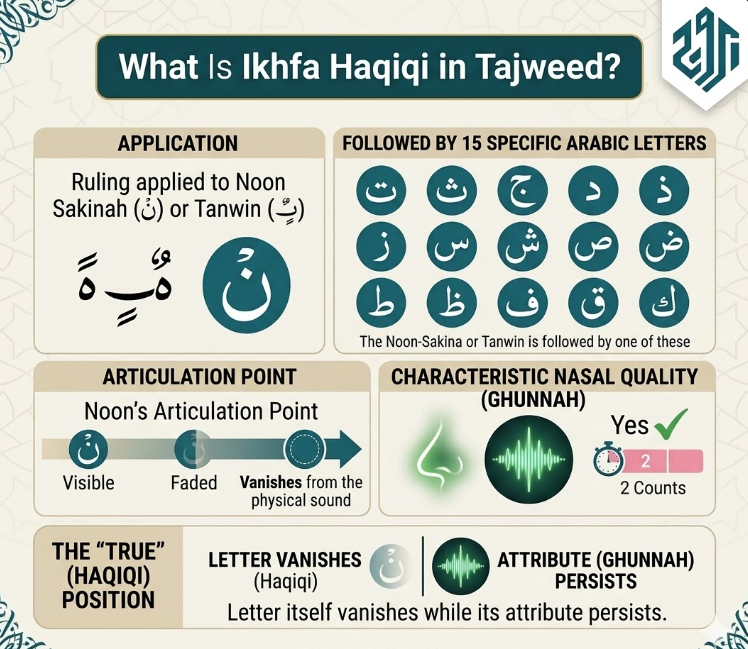
Ikhfa means concealment. It describes a sound state precisely between Izhar and Idgham — the Noon is neither fully pronounced nor fully merged. Instead, it is held in a suspended nasal resonance (Ghunnah) for two counts while the tongue or lips prepare for the following letter, then that following letter is released without Shaddah.
This is called Ikhfa Haqiqi (true concealment) and applies before 15 letters — every letter in the Arabic alphabet that is not an Izhar, Idgham, Iqlab, or the Noon itself.
The 15 Letters of Ikhfa
Classical Tajweed scholars collected these 15 letters in the opening words of a famous poem by Imam al-Jamzuri in Tuhfat al-Atfal:
صِفْ ذَا ثَنَا كَمْ جَادَ شَخْصٌ قَدْ سَمَا / دُمْ طَيِّبًا زِدْ فِي تُقًى ضَعْ ظَالِمَا
The 15 letters are: ص ذ ث ك ج ش ق س د ط ز ف ت ض ظ
The Three Levels of Ikhfa
Ikhfa is not uniform — its intensity varies based on how close the following letter’s makhraj is to the Noon’s articulation point:
| Level | Letters | Description |
| Highest (strongest concealment) | ط د ت | Closest makhraj to Noon — heaviest nasal resonance |
| Lowest (lightest concealment) | ق ك | Farthest makhraj — lightest nasal resonance |
| Middle | Remaining 10 letters | Moderate nasal resonance |
Quranic Examples of Ikhfa
مَنْصُورًا
Mansura
“Supported/Aided.” (Al-Isra’ 17:33)
Noon before Sad in one word — nasal held at middle level before Sad is released.)
يَنْطِقُونَ
Yantiqoon
“They speak.” (Al-Mursalat 77:36)
Noon before Ta — highest level Ikhfa, with strong nasal resonance.
رِيحًا صَرْصَرًا
Reehan sarsara
“A screaming wind.” (Fussilat 41:16)
Tanwin before Sad across two words — middle-level concealment with clear Ghunnah.)
Students working through our Online Tajweed recitation course often discover that Ikhfa is the rule they have been applying incorrectly for years — either converting it to full Izhar (pronouncing the Noon too clearly) or collapsing it into Idgham (merging too completely).
Our Al-Azhar-trained instructors correct this in live sessions through ear-training before rule drilling.
Book your first FREE recitation lesson

For a deeper treatment of the Ikhfa letters specifically, see our detailed guide on the Ikhfa letters in Tajweed.
Read also: Comparison Between Madd Muttasil and Madd Munfasil with Examples
The Complete Comparison: Izhar vs Idgham vs Iqlab vs Ikhfa
Here is the full side-by-side comparison of all four rulings — the most referenced reference table for students studying these rules:
| Feature | Izhar | Idgham | Iqlab | Ikhfa |
| Meaning | Clarity | Merging | Substitution | Concealment |
| Number of letters | 6 | 6 (split: 4+2) | 1 | 15 |
| Letters | ء هـ ع ح غ خ | ي ن م و ل ر | ب | ص ذ ث ك ج ش ق س د ط ز ف ت ض ظ |
| Noon sound | Fully pronounced | Fully merged (disappears) | Converted to Meem | Partially concealed |
| Ghunnah present? | No | With ينمو: Yes / With لر: No | Yes | Yes |
| Shaddah on next letter? | No | Yes | No | No |
| One word or two? | Both | Two words only | Both | Both |
| Tanwin applicable? | Yes | Yes | Yes | Yes |
| Sound position | Clear Noon | No Noon sound | Nasal Meem held | Suspended nasal |
This table shows why Iqlab stands apart from the others — it is the only ruling that introduces an entirely new sound (Meem) not present in the original text.
Read also: What Is Noorani Qaida?
Common Mistakes Students Make with Ikhfa, Idgham, Izhar, and Iqlab in Tajweed
Understanding the rules conceptually is one thing; applying them consistently during recitation is another. In our experience at Buruj Academy, the following errors appear most frequently among non-Arabic speaking students:
A. Confusing Ikhfa with Izhar
Students who learned to read Quran informally often pronounce the Noon clearly before Ikhfa letters, treating it as Izhar. The most common instance is مَنْ كَانَ — the Noon before Kaf must be concealed, not clearly pronounced.
B. Applying Idgham within one word
Beginners sometimes merge the Noon in الدُّنْيَا or بُنْيَان, producing an incorrect doubled Yaa sound. The rule is absolute — Idgham never occurs within a single word.
C. Skipping the Meem in Iqlab
When reciting quickly, students drop the Meem conversion entirely, pronouncing the Noon before Ba as Ikhfa or simply as a brief nasal. This eliminates Iqlab entirely.
D. Applying Ghunnah in Idgham without Ghunnah
Adding even a slight nasal resonance before Lam or Ra after Noon Sakinah or Tanwin is a Tajweed error. The merge must be completely silent.
These are exactly the patterns our instructors identify in the first few sessions of our Quran Reading Course. Correction at this stage — before incorrect patterns become habit — is far more effective than remediation later.
Book your Free trial lesson and start reading the Quran

For a broader picture of how these rules sit within the full Tajweed system, our guide on Tajweed rules and Quranic recitation provides essential context.
Discover the Buruj Academy Difference
Step into our virtual classrooms and see how our expert instructors make learning Quran and Arabic intuitive and clear. We focus on overcoming the specific hurdles non-native speakers face, building your confidence and connection with the Quran.
Master Tajweed with Buruj Academy’s Expert Instructors
These four rulings — Izhar, Idgham, Iqlab, and Ikhfa — are among the most frequently applied rules in the entire Quran. Knowing them transforms your recitation from approximate to accurate.
Buruj Academy offers Online Tajweed Classes taught by Al-Azhar University graduates and Ijazah-certified instructors with 12+ years of experience teaching non-Arabic speakers.
Our Buruj Method trains your ear before your memory — you hear correct application before you drill rules. Sessions are 1-on-1, flexible, and individually paced.
Book your free trial lesson and hear the difference a qualified teacher makes from your very first session.
Join a supportive learning environment tailored to your pace and lifestyle. Start your journey toward excellence by enrolling in one of our specialized tracks:
- Online Tajweed Classes
- Tajweed Classes for Beginners
- Tajweed Classes for Adults
- Tajweed Classes for Sisters
- Tajweed Classes for Kids
- Advanced Tajweed Course
- Amli Tajweed Course (Practical Application)
Ready to transform your recitation? book your free assessment and start your path to Tajweed mastery today!
Excel in Your Quranic Studies
Join Buruj Academy and master the Quran with our structured, professional curriculum.
Book Your Free TrialConclusion
The difference between Ikhfa, Idgham, Izhar, and Iqlab comes down to one governing principle: how the Noon sound interacts with what follows it. Izhar keeps it clear, Idgham absorbs it, Iqlab transforms it, and Ikhfa suspends it between the two extremes. Each ruling has specific letters, specific conditions, and a specific sound output that cannot be approximated.
Applied correctly, these four rules do more than satisfy Tajweed requirements — they produce the measured, precise recitation that honors the Quran’s language as it was revealed. With consistent practice under qualified guidance, applying them becomes second nature.
Frequently Asked Questions About Ikhfa, Idgham, Izhar, and Iqlab
What Is the Easiest Way to Remember the Difference Between the Four Tajweed Rules for Noon Sakinah?
Link each rule to what happens to the Noon sound: Izhar = Noon stays clear. Idgham = Noon disappears into the next letter. Iqlab = Noon becomes Meem. Ikhfa = Noon hides partially with a nasal resonance. These four outcomes — clear, gone, transformed, hidden — each map to a distinct group of Arabic letters.
Does Idgham Apply When Noon Sakinah and the Following Letter Are in the Same Word?
No — Idgham applies only across two separate words. When Noon Sakinah and an Idgham letter (such as Yaa or Waw) appear in the same word, Izhar applies instead. This explains why الدُّنْيَا and صِنْوَانٌ use clear Noon pronunciation despite being followed by Idgham letters.
How Long Should the Ghunnah Be Held in Ikhfa and Iqlab?
The Ghunnah in both Ikhfa and Iqlab is held for two counts (two Harakah), equivalent to the duration of a natural Madd Asli. This two-count measure is the same standard used for Ghunnah in Idgham with Ghunnah. For more detail on how Ghunnah functions across Tajweed rules, see our full guide on Ghunnah and its rules.
Can Tanwin Follow the Same Four Rules as Noon Sakinah?
Yes — Tanwin follows the same four rulings without exception. The only structural difference is that Tanwin never appears within a single word, so all four rulings for Tanwin occur across word boundaries. This is why Idgham for Tanwin always involves two words, matching the condition already required for Noon Sakinah Idgham.
How Do I Know Which of the 15 Ikhfa Letters Requires the Strongest Nasal Resonance?
Ikhfa is strongest before ط, د, and ت — the three letters whose articulation points are closest to the Noon’s makhraj. It is lightest before ق and ك, which are produced furthest from the Noon’s position. All remaining ten Ikhfa letters fall at a middle level of concealment. Our guide to Idgham rules also covers how articulation proximity governs merging decisions.