 Tajweed
| Key Takeaways |
| Noorani Qaida was authored by Sheikh Noor Muhammad Haqqani, born in 1865 in Punjab, India, and died in 1925. |
| The Qaida contains 17 progressive lessons, moving from individual Arabic letters to complex Tajweed combinations. |
| Every word in the Noorani Qaida is sourced directly from the Quran, making it uniquely suited for Quranic reading. |
| Children as young as 4 years old can begin the Qaida; most students complete it within 3–6 months of consistent study. |
| The Noorani Qaida differs from the Madani Qaida primarily in structure, regional use, and phonetic progression approach. |
Most beginners trying to read the Quran face an immediate barrier: they encounter Arabic script with no idea where to start. The Noorani Qaida solves this problem at the root, systematically building every skill a new reader needs before they ever open the full Mushaf.
Noorani Qaida is a structured foundational booklet for Quranic Arabic reading, designed specifically for non-Arabic speakers, children, and complete beginners. It progresses methodically from individual letter recognition through vowels, prolongation, and doubled letters — building genuine reading ability, not just memorized shapes.
Table of Contents:
What Is Noorani Qaida?
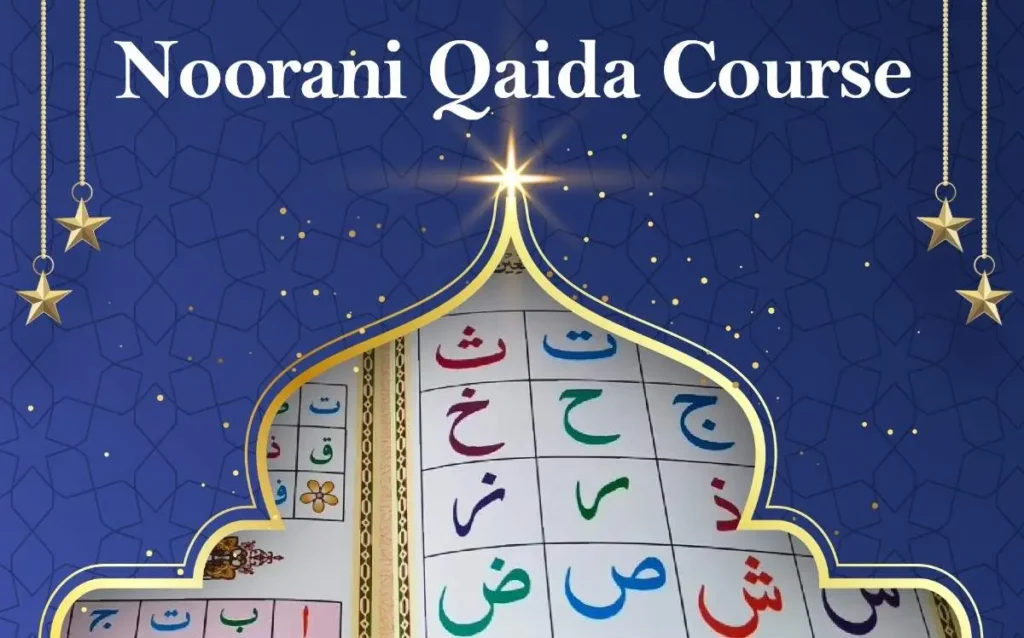
Noorani Qaida is the most widely used beginner’s reading primer for the Quran in the world. Noorani Qaida teaches Arabic letter recognition, correct articulation (Makharij al-huruf), and foundational Tajweed rules through exclusively Quranic vocabulary, making every lesson a direct connection to the Book of Allah.
What is the Origin of Noorani Qaida?
The Qaida was authored by Sheikh Noor Muhammad Haqqani, born in 1865 in the Punjab region of India. He completed his religious studies at a prominent seminary there, then pursued specialization in Hadith sciences under the scholar Ahmad Ali Saharanpuri.
He authored the Qaida as part of a broader educational methodology and passed away in 1925.
Why Is Every Word in the Noorani Qaida Taken from the Quran?
This design choice is intentional and significant. Unlike some alternative primers that include non-Arabic words for phonetic practice, the Noorani Qaida uses exclusively Quranic vocabulary. This means students are never practicing on unfamiliar or invented words — every sound they train corresponds to actual Quranic recitation.
In our experience at Buruj Academy, this approach dramatically shortens the transition from the Qaida to reading the Quran itself.
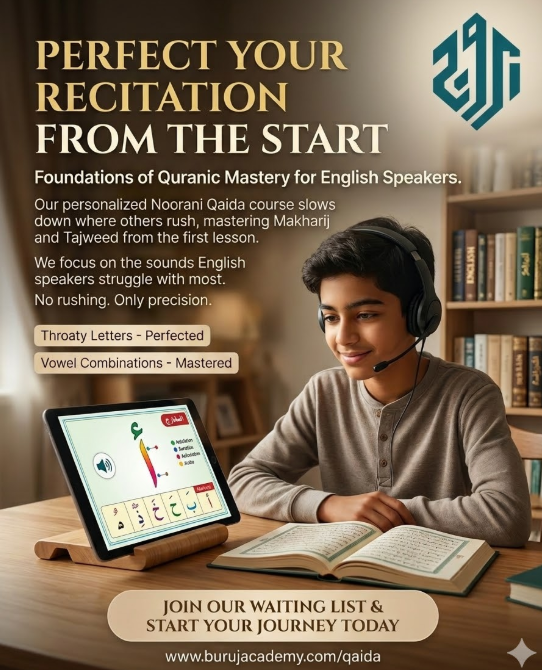
Our Noorani Qaida Online Course at Buruj Academy follows the original Haqqani structure with Tajweed integration built in from the first lesson.
Book your FREE trial lesson in the Noorani Qaida course
What Are the Topics Covered in Noorani Qaida?
The Noorani Qaida covers 16–17 structured lessons, each one building directly on the previous. Skipping ahead is not merely unhelpful — it creates foundational gaps that appear later as pronunciation errors in actual Quranic recitation.
| Lesson | Topic | Core Skill Developed |
| 1 | Individual Letters (Huroof al-Mufridat) | Letter recognition and Makharij |
| 2 | Compound Letters (Huroof al-Murakkabat) | Letter shape changes in words |
| 3 | Abbreviated Letters (Huroof al-Muqatta’at) | Recitation of disconnected Surah-opening letters |
| 4–5 | Short Vowels and Tanween | Fathah, Kasrah, Dammah, and double vowels |
| 6 | Harakaat and Tanween Practice | Reading complete simple words |
| 7–8 | Standing Vowels, Madd, and Leen | Letters of prolongation and their correct duration |
| 9 | Combined Practice | Harakaat, Madd, Leen, and Tanween together |
| 10–11 | Sukoon (Jazm) | Vowel-less letters and smooth consonant connection |
| 12–17 | Tashdeed and Advanced Combinations | Doubled letters combined with all previous rules |
Lessons 1-3: Arabic Alphabet Recognition and Makharij
The first lesson establishes the 29 Arabic letters with their correct Makharij — the precise articulation points in the mouth, throat, and lips from which each letter originates.
Students also begin distinguishing between heavy letters (Tafkhim) and light letters (Tarqiq) — a distinction that directly affects recitation accuracy.
Lessons 4–6: Short Vowels, Tanween, and Their Practice
Short vowels — Fathah, Kasrah, and Dammah — are introduced alongside Tanween, the doubled vowel marks that produce a nasal “nn” sound at word endings. In our Qaida sessions, we consistently find that non-Arabic speakers initially conflate Fathah and Tanween in fast recitation; dedicated practice in Lesson 6 corrects this before it becomes a habit.
For a deeper understanding of Arabic vowel marks, our blog on vowels in Arabic provides clear additional context.
Lessons 7–9: Madd, Leen, and Prolongation Rules
Madd (prolongation) is introduced here through the three letters: Alif, Waw, and Ya. The student learns not just that sounds are lengthened, but how long — establishing the foundational two-count natural Madd and differentiating it from the shorter Leen sounds found in words like خَوْف and بَيْت.
This precision is what separates Qaida-trained readers from those who simply memorized letter shapes.
Lessons 10–17: Sukoon, Tashdeed, and Mastery Combinations
Sukoon (the resting mark) teaches students to connect a voweled letter to a non-voweled one smoothly — a skill directly required for reading Arabic script. Tashdeed then requires the student to mentally “double” a letter and give it full emphasis.
The final lessons combine all previous rules into increasingly complex word formations drawn from Quranic verses.
What Are the Benefits and Importance of Noorani Qaida?
The Noorani Qaida is not simply a stepping-stone — it is a complete phonetic and Tajweed foundation. Its importance lies in what it prevents as much as what it teaches.
1. Makharij mastery prevents meaning errors
Arabic letters that sound similar to non-native ears — such as س and ص, or ح and ه — are actually produced at entirely different articulation points.
Mispronouncing them in Quranic recitation can alter meaning. The Qaida trains the ear and tongue before the student encounters full verses, preventing these errors from becoming ingrained.
2. Tajweed integration from day one
Unlike generic Arabic alphabet primers, the Qaida introduces Tajweed rules contextually — students hear and practice rules as they arise, not as an abstract list memorized separately. This aligns with the Buruj Method’s sound-before-rules approach used by our Ijazah-certified instructors at Buruj Academy.
3. Progressive confidence building
Adult beginners especially struggle with the pressure of “reading Arabic incorrectly.” The Qaida’s controlled, letter-by-letter progression means students build genuine competence at each stage. By the time they reach Lesson 10, they are already reading real Quranic words — and they know it.
For parents exploring options for their children, our guide on how to learn Arabic for kids covers how the Qaida fits within a broader Arabic learning plan.
Excel in Your Quranic Studies
Join Buruj Academy and master the Quran with our structured, professional curriculum.
Book Your Free TrialHow to Learn Noorani Qaida Effectively?
Learning Noorani Qaida effectively requires three things: a qualified teacher, a consistent schedule, and correct sequencing. Self-study using only audio recordings is possible for reinforcement, but cannot replace real-time pronunciation correction from a trained instructor — especially for makharij accuracy.
How to Teach Noorani Qaida to Beginners?
A teacher working through the Qaida should follow this progression:
- Introduce each letter audibly before visually — the student hears the sound before seeing the shape
- Isolate the Makhraj — demonstrate where the letter originates in the mouth or throat
- Contrast similar letters — pair ط with ت, or ذ with ز, to build discrimination
- Introduce vowel marks on mastered letters only — never before the base letter is secure
- Practice with Quranic words immediately — connect each lesson to real Quranic vocabulary
At Buruj Academy, our instructors follow this sequence in every Noorani Qaida for Beginners session. The most common mistake we observe in self-taught students is proceeding to Tanween before Harakaat are fully internalized — creating a shaky foundation that must be corrected later.
Book your FREE trial lesson in the Noorani Qaida course
How Long Does It Take to Finish the Qaida?
| Student Profile | Session Frequency | Estimated Completion Time |
| Child (age 4–7) | 3–4 sessions/week, 20–30 min each | 3–6 months |
| Child (age 8–12) | 3–5 sessions/week, 30 min each | 2–4 months |
| Teen or Adult Beginner | 3–5 sessions/week, 45 min each | 1–3 months |
| Adult with Prior Arabic Exposure | Daily 30-min sessions | 5–8 weeks |
These are instructional estimates from our teachers’ experience — individual pace varies based on consistency, mother tongue, and prior exposure to Arabic script.
Is Noorani Qaida the Best Choice for Kids?
For most children beginning Quranic reading, the Noorani Qaida is the strongest foundational choice. Noorani Qaida exclusive use of Quranic vocabulary means children are always practicing with meaningful, sacred language. Its progressive structure is also forgiving for young attention spans — each lesson is short enough to complete in a single focused session.
Children aged 4–7 typically engage best when lessons combine the Qaida’s content with visual aids, repetition songs, and letter games. Our Noorani Qaida for Kids course incorporates exactly this approach.
By age 8–10, children can move through the Qaida at a faster pace and are often ready to begin reading the Quran directly within 3–4 months of consistent study.
For broader context on supporting children with Arabic and Quranic learning, our blog on learning the Arabic alphabet for kids covers complementary strategies that reinforce Qaida lessons between sessions.
Sign up your kid for a free Noorani Qaida lesson

What Is the Difference Between Noorani Qaida and Madani Qaida?
The Noorani Qaida and Madani Qaida are both foundational Quranic reading primers, but they differ in several meaningful ways:
| Feature | Noorani Qaida | Madani Qaida |
| Author | Sheikh Noor Muhammad Haqqani | Developed and popularized in Madinah-based teaching circles |
| Vocabulary source | 100% Quranic words | Primarily Quranic, with some supplementary Arabic words |
| Tajweed integration | Woven throughout all lessons | Often introduced more explicitly in later lessons |
| Regional prevalence | South Asia, UK, US, global online | Gulf countries, Madinah-adjacent institutions |
| Lesson count | 17 lessons | Varies by edition (typically 12–15) |
| Phonetic focus | Makharij and Sifat from Lesson 1 | More gradual phonetic introduction |
Neither is definitively superior — the Noorani Qaida’s all-Quranic vocabulary gives it a slight edge for pure Quranic reading preparation, while the Madani Qaida’s structure may suit some institutional settings. At Buruj Academy, our curriculum uses the Noorani Qaida because its direct connection to Quranic text accelerates the student’s transition to actual Quran reading.
What Alternatives to Noorani Qaida Exist for Beginners?
Several alternatives exist for students or teachers seeking different approaches to foundational Quranic reading:
Qa’idat Noor al-Bayan is widely used in Gulf-based institutions and shares many structural similarities with the Noorani Qaida but includes additional phonetic exercises between lessons.
Al-Qa’idah al-Baghdadiyyah follows a comparable letter-to-word progression but includes some non-Quranic Arabic vocabulary, which may be more accessible for students learning Modern Standard Arabic simultaneously. Our blog on the easiest way to learn Arabic discusses how general Arabic learning and Quranic reading preparation can be structured in parallel.
Al-Qa’idah al-Fathiyyah adds some structural modifications introduced by Sheikh Fath al-Madani, and is sometimes preferred in Levantine teaching contexts.
For most non-Arabic speaking beginners in the West, the Noorani Qaida remains the most widely supported option — the largest pool of qualified teachers, the most available audio resources, and the most direct path to Quranic recitation.
Discover the Buruj Academy Difference
Step into our virtual classrooms and see how our expert instructors make learning Quran and Arabic intuitive and clear. We focus on overcoming the specific hurdles non-native speakers face, building your confidence and connection with the Quran.
Start Your Noorani Qaida Journey with Buruj Academy’s Expert Instructors
The Noorani Qaida is the most direct path from zero Arabic reading ability to confident Quranic recitation — but its effectiveness depends entirely on the quality of instruction guiding the journey.
Buruj Academy’s Noorani Qaida Online Course is taught by Al-Azhar University graduates and Ijazah-certified instructors with 12+ years of experience teaching non-Arabic speakers globally. Every session is personalized 1-on-1, fully online, and scheduled flexibly around your life.
Whether you are enrolling yourself or your child, our Noorani Qaida for Adults and Noorani Qaida for Kids courses provide structured, phonetically precise instruction from the very first letter.
Book your free trial lesson today and take the first step toward reading the Quran with confidence, Insha’Allah.
Start your path to excellence with one of our foundational tracks:
- Noorani Qaida Online Course (Comprehensive & Structured)
- Noorani Qaida Course for Beginners (Focus on Fundamentals)
- Noorani Qaida Course for Kids (Interactive & Engaging Lessons)
- Noorani Qaida Course for Adults (Tailored for Mature Learners)
- Noorani Qaida with Tajweed Course (Integration of Core Rules)
Ready to master the basics with precision? Join Buruj Academy today and book your free introductory session to begin your Quranic foundation!
Excel in Your Quranic Studies
Join Buruj Academy and master the Quran with our structured, professional curriculum.
Book Your Free TrialConclusion
The Noorani Qaida is far more than a beginner’s booklet — it is a carefully engineered phonetic and Tajweed foundation built entirely on Quranic language. From Sheikh Haqqani’s original vision in 19th-century Punjab to its global use today, its design has proven effective precisely because it trains the ear, tongue, and eye together from the very first lesson.
Whether you are a parent choosing a starting point for your child, an adult beginning this path for the first time, or a teacher seeking a reliable curriculum, the Noorani Qaida — when taught correctly and sequentially — gives every student the tools to approach the Quran with both accuracy and reverence.
Frequently Asked Questions About Noorani Qaida
At What Age Should a Child Begin Noorani Qaida?
Most children can begin the Noorani Qaida at age 4, particularly with a patient, child-trained instructor. At this age, sessions should be short — 15 to 20 minutes — and visually engaging. Children aged 6 and above typically progress through the Qaida faster and can handle 25 to 30-minute focused sessions comfortably.
Can Adults Learn Noorani Qaida Without Prior Arabic Knowledge?
Yes — the Noorani Qaida is designed precisely for complete beginners regardless of age. Adults often progress faster than children due to stronger focus and pattern recognition, though they may need extra time on Makharij since adult pronunciation habits are more established. Our Noorani Qaida for Adults course addresses adult-specific pronunciation challenges directly.
Is It Necessary to Learn Noorani Qaida Before Reading the Quran?
It is not technically mandatory, but it is strongly recommended for non-Arabic speakers. Attempting to read the Quran without proper letter recognition and basic Tajweed foundation leads to persistent mispronunciation errors that become very difficult to correct later. The Qaida prevents these errors before they form.
How Many Lessons Are in the Noorani Qaida?
The Noorani Qaida contains 17 structured lessons, progressing from individual letter recognition through short vowels, prolongation marks, Sukoon, and Tashdeed. Each lesson builds directly on the previous one. Completing all lessons in sequence, without skipping, is essential for genuine reading competence.
What Is the Difference Between Noorani Qaida and Tajweed?
The Noorani Qaida is a beginner reading primer that introduces foundational Tajweed concepts gradually within a letter-by-letter learning structure. Full Tajweed study goes significantly deeper — covering rules like Ikhfa, Idgham, Qalqalah, and Ghunnah in systematic detail. The Qaida prepares students for Tajweed study; it does not replace it. Our Noorani Qaida with Tajweed Course bridges both stages seamlessly.