 Quran
Quran

Surah Al Kahf is one of the most beloved surahs in the Quran, recited by millions every Friday in fulfillment of a well-established Sunnah. Yet its 110 verses, rich narrative complexity, and recurring similar-sounding passages make it one of the more challenging surahs for non-Arabic speakers to memorize with accuracy.
The most effective method to memorize Surah Al Kahf is to divide it into its four natural thematic stories, master the Tajweed of each section before memorizing it, and build a daily revision system that anchors new verses to previously secured ones.
Learners who follow a structured, phase-by-phase approach — rather than attempting the surah linearly from memory alone — consistently achieve stable, long-lasting memorization.
Table of Contents:
1. Understand Why Surah Al Kahf Is Worth Every Effort Before You Begin
The motivation behind your memorization determines whether you sustain it. Surah Al Kahf holds a specific prophetic distinction that makes it unique among longer surahs. The Prophet ﷺ said, as recorded in Sahih Muslim 809, that whoever recites Surah Al Kahf on Friday will have a light shine for him between two Fridays.
This hadith is not simply an encouragement — it is a built-in weekly renewal of purpose. In our experience at Buruj Academy, students who internalize the why behind this surah sustain their memorization through difficult weeks far better than those treating it as a purely academic exercise.
Understanding the surah’s four thematic stories also provides a mental architecture for memorization:
| Story | Verses | Core Theme |
| People of the Cave | 1–26 | Faith and divine protection |
| The Two Garden Owners | 27–44 | Gratitude vs. arrogance |
| Musa and Al Khidr | 45–82 | Knowledge and divine wisdom |
| Dhul Qarnayn | 83–110 | Power, justice, and accountability |
Knowing these four pillars means you never feel lost inside 110 verses — you always know which story you are in and what comes next.
2. Build a Realistic Daily Memorization Schedule for Surah Al Kahf
To memorize Surah Al Kahf with lasting retention, you must plan your timeline before you begin — not after frustration sets in. At Buruj Academy, our Online Hifz Program uses structured scheduling as the first lesson, not an afterthought.
Start Hifz today with a FREE trial session

Surah Al Kahf contains 110 verses. Below is a realistic planning guide based on daily verse targets:
| Daily New Verses | Estimated Completion | Suited For |
| 3 verses/day | ~37 days | Busy adults, beginners |
| 5 verses/day | ~22 days | Intermediate learners |
| 7 verses/day | ~16 days | Advanced students with prior Hifz experience |
The most important scheduling principle is this: never separate new memorization from revision.
For every 5 new verses you add, spend equal time reviewing the verses already memorized. Students who skip this step almost always find their early verses fading before they reach verse 50.
For a deeper look at building a sustainable system, our guide on Quran memorization schedules walks through weekly planning in detail.
3. Master the Tajweed of Each Section Before You Memorize It
Memorizing words incorrectly is far worse than not memorizing them at all — because every wrong pronunciation becomes a habit requiring intensive correction later. This is the most consistent mistake we see from self-taught learners coming to Buruj Academy for the first time.
Before memorizing any section of Surah Al Kahf, recite it aloud with correct Tajweed until you can do so fluently. The surah contains several rules that appear repeatedly and demand active attention:
What Are the Key Tajweed Rules Found in Surah Al Kahf?
Surah Al Kahf presents a rich environment for Tajweed application. The following rules appear with high frequency:
Ghunnah (nasal sound): The recurring Noon and Meem Mushaddad throughout the surah require a sustained two-count nasal resonance. Our detailed guide on Ghunnah and its rules will help you apply this accurately.
Ikhfa: Noon Sakinah followed by Ikhfa letters appears frequently. Review the Ikhfa letters in Tajweed to approach these passages with confidence.
Idgham: Merging rules apply at several verse boundaries. Understanding Idgham rules in Tajweed before reaching these passages prevents habitual errors.
Madd (elongation): Surah Al Kahf contains multiple Madd types — particularly Madd Tabii and Madd Lazim — that affect recitation rhythm significantly.
If you are not yet confident in these rules, Buruj Academy’s Tajweed for Beginners course provides the exact foundational grounding you need before memorization.
Book Your FREE Trial Lesson to Begin Your Tajweed Journey

4. Begin With the First Story (Verses 1–26) Using the Chunking Method
The first story — the People of the Cave — opens with verses of powerful, flowing rhythm that are relatively accessible for new memorizers. Begin here, not because it is easy, but because its narrative arc gives you natural memory anchors.
The Chunking Method divides each story into micro-units of 3–5 verses. Memorize each chunk completely before moving to the next. Within each chunk, use this sequence:
- Listen to the chunk recited by a qualified reciter at least 5 times before attempting to repeat
- Recite aloud slowly with mushaf open, focusing on Tajweed accuracy
- Close the mushaf and attempt recitation from memory — returning to it immediately on error
- Repeat until 3 consecutive error-free recitations are achieved
- Link the new chunk to the previous one by reciting both together
For verses 1–10, pay particular attention to the opening:
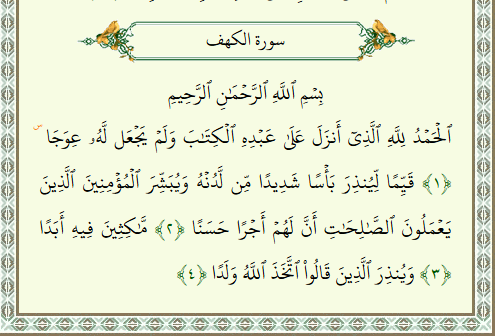
الْحَمْدُ لِلَّهِ الَّذِي أَنزَلَ عَلَىٰ عَبْدِهِ الْكِتَابَ وَلَمْ يَجْعَل لَّهُ عِوَجًا
Alhamdu lillahil-ladhī anzala ʿalā ʿabdihil-kitāba wa lam yajʿal lahū ʿiwajā
“[All] praise is [due] to Allah, who has sent down upon His Servant the Book and has not made therein any deviance.” (Al Kahf 18:1)
Read also: The 3×3 Quran Memorization Method
5. Identify and Drill the Mutashabihat (Similar Verses) in Al Kahf Specifically
Surah Al Kahf contains a feature that makes it uniquely challenging: mutashabihat — verses that are structurally or lexically similar and easily confused during recitation. This is where most memorizers experience mid-surah collapse.
How Do You Prevent Confusing Similar Verses in Al Kahf?
The most effective technique we use at Buruj Academy is what we call contrast drilling — deliberately reciting two similar verses back-to-back, identifying exactly where they differ, and verbally naming the difference before moving on.
Creating a personal “confusion map” — a simple list of your specific problematic verse pairs — and reviewing it daily for two weeks produces measurable improvement in 95% of the students we work with.
Excel in Your Quranic Studies
Join Buruj Academy and master the Quran with our structured, professional curriculum.
Book Your Free Trial6. Memorize the Second Story (Verses 27–44) With Context-Anchoring Techniques
The story of the Two Garden Owners spans verses 27–44 and contains some of the surah’s most vivid imagery. Context-anchoring uses the story’s visual narrative as a memory scaffold — associating each verse with a specific scene in the story’s sequence.
As you memorize this section, actively visualize the narrative: the arrogant man surveying his lush gardens, his companion’s warning, and the eventual destruction of everything the man had prized. Each verse becomes a scene marker, not just a string of words.
This approach — using meaning as a memory aid — is one of the most underutilized techniques for non-Arabic speakers. It requires a basic understanding of the story, which is why reading a reliable Tafsir summary before beginning each section is part of our standard methodology.
Buruj Academy’s Hifz for Adults course integrates this context-anchoring system directly into lesson planning, making it structured rather than ad hoc.
Book Your Free Trial Lesson with Buruj’s Hifz Course for Adults

7. Approach the Musa and Al Khidr Story (Verses 45–82) as Four Distinct Episodes
The longest and most complex story in Surah Al Kahf — the story of Musa and Al Khidr — spans 38 verses and contains four distinct episodes. Treating it as one block is the primary reason students lose their memorization of this section within weeks.
Divide it into episodes:
| Episode | Verses | Scene |
| The meeting and agreement | 65–70 | Musa meets Al Khidr and agrees to conditions |
| The boat | 71–73 | Al Khidr damages the boat — Musa questions |
| The boy | 74–76 | Al Khidr takes the boy’s life — Musa questions |
| The wall | 77–78 | Al Khidr rebuilds the wall — explanation begins |
| The explanations | 79–82 | Al Khidr reveals the wisdom behind each act |
Memorize each episode to completion and link them sequentially before moving to the Dhul Qarnayn story. This prevents the notorious mid-story collapse many students experience around verse 70.
Read also: Best Websites to Read and Study the Quran Online
8. Complete the Final Story (Verses 83–110) and Solidify the Full Surah Connection
The Dhul Qarnayn story (verses 83–110) closes Surah Al Kahf with a distinct rhythmic shift. Its shorter verse structure makes memorization faster — but this can create a false sense of security that leads to under-revision.
Memorize this section using the same chunking method as earlier stories. Once complete, your most important task begins: full-surah recitation from memory, from verse 1 to verse 110, without interruption.
The first time you attempt this, expect errors — particularly at story transitions. These transition points (verses 26–27, 44–45, 82–83) are where the brain’s indexing of stories as separate units creates hesitation. Drilling transitions as dedicated 5-minute daily sessions closes this gap quickly.
For guidance on sustaining motivation during the final phase of memorization, our article on the benefits of memorizing Quran is worth reading before you reach this stage.
9. Build a Non-Negotiable Weekly Revision System for Surah Al Kahf
Memorizing Surah Al Kahf is only half the achievement. Without structured revision, the average non-Arabic speaker begins losing verses within 10–14 days of their last review. This is not a personal failure — it is how human memory works without reinforcement.
A practical weekly revision structure for Surah Al Kahf looks like this:
| Day | Revision Focus |
| Saturday | Verses 1–30 |
| Sunday | Verses 31–60 |
| Monday | Verses 61–90 |
| Tuesday | Verses 91–110 |
| Wednesday | Full surah recitation (continuous) |
| Thursday | Weak spots and mutashabihat drilling |
| Friday | Full recitation as Sunnah — ideally in Salah |
The Friday recitation as an act of worship — not merely a review — is the most powerful revision habit we have observed across years of teaching. Students who recite Al Kahf in Friday prayer or as a dedicated post-Fajr recitation retain it at dramatically higher rates than those who review it academically only.
Our full guide on how to memorize Quran faster includes additional retention strategies directly applicable here.
10. Record Yourself and Submit to Qualified Correction Regularly
Self-assessment is unreliable for Quran memorization. The human ear adapts to its own recitation patterns — including its errors — making it genuinely difficult to detect your own mispronunciations or dropped vowels after weeks of solo practice.
Recording your recitation and submitting it to a qualified teacher for correction is not optional for serious memorizers. It is the mechanism that separates memorization that will hold for life from memorization that quietly deteriorates.
At Buruj Academy, our Online Hifz Program includes regular recitation sessions with Al-Azhar-trained Hifz specialists who provide immediate, verse-by-verse correction in real-time. Students who work with our instructors consistently detect and correct errors in their Al Kahf memorization that they had unknowingly carried for months during self-study.
Read also: How to Memorize a Surah in 30 Minutes?
Discover the Buruj Academy Difference
Step into our virtual classrooms and see how our expert instructors make learning Quran and Arabic intuitive and clear. We focus on overcoming the specific hurdles non-native speakers face, building your confidence and connection with the Quran.
Accelerate Your Surah Al Kahf Memorization with Buruj Academy’s Online Hifz Program
Memorizing Surah Al Kahf with lasting accuracy requires more than determination — it requires a structured system and qualified guidance.
Buruj Academy’s Online Hifz Program provides exactly that, delivered by Al-Azhar University graduates and Ijazah-certified instructors with 12+ years of experience teaching non-Arabic speakers worldwide.
Our instructors apply the Buruj Method — Consistency-before-speed and Patience-before-performance — to build retention that lasts, not just memorization that passes.
You receive personalized 1-on-1 sessions, a customized revision schedule, and real-time correction tailored to your level and schedule.
Book your free trial lesson today and take the first structured step toward memorizing Surah Al Kahf with confidence and accuracy.
Take the first step toward this lifelong blessing by enrolling in a program tailored to your pace:
- Online Hifz Program (Comprehensive Quran Memorization)
- Juz 30 Memorization Course (Perfect for focused starts)
- Hifz Classes for Kids (Engaging and interactive)
- Hifz Classes for Adults (Flexible scheduling for busy lives)
- Hifz Classes for Sisters (Private, supportive learning)
- Short Surah Memorization Course (Ideal for daily prayers)
- Hifz Ijazah Course (For advanced students seeking certification)
Don’t let another day pass without moving closer to your goal. Join Buruj Academy today and schedule your free trial session to begin your Hifz journey!
Excel in Your Quranic Studies
Join Buruj Academy and master the Quran with our structured, professional curriculum.
Book Your Free TrialConclusion
Memorizing Surah Al Kahf is one of the most rewarding goals a Muslim can set — and one of the most achievable, when approached with the right structure. The key is not speed or talent; it is the combination of thematic division, Tajweed accuracy, active revision, and consistent accountability that transforms 110 verses from an overwhelming list into a living part of your worship.
Every Friday you recite this surah in full is a reminder of why the effort was worth it. Start with one story, build one habit, and trust the process — Insha’Allah, the light mentioned in the hadith is waiting on the other side of your consistency.
Frequently Asked Questions About How to Memorize Surah Al Kahf
How Long Does It Take to Memorize Surah Al Kahf?
Most adult non-Arabic speakers memorizing 3–5 verses per day complete Surah Al Kahf in 22–37 days of new memorization. Adding consistent daily revision, the full process of stable, reliable memorization typically spans 6–10 weeks. Learners with prior Hifz experience or strong Tajweed foundations progress more quickly.
What Is the Best Time of Day to Memorize Surah Al Kahf?
Post-Fajr is the most consistently effective memorization window, combining spiritual focus with proven cognitive receptivity. Our guide on the best time to memorize Quran details both the spiritual and scientific reasoning. Evening sessions before sleep are effective for revision rather than new memorization.
Is It Necessary to Understand Arabic to Memorize Surah Al Kahf?
You do not need to speak Arabic fluently, but understanding the basic meaning of each verse significantly strengthens retention. Reading a translation and brief Tafsir summary of each story before memorizing it gives your memory semantic anchors — turning word strings into meaningful scenes that the brain holds far more reliably.
Can Children Memorize Surah Al Kahf Successfully?
Yes — children typically memorize Surah Al Kahf more quickly than adults due to stronger phonetic plasticity, but they require shorter daily sessions (10–15 minutes) and more gamified review methods. Buruj Academy’s Hifz for Kids course uses age-appropriate techniques that build both memorization accuracy and genuine love for the surah.