 Quran
Quran
| Key Takeaways |
| Children aged 4–7 absorb and retain Quranic verses most naturally due to peak phonological memory development. |
| Starting with short surahs from Juz’ 30 builds early confidence and creates sustainable memorization momentum for young learners. |
| Daily consistency of even 10–20 minutes outperforms long, irregular sessions in building lasting Hifz habits for children. |
| Proper Tajweed from day one prevents deeply ingrained mispronunciation errors that become harder to correct as children grow. |
| A qualified Hifz teacher provides structured revision systems that parents alone cannot replicate through self-guided home practice. |
Every parent who has watched their child recite even one ayah from memory understands the indescribable feeling that follows — a mixture of pride, gratitude, and the quiet awareness that something spiritually significant just happened.
For Muslim parents in the West, the question is rarely whether to pursue this goal — it is how to pursue it practically, within real life, with real children.
Making your child memorize the Quran requires a structured, age-appropriate approach: short daily sessions, correct Tajweed from the start, strategic surah selection, qualified teacher guidance, and a home environment that treats the Quran as a living presence — not a school subject.
Table of Contents:
1. Start at the Right Age to Build the Strongest Memorization Foundation
The optimal window to begin Quran memorization for most children is between ages 4 and 7. At this stage, the phonological memory — the brain’s capacity to absorb and replicate sounds — is at its developmental peak.
Children at this age do not need to understand every word to retain it; they absorb patterns, rhythms, and repetition with remarkable ease.
This does not mean younger children cannot benefit from Quranic exposure — in fact, reciting to infants and toddlers plants seeds of familiarity that ease later formal memorization.
However, structured Hifz works best when a child can follow simple instructions, sit for short sessions, and repeat phrases consistently.
Our article on the best age to memorize Quran explores this developmental window in depth, including what research and classical Islamic scholarship both confirm about early childhood memorization.
What If Your Child Is Older?
Children aged 8–12 memorize with greater comprehension and can handle longer sessions, making this stage equally productive — just with different methods.
Teenagers require motivation-centered approaches alongside structure. No age is too late; the approach simply shifts.
2. Ensure Your Child Learns Correct Tajweed Before Memorizing Full Surahs
Memorizing words with incorrect pronunciation creates a far harder problem than starting slowly with correct articulation. Once a child’s muscle memory locks in a mispronounced letter — a ق that sounds like a ك, or a ض articulated from the wrong point — correcting it later requires unlearning deeply embedded patterns.
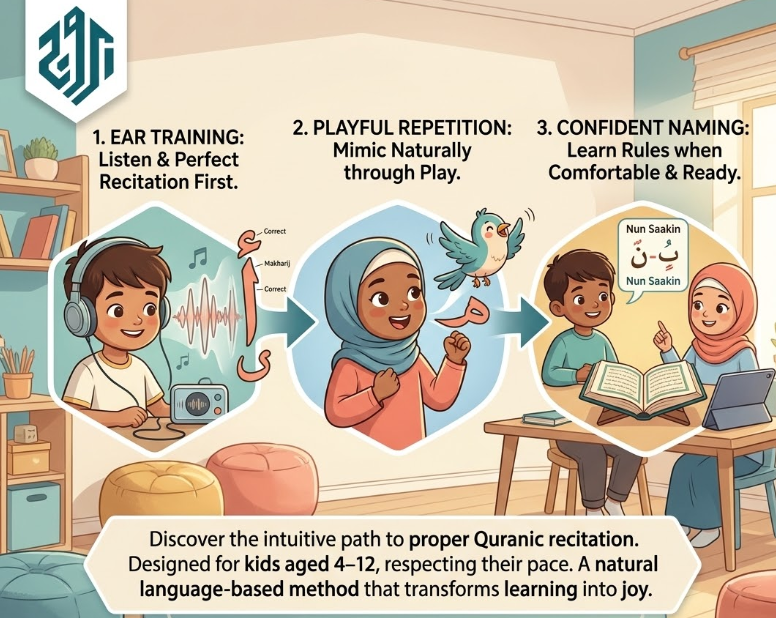
Before or alongside early memorization, every child needs foundational Tajweed exposure. This does not mean overwhelming a five-year-old with rule names.
It means ensuring their teacher models correct sounds and gently corrects errors from the first session — training the ear before demanding output.
Buruj Academy’s Tajweed for Kids course integrates Tajweed correction into every memorization session from day one. Our Al-Azhar-trained Hifz specialists and Ijazah-certified instructors ensure that what your child memorizes is recited correctly — not just repeated.
Book your child’s free Tajweed trial lesson today
For parents wanting to understand the foundational rules their child will encounter, our Tajweed for beginners guide provides a clear starting point.
| Age Group | Tajweed Focus at This Stage |
| 4–6 years | Listening and repeating — ear training, basic makharij modeled by teacher |
| 7–9 years | Introduction to noon sakinah rules, madd basics, simple letter distinctions |
| 10–12 years | Formal Tajweed rule names alongside memorization, self-correction habits |
| 13+ years | Full rule application with live recitation review each session |
3. Begin with the Shortest Surahs to Build Real Confidence Early
The single most effective starting point for a child’s Hifz is Juz’ 30 — the final section of the Quran, containing the shortest surahs most frequently recited in daily prayer. Starting here is not a compromise; it is sound pedagogical strategy.
When a child memorizes Surah Al-Ikhlas, Al-Falaq, and An-Nas within their first weeks, they experience an early and genuine sense of achievement.
This positive experience — “I memorized part of the Quran” — activates intrinsic motivation that no external reward system can replicate as effectively.
Our guides on the easiest surahs to memorize and the shortest surahs to memorize provide sequenced recommendations for building this early foundation systematically.
Recommended Starting Sequence for Young Children
- Surah Al-Fatiha (7 ayat) — foundational for prayer
- Surah Al-Ikhlas (4 ayat) — short, rhythmic, theologically rich
- Surah Al-Falaq and An-Nas (5 and 6 ayat) — natural pair, builds pattern recognition
- Surah Al-Kawthar (3 ayat) — shortest surah, immediate win
- Progress through Juz’ 30 in reverse order (114 down to 78)
4. Establish a Daily Memorization Routine That Fits Real Family Life
Consistency is the single most powerful variable in a child’s Hifz progress — more than talent, more than session length, and more than the method used. A child who memorizes for 15 minutes every day will reliably outperform one who memorizes for 90 minutes twice a week.
In our experience working with families across the West through Buruj Academy, the sessions most likely to be abandoned are those scheduled for inconvenient times without backup plans.
The sessions most likely to succeed are anchored to an existing daily habit — after Fajr, before school, directly after dinner, or as part of a bedtime routine.
Short, protected, and non-negotiable is the goal. Even on difficult days, a five-minute review of previously memorized material keeps the habit alive and prevents forgetting.
| Session Component | Time Allocation | Purpose |
| Revision of yesterday’s new verse(s) | 3–5 minutes | Consolidates short-term memory |
| Revision of older memorized surahs | 5–7 minutes | Prevents decay, builds long-term retention |
| New memorization | 10–15 minutes | Incremental progress |
| Listening to recitation (audio) | 3–5 minutes | Trains ear, reinforces correct sound |
Our Quran memorization schedule guide offers ready-to-use weekly structures that families can adapt to their specific household rhythms.
5. Use Repetition Strategically Rather Than Simply Repeating More Times
Not all repetition is equal. Research in cognitive science — and centuries of Islamic pedagogical tradition — confirm that spaced repetition (reviewing material at increasing intervals) produces far more durable memorization than massed repetition (repeating the same thing many times in one sitting).
For children, this means a new ayah memorized today should be reviewed tomorrow, then three days later, then a week later, then again after two weeks. This spaced pattern moves the verse from short-term working memory into long-term retention — the goal of every Hifz session.
Practically, this means your child’s daily session should always include review of older material alongside new memorization.
A common error many parents make is focusing entirely on new verses while neglecting older ones — resulting in a child who can recite the newest surah but has forgotten what was memorized three weeks prior.
The Prophet ﷺ emphasized protecting what has been memorized. As recorded in Sahih al-Bukhari (hadith 5031), he described the Quran as being like a camel that must be tied — if left unattended, it escapes. This is the classical foundation of the revision-first principle in Hifz pedagogy.
Excel in Your Quranic Studies
Join Buruj Academy and master the Quran with our structured, professional curriculum.
Book Your Free Trial6. Enroll Your Child with a Qualified Hifz Teacher Who Understands Child Pedagogy
A qualified teacher transforms a child’s Hifz from a parent-managed effort into a structured, accountable learning system. The teacher’s role is not simply to listen and correct — it is to sequence the material intelligently, manage the revision load, adjust the pace based on the child’s current retention capacity, and provide the corrective feedback that parents, without Tajweed expertise, cannot reliably provide.
In our sessions at Buruj Academy, we consistently observe that children enrolled in structured 1-on-1 Hifz classes memorize with greater accuracy and retain material significantly longer than children relying on parental guidance alone.
The accountability of a scheduled session — a real teacher expecting preparation — also builds discipline that extends beyond Quran learning.
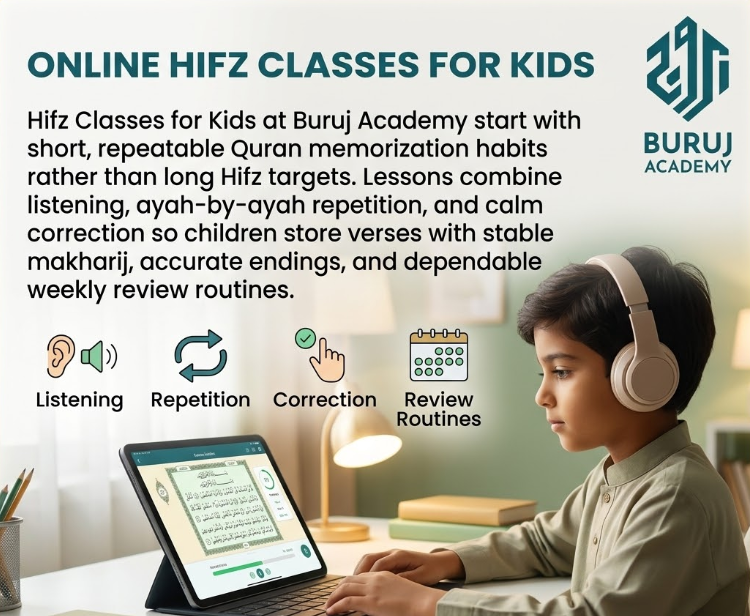
Buruj Academy’s Online Hifz Program for kids pairs each child with an Al-Azhar-trained Hifz specialist experienced in child-appropriate pacing, positive reinforcement, and Tajweed-integrated memorization. Flexible scheduling means sessions fit around school, sports, and family commitments.
Start your child’s Hifz classes with a FREE session
What to Look for in a Hifz Teacher for Your Child
- Ijazah certification in Quran recitation — ensures the chain of correct transmission
- Experience teaching children specifically — adult Hifz teachers do not automatically translate to child pedagogy
- Patience and a positive correction style — harsh correction creates anxiety, which impedes memory
- A clear revision system — not just new memorization each session
Book Your Kid a Free Trial Lesson With One of Buruj’s Quran Tutors for Children

Read also: The Importance of Memorizing Quran for Kids
7. Create a Quran-Rich Home Environment That Supports Daily Exposure
A child memorizes most effectively when the Quran is not confined to a single daily session but exists as a natural part of the home’s soundscape. Passive listening — hearing correct recitation played during meals, car rides, or before sleep — reinforces the sound patterns the child is actively memorizing in their sessions.
This environmental approach is well-established in language acquisition research and applies equally to Quran memorization.
A child who has heard Surah Al-Mulk recited correctly dozens of times before formally memorizing it will find the memorization session dramatically easier, because the sounds are already familiar.
Simple, practical ways to build this environment include playing a recitation of the current surah being memorized in the background daily, reciting the memorized surahs aloud in prayer so the child hears them in context, and making Quran recitation a visible, valued part of parent behavior — not just an assignment given to the child.
For parents looking for practical tools to support this at home, our Quran learning tools for kids and Quran activities for kids guides offer hands-on, tested resources.
8. Use Motivation Systems That Build Intrinsic Love for the Quran
External reward systems — sticker charts, prizes, screen-time privileges — can be effective short-term tools for establishing a habit. However, parents who rely on external rewards beyond the early habit-formation stage often find that motivation collapses the moment the reward is removed.
The deeper goal is helping a child develop an internal relationship with the Quran — where memorizing feels meaningful rather than transactional. This comes from how parents talk about the Quran in the home, the reverence shown during recitation, and the visible joy expressed when the child recites correctly.
Sharing age-appropriate Quran facts for kids and prophets’ stories in Islam for kids builds the child’s connection to the broader Quranic world — giving the memorization personal meaning beyond completing an assignment.
Effective Motivation Strategies by Age
| Age | What Works Best |
| 4–6 years | Praise, physical affection, small immediate rewards, parental excitement |
| 7–9 years | Progress charts visible to the child, milestone celebrations, peer recognition |
| 10–12 years | Purpose-based conversations about why Hifz matters, longer-term goal setting |
| 13+ years | Autonomy in scheduling, understanding the spiritual weight of being a Hafiz |
Do Children Memorize the Quran Before Learning to Read?
Yes, children memorize the Quran before learning to read, and this is both historically established and practically sound. For centuries, Muslim children across the Arab world and beyond memorized significant portions of the Quran entirely through listening and oral repetition, before developing formal reading ability.
Young children aged 3–6 are in many cases better served by purely auditory memorization — hearing their teacher recite and repeating back — than by attempting to read Arabic script they have not yet mastered.
Reading and memorization are distinct skills that can be developed in parallel or sequentially, depending on the child’s age and readiness.
This does not mean reading should be postponed indefinitely. A child who memorizes without eventually learning to read Arabic cannot independently review their Hifz through the Mushaf, which creates dependency on audio alone.
The practical recommendation is to begin basic Arabic letter recognition — through a structured Noorani Qaida for Kids course — alongside or shortly after beginning memorization, so both skills develop in a reinforcing relationship.
Sign up your kid for a free Noorani Qaida lesson

How to Help Kids with Hifz Quran When They Hit a Memorization Plateau?
Every child going through Hifz will reach a point where new memorization feels harder, previously memorized material slips, and motivation dips. This is not failure — it is a predictable phase in any sustained learning process, and knowing it is coming allows parents to respond wisely rather than reactively.
The most common cause of a plateau is an overloaded revision pile. As the total amount of memorized material grows, the daily review time required grows proportionally.
If the revision system is not adjusted, older surahs begin fading while new memorization continues — and the child feels they are losing ground faster than gaining it.
The correct response is a temporary pause on new memorization and a focused consolidation period — reviewing all memorized material systematically until it is solid before adding new verses.
Our guide on memorizing Quran faster covers practical plateau-recovery strategies applicable to children and adults alike.
Additionally, revisiting the best time to memorize Quran can help parents identify whether the session timing itself needs adjustment — early morning sessions after Fajr, for instance, consistently produce stronger retention across all age groups.
Read also: Juz Amma Memorization for Kids
Discover the Buruj Academy Difference
Step into our virtual classrooms and see how our expert instructors make learning Quran and Arabic intuitive and clear. We focus on overcoming the specific hurdles non-native speakers face, building your confidence and connection with the Quran.
Start Your Child’s Hifz with Buruj Academy’s Expert Instructors
Helping your child memorize the Quran is one of the most meaningful investments a parent can make — and it deserves expert guidance from the very first session.
Buruj Academy’s Hifz for Kids course provides:
- Al-Azhar-trained Hifz specialists and Ijazah-certified instructors with 12+ years teaching non-Arabic-speaking children
- The Buruj Method: Consistency-before-speed, Tajweed-integrated from day one
- Personalized 1-on-1 sessions with structured revision systems tailored to your child’s age and pace
- Flexible 24/7 scheduling built around school and family life
- Real-time correction and measurable progress from the first lesson
Book a free trial lesson and let your child’s Hifz begin with the foundation it deserves.
Take the first step toward this lifelong blessing by enrolling in a program tailored to your pace:
- Online Hifz Program (Comprehensive Quran Memorization)
- Juz 30 Memorization Course (Perfect for focused starts)
- Hifz Classes for Kids (Engaging and interactive)
- Hifz Classes for Adults (Flexible scheduling for busy lives)
- Hifz Classes for Sisters (Private, supportive learning)
- Short Surah Memorization Course (Ideal for daily prayers)
- Hifz Ijazah Course (For advanced students seeking certification)
Don’t let another day pass without moving closer to your goal. Join Buruj Academy today and schedule your free trial session to begin your Hifz journey!
Excel in Your Quranic Studies
Join Buruj Academy and master the Quran with our structured, professional curriculum.
Book Your Free TrialConclusion
Making your child memorize the Quran is not a single decision — it is a series of daily, loving choices: the right starting age, the right teacher, the right environment, and the right rhythm of new memorization and patient review.
The steps above are not theory. They are what we have seen work, consistently, across hundreds of children taught through Buruj Academy.
The families who succeed are not the ones with the most time or the most resources. They are the ones who begin with a clear structure and protect it.
Start where your child is, build the habit before the workload, and trust that small, consistent steps accumulate into something extraordinary — a child who carries the words of Allah ﷻ in their heart.
Frequently Asked Questions About How to Make Your Child Memorize the Quran
What is the best age to start Quran memorization for a child?
Most children are ready to begin structured Hifz between ages 4 and 7, when phonological memory is strongest and auditory repetition comes most naturally. However, children aged 8–12 memorize with comprehension advantages. The best age is when your individual child can follow simple instructions, repeat phrases, and maintain short sessions.
How many verses should a child memorize per day?
For children aged 4–7, one to three short ayat per day is realistic and sustainable. Children aged 8–12 can handle three to five ayat daily depending on verse length. Quality and correct Tajweed always outweigh quantity — a child who memorizes two verses correctly retains them far longer than one who rushes through five.
Do children need to learn Arabic before memorizing the Quran?
No — children can and regularly do memorize Quran before reading Arabic. Young children memorize auditorily through listening and repetition. However, learning basic Arabic letter recognition through a foundational course like Noorani Qaida should run alongside or shortly after memorization begins, enabling independent Mushaf review as the child grows.
How do I stop my child from forgetting what they have memorized?
Forgetting is prevented through a structured daily revision system — not just continuous new memorization. Every session must include review of recent and older material before any new verses are added. As the total memorized amount grows, the revision portion of each session should grow proportionally. A qualified Hifz teacher will manage this system on your behalf.
How long does it take for a child to memorize the entire Quran?
With consistent daily sessions of 20–30 minutes guided by a qualified teacher, children typically complete the full Quran in 3–7 years, depending on their age, starting point, consistency, and natural aptitude. Children who begin around ages 5–7 with strong daily habits regularly complete their Hifz by ages 10–14, Insha’Allah.