 Quran
Quran
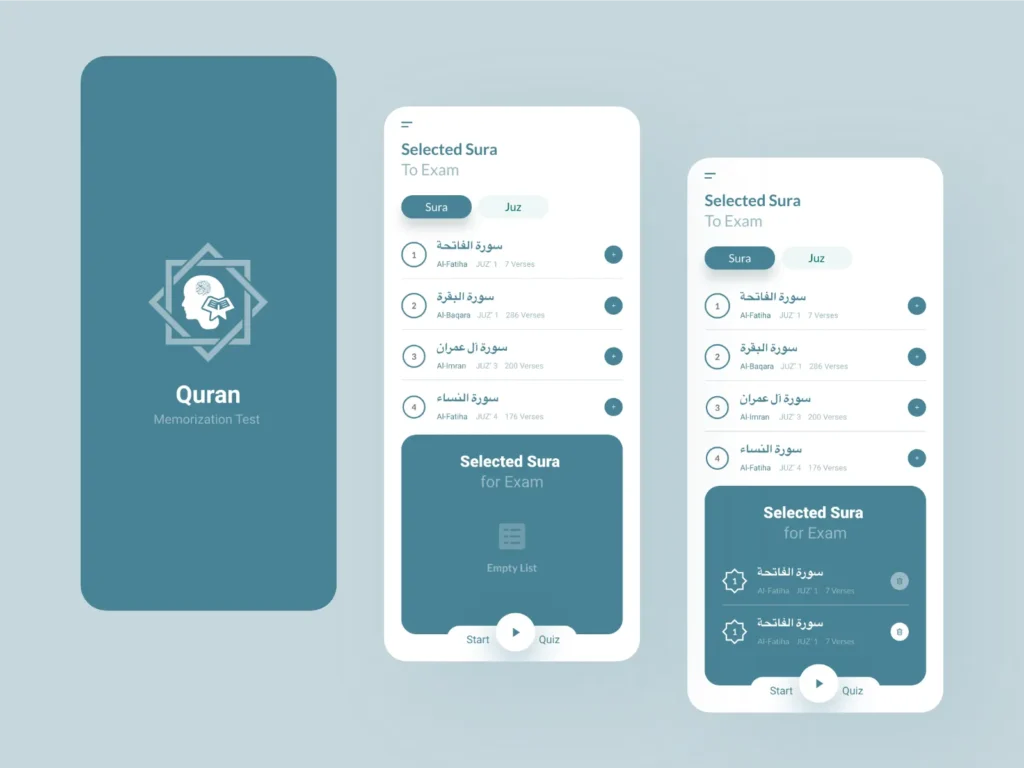
Knowing that you have memorized a surah and being able to recite it accurately under pressure are two very different things.
Many students discover this gap only when they sit before a teacher and the words suddenly feel less certain than they did during solo practice.
A proper Quran memorization test is not meant to intimidate — it is a diagnostic tool that reveals exactly where your Hifz is solid, where revision is needed, and what your honest next step should be.
In this article, we walk you through actual test questions for each Hifz level, so you can assess your standing right now.
Table of Contents:
What Does a Quran Memorization Test Actually Measure?
A Quran memorization test measures three interconnected skills: retention accuracy (can you recall the words without error?), Tajweed application (are the rules correct during recitation?), and revision consistency (can you recite reliably, not just once but repeatedly?). All three must be present for Hifz to be considered complete.
In Buruj’s Azhari Quran tutors’ experience, students often overestimate their retention because they test themselves sequentially — always starting from the beginning of a surah.
Book a FREE trial session with one of Buruj’s Azhari Quran tutors

A real Hifz evaluation will ask you to begin from the middle of a page, or to continue after a specific verse the teacher points to. That is the standard we use, and it is the standard you should prepare for.
| Assessment Area | What It Tests | Common Weakness Found |
| Verbal Retention | Recall of exact words and sequence | Skipping or substituting similar-sounding words |
| Tajweed Accuracy | Rules applied during recitation | Ghunnah length, Madd counts, Qalqalah echo |
| Revision Consistency | Reliability across sessions | Strong in new portions, weak in older ones |
| Transition Points | Moving between surahs or pages | Losing flow at the start of a new surah |
Each of the sections below presents a specific Hifz level with authentic test questions you can use today for self-assessment.
Level 1 Quran Memorization Test
A beginner Hifz test focuses on Juz 30 surahs — specifically the last 10 to 15 surahs — and evaluates whether the student has memorized the words accurately, recites with basic Tajweed, and can maintain flow without reverting to reading. This level does not require mastery of complex rules, but it does require correctness.
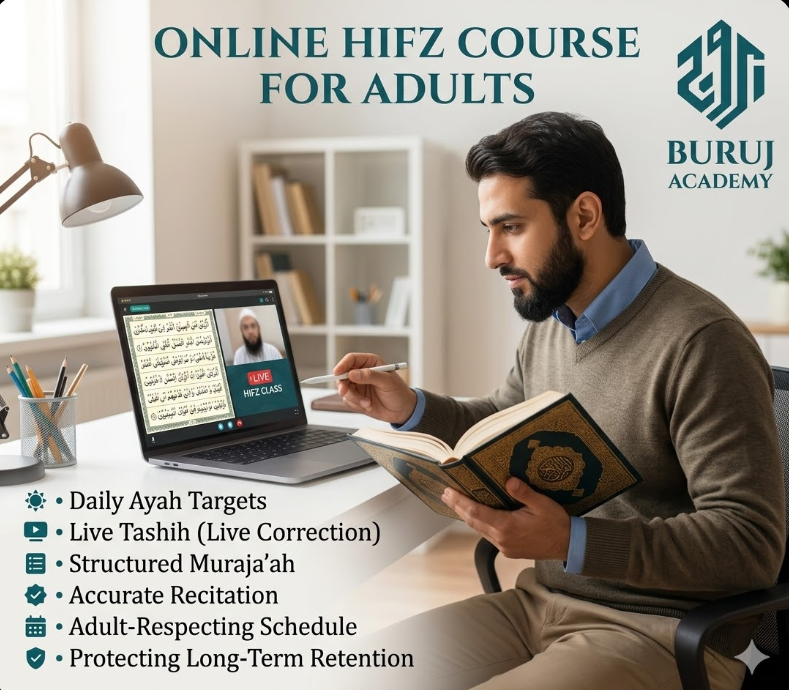
If you are just beginning your memorization path, our Hifz for Beginners course — or for adults specifically, our Hifz for Adults program — gives you a structured starting point with Al-Azhar-trained Hifz specialists who set the right foundation from day one.
Book Your Free Trial Lesson with Burruj’s Hifz Course for Adults
Test Yourself: Beginner Level Questions
Try these questions honestly. Recite aloud — do not read from the Mushaf.
Question 1:
Recite Surah Al-Ikhlas (112:1–4) from memory, then recite Surah Al-Falaq (113:1–5) immediately after without pausing.
What is expected: Smooth transition between the two surahs, correct Ghunnah on the Noon and Meem letters, and no dropped words in Al-Falaq’s longer verses.
Question 2:
In Surah Al-Fil (105:1–5), what comes after أَلَمْ تَرَ كَيْفَ فَعَلَ رَبُّكَ بِأَصْحَٰبِ ٱلْفِيلِ? Continue reciting from that verse.
What is expected: Whether you can pick up mid-surah without restarting from the beginning — a key indicator of genuine memorization versus surface recall.
Question 3:
Recite the three verses of Surah Al-Kawthar (108:1–3). Then explain: is there a Madd in this surah? Where?
What is expected: Identification of إِنَّ شَانِئَكَ هُوَ ٱلْأَبْتَرُ with correct Madd Tabee’i on the Alif in “شَانِئَكَ.”
Question 4:
Recite Surah Az-Zalzalah (99:1–8) and pause correctly at the end of verse 7. Is your Waqf on يره correct?
What is expected: Natural pause at verse end, correct vowel suppression on Waqf — a Tajweed skill beginners often overlook.
| Beginner Test Criteria | Pass Standard |
| Recite 5 short surahs consecutively | Zero dropped words, natural pace |
| Begin recitation from a mid-surah verse | No need to restart from surah beginning |
| Apply basic Ghunnah on Noon and Meem | Consistent 2-count nasal sound |
| Identify one Madd in a given surah | Correct identification and length |
Read also: Inspirational Quran Memorization Quotes
Level 2 Quran Memorization Test: How Strong Is Your Juz 30 Mastery?
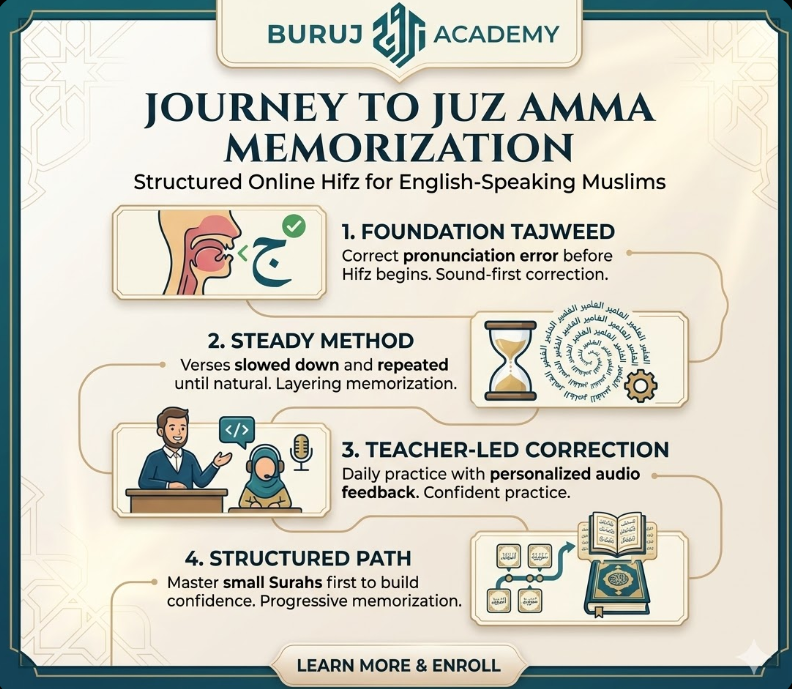
A Juz 30 mastery test examines whether the student has memorized all 37 surahs of the final Juz solidly — not just the commonly recited ones. It tests sequential flow, surah-opening accuracy, and the ability to recite from any point across the entire Juz without hesitation or restart.
We consistently observe at Buruj Academy that students who memorize Juz 30 in order from An-Nas backward to An-Naba’ tend to have stronger retention of the shorter surahs but weaker retention of the longer ones like An-Naba’, An-Nazi’at, and Abasa. A proper Juz 30 test will probe exactly those longer surahs.
Our Juz 30 Memorization course is designed to close these gaps systematically, with Ijazah-certified instructors who test students regularly throughout — not only at the end.
Book Your Kid’s First Session in Buruj’s Juz 30 Memorization Course
Test Yourself: Juz 30 Level Questions
Question 1:
Recite from the beginning of Surah An-Naba’ (78:1) through to the end of verse 20. Do not stop to think between verses.
What is expected: Fluency across 20 consecutive verses of a longer surah without gaps — the most common failure point in Juz 30 evaluation.
Question 2:
What are the opening words of Surah At-Takwir? Recite the first 7 verses (81:1–7).
What is expected: Correct opening — إِذَا ٱلشَّمْسُ كُوِّرَتْ — and accurate recall of the repeated “إِذَا” structure across the first seven verses.
Excel in Your Quranic Studies
Join Buruj Academy and master the Quran with our structured, professional curriculum.
Book Your Free Trial
Question 3:
Continue from this verse: وَمَا هُوَ عَلَى ٱلْغَيْبِ بِضَنِينٍ — which surah is this from, and what comes next?
What is expected: Recognition that this is At-Takwir 81:24, and the ability to continue with وَمَا هُوَ بِقَوْلِ شَيْطَٰنٍ رَّجِيمٍ without prompting.
Question 4:
Recite from the beginning of Surah Abasa (80:1) through to verse 16. Apply correct Qalqalah on every applicable letter.
Read also: Learn Egyptian Arabic for Kids
Level 3 Quran Memorization Test: Can You Recite the Middle Juz’ Solidly?
An intermediate Hifz test — typically applied to students who have memorized between 5 and 15 Juz’ — evaluates recitation accuracy across non-sequential portions, the ability to transition between surahs within a Juz’, and consistent Tajweed application throughout longer passages. This level is where Waqf and Ibtida’ (stopping and starting) become examinable.
Test Yourself: Intermediate Level Questions
Question 1:
Open to Juz 18 (Surah Al-Mu’minun, verse 1). Recite from قَدْ أَفْلَحَ ٱلْمُؤْمِنُونَ (23:1) through to the end of verse 11. Then stop — and identify the Ikhfa letters in what you just recited.
Question 2:
Recite the last five verses of Surah Al-Kahf (18:106–110) — the final Waqf point is a common place where students either rush or apply incorrect Madd.
Question 3:
Continue reciting from verse 87 of Surah Al-Isra’ (17:87) إِلَّا رَحْمَةً مِّن رَّبِّكَ ۚ إِنَّ فَضْلَهُۥ كَانَ عَلَيْكَ كَبِيرًا for 10 verses without stopping.
What is expected: The ability to begin from a specific verse rather than from the surah’s opening — and to maintain pace and Tajweed for 10 consecutive verses.
Question 4:
In Surah Maryam, where does the Idgham in مِن نَّبِيٍّ occur? Recite the full verse in context.
What the examiner listens for: Identification and correct application of Idgham with Ghunnah (Noon into Noon) — a rule explained in our Idgham rules in Tajweed guide.
Read also: Steps to a Successful Quran Hifz Journey
| Intermediate Skill | Test Method | Pass Standard |
| Non-sequential start | Teacher selects any verse | Begin without restarting surah |
| Waqf and Ibtida’ | Stop at teacher’s signal | Correct silence and clean restart |
| Ikhfa identification | Post-recitation identification | Name letter + apply rule correctly |
| Consecutive 10-verse recitation | Any Juz in memorized range | Zero hesitations, correct Madd |
Level 4 Quran Memorization Test: Are You Ready for a Full Hifz or Pre-Ijazah Evaluation?
A complete Hifz test — used before an Ijazah examination — requires that the student can be tested from any verse in the entire Quran, recite with full Tajweed precision, maintain consistent revision across all 604 pages, and demonstrate knowledge of major Waqf markers throughout. This is the standard our Ijazah-certified instructors apply in Buruj Academy’s Hifz Ijazah course.
Book your FREE trial lesson in your path to Ijazah
Test Yourself: Full Hifz Level Questions
Question 1:
The examiner opens the Mushaf to a random page. They point to a verse anywhere on that page. Recite forward for one full page without error.
What the examiner listens for: Zero hesitation at the start, consistent Tajweed application throughout, and clean Waqf at the page’s end. At this level, a single repeated word is noted; two errors on one page is a fail.
Question 2:
Recite Surah Al-Kahf (18:1) from memory in its entirety — this surah is considered one of the core Hifz evaluation surahs due to its length (110 verses) and thematic transitions.
What the examiner listens for: Full recitation without teacher prompts.
Question 3:
Identify and recite the three Waqf Lazim (mandatory stop) markers in Surah Al-Baqarah from memory.
What the examiner listens for: Knowledge that Waqf Lazim (marked م in the Mushaf) indicates that continuing without stopping changes the meaning — and that this applies in specific positions the student must have internalized.
Question 4:
The examiner recites a verse. Identify the surah and verse number, then continue reciting the following 5 verses.
What the examiner listens for: Surah recognition from any verse — not just famous opening verses. This tests depth of familiarity with the entire Quran text.
Discover the Buruj Academy Difference
Step into our virtual classrooms and see how our expert instructors make learning Quran and Arabic intuitive and clear. We focus on overcoming the specific hurdles non-native speakers face, building your confidence and connection with the Quran.
| Full Hifz Test Standard | Acceptable Error Rate |
| Random page recitation | Max 1 minor error per page |
| Surah identification from verse | 90% accuracy across full Quran |
| Waqf and Ibtida’ | Mandatory stops applied correctly |
| Tajweed application | Rules consistent throughout long passages |
| Full revision cycle | All 30 Juz’ within regular review rotation |
Read also: Arabic Alphabet Activities for Kids
Start Your Formal Hifz Evaluation with Buruj Academy’s Expert Instructors
Self-testing reveals your gaps — but formal, structured evaluation with a qualified teacher is what builds a Hifz that holds for life.
Buruj Academy’s Online Hifz Program provides personalized evaluations conducted by Al-Azhar University graduates and Ijazah-certified instructors with 12+ years of experience teaching non-Arabic speakers globally.
Whether you are just beginning with Juz 30 or preparing for a full Hifz completion, our structured approach — built on the Buruj Method of Consistency-before-speed — gives every student a realistic, personalized memorization path with built-in testing at every stage.
Flexible 1-on-1 online sessions, customized revision schedules, and real-time feedback mean your Hifz is evaluated and corrected as you build it — not only at the end.
Book your free trial lesson and let our instructors assess your current level and map your path forward.
Take the first step toward this lifelong blessing by enrolling in a program tailored to your pace:
- Online Hifz Program (Comprehensive Quran Memorization)
- Juz 30 Memorization Course (Perfect for focused starts)
- Hifz Classes for Kids (Engaging and interactive)
- Hifz Classes for Adults (Flexible scheduling for busy lives)
- Hifz Classes for Sisters (Private, supportive learning)
- Short Surah Memorization Course (Ideal for daily prayers)
- Hifz Ijazah Course (For advanced students seeking certification)
Don’t let another day pass without moving closer to your goal. Join Buruj Academy today and schedule your free trial session to begin your Hifz journey!
Excel in Your Quranic Studies
Join Buruj Academy and master the Quran with our structured, professional curriculum.
Book Your Free TrialConclusion
A Quran memorization test is not a judgment — it is a mirror. It shows you exactly where your Hifz is strong and where it needs more attention, and that clarity is what makes progress possible.
Working through level-appropriate test questions — from Juz 30 short surahs to full Quran random-verse recitation — gives you an honest picture of your readiness before a formal evaluation. Alhamdulillah, every gap you find through self-testing is a gap you can close.
The path to solid Hifz is built one accurate verse at a time, with consistent revision and qualified guidance. Insha’Allah, these questions bring you one step closer to a Hifz that lasts.
Frequently Asked Questions About Quran Memorization Tests
What Is Tested in a Standard Quran Memorization Exam?
A standard Hifz exam tests three areas: verbal retention (accurate recall of words in sequence), Tajweed application (correct recitation rules throughout), and revision depth (whether older memorized portions remain solid). Examiners typically select verses at random, require mid-surah starts, and observe Waqf and Ibtida’ application. Consistent Ghunnah, Madd lengths, and letter articulation are all evaluated.
How Many Errors Are Allowed in a Hifz Test?
The accepted standard in classical Hifz evaluation — including pre-Ijazah assessments — allows a maximum of one to two minor errors per page, with no repeated errors of the same type across the test. Errors involving meaning change, missing words, or incorrect Tajweed on heavy letters carry more weight than minor hesitations.
How Should I Prepare for a Quran Memorization Test?
Preparation involves regular revision of all memorized portions — not just recent ones — with daily sessions that include non-sequential recitation practice. Testing yourself from random verses, drilling surah transitions, and reading about the best time to memorize Quran will strengthen both retention and test readiness.
Can Adults Take a Formal Hifz Evaluation?
Absolutely. Buruj Academy’s Hifz for Adults course includes structured evaluation milestones throughout the memorization journey — not only at completion. Adults who follow a consistent revision system and receive regular teacher feedback can absolutely achieve and maintain testable Hifz, regardless of when they began.