 Tajweed
| Key Takeaways |
| The tongue produces sounds at 10 distinct articulation points, covering 18 of the Arabic alphabet’s 28 letters. |
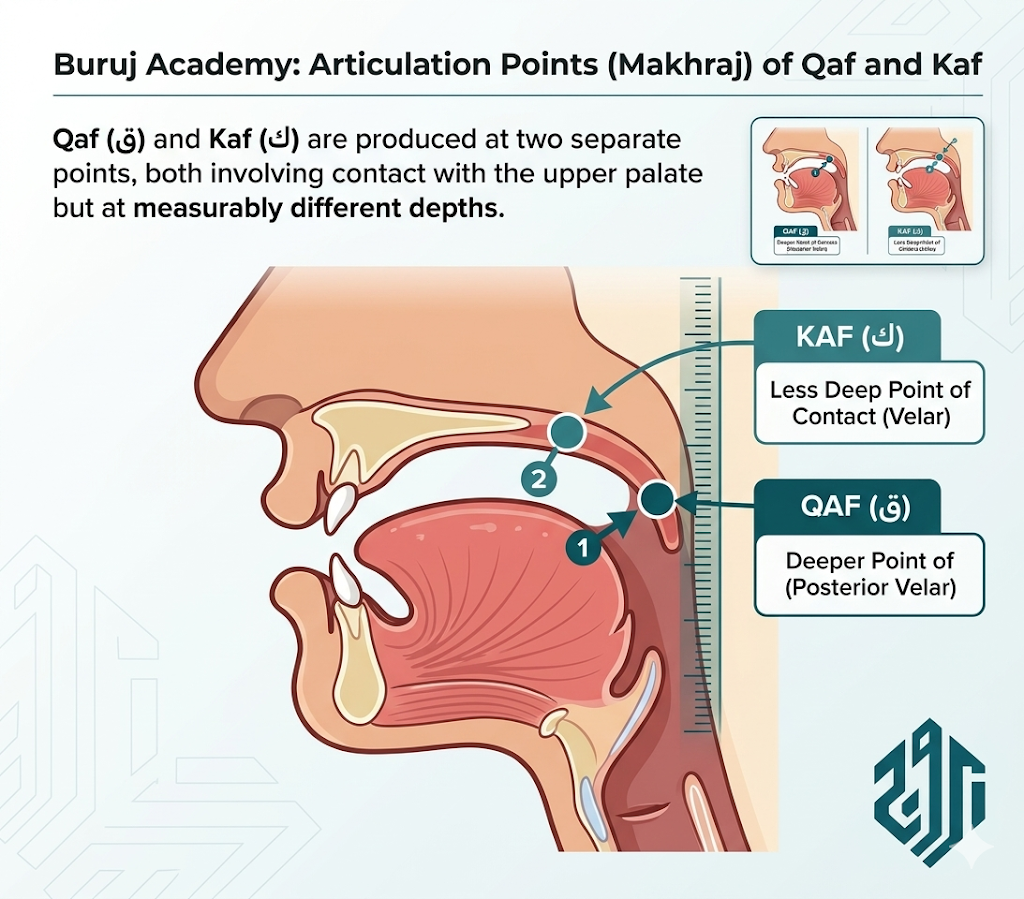
| Qaf and Kaf both exit from the back of the tongue but differ in depth — Qaf sits deeper toward the throat than Kaf. |
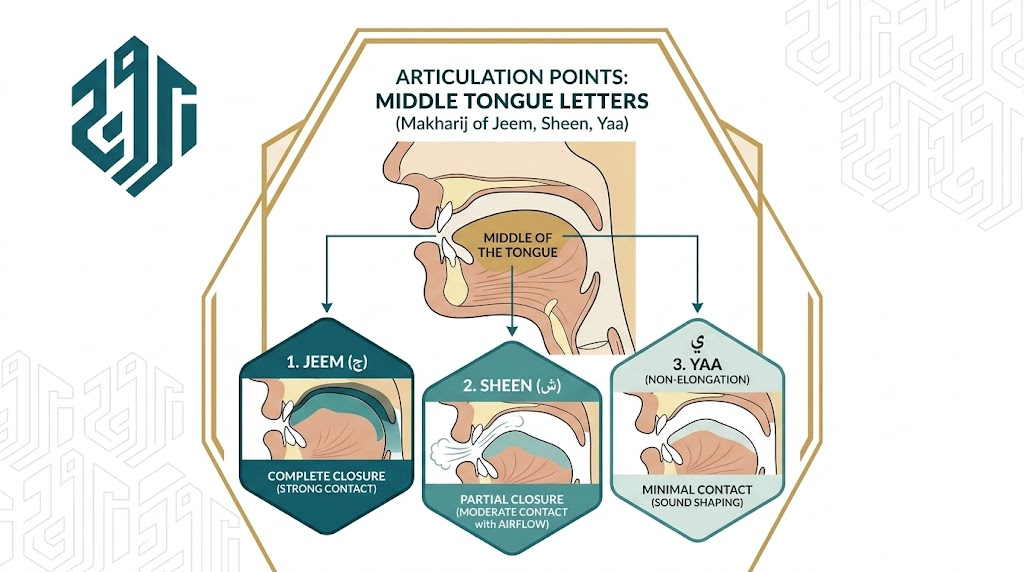
| The middle of the tongue produces three letters — Jeem, Sheen, and non-elongation Yaa — each with different contact levels. |
| Daad is considered the most difficult Arabic letter to articulate correctly, exiting from one side of the tongue against the upper molars. |
| The tip of the tongue alone produces ten letters across five distinct articulation sub-points, including Noon, Raa, Taa, Daal, Taa, Seen, Saad, Zaay, Thaa, Dhaal, and Dhaa’. |
Mastering where sounds come from is the foundation of accurate Quranic recitation. Before you can apply Tajweed rules correctly, you need to know where each letter originates — and no organ shapes Arabic phonetics more profoundly than the tongue.
The tongue is responsible for 18 of the Arabic alphabet’s 28 letters, produced at 10 distinct articulation points (makharij).
Table of Contents:
What Are the Tongue Letters in Tajweed?
The tongue letters in Tajweed are the 18 Arabic letters whose sounds originate from the tongue itself, produced at 10 different articulation points (makharij) ranging from the deepest back of the tongue to its very tip.
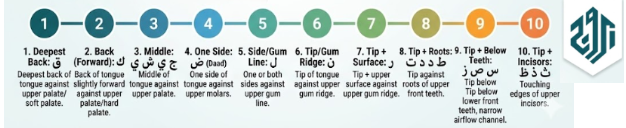
These 18 letters span the entire tongue — from Qaf at the farthest reach to Thaa at the tip touching the upper front teeth.
This makes the tongue the most productive articulation organ in the Arabic language. No other single organ accounts for as many letters.
| Articulation Point | Letters Produced | Position on Tongue |
| Deepest back of tongue | ق (Qaf) | Against upper palate |
| Back of tongue (slightly forward) | ك (Kaf) | Against upper palate |
| Middle of tongue | ج ش ي (Jeem, Sheen, Yaa*) | Against upper gum ridge |
| One side of tongue | ض (Daad) | Against upper molars |
| One or both sides | ل (Laam) | Against upper gum line |
| Tip of tongue | ن (Noon) | Against upper gum ridge |
| Tip + upper surface | ر (Raa) | Against upper gum ridge |
| Tip + upper front teeth roots | ط د ت (Taa, Daal, Taa) | Against roots of upper front teeth |
| Tip + below lower front teeth | س ص ز (Seen, Saad, Zaay) | Narrow airflow channel |
| Tip + edges of upper front teeth | ث ذ ظ (Thaa, Dhaal, Dhaa’) | Touching edges of upper incisors |
*Non-elongation Yaa only
In our Online Tajweed Classes at Buruj Academy, taught by Al-Azhar University graduates and Ijazah-certified instructors, makharij mastery is always the starting point — because every rule of Tajweed depends on producing the right letter from the right place.
Book Your FREE Trial Lesson to Begin Your Tajweed Journey

1. The Back of the Tongue Produce Qaf and Kaf
The back of the tongue produces two letters — Qaf (ق) and Kaf (ك) — at two separate points, both involving contact with the upper palate but at measurably different depths.
Qaf (ق) exits from the deepest reachable point of the tongue against the upper palate. It is the letter closest to the throat among all tongue letters. Kaf (ك) exits from a point just slightly forward of Qaf, still against the upper palate, but noticeably closer to the front of the mouth.
This distinction matters practically: students who conflate Qaf and Kaf produce a sound that is neither — and in Quranic recitation, confusing these two letters can alter meaning entirely.
Why Does the Qaf-Kaf Distinction Matter in Recitation?
Consider the word قَلْبٌ (heart) versus كَلْبٌ (dog). Both begin with a back-tongue letter — but producing Qaf where Kaf belongs, or vice versa, changes meaning in ways no reciter should allow.
In our sessions at Buruj Academy, this is one of the first distinctions Al-Azhar-trained instructors address with new students, because the error is common and the consequence is significant.
A reliable way to locate Qaf: produce a deep “Q” from the very back of your tongue while saying “Qatar” — that depth is your Qaf makhraj. Kaf sits measurably forward from there.
Book a FREE trial session with one of Buruj’s Azhari Quran and Tajweed tutors

2. The Letters Come from the Middle of the Tongue
Three letters exit from the middle of the tongue against the upper gum ridge: Jeem (ج), Sheen (ش), and non-elongation Yaa (ي). This is the third articulation point of the tongue and the only one that produces three letters from a single location.
The key distinction among these three lies in how much contact the middle of the tongue makes with the upper palate.
A. Jeem (ج) Requires Full Middle-Tongue Contact
Jeem (ج) is produced by pressing the middle of the tongue firmly against the upper gum ridge — a complete, deliberate closure. The release of this closure produces the characteristic “J” sound. Without that firm contact, Jeem softens into something resembling a foreign sound that doesn’t exist cleanly in Arabic.
B. Sheen (ش) and Yaa (ي) Require Partial Contact
Sheen (ش) and non-elongation Yaa (ي) are both produced with the middle of the tongue approaching the upper gum ridge without making full contact. This partial approach — technically called tafawwut (separation) — allows air to pass through, which is what gives Sheen its distinctive hiss-like quality and Yaa its semi-vowel nature.
read also: What is the Importance of Tajweed?
What Is Non-Elongation Yaa?
Non-elongation Yaa refers specifically to the Yaa that carries a vowel mark (harakah) or the Yaa that is sukoon but is NOT preceded by a kasrah. This distinguishes it from the Yaa Madd (elongation Yaa), which functions as a vowel letter and exits from a different point. Understanding this distinction is essential — you can explore its connection to vowel letters in our guide to Madd Asli and the rules of natural elongation.
3. Daad is the Hardest Tongue Letter to Pronounce
Daad (ض) is widely recognized in classical Tajweed scholarship as the most phonetically complex letter in Arabic — so much so that Arabic itself has historically been described as Lughat al-Daad (the language of Daad), referring to this letter’s unique phonetic difficulty.
Daad exits from one side of the tongue — the left side is considered easier for most speakers and therefore more commonly used — pressed against the upper molars (al-adraas). This lateral articulation point is unlike any other Arabic letter.
Excel in Your Quranic Studies
Join Buruj Academy and master the Quran with our structured, professional curriculum.
Book Your Free TrialWhich Side of the Tongue Produces Daad?
Classical Tajweed scholars allow Daad to exit from either the left or right side of the tongue, or theoretically both sides simultaneously. In practice, the left side is physiologically easier for the majority of reciters, and this is the side most students are guided to use first.
In our experience teaching non-Arabic speakers at Buruj Academy, Daad is the single letter that requires the most dedicated individual correction. Students frequently produce either a distorted “D” sound or merge it toward “Dh” — both of which fall outside correct articulation.
The correct Daad has a distinctive heaviness (tafkheem) and a wide contact between the tongue side and the upper back teeth.
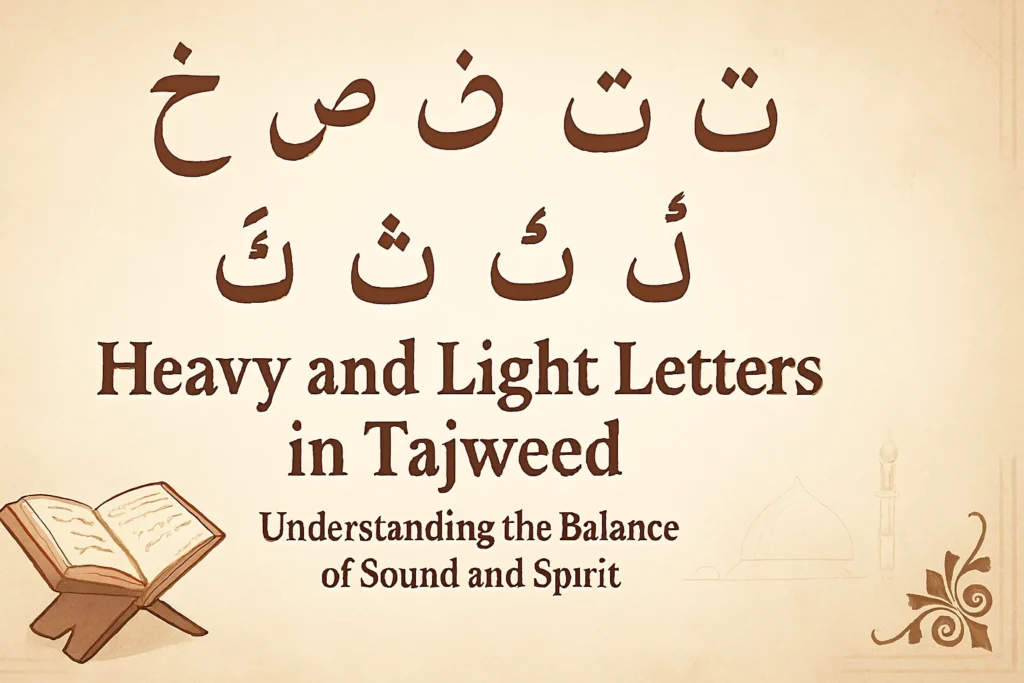
For a fuller treatment of how heavy letters like Daad behave in recitation, see our guide on heavy and light letters in Tajweed.
Discover the Buruj Academy Difference
Step into our virtual classrooms and see how our expert instructors make learning Quran and Arabic intuitive and clear. We focus on overcoming the specific hurdles non-native speakers face, building your confidence and connection with the Quran.
4. The Tongue Produces Laam Letter
Laam (ل) exits from one or both sides of the tongue against the gum line of the upper teeth — covering the gum tissue above the molars, the canines, and the incisors. This is the broadest gum contact of any Arabic letter.
Classical scholars differ on whether Laam exits from one side or both. Some hold that recitation using either side is acceptable, while others observe that the right side feels more natural for most speakers. Both positions have scholarly grounding, and both produce a valid Laam.
What is not debated is the range of the contact: Laam’s gum-line contact extends from the back molars all the way forward to the incisors — a uniquely wide articulation span that distinguishes it from all other tongue-tip letters.
read also: Haroof e Muqataat: The Disjointed Letters of the Quran
| Letter | Articulation Zone | Contact Type |
| Laam (ل) | One or both sides of tongue | Upper gum line, molars to incisors |
| Daad (ض) | One side of tongue | Upper molars only |
| Noon (ن) | Tip of tongue | Upper gum ridge behind incisors |
Buruj Academy’s Tajweed for Beginners course follows this sequence — makharij first, rules second — taught by Ijazah-certified instructors who correct tongue placement in real time during every session.
Book Your FREE Trial Lesson to Begin Your Tajweed Journey

5. Tip of the Tongue Letters in Arabic
The tip of the tongue — taraf al-lisaan — produces ten letters across five distinct sub-points. This makes the tongue tip the single most productive sub-region of any articulation organ in Arabic.
A. Noon and Raa: The Gum-Ridge Tip Letters
Noon (ن) exits from the tip of the tongue against the upper gum ridge. Raa (ر) exits from a point that is similarly positioned but reaches slightly further back along the tongue’s upper surface, making it marginally deeper than Noon.
This slight depth difference is what gives Raa its distinctive “rolling” potential — its position allows for repetition (takraar) that must be suppressed during recitation to avoid an exaggerated trill.
Students who produce an exaggerated rolled Raa are typically allowing the tongue tip to vibrate more than once, which is a recognized Tajweed error.
Noon’s articulation point is also closely connected to its nasal quality (ghunnah). For a detailed exploration of how Noon interacts with the rules of nasalization, visit our complete guide on Ghunnah and its rules.
B. Taa, Daal, and Taa: Letters of the Upper Front Tooth Roots
Taa (ط), Daal (د), and Taa (ت) all exit from the tip of the tongue pressed against the roots of the upper front teeth (the incisors). Of the three:
- Taa (ط) sits deepest — it is a heavy, emphatic letter with a strong pressing quality
- Daal (د) sits below Taa in firmness
- Taa (ت) is the lightest and most forward of the three
This trio shares a makhraj but differs significantly in their sifat (attributes) — Taa carries Isti’laa (elevation) and Itbaaq (enclosure), which gives it its emphatic weight.
Taa and Daal do not carry these attributes, which is why they sound markedly lighter despite coming from the same location.
C. Seen, Saad, and Zaay: The Whistling Letters
Seen (س), Saad (ص), and Zaay (ز) exit from the tip of the tongue positioned just below the lower front teeth, with a narrow channel maintained between the tongue surface and the upper palate for air to escape.
This narrow-channel airflow is what produces their characteristic hissing quality — these three letters are classified among the sifir (whistling) letters in traditional Tajweed scholarship.
Saad is the emphatic version of Seen, carrying Isti’laa and Itbaaq, while Zaay adds vocal vibration (Jahr).
D. Thaa, Dhaal, and Dhaa’: The Interdental Letters
Thaa (ث), Dhaal (ذ), and Dhaa’ (ظ) exit from the tip of the tongue making light contact with the edges of the upper front teeth. These are the interdental letters of Arabic — their sound is produced at the very frontier of the mouth.
| Tip-of-Tongue Group | Letters | Contact Point |
| Gum-ridge group | ن، ر | Upper gum ridge behind incisors |
| Tooth-root group | ط، د، ت | Roots of upper front teeth |
| Whistling group | س، ص، ز | Tip below lower teeth, narrow channel above |
| Interdental group | ث، ذ، ظ | Edges of upper front teeth |
For students building their foundational understanding of articulation points across all five organs of speech — not just the tongue — our complete guide to Makharij al-Huruf provides the full picture.
How Do Tongue Letter Errors Affect Tajweed Rules?
Mispronouncing a tongue letter doesn’t only affect that letter — it creates a cascade of errors through connected Tajweed rules. When Noon is misarticulated, for example, its nasalization rules (Ikhfa, Idgham, Iqlab) cannot be applied correctly because the base sound is already wrong.
In our instructors’ experience at Buruj Academy, students who struggle with rules like Ikhfa and its 15 letters or Idgham rules almost always have an underlying makhraj weakness — not a rule-memory problem. Fixing the articulation point resolves the rule application naturally.
This is why the Buruj Method follows a sound-before-rules sequence: we train the ear and the tongue before introducing rule names.
Students who begin with correct makharij absorb Tajweed rules significantly faster than those who memorize rules without phonetic grounding.
Excel in Your Quranic Studies
Join Buruj Academy and master the Quran with our structured, professional curriculum.
Book Your Free TrialMaster Tajweed with Buruj Academy’s Expert Instructors
The 18 tongue letters are the heart of Arabic phonetics — and mastering their articulation points is the foundation of beautiful, accurate Quranic recitation.
At Buruj Academy, our Online Tajweed Classes are taught by Al-Azhar University graduates and Ijazah-certified instructors with 12+ years of experience guiding non-Arabic speakers. We offer:
- The Buruj Method: sound-before-rules sequencing for lasting accuracy
- Personalized 1-on-1 sessions with real-time pronunciation correction
- Flexible 24/7 scheduling to fit any time zone or lifestyle
- Proven progression from makharij foundations to full Tajweed mastery
Book your free trial lesson today and let our instructors guide your tongue to the right place — from the very first session, Insha’Allah.
Join a supportive learning environment tailored to your pace and lifestyle. Start your journey toward excellence by enrolling in one of our specialized tracks:
- Online Tajweed Classes
- Tajweed Classes for Beginners
- Tajweed Classes for Adults
- Tajweed Classes for Sisters
- Tajweed Classes for Kids
- Advanced Tajweed Course
- Amli Tajweed Course (Practical Application)
Ready to transform your recitation? book your free assessment and start your path to Tajweed mastery today!
Conclusion
The tongue is Arabic’s most versatile phonetic instrument — 18 letters, 10 articulation points, and a precision that no other organ matches. Understanding where each letter originates transforms recitation from approximate to accurate, from imitation to genuine Tajweed.
Makharij knowledge is not an advanced topic reserved for scholars. It is the starting point — the ground floor of correct recitation. Whether you are refining a letter you have recited for years or building your foundation from scratch, returning to the articulation point is always the right first step. May Allah make your recitation a source of closeness to His words, Ameen.
Frequently Asked Questions About Tongue Letters in Tajweed
How Many Letters Come from the Tongue in Tajweed?
Eighteen Arabic letters originate from the tongue, produced at ten distinct articulation points (makharij). These letters span the entire tongue — from the deepest back portion producing Qaf and Kaf to the tip producing interdental letters like Thaa, Dhaal, and Dhaa’. The tongue is the most productive articulation organ in the Arabic alphabet.
What Is the Hardest Tongue Letter to Pronounce for Non-Arabic Speakers?
Daad (ض) is considered the most difficult tongue letter for non-Arabic speakers to articulate correctly. It exits from one side of the tongue against the upper molars — a lateral articulation that has no equivalent in most world languages. Non-Arabic speakers most often mispronounce Daad as a plain “D” sound, losing its correct emphatic quality entirely.
What Is the Difference Between the Articulation Points of Noon and Raa?
Both Noon (ن) and Raa (ر) exit from the tip of the tongue near the upper gum ridge, but Raa’s articulation point extends slightly further back along the tongue’s upper surface. This depth difference accounts for Raa’s heavier, more resonant quality and its susceptibility to the Tajweed error of excessive rolling.
Why Does the Tip of the Tongue Produce So Many Letters?
The tongue tip is the most mobile and precise part of the tongue, capable of making contact at multiple positions — the gum ridge, the tooth roots, the area just below the lower front teeth, and the edges of the upper incisors. This physiological versatility allows it to produce ten distinct letters across five sub-points, making it the most productive single region of any speech organ in Arabic.