 Tajweed
| Key Takeaways |
| Tajweed is the science of reciting the Quran as Prophet Muhammad ﷺ received and taught it, letter by letter. |
| Scholars of Islam classify learning Tajweed as a collective obligation (fard kifayah) and applying it as individually required during recitation. |
| Changing a letter’s sound through incorrect pronunciation can alter the meaning of a Quranic word entirely. |
| The Prophet ﷺ explicitly praised beautiful, measured Quran recitation in multiple authentic hadiths recorded in Sahih collections. |
| Tajweed protects the Quran’s divine preservation by ensuring no sound, letter, or rule is lost across generations of reciters. |
Every Muslim who recites the Quran carries an enormous trust — the words of Allah ﷻ, preserved sound by sound across fourteen centuries. That preservation does not happen by accident; it happens through Tajweed.
The importance of Tajweed reaches beyond aesthetics. Tajweed is the systematic science that protects Quranic pronunciation from distortion, preserves intended meanings, fulfills a Prophetically established obligation, and connects every reciter to an unbroken chain of transmission stretching back to Jibreel (AS) himself.
Table of Contents:
1. Tajweed Is the Method Allah ﷻ Commanded for Quran Recitation
Allah ﷻ did not simply instruct the believers to recite the Quran — He specified how it must be recited. In Surah Al-Muzzammil, He commands:
وَرَتِّلِ ٱلْقُرْءَانَ تَرْتِيلًا
Wa rattilil-Qur’āna tartīlā
“And recite the Quran with measured recitation.” (Al-Muzzammil 73:4)
The Arabic word tartīl — translated here as “measured recitation” — is precisely what Tajweed science delivers: deliberate, accurate, rule-governed pronunciation of every letter in its correct form.
Classical scholars of Tafsir, including Ibn Kathir, explained tartīl as reciting slowly and clearly with correct letter articulation. Tajweed is not a scholarly embellishment added centuries later — it is the practical fulfillment of a Quranic directive.
At Buruj Academy, our Al-Azhar University graduates teach students from their very first lesson that Tajweed is not a performance standard — it is an act of obedience.
When you enroll in our Online Tajweed Classes, this foundational understanding shapes everything that follows.
Book Your FREE Trial Lesson to Begin Your Tajweed Journey

The Importance of Tajweed Hadith
The Prophetic tradition establishes the importance of Tajweed with unmistakable clarity. The Prophet Muhammad ﷺ said:
“The one who is proficient in the Quran will be with the noble, righteous scribes (angels).” (Sahih Muslim 798)
This hadith draws a direct connection between mastery in Quran recitation and elevated spiritual rank.
Proficiency here refers to precision — reciting each letter from its correct articulation point (makhraj) with its established attributes (sifat). That precision is Tajweed by definition.
The same hadith continues to acknowledge those who struggle: the one who recites with difficulty still receives a double reward — one for the recitation and one for the effort.
This is not a permission to remain inaccurate permanently; it is an encouragement to persist through the learning process. The goal remains correct recitation.
In our sessions at Buruj Academy, we share this hadith in the very first lesson with adult beginners — particularly those who feel embarrassed by their pronunciation. It reframes their effort as an act of worship, not a performance to be judged.
2. Incorrect Pronunciation Can Change the Meaning of Allah’s Words
This is perhaps the most sobering dimension of Tajweed’s importance: a single mispronounced letter can transform the meaning of a Quranic phrase entirely.
Arabic is a precision language. Letters sharing similar sounds — such as ح (ha) and هـ (ha), or ع (‘ayn) and أ (hamzah), or ق (qaf) and ك (kaf) — are entirely distinct in meaning when they appear in Quranic text.
Replacing one with the other is not a harmless accent difference; it is a change to the word of Allah ﷻ itself.
Lahn Jaliyy and Lahn Khafiyy
Classical Tajweed scholars identified two categories of error: Lahn Jaliyy (clear, obvious error) and Lahn Khafiyy (subtle, hidden error).
Lahn Jaliyy — such as replacing one letter with another — is considered sinful during recitation by scholarly consensus.
Lahn Khafiyy involves violations of Ghunnah duration, Madd length, or Qalqalah application, and is blameworthy for those who have the means to learn.
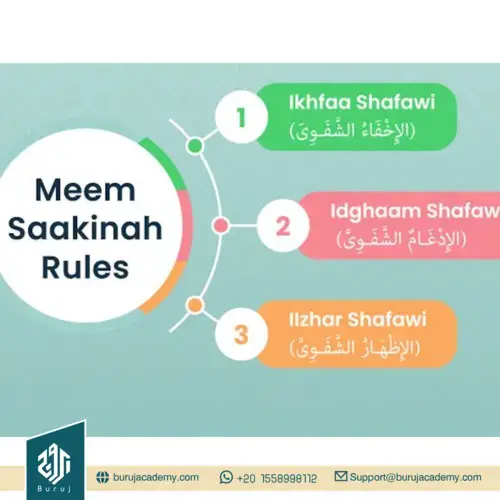
Understanding the rules of Ikhfa in Tajweed and Idgham belongs to this protection framework — rules that prevent subtle distortions that accumulate into meaningful differences over generations.
3. Tajweed Preserves the Quran’s Divine Miracle Across Generations
The Quran is the only book on earth memorized by millions of people, transmitted sound-for-sound across fourteen centuries without alteration. Tajweed is the mechanism that makes this preservation possible.
Every rule in Tajweed science — Ghunnah duration, Madd categories, Qalqalah echo, the distinction between Tafkhim and Tarqiq — exists to prevent phonetic drift.
Without standardized rules governing how each sound is produced, regional accents and natural language evolution would gradually reshape how the Quran sounds. Tajweed freezes the recitation in its revealed form.
read also: Tongue Letters in Tajweed
| Tajweed Rule | What It Protects | Example |
| Makhraj (Articulation Points) | Correct letter identity | ح vs هـ, ق vs ك |
| Sifat al-Huruf (Letter Attributes) | Sound quality of each letter | Tafkhim/Tarqiq, Qalqalah |
| Ghunnah | Nasal resonance duration | Noon/Meem mushaddad |
| Madd (Elongation) | Vowel length and word meaning | Madd tabii vs Madd munfasil |
| Waqf Rules | Correct pausing without meaning distortion | Stopping at permitted points |
Each of these rules has been transmitted through an unbroken chain (sanad) from teacher to student, generation to generation, back to the Prophet ﷺ himself.
Excel in Your Quranic Studies
Join Buruj Academy and master the Quran with our structured, professional curriculum.
Book Your Free Trial4. Tajweed Deepens Khushu’ and Spiritual Connection During Salah
Beyond the scholarly and linguistic dimensions, Tajweed profoundly transforms the inner experience of recitation. When a believer learns to elongate the Madd, feel the vibration of Qalqalah, and hold the resonance of Ghunnah — the Quran stops being a text to get through and becomes a speech to be present with.
This is not a subjective impression. It is consistent with what Allah ﷻ describes about the effect of the Quran on attentive hearts. In Surah Az-Zumar:
ٱللَّهُ نَزَّلَ أَحْسَنَ ٱلْحَدِيثِ كِتَٰبًا مُّتَشَٰبِهًا مَّثَانِىَ تَقْشَعِرُّ مِنْهُ جُلُودُ ٱلَّذِينَ يَخْشَوْنَ رَبَّهُمْ
“Allāhu nazzala aḥsanal-ḥadīth”
“Allah has sent down the best statement: a consistent Book wherein is reiterated. The skins shiver therefrom of those who fear their Lord.” (Az-Zumar 39:23)
Students in our Tajweed for Beginners course frequently report the same experience: within weeks of learning correct articulation, their Salah feels qualitatively different. The Fatiha they have recited for years becomes something they feel — not merely recite.
Book Your FREE Trial Lesson to Begin Your Tajweed Journey
Discover the Buruj Academy Difference
Step into our virtual classrooms and see how our expert instructors make learning Quran and Arabic intuitive and clear. We focus on overcoming the specific hurdles non-native speakers face, building your confidence and connection with the Quran.
5. Tajweed Connects the Reciter to the Prophetic Chain of Transmission
Every authentic Tajweed teacher holds an Ijazah — a certification granted only after demonstrating recitation mastery before a qualified scholar, who received it from their teacher, and so on, in an unbroken chain reaching the Prophet ﷺ. Learning Tajweed from a qualified instructor places you within this living tradition.
This is not ceremonial. The Ijazah system is the mechanism by which the Quran’s oral transmission has been authenticated across centuries.
When you learn Tajweed from an Ijazah-certified instructor, you are not merely acquiring a skill — you are connecting to a spiritual lineage.
For those who wish to formalize this connection, Buruj Academy’s Online Ijazah Course provides structured preparation under qualified Ijazah-holding scholars, preparing students for certification through an authentic sanad.
Book your FREE trial lesson in your path to Ijazah
6. Tajweed Is the Foundation Every Hifz Student Requires
Students pursuing Quran memorization cannot separate memorization from Tajweed. Whatever a student memorizes incorrectly, they will recite incorrectly — consistently, habitually, and across decades.
Correcting deep memorization errors after the fact is far more difficult than learning correctly from the beginning.
This connection is why Buruj Academy’s Online Hifz Program integrates Tajweed correction into every memorization session. Our Hifz specialists — themselves Al-Azhar University graduates — do not treat Tajweed and Hifz as separate subjects. They are a unified discipline.
If you are beginning your Quran reading path before memorization, the guidance in our article on reading the Quran for the first time provides a helpful starting point before Tajweed study.
read also: Haroof e Muqataat: The Disjointed Letters of the Quran
| Learning Stage | Tajweed Priority | Why It Matters |
| New reader (Noorani Qaida) | Letter recognition + basic sounds | Prevents foundational errors from forming |
| Quran reading student | Noon/Meem rules, Madd, Waqf | Ensures readable, accurate recitation |
| Hifz student | Full rule application during memorization | Prevents incorrect patterns from being locked in |
| Advanced reciter | Sifat precision, rare rule interactions | Refines toward Ijazah-level accuracy |
Book Your Free Trial Lesson with Burruj’s Hifz Course for Adults

Benefits of Learning Tajweed for Non-Arabic Speakers Specifically
For non-Arabic speaking Muslims, the benefits of learning Tajweed carry additional weight. Without Tajweed training, English-speaking students inevitably approximate Arabic sounds through the filter of their mother tongue — producing phonetically comfortable but Islamically inaccurate recitations.
English does not contain the sounds of ع, ح, خ, ق, or غ. Without deliberate Tajweed instruction, these letters are routinely replaced with the nearest English equivalent.
The result is a recitation that may feel fluent but contains consistent Lahn Jaliyy — observable errors that a qualified teacher would identify immediately.
| Common Error Among English Speakers | Correct Application | Rule Involved |
| Pronouncing ق (Qaf) as “k” | Deep back-of-throat stop | Makhraj al-Lisan |
| Pronouncing ع (‘Ayn) as a glottal stop or skipping | Constricted mid-throat sound | Makhraj al-Halq |
| Flattening ص (Sad) to “s” | Heavy, emphatic sibilant | Tafkhim/Isti’la |
| Shortening all Madd sounds equally | Two, four, or six count elongations | Madd categories |
| Missing Ghunnah on Noon mushaddad | Held nasal resonance for two counts | Ghunnah |
Our Ijazah-certified instructors at Buruj Academy have taught these corrections to students from over 40 countries. In our experience, most adult beginners need 6–8 weeks of focused practice before the ع and ح distinction becomes natural — but with consistent daily practice, it becomes muscle memory.
Book a FREE trial session with one of Buruj’s Azhari Quran tutors

Excel in Your Quranic Studies
Join Buruj Academy and master the Quran with our structured, professional curriculum.
Book Your Free TrialStart Applying Tajweed with Buruj Academy’s Expert Instructors
Tajweed is not a subject for scholars alone — it is an obligation and a gift available to every Muslim willing to learn. The rules exist to protect you, not to intimidate you.
Buruj Academy’s Online Tajweed Classes are taught by Ijazah-certified, Al-Azhar University graduates with 12+ years of experience teaching non-Arabic speakers across the globe.
Our Buruj Method begins with sound before rules — training your ear before your memory — so every rule you learn is already familiar when it arrives.
We offer personalized 1-on-1 sessions, flexible 24/7 scheduling, real-time pronunciation correction, and a clear progression path from first lesson to confident, beautiful recitation.
Book your free trial lesson today and recite the Quran the way it was revealed — sound by sound, letter by letter, Insha’Allah.
Join a supportive learning environment tailored to your pace and lifestyle. Start your journey toward excellence by enrolling in one of our specialized tracks:
- Online Tajweed Classes
- Tajweed Classes for Beginners
- Tajweed Classes for Adults
- Tajweed Classes for Sisters
- Tajweed Classes for Kids
- Advanced Tajweed Course
- Amli Tajweed Course (Practical Application)
Ready to transform your recitation? book your free assessment and start your path to Tajweed mastery today!
Conclusion
The importance of Tajweed is not a matter of scholarly opinion — it is grounded in a divine command, established by Prophetic example, and safeguarded by fourteen centuries of authenticated transmission. Every rule in this science exists for a reason: to protect the word of Allah ﷻ from distortion and to honor it in the manner its Revealer intended.
For non-Arabic speaking Muslims especially, Tajweed is the bridge between reciting the Quran and reciting it correctly.
The path begins with a qualified teacher, consistent practice, and the understanding that every improvement in your recitation is an act of worship. May Allah ﷻ grant us all the ability to recite His words as they deserve to be recited.
Frequently Asked Questions About the Importance of Tajweed
Is Learning Tajweed Obligatory for Every Muslim?
Scholars classify Tajweed knowledge as fard kifayah — a collective obligation met when a sufficient number in a community master it. However, applying basic Tajweed rules during recitation to avoid meaning-altering errors is considered individually required. Every Muslim who recites the Quran carries the responsibility to avoid clear, observable mistakes in pronunciation.
What Is the Difference Between Tajweed and Tarteel?
Tarteel is the Quranic term for measured, deliberate recitation commanded in Surah Al-Muzzammil (73:4). Tajweed is the practical science that defines how tarteel is achieved — through correct makharij, sifat, and rule application. Tarteel is the command; Tajweed is the method. Both refer to the same goal: reciting the Quran as it was revealed.
Can I Learn Tajweed Without Knowing Arabic?
Yes — and millions of non-Arabic speaking Muslims do exactly this. Tajweed is a phonetic and rule-based science, not a language comprehension subject. You learn to produce sounds correctly and apply pronunciation rules without requiring Arabic fluency. Our Tajweed for Beginners course is specifically designed for non-Arabic speakers starting from zero.
How Long Does It Take to Learn Basic Tajweed Rules?
In our instructors’ experience at Buruj Academy, students attending two 30-minute sessions per week typically grasp foundational rules — Noon sakinah, Meem sakinah, basic Madd categories, and Ghunnah — within three to four months. Consistent daily practice between sessions accelerates this significantly. For deeper detail on rules like Ghunnah and Qalqalah, our blog provides focused guides.
Does Tajweed Apply During Salah?
Yes. Recitation within Salah carries the same rules as recitation outside of it. Clear pronunciation errors that alter meaning — Lahn Jaliyy — are to be avoided during prayer. This is precisely why learning Tajweed improves the quality and khushu’ of Salah directly, not only standalone recitation practice.