 Tajweed
Reciting the Holy Quran with proper Tajweed is a spiritual act that elevates a Muslim’s connection to Allah (SWT) and His divine words. Tajweed, the art and science of reciting the Quran correctly and beautifully, involves a precise set of rules governing every letter, vowel, and pause. Among the most fundamental and frequently encountered of these rules are the Rules of Noon Saakin and Tanween.
What is Noon Saakin and Tanween?
The “Noon Saakin” (نْ) refers to a silent “Noon” that carries a Sukoon (ـْ), while “Tanween” ( ً ٍ ٌ ) refers to the “Noon Saakin” sound added at the end of nouns, written as double Fatha, double Kasra, or double Damma. These two seemingly simple elements play a crucial role in shaping the sound and flow of Quranic recitation.
Misapplication of their rules can lead to errors in pronunciation, disrupting the rhythm and beauty of the Quran, and potentially altering the intended meaning. Therefore, a deep understanding and diligent application of the Rules of Noon Saakin and Tanween are absolutely essential for anyone aspiring to recite the Quran accurately and melodiously.
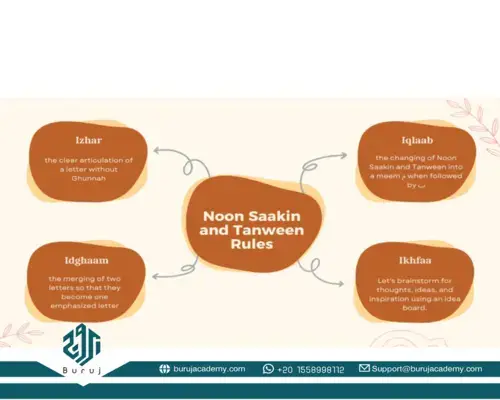
This comprehensive guide will meticulously explore the four primary Rules of Noon Saakin and Tanween: Izhar (إظهار), Idgham (إدغام), Iqlab (إقلاب), and Ikhfa’ (إخفاء). We will break down each rule with clear explanations, provide numerous illustrative examples directly from the Quran, and offer practical tips for their mastery.
Whether you are a beginner taking your first steps in Tajweed or an advanced student aiming for perfection in your recitation, grasping the Rules of Noon Saakin and Tanween will significantly enhance your ability to recite the Quran with clarity, precision, and a profound sense of devotion.
At Buruj Academy, our Online Tajweed Classes teach students to identify Noon Saakin and Tanween visually before addressing their rules, ensuring recognition accuracy becomes automatic through the Buruj Method‘s sound-before-rules approach.
Book Your FREE Trial Lesson to Begin Your Tajweed Journey

The Fundamentals: Understanding the Rules of Noon Saakin (نْ) and Tanween ( ً ٍ ٌ )
Before diving into the specific rules, it’s crucial to have a clear understanding of what Noon Saakin and Tanween are:
- Noon Saakin (نْ): This is a “Noon” letter that has no vowel (Fatha, Kasra, or Damma). It carries the Sukoon symbol (ـْ). It can appear in the middle of a word or at the end of a word. Its original form is present in the writing.
- Tanween ( ً ٍ ٌ ): This is an additional “Noon Saakin” sound (نْ) that occurs only at the end of nouns. It is pronounced but not written as a Noon. Instead, it is written as double short vowels:
- Fathatain ( ً ): Double Fatha, pronounced as “an”.
- Kasratain ( ٍ ): Double Kasra, pronounced as “in”.
- Dammatain ( ٌ ): Double Damma, pronounced as “un”.
The Rules of Noon Saakin and Tanween dictate how these sounds are pronounced when they are followed by any of the 28 letters of the Arabic alphabet.
Noon Saakin and Tanween Rules
To ensure the rhythmic and precise pronunciation of the Quranic text, specific phonetic rules are applied to the Noon Saakin and Tanween. Below is a detailed breakdown of the four primary rules: Izhar, Idgham, Iqlab, and Ikhfa’.
Rule 1: Izhar (الإظهار) – Clear Pronunciation
The first rule is Izhar, meaning “to make clear” or “to make apparent.” This rule applies when Noon Saakin (نْ) or Tanween ( ً ٍ ٌ ) is followed by one of the six Throat Letters (حروف الحلق). These letters are:
ء (Hamzah), هـ (Haa), ع (Ain), ح (Haa), غ (Ghain), خ (Khaa)
When Izhar occurs, the Noon Saakin or Tanween is pronounced clearly and distinctly, without any Ghunnah (nasal sound) or merging with the following letter. The sound comes purely from the mouth.
Characteristics of Izhar:
- Clarity: The Noon Saakin or Tanween is pronounced fully and clearly.
- No Ghunnah: There is no nasalization.
- Separation: The sound of the Noon Saakin/Tanween is separate from the following throat letter.
Examples from the Quran:
- مَنْ آمَنَ (Man Aamana): Here, the Noon Saakin in “Man” (مَنْ) is followed by Hamzah (ء). The Noon is pronounced clearly.
- مِنْ هَادٍ (Min Haadin): The Noon Saakin in “Min” (مِنْ) is followed by Haa (هـ). The Noon is clear.
- سَمِيعٌ عَلِيمٌ (Samee’un ‘Aleem): The Tanween in “Samee’un” (سَمِيعٌ) is followed by Ain (ع). The Tanween is pronounced clearly.
- مِنْ حَيْثُ (Min Haithu): The Noon Saakin in “Min” (مِنْ) is followed by Haa (ح). The Noon is clear.
- فَسَيُنْغِضُونَ (Fasayun-ghidhoona): The Noon Saakin in “Sayun” (سَيُنْ) is followed by Ghain (غ). The Noon is clear.
- وَمَنْ خَافَ (Wa man Khaaaf): The Noon Saakin in “Man” (مَنْ) is followed by Khaa (خ). The Noon is clear.
Rule 2: Idgham (الإدغام) – Merging
The second rule is Idgham, meaning “to merge” or “to assimilate.” This rule applies when Noon Saakin (نْ) or Tanween ( ً ٍ ٌ ) is followed by one of the six letters of Idgham, collected in the word يَرْمَلُونَ (Yarmaloon). These letters are:
ي (Yaa), ر (Raa), م (Meem), ل (Laam), و (Waw), ن (Noon)
Idgham is further divided into two types:
a) Idgham bi Ghunnah (إدغام بغنة) – Merging with Nasal Sound
This occurs when Noon Saakin (نْ) or Tanween ( ً ٍ ٌ ) is followed by one of the letters يَرْمَلُونَ (Yarmaloon), but specifically from the letters ي, ن, م, و (collected in the word يَنْمُو – Yanmoo).
In this case, the Noon Saakin or Tanween sound merges completely into the following letter, and a Ghunnah (nasal sound) is produced and held for approximately two counts.
Characteristics of Idgham bi Ghunnah:
- Merging: The Noon Saakin/Tanween completely merges into the following letter.
- Ghunnah: A clear nasal sound is produced and held for two counts.
Examples from the Quran:
- مَنْ يَعْمَلْ (Man Ya’mal): The Noon Saakin in “Man” (مَنْ) merges with Yaa (ي) with Ghunnah.
- مِنْ نِعْمَةٍ (Min Ni’matin): The Noon Saakin in “Min” (مِنْ) merges with Noon (ن) with Ghunnah.
- عَذَابٌ مُقِيمٌ (Azabun Muqeem): The Tanween in “Azabun” (عَذَابٌ) merges with Meem (م) with Ghunnah.
- مِنْ وَالٍ (Min Waalin): The Noon Saakin in “Min” (مِنْ) merges with Waw (و) with Ghunnah.
Important Note: Idgham does not occur if the Noon Saakin and the letter of Idgham are in the same word. In such cases, it becomes Izhar Mutlaq (إظهار مطلق), meaning clear pronunciation without Ghunnah. There are only four such words in the Quran: دُنْيَا (Dunya), بُنْيَانٌ (Bunyan), قِنْوَانٌ (Qinwan), صِنْوَانٌ (Sinwan).
b) Idgham bila Ghunnah (إدغام بلا غنة) – Merging without Nasal Sound
This occurs when Noon Saakin (نْ) or Tanween ( ً ٍ ٌ ) is followed by one of the letters ل (Laam) or ر (Raa).
In this type of Idgham, the Noon Saakin or Tanween sound merges completely into the following letter, but without any Ghunnah (no nasal sound).
Characteristics of Idgham bila Ghunnah:
- Complete Merging: The Noon Saakin/Tanween completely merges into Laam or Raa.
- No Ghunnah: No nasal sound is produced.
Examples from the Quran:
- مِنْ لَدُنْهُ (Min ladunhu): The Noon Saakin in “Min” (مِنْ) merges with Laam (ل) without Ghunnah.
- غَفُورٌ رَحِيمٌ (Ghafoorun Raheem): The Tanween in “Ghafoorun” (غَفُورٌ) merges with Raa (ر) without Ghunnah.
Discover the Buruj Academy Difference
Step into our virtual classrooms and see how our expert instructors make learning Quran and Arabic intuitive and clear. We focus on overcoming the specific hurdles non-native speakers face, building your confidence and connection with the Quran.
Rule 3: Iqlab (الإقلاب) – Conversion
The third rule is Iqlab, meaning “to convert” or “to change.” This rule is the simplest and occurs only in one specific case: when Noon Saakin (نْ) or Tanween ( ً ٍ ٌ ) is followed by the letter ب (Baa).
In this situation, the Noon Saakin or Tanween sound is converted into a light Meem (م) sound. This converted Meem is then pronounced with an Ikhfa’ (concealment) and a Ghunnah (nasal sound) of approximately two counts, while the lips are gently closed. You will often see a small “م” written above the Noon Saakin or Tanween in the Mushaf to indicate Iqlab.
Characteristics of Iqlab:
- Conversion: Noon Saakin/Tanween sound changes to a soft Meem sound.
- Ghunnah: A nasal sound is produced and held for two counts.
- Gentle Lip Closure: The lips close gently, preparing for the “Baa” sound that follows.
Examples from the Quran:
- مِنْ بَعْدِ (Min Ba’d): The Noon Saakin in “Min” (مِنْ) is converted to a Meem sound and pronounced with Ghunnah before the Baa (ب).
- لَيُنْبَذَنَّ (Layunbazanna): The Noon Saakin in “Layun” (لَيُنْ) is converted to a Meem sound with Ghunnah before the Baa (ب).
- سَمِيعٌ بَصِيرٌ (Samee’un Baseer): The Tanween in “Samee’un” (سَمِيعٌ) is converted to a Meem sound with Ghunnah before the Baa (ب).
Through Buruj Academy‘s Amli Tajweed Course, students practice Iqlab in real recitation contexts with immediate instructor correction, bridging the gap between understanding the rule conceptually and applying it accurately.
Book Your FREE Trial Lesson in Buruj’s Amli Tajweed Course

Rule 4: Ikhfa’ (الإخفاء) – Concealment
The fourth and final rule is Ikhfa’, meaning “to conceal” or “to hide.” This rule is the most common and applies when Noon Saakin (نْ) or Tanween ( ً ٍ ٌ ) is followed by any of the remaining 15 letters of the Arabic alphabet. These letters are those which are not among the Throat Letters (Izhar), the letters of Yarmaloon (Idgham), or Baa (Iqlab).
The letters of Ikhfa’ are:
ت ث ج د ذ ز س ش ص ض ط ظ ف ق ك
In Ikhfa’, the Noon Saakin or Tanween sound is neither fully pronounced (like Izhar) nor fully merged (like Idgham). Instead, it is concealed or hidden into a light nasal sound (Ghunnah) that is held for approximately two counts. The articulation point of the Ghunnah shifts towards the articulation point of the following letter.
Characteristics of Ikhfa’:
- Concealment: The Noon Saakin/Tanween sound is hidden, not fully pronounced.
- Ghunnah: A nasal sound is produced and held for two counts.
- Readiness for Next Letter: The tongue or lips prepare for the pronunciation of the following letter during the Ghunnah.
Examples from the Quran:
- مَنْصُورًا (Mansooran): The Noon Saakin in “Man” (مَنْ) is followed by Saad (ص). The Noon is concealed with Ghunnah.
- مِنْ دُونِ (Min Dooni): The Noon Saakin in “Min” (مِنْ) is followed by Daal (د). The Noon is concealed with Ghunnah.
- رِيحًا صَرْصَرًا (Reehan Sarsara): The Tanween in “Reehan” (رِيحًا) is followed by Saad (ص). The Tanween is concealed with Ghunnah.
- أَنْ تَتْلُوَ (An Tatluwa): The Noon Saakin in “An” (أَنْ) is followed by Taa (ت). The Noon is concealed with Ghunnah.
- عَزِيزٌ كَرِيمٌ (‘Azeezun Kareem): The Tanween in “Azeezun” (عَزِيزٌ) is followed by Kaaf (ك). The Tanween is concealed with Ghunnah.
Buruj Academy‘s Advanced Tajweed Course addresses these subtle Ikhfa variations in depth, taught by Al-Azhar graduates who train students to hear and produce these distinctions accurately.
Master Tajweed at Buruj with a free lesson.

Read Also: Qalqalah letters
Mastering the Rules of Noon Saakin and Tanween: Practical Steps
Mastering these Rules of Noon Saakin and Tanween requires more than just theoretical knowledge. It demands consistent practice and guidance.
1. Listen Actively:
Regularly listen to authentic Quran recitations by renowned Qaris (reciters). Pay close attention to how they apply these rules, especially the duration and quality of the Ghunnah.
2. Practice Consistently:
Dedicate a specific time each day to practice. Start with simple verses and gradually move to more complex ones. Focus on applying each rule correctly.
3. Seek Expert Guidance:
The most effective way to master Tajweed is with a qualified teacher. An experienced instructor can correct your mistakes, provide personalized feedback, and guide you through the intricacies of pronunciation. Buruj Academy’s expert tutors from Egypt are specifically trained to teach Tajweed to students worldwide.
4. Recite Slowly:
Begin by reciting slowly and deliberately. This allows you to consciously apply each rule. As you gain proficiency, your speed will naturally increase without compromising accuracy.
5. Utilize Resources:
Refer to Tajweed charts, diagrams, and online resources that illustrate these rules. Use audio recitations to mimic the correct sounds.
Common Errors Students Make When Applying Tanween Tajweed Rules in Recitation
Understanding rules intellectually differs from applying them consistently under recitation pressure. These are the most frequent errors we observe in students learning tanween Tajweed rules.
1. Applying Idgham Rules Inside Single Words
Students sometimes apply Idgham to Noon Saakin when it appears within the same word as a following Idgham letter. As noted earlier, this is incorrect. Idgham applies only across word boundaries.
2. Pronouncing Ghunnah During Idgham Without Ghunnah
When Noon Saakin precedes Laam (ل) or Raa (ر), no ghunnah is produced. Many students habitually nasalize every Idgham, creating an error on these two letters specifically.
3. Forgetting Iqlab in Fast Recitation
During fluent reading, the Iqlab transition can be missed. Students revert to pronouncing a regular Noon before Baa instead of converting to the Meem quality. Slowing down during practice phases builds the muscle memory needed to maintain Iqlab at speed.
Start Learning the Quran Today
Join our qualified teachers and begin your journey in Quran recitation, Tajweed, and understanding — from the comfort of your home.
Book Your Free TrialRead Also: Tajweed Rules: Essential Guide to Perfect Quranic Recitation with Buruj Academy
Master Tajweed with Buruj Academy’s Expert Instructors
The rules of Noon Saakin and Tanween form a precise, learnable system—and the right instructor makes all the difference in applying them correctly.
Buruj Academy offers:
- Ijazah-certified instructors and Al-Azhar University graduates
- 12+ years teaching non-Arabic speakers globally
- The Buruj Method: sound-before-rules for genuine mastery
- Personalized 1-on-1 sessions with real-time recitation correction
- Flexible 24/7 scheduling for students worldwide
- Structured progression from rule understanding to applied recitation
Book your free trial lesson with Buruj Academy today and experience expert Tajweed instruction built around your learning pace and goals.
See which of Burooj’s courses aligns with your learning path:
- Tajweed Classes
- Tafseer Al-Quran Course
- Quran Recitation Course
- Hifz Course (Quran Memorization)
- Quranic Arabic Classes
- Noorani Qaida course
- Islamic Studies

Conclusion
The Rules of Noon Saakin and Tanween are cornerstones of proper Quranic recitation. Mastering Izhar, Idgham, Iqlab, and Ikhfa’ is not just about adhering to linguistic rules; it’s about honoring the words of Allah (SWT) and enhancing your spiritual connection. This detailed understanding allows you to recite with greater confidence, clarity, and beauty.
Buruj Academy offers a unique opportunity for learners globally to master these essential Tajweed rules. With our comprehensive Tajweed courses and highly experienced tutors from Egypt, you will receive the personalized guidance needed to perfect your recitation.



Leave a Reply