 Quran
Quran
Have you ever listened to a masterful Quran reciter and, consequently, felt captivated? The words flow with a distinct rhythm. In addition, certain letters resonate with a powerful, echoing sound. This isn’t a secret talent; instead, it’s the result of mastering the science of Tajweed, which is a collection of rules for reciting the Quran correctly. One of the most fundamental rules, for instance, involves the Qalqalah letters. Moreover, understanding and applying Qalqalah can transform your recitation, thereby giving it the vibrancy and precision it deserves.
Here at Buruj Academy, we believe learning the Quran should be a journey of profound connection. Therefore, that journey starts with a solid foundation in its language. This article, subsequently, guides you through the intricacies of the Qalqalah letters. First, it explains what they are. Next, it shows you how to pronounce them. Finally, it tells you why they are so crucial for anyone who wants to recite the Quran with excellence.
The Five Qalqalah Letters and Their Articulation Points
In Arabic, certain letters have a unique characteristic. This happens when they carry a sukoon, or a silent marker. They create an echoing sound upon pronunciation. We call this phenomenon Qalqalah, which literally means “disturbance” or “vibration.” This vibration ensures the letter stays clear and distinct. It prevents it from blending with the sounds that come before or after it. Think of it as a subtle bounce or echo that makes the sound jump out.
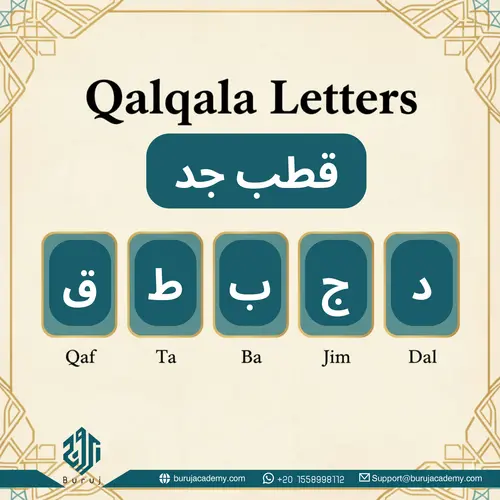
There are five Qalqalah letters. You can easily remember them by their collective phrase: “قطب جد” (Qutb Jud).
The five letters are:
- ق (Qaf)
- ط (Ta)
- ب (Ba)
- ج (Jim)
- د (Dal)
When these five letters have a sukoon, you must pronounce them with this special echoing effect. Neglecting this rule can alter a word’s meaning. At the very least, it takes away from the beauty and clarity of your recitation.
| Letter | Name | Articulation Point |
| ق | Qaf | Deep back of tongue meeting soft palate |
| ط | Ta (emphatic) | Tip of tongue meeting upper gum ridge |
| ب | Ba | Both lips pressing together |
| ج | Jeem | Middle of tongue meeting hard palate |
| د | Dal | Tip of tongue meeting upper front teeth base |
These five letters share a quality that makes echo physically inevitable: their articulation points involve complete oral closure, creating pressure that releases audibly. Understanding each letter’s makhraj helps students produce authentic Qalqalah rather than an artificial added sound.
At Buruj Academy, our Online Tajweed Classes train students to feel this pressure before applying the rule, ensuring Qalqalah emerges naturally from correct articulation rather than conscious addition.
Book Your FREE Trial Lesson to Begin Your Tajweed Journey

Understanding the Echo (Qalqalah Letters): Levels of Qalqalah
Reciting the Quran requires precision, so the rule of Qalqalah is no exception. We categorize the echoing sound into three distinct types. Each type has its own level of emphasis. You must distinguish between them to achieve the correct pronunciation.
1. Qalqalah Sughra: The Minor Echo
You pronounce a Qalqalah Sughra when one of the five letters appears in the middle of a word with a sukoon. Since the pronunciation of the word continues after the letter, the echoing sound is minor and quick. You create a gentle bounce, not a prolonged one.
For example, consider the word: يَدْخُلُونَ (yadkhulūna).
Here, the letter د (dal) has a sukoon and appears in the middle. You don’t hold the sound of the dal. Instead, you give it a light, bouncing quality. The sound of the dal vibrates, but the word’s flow remains smooth.
Another example is the word: يَقْطَعُونَ (yaqtaʿūna). The ق (qaf) has a sukoon in the middle. You create a gentle echo for the qaf, keeping the recitation flowing without interruption. In short, this minor form of Qalqalah ensures each letter maintains its identity.
2. Qalqalah Kubra: The Major Echo
This type of Qalqalah occurs when a Qalqalah letter with a sukoon appears at the very end of a word. You perform this sukoon by stopping on the word. The echo here is much more prominent and stronger than the minor form. This is because you finish the word on that letter. You don’t just create a light bounce; you make a clear, resonant sound.
A powerful example is the word خَلَقَ (khalaq). The ق (qaf) at the end receives a strong, echoing bounce. This makes its pronunciation distinct and forceful.
You will find this form of Qalqalah frequently at the end of āyāt (verses) in the Quran. The last letter of a word is often a Qalqalah letter. Its clear, bouncing sound gives the recitation a beautiful, well-defined finish.
3. Qalqalah Akbar: The Greater Echo
This is the most powerful and distinct form of Qalqalah. You encounter it when one of the five Qalqalah letters appears at the very end of a word and has a shaddah (a doubling mark). When you stop on this word, you first create slight pressure on the letter. Then, you release it with a powerful echo. The vibration is the most intense here. In fact, it reflects the presence of the shaddah.
A prime example comes from Surah Al-Masad, with the phrase وَتَبَّ (wa tabb). When you stop on the word, the ب has a shaddah. You give it a firm press and then release it with a strong, definitive echo. The sound is full and resonant.
The most common examples in the Quran are words like وَالْحَجَّ (wal-ḥajj). When you stop on the final ج (jim) or ب (ba), which have a shaddah, you must perform this pronounced, strong Qalqalah. It makes the letter sound as if you are saying it twice, but with the distinct echoing quality that defines the rule.
This three-tier system distinguishes students pursuing advanced recitation or Ijazah certification from those with basic Tajweed knowledge. Buruj Academy‘s Advanced Tajweed Course covers these distinctions explicitly with recitation comparisons.
Master Tajweed at Buruj with a free lesson.

The Conditions That Activate Qalqalah During Recitation
Qalqalah does not apply to every occurrence of these five letters. Two precise conditions must be met simultaneously.
| Condition | Description | Example |
| Letter must be one of the five | ق ط ب ج د only | Other letters never receive Qalqalah |
| Letter must carry sukoon | Either original sukoon or sukoon due to waqf (stopping) | Voweled Qalqalah letters do NOT echo |
When a Qalqalah letter carries a fatha, kasra, or damma, no Qalqalah applies whatsoever. Students frequently apply Qalqalah to voweled ب or ج, which is an error. Only saakin Qalqalah letters activate the rule.
Through Buruj Academy‘s Amli Tajweed Course, students practice identifying these conditions in real Quran passages with immediate instructor correction, developing accurate recognition instincts.
Book Your FREE Trial Lesson in Buruj’s Amli Tajweed Course

Read Also: Ghunnah and its rules
Why Mastering Qalqalah Matters for Your Quran Recitation
Knowing these rules isn’t just about academic knowledge. Indeed, it has a profound impact on the quality and beauty of your recitation. Learning Qalqalah letters is a cornerstone of proper Tajweed. Furthermore, Tajweed itself is a pathway to a deeper connection with the Quran.
First, correct Qalqalah prevents silent letters from disappearing. Without the echo, a letter like ق (qaf) could easily get lost in a word’s middle. The Qalqalah ensures its proper articulation. This preserves the original text’s integrity. You pronounce every letter with its correct sound, just as the Prophet Muhammad (peace be upon him) did.
Second, Qalqalah brings rhythm and flow to the recitation. The subtle bouncing sounds of Qalqalah Sughra and the strong, definitive echoes of Qalqalah Kubra and Akbar add a beautiful musicality to the recitation. This is what you often hear in the voices of professional reciters. Their clear articulation of every rule, including Qalqalah, makes their recitation so compelling.
Ultimately, mastering Qalqalah is an act of reverence. You show respect for Allah’s word by striving to recite it in the most accurate and beautiful way possible. It transforms your recitation from a simple reading into a devotional act. In turn, this brings you closer to the divine message.
Discover the Buruj Academy Difference
Step into our virtual classrooms and see how our expert instructors make learning Quran and Arabic intuitive and clear. We focus on overcoming the specific hurdles non-native speakers face, building your confidence and connection with the Quran.
Common Pitfalls: Avoiding Mistakes with Qalqalah
As you begin to practice, you might encounter a few common pitfalls. Recognizing these mistakes will help you correct them and perfect your pronunciation.
1. Adding a Vowel Sound:
One frequent mistake is adding a small vowel sound (like a fatha or kasra) after the echoing letter. The Qalqalah sound should be pure and clear, not followed by a vowel. It’s an echo, not a new syllable.
2. Lack of Clarity:
Sometimes, learners perform Qalqalah, but the sound is weak and unclear. You must ensure the echo is distinct and audible, especially for Qalqalah Kubra and Akbar. Don’t be afraid to give the letter a solid bounce.
3. Making it Too Long:
A Qalqalah echo should be quick and sharp. You should not prolong the sound or make it last too long. It is a swift release of the letter’s sound, not a drawn-out one.
4. Neglecting the Rule:
This is the most critical error. Simply forgetting to perform Qalqalah on a letter with a sukoon can change the meaning. At best, it makes the recitation sound incorrect. Always remain mindful of the five Qalqalah letters when you see them.
How to Practice Qalqalah Letters Correctly Using Targeted Drilling
Correct Qalqalah practice requires isolating the physical sensation before applying it in running recitation. We recommend this systematic drilling sequence.
Step 1: Produce each of the five letters in isolation with sukoon. Hold the articulation closure, then release — feel the natural pressure and resulting echo.
Step 2: Practice Sughra in short words — يَقْطَعُ, أَجْدَرُ, يَبْخَلُ — focusing on restraint. The echo should be present but not exaggerated.
Step 3: Practice Kubra at verse endings. Recite the last word of verses ending in Qalqalah letters, pausing deliberately and allowing the full echo to resolve completely before moving on.
Step 4: Record yourself reciting Surahs rich in Qalqalah — Al-Falaq, Al-Ikhlas, Al-Buruj — and compare your Sughra versus Kubra intensity. The difference should be audibly clear.
Buruj Academy’s Tajweed for Beginners provides structured drilling sequences exactly like this, with Al-Azhar-trained instructors who assess each level individually and correct articulation at the makhraj level, not just the surface sound.
Book Your FREE Trial Lesson to Begin Your Tajweed Journey
Beyond the Qalqalah letters: The Wider World of Tajweed
The rule of Qalqalah is just one of many beautiful rules within the science of Tajweed. Once you have a firm grasp of these five Qalqalah letters and their pronunciation, you can move on to other rules. These include Idgham, Ikhfa, and Izhar. Each rule adds a new layer of beauty and precision to your recitation. As a result, it turns a simple reading into a profound spiritual experience.
Tajweed is a lifelong pursuit. The deeper you go, the more you appreciate the elegance and perfection of the Arabic language and the Quran it holds. We encourage you to start with Qalqalah. Then, continue your journey into the wider world of Tajweed. The rewards—in this life and the next—are immeasurable.
For more Tajweed lessons, you can read Ghunnah and its rules and Types of Madd in Tajweed.
Start Learning the Quran Today
Join our qualified teachers and begin your journey in Quran recitation, Tajweed, and understanding — from the comfort of your home.
Book Your Free TrialMaster Qalqalah and All Tajweed Rules with Buruj Academy’s Expert Instructors
Qalqalah is one rule within a complete Tajweed system. Mastering it properly requires certified instruction, not guesswork.
Buruj Academy offers:
- Ijazah-certified instructors and Al-Azhar University graduates with 12+ years of experience
- The Buruj Method: sound-before-rules training that builds physical accuracy first
- Personalized Learning Plans tailored to your current recitation level
- Real-time correction in private 1-on-1 online sessions
- Flexible 24/7 scheduling for global students
- Structured progression from foundational rules to advanced mastery
Book your free trial lesson today and let our instructors assess your Qalqalah application, correct your recitation from the root, and guide you toward confident, accurate Quran recitation. Insha’Allah, your recitation will reflect genuine Tajweed knowledge, not approximation.
See which of Burooj’s courses aligns with your learning path:
- Tajweed Classes
- Tafseer Al-Quran Course
- Quran Recitation Course
- Hifz Course (Quran Memorization)
- Quranic Arabic Classes
- Noorani Qaida course
- Islamic Studies

Conclusion (Qalqalah letters)
Mastering the Qalqalah letters is a significant milestone on the path to beautiful Quranic recitation. You now understand what they are, their three types, and why they are so vital. By applying this knowledge, you make your recitation more accurate, beautiful, and meaningful. Remember the “echoing sound” and practice with diligence.
At Buruj Academy, we are ready to help you take the next step. Whether you are just beginning or looking to refine your skills, our expert tutors and comprehensive courses provide the perfect environment for you to succeed. We welcome you to join our family of learners. Let us embark on a rewarding journey of spiritual and linguistic growth together.


Leave a Reply