 Tajweed
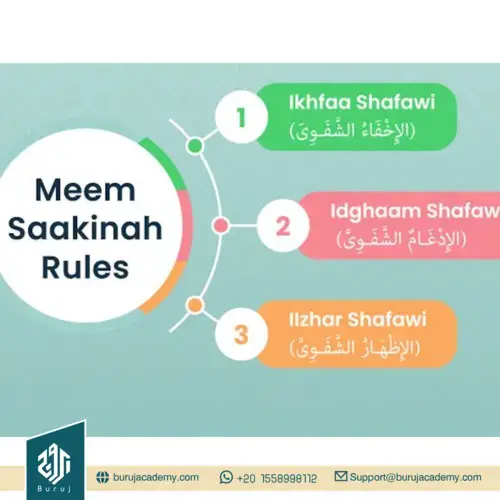
Reciting the Holy Quran with proper Tajweed is a vital part of a Muslim’s faith. Tajweed is the science of beautifying the recitation. It includes a set of rules for pronunciation, pauses, and flow. Among these, the Rules of Meem Saakin (the silent “Meem” – مْ) are very important. They ensure the recitation is clear and melodious.
The letter “Meem” (م) appears often in the Quran. When it has a “Sukoon” (ـْ), it becomes silent. This silent Meem is subject to specific rules based on the letter that follows it. Understanding and applying these Rules of Meem Saakin is crucial for reciting the Quran correctly. It helps honor the language’s beauty and preserve its intended meaning. Neglecting these rules can change the sound and even the interpretation of the sacred verses.
This comprehensive guide will explain the three main Rules of Meem Saakin. These are Ikhfa’ Shafawee, Idgham Shafawee, and Izhar Shafawee. We will explore each rule with clear explanations and examples from the Quran. This guide will also provide practical tips for applying them.
Whether you are a beginner or an experienced reciter, mastering these rules will enhance your recitation. Buruj Academy, based in Egypt, offers expert-led online courses to help you master these essential rules and elevate your connection with the Quran.
The Foundation: What is Meem Saakin (مْ)?
First, it is essential to understand what “Meem Saakin” means. In Arabic, a “Saakin” letter has the Sukoon symbol (ـْ). This symbol shows the absence of a short vowel. Therefore, “Meem Saakin” is the letter “Meem” (م) when it is silent.
This silent Meem can be in the middle of a word or at the end of it. The Rules of Meem Saakin explain how to pronounce this silent Meem based on the letter that comes right after it. Following these rules ensures a smooth and beautiful recitation.
At Buruj Academy, our Online Tajweed Classes teach meem saakin using our sound-first approach: students hear correctly modeled examples repeatedly before rules are formally introduced, building accurate instincts that stick.
Book Your FREE Trial Lesson to Begin Your Tajweed Journey

Meem Sakinah Rules
The rules of Meem Sakinah govern how a silent Meem is pronounced depending on the letter that follows it in the Quranic text. Mastering these three distinct rules—Ikhfa’, Idgham, and Izhar Shafawee—is essential for achieving correct Tajweed and preserving the natural flow of recitation.
Rule 1: Ikhfa’ Shafawee (الإخفاء الشفوي) – Labial Concealment
The first rule is Ikhfa’ Shafawee. This rule applies when a Meem Saakin (مْ) is followed by the letter Baa (ب).
In this case, you “conceal” the Meem sound. You do this by making a light nasal sound (Ghunnah) while your lips are gently touching. The lips should not be closed with pressure. This Ghunnah should be held for about one count. The word “Shafawee” (شفوي) means “labial” because both “Meem” and “Baa” are pronounced using the lips.
Key characteristics of Ikhfa’ Shafawee:
- Nasal Sound (Ghunnah): A light sound is produced from the nasal cavity.
- Gentle Lip Contact: The lips touch lightly, preparing for the “Baa” sound.
- Concealment: The clear “Meem” sound is softened and somewhat hidden in the Ghunnah.
Examples of Ikhfa’ Shafawee from the Quran:
- تَرْمِيهِم بِحِجَارَةٍ (Tarmihim bihijarah): In Surah Al-Fil (105:4), the Meem Saakin in “Tarmihim” is followed by the letter Baa. The Meem is recited with a light Ghunnah before pronouncing the “Baa”.
- وَمَا صَاحِبُكُم بِمَجْنُونٍ (Wa maa sahibukum bimajnoon): In Surah At-Takwir (81:22), the Meem Saakin in “sahibukum” is followed by a Baa. The same rule of Ikhfa’ Shafawee applies here.
Discover the Buruj Academy Difference
Step into our virtual classrooms and see how our expert instructors make learning Quran and Arabic intuitive and clear. We focus on overcoming the specific hurdles non-native speakers face, building your confidence and connection with the Quran.
Rule 2: Idgham Shafawee (الإدغام الشفوي) – Labial Merging
The second rule is Idgham Shafawee. It is also known as Idgham Mithlain Sagheer (merging of two identical letters). This rule applies when a Meem Saakin (مْ) is followed by another Meem (م) that has a vowel.
Here, the two Meem sounds are merged into one, emphasized Meem. This is done with a nasal sound (Ghunnah) held for about two counts. “Mithlain Sagheer” means the two identical letters are next to each other, with the first being silent and the second having a vowel.
Key characteristics of Idgham Shafawee:
- Merging: The two “Meem” sounds blend completely into one.
- Emphasis: The resulting “Meem” sound is pronounced with stress.
- Ghunnah: A clear nasal sound is held for two counts.
- Full Lip Closure: The lips close fully to pronounce the merged “Meem” sound.
Examples of Idgham Shafawee from the Quran:
لَهُم مَّا يَشَاءُونَ
Lahum mā yashāʾūn
“For them is whatever they wish.” (Ya-Sin 36:57)
Idgham Shafawi: مْ followed by مَّ — complete merge into one strengthened meem with ghunnah
Why Idgham Shafawi Sounds Like One Meem
Because both letters share identical articulation points and characteristics, the merge is total and effortless. Unlike Idgham of noon saakin, where letters merge into partially different sounds, this is meem absorbing meem completely.
Through Buruj Academy’s Amli Tajweed Course, students practice this merge in real recitation with live instructor feedback, ensuring the ghunnah length is accurate rather than rushed or prolonged beyond two harakaat.
Book Your FREE Trial Lesson in Buruj’s Amli Tajweed Course

Rule 3: Izhar Shafawee (الإظهار الشفوي) – Labial Clarity
The third and most common rule is Izhar Shafawee. This rule applies when a Meem Saakin (مْ) is followed by any letter of the Arabic alphabet except for Baa (ب) and Meem (م).
In this situation, you pronounce the Meem Saakin clearly and distinctly. There should be no Ghunnah or merging. The word “Izhar” (إظهار) means “to make clear.”
Key characteristics of Izhar Shafawee:
- Clear Pronunciation: The “Meem Saakin” sound is articulated plainly.
- No Ghunnah: There is no nasal sound.
- Separation of Sounds: The “Meem” sound and the sound of the following letter are pronounced separately.
Important Note: Reciters should be extra careful to pronounce the Meem Saakin clearly when it is followed by the letters Faa (ف) and Waw (و). There is a natural tendency to merge the sounds, but this is incorrect. The Meem must remain clear.
Examples of Izhar Shafawee from the Quran:
- عَلَيْهِمْ وَلَا (‘Alayhim wa laa): In Surah Al-Fatiha (1:7), the Meem Saakin in “‘Alayhim” is followed by the letter Waw. The Meem should be pronounced clearly.
- أَمْ لَمْ تُنْذِرْهُمْ (Am lam tunthirhum): In Surah Al-Baqarah (2:6), the Meem Saakin in “lam” is followed by the letter Taa. The Meem is pronounced with clear Izhar.
- كُنْتُمْ خَيْرَ أُمَّةٍ (Kuntum khayra ummatin): From Surah Aal-Imran (3:110), the Meem Saakin in “Kuntum” is followed by the letter Khaa. Clear Izhar Shafawee is applied.
Read Also: Makharij al Huruf
How to Master the Rules of Meem Saakin
Mastering these rules requires consistent practice and careful listening. Here are some practical tips to help you.
- Listen Attentively: Regularly listen to Quran recitations by famous Qaris who apply proper Tajweed. Pay close attention to how they pronounce the Meem Saakin.
- Practice Daily: Dedicate time each day to practice reciting verses that contain these rules. Focus on getting the Ghunnah duration and lip movements correct.
- Seek Expert Feedback: The best way to improve is with a qualified teacher. A good teacher can identify and correct your mistakes early on. At Buruj Academy, our expert tutors provide this personalized feedback.
- Use Visual Aids: Refer to Tajweed charts and diagrams that illustrate the Rules of Meem Saakin. This can help you understand and remember them.
- Recite Slowly: When practicing, recite slowly and clearly. Focus on applying each rule correctly. Speed will come naturally with mastery.
The Most Common Meem Saakin Errors Students Make During Recitation
Understanding rules theoretically is different from applying them correctly under recitation conditions. These are the error patterns we observe most frequently among non-Arabic speaking students.
| Error Type | Which Rule Affected | What Students Do Incorrectly | How to Correct It |
| Lips closing too early | Ikhfa Shafawi | Full meem is produced before ba | Keep lips slightly open during ghunnah |
| Weak or missing ghunnah | Idgham Shafawi | Meem merges silently without nasal resonance | Engage the nasal passage actively |
| Adding ghunnah unnecessarily | Izhar Shafawi | Nasal hum bleeds into the following letter | Practice meem in isolation, then with following letter |
| Rushing the ghunnah | Ikhfa and Idgham | Ghunnah shortened below two harakaat | Count precisely during slow recitation practice |
Correcting these errors requires auditory training alongside rule memorization. Reading explanations alone rarely resolves deep-rooted pronunciation habits—live correction from a qualified instructor accelerates improvement significantly.
Buruj Academy’s Advanced Tajweed Course addresses exactly these nuanced error patterns, with instructors trained to identify subtle labial position mistakes that students cannot self-diagnose.
Master Tajweed at Buruj with a free lesson.

Read Also: Rules of Waqf and Ibtida
A Practical Method for Applying Meem Saakin Rules While Reading Quran
When you encounter meem saakin during recitation, a trained reciter’s internal process takes approximately a fraction of a second. For students still building this automaticity, a structured approach helps.
First, identify the letter immediately following the meem saakin. Second, determine whether it is ba, meem, or something else. Third, apply the corresponding rule without hesitation.
Building Automaticity Through Targeted Drilling
Practice isolated pairs before full verses. Take meem saakin with ba, repeat it thirty times with correct lip position. Then meem saakin with meem, repeating the merged form until it sounds natural. Finally, practice meem saakin with each Izhar letter individually.
This progressive drilling method builds the neural pathways that make correct application automatic during connected recitation. Insha’Allah, within weeks of consistent practice, rule selection becomes instinctive rather than deliberate.
Start Learning the Quran Today
Join our qualified teachers and begin your journey in Quran recitation, Tajweed, and understanding — from the comfort of your home.
Book Your Free TrialRead Also: Tajweed Rules: Essential Guide to Perfect Quranic Recitation with Buruj Academy
Master Tajweed Rules with Buruj Academy’s Expert Instructors
The meem saakin rules are foundational to accurate Quranic recitation—and expert guidance makes all the difference.
At Buruj Academy, we offer:
- Ijazah-certified instructors and Al-Azhar University graduates with 12+ years teaching non-Arabic speakers
- The Buruj Method: sound-before-rules training that builds accurate instincts before rule memorization
- Personalized 1-on-1 sessions with real-time correction of labial position and ghunnah errors
- Flexible 24/7 scheduling for adults, students, and busy professionals
- Structured progression from foundational rules to full Tajweed mastery
Book your free trial lesson today and experience instructor-guided Tajweed correction firsthand. Visit Buruj Academy to get started.
See which of Burooj’s courses aligns with your learning path:
- Tajweed Classes
- Tafseer Al-Quran Course
- Quran Recitation Course
- Hifz Course (Quran Memorization)
- Quranic Arabic Classes
- Noorani Qaida course
- Islamic Studies

Conclusion: Elevating Your Quranic Recitation
The Rules of Meem Saakin are an integral part of Tajweed. They contribute significantly to the beauty and accuracy of Quranic recitation. By diligently applying Ikhfa’ Shafawee, Idgham Shafawee, and Izhar Shafawee, you can elevate your connection with the Holy Quran.
Consistent effort and seeking guidance from knowledgeable teachers are key. Buruj Academy’s comprehensive online courses and experienced tutors provide a supportive environment for learners worldwide to master these essential rules.
Ready to perfect your recitation? Visit our courses page to explore our Tajweed programs and meet our expert tutors. Follow us on Facebook, YouTube, and Instagram for more valuable resources.
Related Articles
Tajweed


Leave a Reply