 Arabic
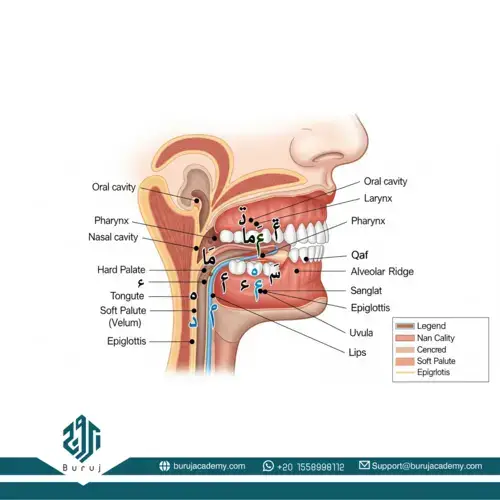
If you want to recite the Qur’an beautifully and accurately, you must master Makharij al Huruf—the articulation points of Arabic letters. By understanding exactly where each letter originates, you ensure correct pronunciation, preserve the meaning of each word, and uphold the eloquence of Qur’anic recitation.
In this article, we will walk you through everything you need to know about Makharij al Huruf, from its basics to practical tips for mastery.
Whether you are a beginner or seeking to enhance your Tajweed skills , this guide will serve as your comprehensive reference.
What is Makharij al Huruf?
Makharij al Huruf (مخارج الحروف) literally means “articulation points of letters.” When you pronounce each Arabic letter, you must use a very specific part of the mouth, throat, or nasal cavity. Therefore, mastering these points allows you to distinguish subtle differences between similar sounds—like ص (Saad) and س (Seen). Consequently, this not only prevents mistakes but also enhances the clarity and power of your recitations.
Understanding the Makharij forms the backbone of proper Tajweed and Arabic phonetics, ensuring that you replicate the sounds exactly as they were revealed and taught.
At Buruj Academy, our Online Tajweed Classes teach makharij using the Buruj Method—training your ear to distinguish sounds before your tongue learns to produce them, guided by Ijazah-certified instructors with 12+ years of experience teaching non-Arabic speakers.
Book Your FREE Trial Lesson to Begin Your Tajweed Journey

Why Should You Learn Makharij al Huruf?
Mastering the precise exit points of letters is the foundational step toward spiritual and linguistic excellence in your recitation. Understanding these articulation points ensures that every word you utter remains true to its original meaning and divine revelation.
1. Preserve Perfect Qur’an Recitation
By learning Makharij al Huruf, you will recite verses exactly as they were revealed. Even slight changes in articulation may shift meanings—switching between ح (Haa) and ه (Ha) alters words entirely. Thus, you protect the Qur’an’s authenticity through proper pronunciation and fulfill your duty in preserving its sanctity.
2. Follow the Sunnah of Tajweed
The Prophet Muhammad ﷺ recited the Qur’an precisely and instructed his companions to do so. Therefore, when you learn proper articulation, you fulfill the Sunnah and show true respect for Allah’s words.
3. Gain Fluency in Arabic
Accurately pronouncing Arabic letters helps you strengthen your accent and fluency. Although many non-native speakers find sounds like ع (Ayn) or غ (Ghayn) challenging, practicing their articulation points makes them much easier and more natural.
Additionally, proper articulation improves your listening comprehension as well as your speaking ability, both essential for mastering Arabic.
Check out Buruj Academy’s Tajweed courses today!
Discover the Buruj Academy Difference
Step into our virtual classrooms and see how our expert instructors make learning Quran and Arabic intuitive and clear. We focus on overcoming the specific hurdles non-native speakers face, building your confidence and connection with the Quran.
The Five Major Areas of Makharij al Huruf
Scholars, such as Imam Ibn al-Jazari, defined 17 articulation points, grouping them into five key regions:
1. The Oral Cavity (al-Jawf)
You produce the long vowels ا, و, ي from the empty space in the mouth and throat (al-jawf).
- ا (Alif) – after a fatha
- و (Waw) – after a damma
- ي (Ya) – after a kasra
These sounds form the foundational elongated vowels essential for fluency and melody in recitation
2. The Throat (al-Halq)
The throat area has three distinct points for six letters:
- Bottom of the throat: ء (Hamzah), ه (Ha)
- Middle of the throat: ع (Ayn), ح (Haa)
- Top of the throat: غ (Ghayn), خ (Khaa)
These letters require precise throat control and distinct vocalization techniques, often presenting challenges for learners.
3. The Tongue (al-Lisaan)
Your tongue plays the largest role, with ten articulation points for most of the Arabic alphabet.
- Back of the tongue and soft palate: ق (Qaf), ك (Kaf)
- Middle of the tongue and hard palate: ج (Jeem), ش (Sheen), ي (Ya)
- Side of the tongue: ض (Dad)
- Edge of the tongue and upper teeth: ل (Lam)
- Tip of the tongue and various teeth: ن (Noon), ر (Ra), ت (Ta), د (Dal), ط (Ta), س (Seen), ز (Zay), ص (Saad), ظ (Za), ث (Tha), ذ (Dhal)
The tongue requires precise positioning to differentiate many closely related letters , making this area critical for Tajweed mastery.
ض (Dhad) holds a distinction in Islamic scholarship: Arabic is called “Lughat Ad-Dhad” (the language of Dhad) because this letter exists in no other language on earth. Its makhraj is the side edge of the tongue pressing against the upper molars.
Many students substitute ض with ظ or even a retroflex “d” sound. Both are Tajweed errors affecting recitation validity. Buruj Academy’s Advanced Tajweed Course addresses precisely these subtle makharij distinctions for students pursuing mastery, taught by Al-Azhar graduates specializing in Quranic recitation.
Master Tajweed at Buruj with a free lesson.

4. The Lips (ash-Shafataan)
Your lips produce four letters:
- By closing both lips: ب (Ba), م (Meem)
- By rounding, without full closure: و (Waw)
- By touching the bottom lip to upper teeth: ف (Fa)
5. The Nasal Passage (al-Khayshoom)
You use the nasal cavity to create the nasalization (ghunnah) in م (Meem) and ن (Noon) with the correct Tajweed rules.
Mastering nasal sounds adds a beautiful resonance and proper emphasis to Quranic recitation, especially during prolonged nasalized letters.
Common Mistakes in Makharij al Huruf
Many students confuse similar sounds or mistakenly group articulation points. For instance:
- Mixing up س (Seen) and ص (Saad)
- Pronouncing ذ (Dhal) too much like ز (Zay)
- Making خ (Khaa) sound too much like ح (Haa)
- Ignoring the difference between heavy and light letters (Tafkheem and Tarqeeq)
Fortunately, you can fix these mistakes by listening carefully, practicing repeatedly, and learning from feedback.
Identifying and correcting these errors early strengthens your recitation and prevents bad habits from forming.
Master the Arabic Language
Develop reading, writing, speaking, and comprehension skills through interactive Arabic lessons for all levels.
Start Arabic ClassesHow to Master Makharij al Huruf
First, study with an experienced teacher who can observe your tongue, lips, and throat and correct subtle mistakes.
Next, practice one articulation point at a time. Focus on one group of letters—for instance, only the throat letters—until you clearly differentiate each sound.
Then, make audio recordings. Recording your recitation and reviewing it helps you notice mistakes and track your progress.
Also, listen to expert reciters such as Sheikh Mishary Rashid or Sheikh al-Husary. Pay close attention to how they articulate each letter.
Finally, use visual aids. Learning becomes easier when you study clear diagrams of the tongue, lips, and throat showing where each sound occurs.
Lip Letters and Nasal Articulation Complete the Map of Makharij Al-Huruf
The lips (Al-Shafatan) produce four letters, each using different lip configurations. The nasal passage (Al-Khayshum) doesn’t produce standalone letters—instead, it channels the Ghunnah sound accompanying ن and م in specific Tajweed rules.
Lip Letters Require Precise Pressure Differences
ب requires complete lip closure with vocal cord vibration released as a plosive. م requires the same closure but sustains the nasal resonance through Al-Khayshum simultaneously—this is why م always carries Ghunnah. و uses rounded lips without full closure, while ف positions the upper teeth lightly on the inner lower lip with continuous airflow.
Ghunnah Exclusively Uses the Nasal Passage
The nasal articulation point is unique—it functions only as a resonance chamber, never producing a standalone letter. Ghunnah (nasalization) lasts two counts (harakatayn) in rules like Idgham with Ghunnah and Iqlab, channeling sound through the nasal passage while the mouth articulation completes the letter.
Through Buruj Academy’s Amli Tajweed Course, students practice real-time makharij application during Quran recitation with immediate correction from Ijazah-certified instructors, bridging the gap between understanding articulation points theoretically and applying them correctly in recitation.
Book Your FREE Trial Lesson in Buruj’s Amli Tajweed Course

Read Also: The Ikhfa Letters in Tajweed
A Systematic Practice Method Accelerates Makharij Al-Huruf Mastery
Learning points of articulation arabic requires a specific sequence: auditory recognition before production, isolation before integration, slow recitation before normal pace.
Begin each practice session by listening to a qualified reciter produce the target letter in isolation, then in words, then in Quranic context. Your ear must distinguish the correct sound before your articulation organs can reliably produce it. This is the Buruj Method’s sound-before-rules principle in direct application.
Practice each makhraj letter in isolation for at least five minutes daily before practicing it within words. Then practice three to five Quranic words containing that letter, reciting slowly until muscle memory establishes the correct contact point. Never practice incorrectly at speed—speed solidifies whatever habit exists, correct or not.
Read Also: Rules of Meem Saakin
Master the Arabic Language
Develop reading, writing, speaking, and comprehension skills through interactive Arabic lessons for all levels.
Start Arabic ClassesRead Also: Tajweed Rules: Essential Guide to Perfect Quranic Recitation with Buruj Academy
Master Makharij Al-Huruf with Buruj Academy’s Expert Tajweed Instructors
Accurate makharij is the foundation every confident reciter builds upon—and expert guidance makes that foundation solid from day one.
Buruj Academy’s Online Tajweed Classes offer:
- Ijazah-certified instructors and Al-Azhar University graduates with 12+ years teaching non-Arabic speakers globally
- The Buruj Method: sound recognition trained before rules are introduced
- Real-time makhraj correction with immediate feedback during live 1-on-1 sessions
- Personalized learning plans adapted to your native language interference patterns
- Flexible 24/7 scheduling for students worldwide
- Proven progression from foundational articulation to advanced Tajweed mastery
Book your free trial lesson today and experience expert makharij instruction firsthand—Insha’Allah, correct recitation is closer than you think.
See which of Burooj’s courses aligns with your learning path:
- Tajweed Classes
- Tafseer Al-Quran Course
- Quran Recitation Course
- Hifz Course (Quran Memorization)
- Quranic Arabic Classes
- Noorani Qaida course
- Islamic Studies

Conclusion (Makharij al Huruf)
In summary, mastering Makharij al Huruf gives you a solid foundation for Tajweed and Qur’anic recitation. When you learn the points of origin for each Arabic letter and train yourself to use them correctly, you keep Allah’s message clear, strengthen your fluency, and achieve beautiful recitation. Remember, consistency, proper guidance, and focused practice will transform you from a sincere learner into a confident reciter.
The throat and tongue letters demand the most sustained attention, particularly for English speakers whose native phonetic system lacks equivalents for ع، ح، ض، and ق. Systematic, ear-first practice eliminates the substitution errors that quietly accumulate without qualified correction.
Every Muslim who recites Quran—whether in daily Salah or extended study—benefits from understanding where each letter originates. Alhamdulillah, this knowledge is entirely learnable with the right instruction, consistent practice, and genuine commitment to honoring Allah’s words as they were revealed.


Leave a Reply