 Arabic
| Key Takeaways |
| Children aged 4–10 absorb Arabic phonetics most naturally, but structured learning yields strong results at any age. |
| Ages 4–7 represent the peak window for native-like Arabic pronunciation acquisition in non-Arabic-speaking households. |
| Teenagers aged 13–17 learn Arabic grammar rules faster than young children due to stronger analytical thinking. |
| Adults can reach conversational Arabic proficiency within 1–3 years with consistent, structured daily practice. |
| No age makes Arabic “too difficult” — the method, consistency, and instructor quality matter more than age alone. |
Most parents and adult learners ask the same question before they even open a textbook: am I starting too late? Whether you are enrolling a four-year-old or picking up Arabic yourself at forty, the question of timing matters — and it deserves a direct, honest answer.
The best age to learn Arabic is between 4 and 10, when the brain’s phonological system is at its most flexible. However, teenagers and adults consistently reach strong proficiency with the right structured method. Age shapes how you learn Arabic, not whether you can.
Table of Contents:
What Age Is Best to Learn Arabic?
The best age to start learning Arabic is between 4 and 7 years old for native-like pronunciation, and 5 to 10 for the strongest overall foundation in reading, speaking, and comprehension.
Research in language acquisition consistently identifies early childhood as the period when the brain maps new phonemes most efficiently — and Arabic has sounds that do not exist in English, French, or most European languages.
That said, this window is about advantage, not exclusivity. At Buruj Academy, we have helped students ranging from age four to age sixty-five build genuine Arabic ability. The approach simply changes based on age and cognitive stage.
Why Ages 4–7 Are the Phonetic Golden Window?
Young children acquire sounds through repetition and immersion without conscious effort. Arabic letters like ع (ʿayn), غ (ghayn), ح (ḥa), and خ (kha) require articulation points that English speakers never use.
A five-year-old who hears these sounds consistently will internalize them as natural. An adult learner will need deliberate, corrected practice to reach the same result.
This is why our instructors in our Online Arabic Classes for Kids prioritize sound production long before introducing grammar — the Buruj Method’s sound-before-rules principle is never more powerful than in early childhood.
Book a FREE Arabic trial for your Child

How to Learn Arabic for Young Ages (5–12)?
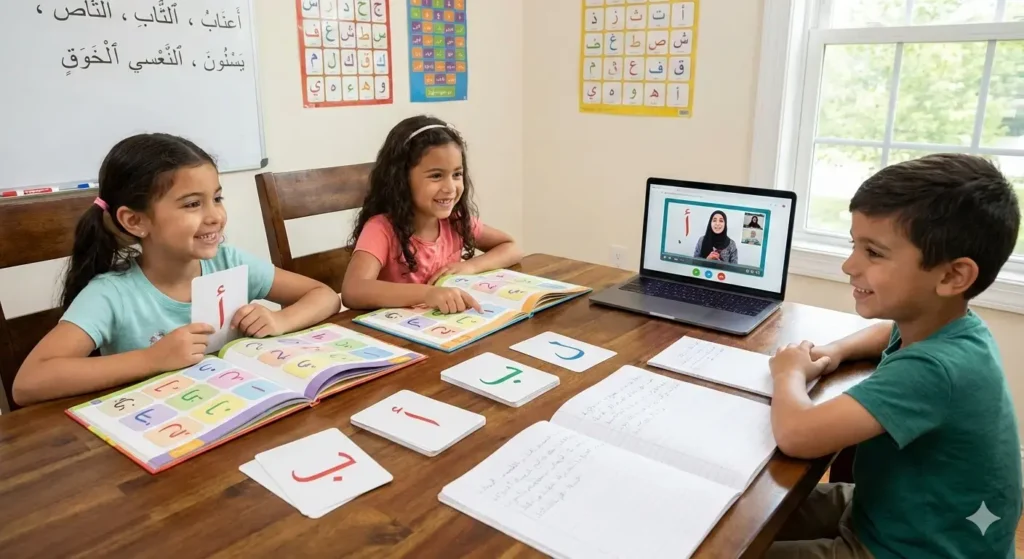
Children in this range learn Arabic most effectively through:
| Method | Why It Works at This Age |
| Short daily sessions (15–20 mins) | Matches attention span; builds habit without burnout |
| Songs, stories, and visual aids | Engages auditory and visual memory simultaneously |
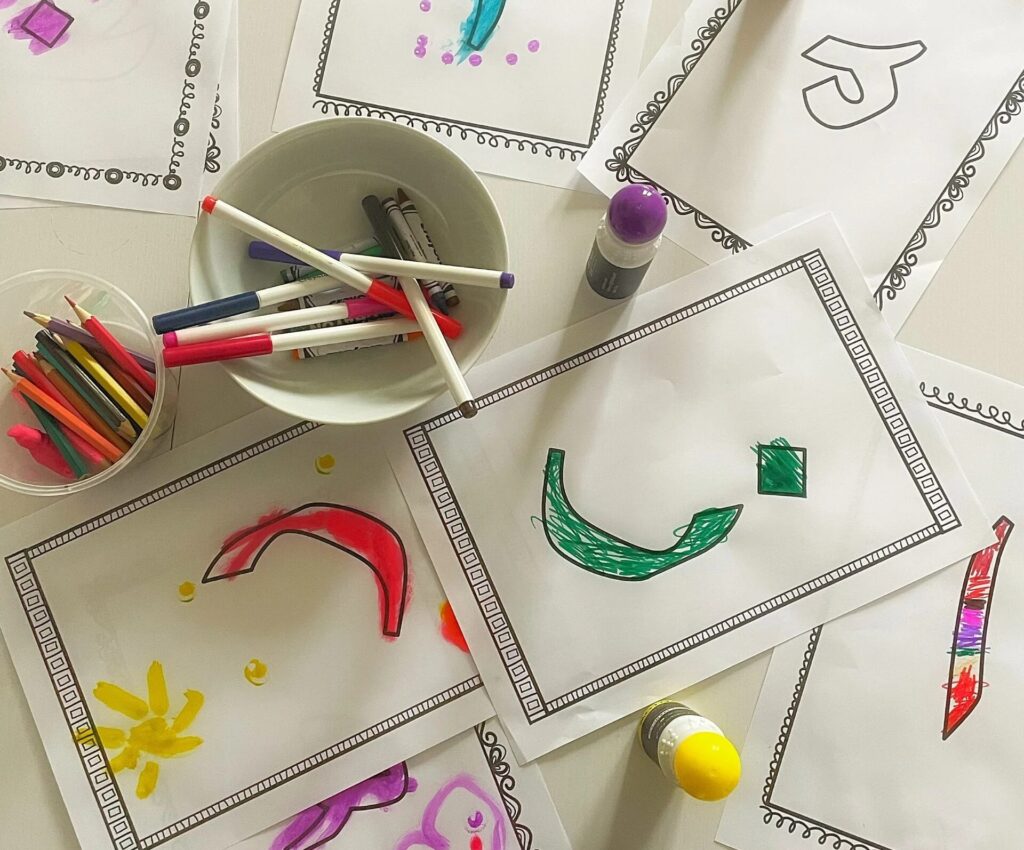
| Letter tracing and coloring | Builds muscle memory for Arabic script |
| Repetition games | Reinforces vocabulary without conscious memorization effort |
| Native-accent audio exposure | Trains the ear before the tongue |
Our Arabic alphabet learning resources for kids show exactly how letter recognition develops when taught through a structured phonics sequence rather than rote memorization.
Can a 13-Year-Old Learn Arabic?
Yes, a 13-year-old can learn Arabic effectively — and in several areas, will actually outperform younger children. By early adolescence, the brain has developed stronger analytical capacity, which means a teenager can understand why Arabic grammar rules work, not just imitate patterns.
They can process verb conjugation tables, understand root-pattern morphology, and self-correct with much greater metacognitive awareness than a six-year-old.
What teenagers lose compared to young children is effortless phonetic absorption. A 13-year-old will need deliberate, structured pronunciation training to master sounds like ع and ق — sounds they did not encounter in their early language development.
What Teenagers Should Focus On First
The most effective Arabic learning path for a 13-to-17-year-old follows this sequence:
- Phonetics before script — master the sound system before reading fluency
- Arabic alphabet mastery — connect sounds to letters systematically
- High-frequency vocabulary — build a working word bank of 300–500 words
- Basic sentence structure — subject-verb-object patterns in Modern Standard Arabic
- Grammar as a system — introduce root-pattern logic after reading confidence is established
Our guide on how to learn Arabic grammar easily was written with exactly this kind of learner in mind — someone who thinks logically but needs a clear, non-overwhelming entry point.
Why Learn Arabic at a Young Age?
Starting Arabic in early childhood provides advantages that extend well beyond language fluency. A child who begins Arabic between 4 and 8 years old builds a phonological foundation that supports Quran recitation, Islamic study, and Arabic literacy simultaneously — three skills that reinforce each other for a lifetime.
The linguistic advantages are significant, but the Islamic dimension is equally compelling. The Quran was revealed in Arabic, and even basic Arabic comprehension transforms a child’s relationship with Salah, Quran recitation, and Islamic learning.
Parents who invest in early Arabic education are, in effect, opening a door that becomes progressively harder to open as the years pass.
The Long-Term Academic Advantage
Children who learn a second language before age 10 demonstrate measurably stronger reading comprehension, phonological awareness, and cognitive flexibility in their native language — benefits documented across multiple linguistic contexts.
Arabic, with its rich root-based morphology, is particularly strong in building pattern recognition skills that support mathematics and logic.
Our Arabic stories for kids and Arabic games for kids resources reflect exactly this principle: early Arabic exposure should feel like exploration, not study.
Master the Arabic Language
Join our expert-led courses and build a strong foundation in Classical and Modern Arabic.
Get Your Free TrialHow to Learn Arabic at Older Ages?
Adult Arabic learners — whether 25, 40, or 60 — bring powerful assets to the learning process: discipline, motivation, contextual understanding, and the ability to study independently. What they lack in phonetic plasticity, they more than compensate for in structured focus.
In our experience at Buruj Academy, adult students who commit to 30 minutes of daily structured study consistently reach basic reading fluency within 3–6 months and conversational competence within 12–24 months.
The key phrase is structured — random app-based exposure does not produce the same results as instructor-guided learning.
| Learner Type | Realistic Timeline to Reading Fluency | Recommended Daily Study |
| Child (4–7) | 6–12 months | 15–20 minutes |
| Child (8–12) | 4–8 months | 20–30 minutes |
| Teenager (13–17) | 3–6 months | 30–40 minutes |
| Adult (18+) | 3–8 months | 30–45 minutes |
| Senior (50+) | 6–12 months | 20–30 minutes |
These are instructional estimates from our teachers’ classroom experience — individual progress varies based on prior language exposure, consistency, and learning style.
For adult beginners, our beginners’ guide to Modern Standard Arabic provides an honest roadmap of what to expect and how to sequence the learning correctly.
Read also: How to Learn Arabic Prayers?
When Is Someone Too Old to Learn Arabic?
No age makes a person too old to learn Arabic — but the honest answer requires some nuance. A learner over 50 should expect that achieving a native-like Arabic accent will require more deliberate effort than it would for a child.
However, reading Arabic fluently, understanding Quranic Arabic, and holding meaningful conversations are entirely achievable goals at any age.
The Prophet Muhammad ﷺ emphasized that seeking knowledge has no age limit. The Islamic tradition of adult scholarship — scholars who memorized the Quran and mastered Arabic in their thirties, forties, and beyond — is well-documented throughout Islamic history.
What changes with age is the method, not the possibility:
- Adults benefit from grammar-first explanations rather than immersion-only approaches
- Explicit phonetic instruction is more effective than passive listening
- Shorter, more frequent sessions outperform long infrequent ones
- Written reinforcement helps adult learners consolidate what auditory repetition achieves naturally in children
Our Arabic Classes for Beginners course is structured around exactly these principles, delivered by Al-Azhar-trained instructors who understand how adult cognition differs from child learning — and how to use that difference as an advantage rather than an obstacle.
Begin learning Arabic at Buruj with a FREE trial lesson

How Many Years Does It Take to Learn Arabic?
The honest answer depends on what “learning Arabic” means to you. Reaching basic reading and listening comprehension takes most non-Arabic speakers 1–2 years of consistent structured study. Reaching professional-level fluency in Modern Standard Arabic takes 3–5 years. Mastering Classical Arabic or Quranic Arabic for deep Tafsir study may take longer.
The Foreign Service Institute (FSI) classifies Arabic as a Category IV language — their most challenging tier — estimating approximately 2,200 classroom hours for English speakers to reach professional working proficiency. That figure is for formal institutional learning; self-directed or part-time learners should plan accordingly.
| Arabic Proficiency Goal | Estimated Timeline (Consistent Study) |
| Read Arabic alphabet fluently | 1–3 months |
| Read short Arabic words and sentences | 3–6 months |
| Basic conversational exchanges | 12–18 months |
| Understand Quran with basic comprehension | 18–36 months |
| Modern Standard Arabic fluency | 3–5 years |
For more detail on realistic timelines, our article on how long it takes to learn Arabic breaks this down by goal, study intensity, and learner background.
Discover the Buruj Academy Difference
Step into our virtual classrooms and see how our expert instructors make learning Quran and Arabic intuitive and clear. We focus on overcoming the specific hurdles non-native speakers face, building your confidence and connection with the Quran.
Start Your Arabic Learning at Buruj Academy — At Any Age
Age determines your starting strategy, not your ceiling. Whether you are enrolling your child at five or beginning your own Arabic study at forty-five, the right structured method makes the difference.
Buruj Academy’s Online Arabic Classes are designed for every stage:
- Al-Azhar University graduates with 12+ years teaching non-Arabic speakers
- Ijazah-certified instructors trained in both language pedagogy and Quranic Arabic
- The Buruj Method: sound-before-rules for beginners, context-before-abstraction for grammar, consistency-before-speed for long-term retention
- Personalized 1-on-1 sessions tailored to your age, level, and schedule
- Flexible 24/7 booking for families, students, and working professionals
Book your free trial lesson today — and let our team build the right plan for exactly where you are starting.
Begin your transformation today by choosing the path that fits your goals:
- Online Arabic Classes (General & Comprehensive)
- Arabic Course for Beginners
- Arabic Alphabet Learning Course
- Online Arabic Classes for Kids
- Arabic Classes for Adults
- Arabic Grammar Course (Nahw & Sarf)
- Intermediate Arabic Course (B1/B2)
- Arabic Speaking Course (Conversational Fluency)
- Arabic Reading Course (Literary Excellence)
- Learn Arabic Writing Course (Calligraphy & Composition)
Ready to speak with confidence? Join the global community at Buruj Academy and book your free placement interview today!
Master the Arabic Language
Join our expert-led courses and build a strong foundation in Classical and Modern Arabic.
Get Your Free TrialConclusion
Arabic is not a language reserved for those who started young. The early years offer phonetic advantages — but teenagers bring analytical strength, and adults bring discipline and purpose. What matters most at every age is a structured method, a qualified instructor, and the consistency to show up.
Whether your child is four or you are beginning at forty, the path to Arabic is open. Insha’Allah, with the right guidance, every learner — at every age — reaches where they are headed.
Read also: Is Arabic Fun to Learn?
Frequently Asked Questions About the Best Age to Learn Arabic
Can Kids Learn Arabic Fluently If They Start After Age 10?
Yes, children who begin Arabic after age 10 can absolutely reach fluency. They may require more deliberate pronunciation training than younger starters, but their stronger analytical skills help them master grammar and vocabulary faster. With a qualified instructor and consistent practice, children aged 10–14 typically achieve solid reading fluency within 6–12 months.
Is It Harder to Learn Arabic as an Adult Than as a Child?
Arabic is more demanding phonetically for adults because the brain’s sound-mapping system is less flexible after puberty. However, adults learn grammar rules, vocabulary systems, and reading patterns more efficiently than young children. In our instructors’ experience, motivated adult learners often progress faster through the structural components of Arabic than children of the same study hours.
What Is the Golden Age to Learn Arabic for Kids?
The golden age for Arabic acquisition is between 4 and 7 years old. During this window, children absorb new phonemes — including Arabic sounds absent from English — with remarkable ease through consistent audio exposure and repetition. Starting at this age significantly increases the likelihood of achieving native-like pronunciation and reading fluency before primary school years end.
How Many Minutes a Day Should a Child Study Arabic?
Children aged 4–7 learn most effectively in sessions of 15–20 minutes daily. Children aged 8–12 can comfortably sustain 20–30 minute structured sessions. Consistency matters far more than session length at young ages — five short sessions per week outperform one long session every few days, both for retention and for building a durable Arabic learning habit.
Is Quranic Arabic Different from the Arabic Taught to Kids?
Quranic Arabic is Classical Arabic — it shares the same script and root system as Modern Standard Arabic but uses vocabulary, grammatical forms, and rhetorical structures specific to the Quran. Children can begin with the Arabic alphabet and basic MSA, then transition to Quranic Arabic study. Our Quranic Arabic Course for Kids bridges exactly this gap with age-appropriate classical instruction.