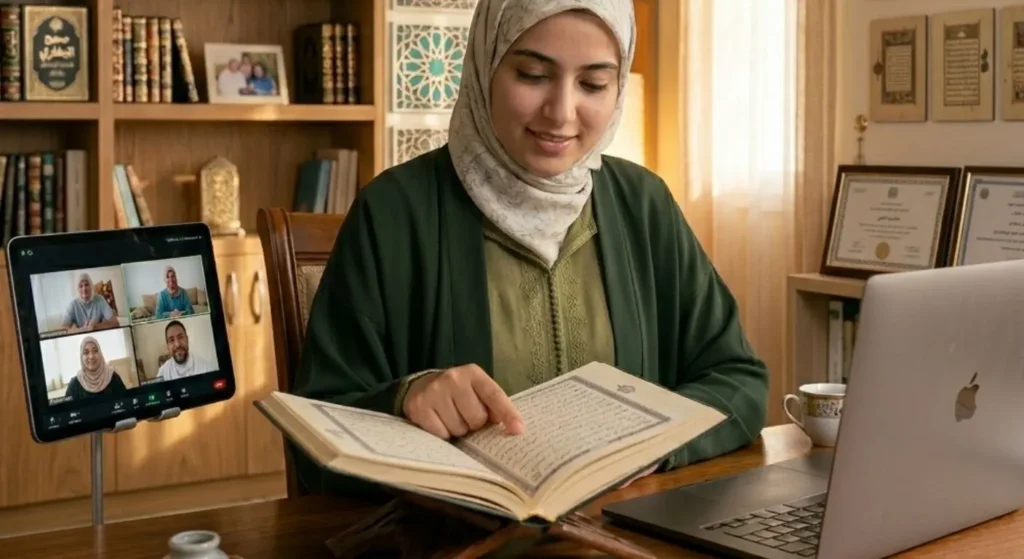
 Quran
Quran

| Key Takeaways |
| A Sanad in Hifz is a named, unbroken chain of teachers connecting a memorizer’s recitation back to the Prophet Muhammad ﷺ. |
| Ijazah al-Hifz is only granted after Talaqqi and Musafahah — reciting the full Quran aloud directly to a certified Shaykh. |
| The standard Hafs ‘an ‘Asim chain traces through ‘Asim ibn Abi al-Najud, Abu ‘Abdurrahman al-Sulami, and ‘Ali ibn Abi Talib. |
| Earning Ijazah al-Hifz typically takes 12 to 24 months of structured sessions after memorization is already complete. |
| A Shaykh must already hold a verified Sanad themselves before they are qualified to grant Ijazah to a student. |
Many Huffaz reach the final page of their memorization and assume the journey is complete. Yet completing Hifz and earning a Sanad are two distinct achievements entirely.
A Sanad in Hifz is the documented chain of teachers linking a memorizer’s recitation back to the Prophet Muhammad ﷺ. It is earned through Ijazah — formal authorization granted after reciting the full Quran to a certified Shaykh.
Table of Contents:
What Does Sanad Mean in the Context of Quran Memorization?
Sanad (سند) means “support” or “chain,” and in Hifz it refers to the named sequence of teachers through whom a student’s recitation connects to the Prophet ﷺ. Each name in the chain represents a scholar who personally heard and approved that recitation.
This is fundamentally different from a study certificate.
A diploma confirms attendance or completion.
A Sanad confirms something else entirely — that a qualified scholar personally listened to every verse and vouched for its accuracy before adding their own name to a centuries-old lineage.
In our Hifz classes at Buruj Academy, students preparing for Ijazah are often surprised to learn that the Sanad predates the written Islamic sciences themselves. The Quran was preserved orally, teacher to student, long before its systematic documentation — and the Sanad is the living record of that unbroken transmission.
This connects directly to why Buruj Academy structures memorization around long-term retention rather than speed.
Our guide on how to memorize Quran faster explains why memorization built for Sanad-level accuracy differs from memorization built purely for completion.
Start Hifz today with a FREE trial session

How Is Sanad Different From Ijazah?
Sanad and Ijazah are two halves of the same certification, not interchangeable terms. Ijazah is the formal permission granted by a Shaykh; the Sanad is the specific chain of names that Ijazah document contains.
Think of Ijazah as the authorization itself and Sanad as the evidence supporting it. A student receives Ijazah with a Sanad — the certificate states, by name, every teacher between the student and the Prophet ﷺ.
Without a documented Sanad, an Ijazah carries no scholarly weight, regardless of how strong the student’s recitation actually is.
Read also:Quran Memorization Certificate
Why Does the Sanad Chain Matter So Much in Islamic Scholarship?
The Sanad matters because it is the mechanism that has protected the Quran’s recitation from distortion for over 1,400 years, using named, accountable transmission rather than anonymous copying. Every link in the chain is a real scholar whose reliability was assessed.
This oral verification system exists precisely because written text alone cannot capture pronunciation, rhythm, or the precise application of Tajweed rules. A manuscript shows letters. A Sanad proves the sound.
The Prophet ﷺ himself emphasized this priority on learning and transmitting the Quran correctly. As reported in Sahih al-Bukhari, narrated by ‘Uthman ibn ‘Affan:
“The best among you are those who learn the Qur’an and teach it” (Sahih al-Bukhari 5027).
This hadith is the scholarly foundation for the entire teacher-to-student transmission model that the Sanad system formalizes.
Students frequently ask why an audio recording or self-study review cannot substitute for a Sanad. The answer is accountability — a recording cannot be cross-examined, but a Shaykh personally staking their scholarly reputation on a student’s recitation carries a different weight entirely.
Read also:How to Get a Hafiz-e-Quran Certificate?
What Does the Traditional Sanad Chain for Hafs ‘an ‘Asim Actually Look Like?
The globally standard Hafs ‘an ‘Asim Sanad traces through a documented sequence of named scholars: from the living Shaykh, back through generations of teachers, to ‘Asim ibn Abi al-Najud, who received the recitation from Abu ‘Abdurrahman al-Sulami, who received it from ‘Ali ibn Abi Talib (رضي الله عنه).
Hafs ‘an ‘Asim is the specific riwayah (transmission narration) used in the overwhelming majority of printed Mushafs worldwide, which is why most Ijazah al-Hifz students pursue certification in this particular chain first.
Each scholar in this lineage did not simply memorize the Quran independently — they recited it aloud, verse by verse, to their own teacher, who corrected any deviation before authorizing them to pass it forward.
Why Do Shorter Chains Carry Special Honor?
A shorter chain — meaning fewer living links between a contemporary Shaykh and the Prophet ﷺ — is considered a distinguishing mark of scholarly honor, though it does not affect the Sanad’s validity. Both long and short authentic chains are equally sound.
Sheikhs trained through Al-Azhar University and similar institutions with centuries of documented scholarly continuity often hold particularly well-preserved chains, since Egypt’s Qira’at tradition has maintained detailed records across generations.
Book a FREE trial session with one of Buruj’s Azhari Quran tutors

How Is Ijazah al-Hifz Actually Earned Through Talaqqi?
Ijazah al-Hifz is earned exclusively through Talaqqi and Musafahah – the student reciting the complete Quran aloud, portion by portion, directly to a Shaykh who listens, corrects, and eventually certifies mastery. No written exam or self-assessment can substitute for this process.
Talaqqi means direct, face-to-face oral transmission from teacher to student. Musafahah refers to the act of reciting directly from memory in the Shaykh’s presence, without deviation from the Mushaf’s exact text.
In our experience, this is the single stage where students most underestimate the timeline. Completing memorization is only the entry point — the recitation must then be re-verified, portion by portion, against a qualified listener’s ear.
| Stage | What Happens | Typical Focus |
| Readiness Assessment | Shaykh evaluates existing Tajweed and Hifz accuracy | Consistency, not just correctness |
| Talaqqi Sessions | Student recites portions live, corrections applied | Accumulated accuracy over weeks |
| Full Recitation | Complete Quran recited from memory to the Shaykh | Endurance and retention under scrutiny |
| Ijazah Granted | Shaykh formally authorizes and adds their name to the Sanad | Certification with documented chain |
A qualified Shaykh must have personally heard the entire recitation before granting Ijazah — partial review or a sampling of surahs is not sufficient for full Ijazah al-Hifz.
Read also:The 7 Best Quran Reciters to Memorize the Quran
What Must the Shaykh Already Hold Before Granting Ijazah?
A Shaykh must hold their own verified Ijazah with an authenticated Sanad before they are qualified to certify any student. Without this, their authorization carries no scholarly standing regardless of their personal recitation ability.
This is why choosing a teacher matters enormously. A certificate issued by an unverified instructor cannot transmit a genuine chain, no matter how polished the paperwork appears.
Students pursuing how to become a Hafiz of the Quran should understand that memorization itself is only the first milestone — Ijazah requires this separate, dedicated verification stage afterward.
Discover the Buruj Academy Difference
Step into our virtual classrooms and see how our expert instructors make learning Quran and Arabic intuitive and clear. We focus on overcoming the specific hurdles non-native speakers face, building your confidence and connection with the Quran.
Excel in Your Quranic Studies
Join Buruj Academy and master the Quran with our structured, professional curriculum.
Book Your Free TrialHow Long Does Earning a Sanad in Hifz Typically Take?
Earning Ijazah al-Hifz typically requires 12 to 24 months of dedicated sessions after memorization is already complete, though the exact timeline is set entirely by the Shaykh’s assessment of readiness rather than a fixed calendar.
This range assumes the student begins Talaqqi with genuinely solid memorization and consistent Tajweed already in place — not memorization still being polished during the certification process itself.
In our sessions at Buruj Academy, the most common reason students underestimate this timeline is confusing “I have memorized the Quran” with “I can recite the Quran flawlessly under live scrutiny.” These are related but distinct standards.
Students beginning Hifz from scratch, rather than pursuing Ijazah after existing memorization, should expect a considerably longer overall path.
Our Quran memorization schedule guide breaks down realistic pacing for the memorization stage itself.
Buruj Academy’s Online Ijazah Course begins every student with a thorough Tajweed and Hifz assessment, because starting formal Talaqqi before recitation is genuinely ready is the most frequent cause of delayed certification.
Book your FREE trial lesson in your path to Ijazah
What Determines Whether a Student Is Ready to Begin Talaqqi?
Readiness for Talaqqi is determined by consistent, automatic application of major Tajweed rules — not by memorization completion alone. A Shaykh examining a student for Ijazah will not proceed if foundational rules require constant prompting.
Rules including Noon Sakinah, Meem Sakinah, Madd, Waqf, and Qalqalah must operate instinctively during recitation. Our guide on Tajweed rules offers a complete framework for self-assessing this readiness honestly before beginning formal certification.
Why Does Having a Structured Teacher Matter More at This Stage?
Structured, expert guidance matters most at the Ijazah stage because self-study cannot verify a Sanad — only a Shaykh who already holds a valid chain can extend it to a new student. This single requirement makes independent certification impossible by definition.
Many students attempt to locate an Ijazah-qualified Shaykh independently, without institutional vetting, and encounter significant obstacles along the way.
Unverifiable credentials, inconsistent availability, and Shuyukh whose own Sanad cannot be confirmed are common frustrations we hear about regularly from students who reach us after a difficult independent search.
Through Buruj Academy’s Hifz Ijazah Course, students are matched with Ijazah-certified instructors and Al-Azhar University graduates whose Sanads are personally verified and fully documented before teaching begins.
Book your FREE trial lesson in your path to Ijazah
This structured approach follows what we call the Buruj Method’s consistency-before-speed principle for Hifz — treating retention accuracy, not calendar pace, as the true measure of Talaqqi readiness.
Students maintaining their memorization during this stage often benefit from reviewing our how to revise memorized Quran guide alongside active Talaqqi sessions.
Accelerate Your Ijazah Journey with Buruj Academy’s Hifz Program
A Sanad connects a Hafiz’s recitation to the Prophet ﷺ through named, verified scholars — earned only through direct Talaqqi with a qualified Shaykh.
Buruj Academy’s Online Hifz Program and Hifz Ijazah Course pair students with Ijazah-certified instructors and Al-Azhar University graduates holding personally documented Sanads.
Our instructors bring 12+ years of experience guiding non-Arabic speakers through this exact certification path.
Every student begins with an honest Tajweed and Hifz readiness assessment — because starting Talaqqi prematurely is the most common cause of delayed Ijazah.
Sessions are 1-on-1, flexibly scheduled, and built around the Buruj Method’s consistency-before-speed approach.
Ready to begin your Sanad journey? Book a free trial lesson with Buruj Academy today.
Take the first step toward this lifelong blessing by enrolling in a program tailored to your pace:
- Online Hifz Program (Comprehensive Quran Memorization)
- Juz 30 Memorization Course (Perfect for focused starts)
- Hifz Classes for Kids (Engaging and interactive)
- Hifz Classes for Adults (Flexible scheduling for busy lives)
- Hifz Classes for Sisters (Private, supportive learning)
- Short Surah Memorization Course (Ideal for daily prayers)
- Hifz Ijazah Course (For advanced students seeking certification)
Don’t let another day pass without moving closer to your goal. Join Buruj Academy today and schedule your free trial session to begin your Hifz journey!
Excel in Your Quranic Studies
Join Buruj Academy and master the Quran with our structured, professional curriculum.
Book Your Free TrialConclusion
A Sanad transforms Quran memorization from a private accomplishment into a documented link within a living, 1,400-year-old chain of transmission. It is earned only through direct recitation to a Shaykh who already holds that chain themselves — never through self-assessment or written examination.
For any Hafiz considering this path, the real preparation begins long before the first Talaqqi session: consistent Tajweed, honest readiness, and a teacher whose own Sanad can be genuinely verified.
Frequently Asked Questions About Sanad and Ijazah in Hifz
Can a Hafiz Recite the Quran Without Ever Getting an Ijazah?
Yes. Completing Hifz and earning Ijazah are separate achievements. Many Huffaz recite the Quran accurately for personal worship or teach informally without ever pursuing the formal Sanad-based certification process.
Is It Possible to Earn an Ijazah in Hifz Fully Online?
Traditional scholars require direct, personal Talaqqi, though many now accept live video sessions as valid. Recorded submissions or asynchronous review are not accepted, since the Shaykh must personally hear and correct the recitation in real time.
Does Every Ijazah Include the Full Sanad Chain Written Out?
Yes, a genuine Ijazah certificate names every scholar in the chain back through the Shaykh’s own lineage. A certificate lacking documented names cannot be verified and carries no recognized scholarly standing.
What Happens if a Shaykh’s Own Sanad Cannot Be Verified?
Any Ijazah they grant would carry no scholarly weight, regardless of the student’s recitation quality, since the Shaykh must hold and personally extend an authenticated chain to certify anyone.