 Tajweed

| Key Takeaways |
| The letter Raa has three possible states in Tajweed: obligatory tafkheem (heaviness), obligatory tarqeeq (lightness), and permissible use of either. |
| Raa is given tafkheem when it carries a fathah or dhammah, or when it is saakin after a fath or dhammah. |
| Raa receives tarqeeq when it is kasrah, saakin after an original kasrah with no following harf isti’laa, or preceded by a saakin yaa. |
| Ra sakinah rules become more nuanced when a harf isti’laa follows — tafkheem applies if that letter carries a fathah, while a kasrah on it allows both options. |
| Five specific Quranic words require special attention for Ra sakinah tafkheem due to following maftuh harf isti’laa: قِرْطَاسٍ، إِرْصَادًا، فِرْقَةٍ، مِرْصَادًا، لَبِالْمِرْصَادِ |
Among all the letters in the Quran, Raa is uniquely demanding. It does not follow a single fixed rule — its pronunciation shifts depending on its vowel, its position, and the letters surrounding it.
Mastering the rules of Raa in Tajweed means understanding three distinct categories: when tafkheem is obligatory, when tarqeeq is obligatory, and when both are permitted. Once these conditions are clear, your recitation becomes both accurate and beautiful.
What Are the Rules of Raa in Tajweed and Why Do They Matter?
The rules of Raa in Tajweed govern whether the letter is pronounced with heaviness (tafkheem) or lightness (tarqeeq). No other letter in Arabic has this same dual nature applied so systematically — Raa literally changes its sonic character based on its diacritical context, making it one of the most carefully studied letters in classical Tajweed scholarship.
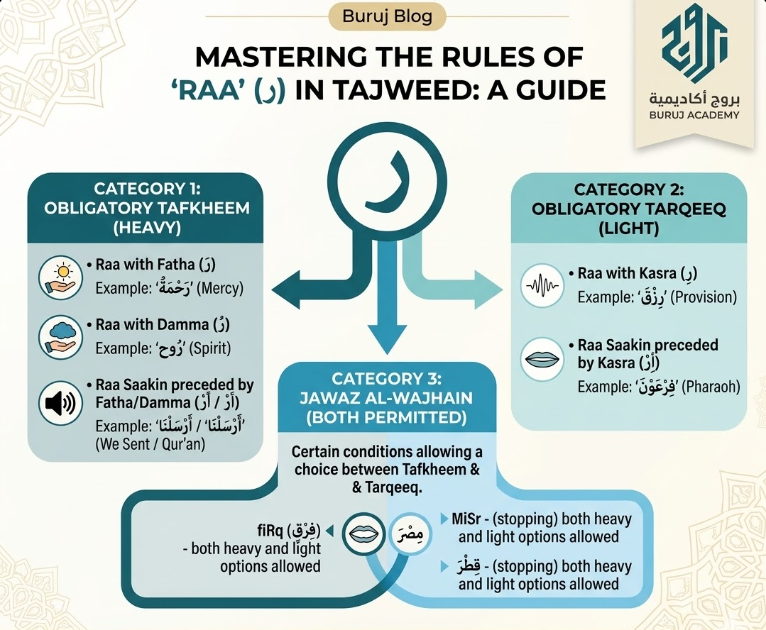
Incorrect pronunciation of Raa is one of the most common errors we observe in students at Buruj Academy. Students often default to a single sound for Raa regardless of context — either making every Raa heavy or every Raa light. Both errors are real mistakes in recitation, and correcting them requires understanding the conditions for each ruling.
At Buruj Academy, our Online Tajweed Classes address Raa rules systematically, training students through live Quranic examples before introducing the theoretical conditions — because hearing the difference first makes the rules far more memorable.
Book Your FREE Trial Lesson to Begin Your Tajweed Journey

When Is Tafkheem of Raa Obligatory?
Tafkheem of Raa is obligatory in six clearly defined conditions, all of which relate to the vowel carried by the Raa itself or the vowel preceding it when it is saakin (vowelless).
Understanding these conditions requires remembering a foundational principle: a maftuhah (fathah) or madhoomah (dhammah) Raa is always heavy, with no exception.
1. Raa Carrying a Fathah or Dhammah
When Raa itself carries a fathah or dhammah, tafkheem is obligatory — both in connection (wasl) and in pausing (waqf).
| Condition | Example | Ruling |
| Raa with fathah | رَبَّنَا (Rabbana) | Tafkheem — obligatory |
| Raa with dhammah | رُحَمَاءُ (Ruhamaa’) | Tafkheem — obligatory |
These are the clearest cases and present no ambiguity whatsoever in classical Tajweed scholarship.
2. Raa Saakin After a Fathah or Dhammah
When Raa carries sukoon and the letter directly before it carries a fathah or dhammah, tafkheem applies both in wasl and waqf.
مَرْيَمَ (Maryam) — the Raa is saakin, preceded by a maftuh Meem, giving obligatory tafkheem.
الْغُرْفَةَ (Al-Ghurfah) — the Raa is saakin, preceded by a madhoom Ghain, giving obligatory tafkheem.
3. Raa Saakin After an Arid (Incidental) Kasrah
When Raa is saakin and the kasrah before it arose incidentally — not as part of the original word structure — tafkheem applies. The most common example is the kasrah that appears when beginning with hamzat al-wasl.
ارْجِعِي (Irji’ee) — the kasrah on the Alif is incidental (arising from the need to start pronunciation), so the saakin Raa that follows it receives tafkheem.
الَّذِي ارْتَضَى (Alladhiy-artadhaa) — the kasrah on the Yaa of “alladhiy” is real, but it belongs to a separate word. Since it is not directly connected to the Raa, tafkheem still applies.
4. Raa Saakin After an Original Kasrah Followed by a Maftuh Harf Isti’laa in the Same Word
This is the most precise condition for tafkheem among the saakin cases. When the Raa is saakin, preceded by an original kasrah, but followed within the same word by a harf isti’laa carrying a fathah, the isti’laa overrides the kasrah effect and tafkheem is obligatory.
The seven huroof isti’laa are: خ ص ض ط ظ غ ق
This condition applies in exactly five Quranic words:
| Word | Surah | Notes |
| قِرْطَاسٍ | Al-An’am | Raa saakin, preceded by kasrah, followed by maftuh Taa (isti’laa) |
| إِرْصَادًا | At-Tawbah | Raa saakin, preceded by kasrah, followed by maftuh Saad (isti’laa) |
| فِرْقَةٍ | At-Tawbah | Raa saakin, preceded by kasrah, followed by maftuh Qaaf (isti’laa) — see also permissible section |
| مِرْصَادًا | An-Naba’ | Raa saakin, preceded by kasrah, followed by maftuh Saad (isti’laa) |
| لَبِالْمِرْصَادِ | Al-Fajr | Same pattern as above |
These five words are memorized individually by serious Tajweed students, and we make it a point to drill them explicitly in our Tajweed for Beginners program at Buruj Academy, because students who have not been taught them inevitably apply tarqeeq incorrectly.
Book Your FREE Trial Lesson to Begin Your Tajweed Journey

When Is Tarqeeq of Raa Obligatory?
Tarqeeq of Raa is obligatory in conditions where the kasrah either directly precedes or phonetically dominates the Raa. The guiding logic is straightforward: kasrah softens Raa, and its influence — whether on the Raa itself or through an adjacent saakin letter — produces tarqeeq.
1. Raa Carrying a Kasrah
This is the simplest case. When Raa itself is maksoorah (carries a kasrah), tarqeeq is obligatory with no conditions — whether the kasrah is original or incidental, in wasl or waqf.
رِزْقًا (Rizqan) and مَرِيجٍ (Mareej) both have Raa carrying an original kasrah — tarqeeq is obligatory.
وَأَنْذِرِ النَّاسَ (wa-andhirin-naas) — the kasrah on Raa here is incidental (for grammatical connection), yet tarqeeq still applies because the kasrah is on the Raa itself.
2. Raa Saakin After an Original Kasrah with No Following Maftuh Harf Isti’laa
When Raa is saakin, preceded directly by an original kasrah, and no maftuh harf isti’laa follows in the same word — tarqeeq is obligatory.
| Example | Ruling |
| شِرْعَةً (Shir’atan) | Tarqeeq — saakin Raa after original kasrah, no isti’laa follows |
| الْفِرْدَوْسِ (Al-Firdaws) | Tarqeeq — same conditions met |
| فِرْعَوْنَ (Fir’awn) | Tarqeeq — Raa saakin after original kasrah, Ain is not a harf isti’laa |
This is precisely where the five isti’laa words above become critical: students who do not know those five words will mistakenly apply tarqeeq to them, because the kasrah before the Raa is visible and real.
3. Raa Saakin Preceded by a Saakin Yaa
When Raa appears saakin and is preceded by a saakin yaa — both in stopping (waqf) — tarqeeq is obligatory. The yaa’s inherent softness passes its quality to the following Raa.
بَصِيرٌ (Baseer) and خَيْرٌ (Khayr) — in waqf, both have a saakin Raa preceded by a saakin yaa, giving obligatory tarqeeq.
If you are familiar with the foundational rules covered in Tajweed for beginners, you will recognize this as an extension of how yaa softens surrounding letters.
4. Tarqeeq of Raa in Waqf (Pausing)
When pausing on Raa, three conditions produce tarqeeq:
| Waqf Condition | Example | Ruling |
| Direct kasrah before Raa | بَصَائِرُ (Basaa’ir) | Tarqeeq in waqf |
| Saakin non-yaa letter between kasrah and Raa | السِّحْرَ (As-Sihr) — kasrah on Sin, then saakin Haa, then Raa | Tarqeeq in waqf |
| Saakin yaa before Raa | قَدِيرٌ (Qadeer) | Tarqeeq in waqf |
Outside these three conditions in waqf, tafkheem applies — for example, pausing on الْقَمَرَ (Al-Qamar) gives tafkheem, as does النُّذُرُ (An-Nudhur).
There is an important distinction here regarding the waqf methods. When pausing with pure sukoon (saakin waqf) or with ishmaam, these three conditions govern the ruling.
But when pausing with rawm — where a faint remnant of the vowel remains audible — the ruling follows wasl, since rawm is functionally treated as a connected recitation in terms of vowel effect.
Excel in Your Quranic Studies
Join Buruj Academy and master the Quran with our structured, professional curriculum.
Book Your Free TrialExamples of Tafkheem and Tarqeeq of Raa
The clearest way to internalize these rules is through direct comparison. The following table presents examples of tafkheem and tarqeeq of Raa drawn from the Quran, organized by condition.
| Condition | Tafkheem Example | Tarqeeq Example |
| Raa with fathah | رَبَّنَا | — |
| Raa with dhammah | رُسُلٌ | — |
| Raa with kasrah | — | رِزْقًا |
| Saakin after fathah | مَرْيَمَ | — |
| Saakin after dhammah | الْقُرْآنُ | — |
| Saakin after original kasrah (no isti’laa) | — | شِرْعَةً |
| Saakin after original kasrah + maftuh isti’laa | مِرْصَادًا | — |
| Saakin after incidental kasrah | ارْجِعِي | — |
| Preceded by saakin yaa (waqf) | — | خَيْرٌ |
Keeping a reference like this during practice sessions is something we actively encourage in Buruj Academy’s live sessions — it shortens the time needed to internalize the contrast.
Discover the Buruj Academy Difference
Step into our virtual classrooms and see how our expert instructors make learning Quran and Arabic intuitive and clear. We focus on overcoming the specific hurdles non-native speakers face, building your confidence and connection with the Quran.
What Are the Ra Sakinah Rules in Detail?
Ra sakinah rules refer specifically to the conditions governing the saakin Raa — the Raa that carries no vowel of its own. This is the most complex category because the ruling depends entirely on what surrounds it.
For students working through the essential Tajweed rules guide, understanding Ra sakinah is often the point where rules start feeling intricate. The key is to assess three things in order: What precedes the Raa? Is that kasrah original or incidental? Does a harf isti’laa follow within the same word?
Ra Sakinah Rules in Wasl (Connection)
In connected recitation, the ruling on saakin Raa follows this decision structure:
Step 1: Is the letter before Raa carrying a fathah or dhammah? → Tafkheem.
Step 2: Is the letter before Raa carrying an incidental kasrah? → Tafkheem.
Step 3: Is the letter before Raa carrying an original kasrah? → Proceed to Step 4.
Step 4: Does a maftuh harf isti’laa follow in the same word? → Tafkheem (five specific words only).
Step 5: No maftuh isti’laa follows? → Tarqeeq.
Ra Sakinah Rules in Waqf (Pausing)
In waqf, the assessment looks backward from the Raa rather than forward:
- Kasrah directly before Raa → Tarqeeq
- Saakin non-yaa letter before Raa, with kasrah before that letter → Tarqeeq
- Saakin yaa before Raa → Tarqeeq
- Fathah or dhammah before Raa (directly or through saakin letter) → Tafkheem
Excel in Your Quranic Studies
Join Buruj Academy and master the Quran with our structured, professional curriculum.
Book Your Free TrialWhen Are Both Tafkheem and Tarqeeq of Raa Permissible?
In three specific situations, classical scholars have accepted both tafkheem and tarqeeq as valid recitation options for the Raa.
First Case: Raa Saakin After a Saakin Harf Isti’laa Preceded by a Kasrah
When Raa is saakin, preceded by a saakin harf isti’laa, and that isti’laa letter itself is preceded by a kasrah — both options are valid. The kasrah before the isti’laa letter creates a pull toward tarqeeq, while the isti’laa letter itself creates a pull toward tafkheem.
مِصْرَ (Misr) and الْقِطْرِ (Al-Qitr) in Surah Saba’ are the most cited examples. In مِصْرَ, the Meem carries kasrah, the Saad (harf isti’laa) is saakin, and the Raa follows — giving both options.
Second Case: Raa Saakin After an Original Kasrah Followed by a Maksoor Harf Isti’laa in the Same Word
When the harf isti’laa following the saakin Raa itself carries a kasrah (not a fathah), its isti’laa quality is weakened by its own kasrah. This is the case of فِرْقٍ in Surah Ash-Shu’ara (26:63).
Classical scholars differed: some gave tafkheem based on the presence of isti’laa, while others gave tarqeeq because the isti’laa letter is maksoor and therefore weakened. The scholarly consensus leans toward tarqeeq being preferred, but tafkheem remains a recognized valid option.
Third Case: Raa Saakin Due to Waqf, Maksoorah when Connected, with a Deleted Yaa After It
When Raa is saakin only because of pausing, would be maksoorahif connected, and a yaa has been omitted in the Uthmanic rasm — both tafkheem and tarqeeq are valid options in waqf.
يَسْرِ (Yasr) in Surah Al-Fajr and نُذُرِ (Nudhur) recurring in Surah Al-Qamar are examples. In wasl, the Raa is maksoorahso tarqeeq applies. In waqf, some scholars gave tafkheem (treating it as saakin after an incidental kasrah) and others gave tarqeeq (honoring the kasrah and the deleted yaa that once followed). Both are valid.
This nuance is discussed in detail in the context of the qalqalah letters and waqf rules, which intersect with how scholars treated letter endings in the Uthmanic script.
Excel in Your Quranic Studies
Join Buruj Academy and master the Quran with our structured, professional curriculum.
Book Your Free TrialMaster Tajweed with Buruj Academy’s Expert Instructors
The rules of Raa in Tajweed are among the most layered rules a student will encounter. Mastering them — from the straightforward maftuhah cases to the nuanced permissible situations — requires structured guidance and repeated practice with live Quranic text.
At Buruj Academy, our Online Tajweed Classes are taught by Ijazah-certified instructors and Al-Azhar University graduates with 12+ years of experience teaching non-Arabic speakers worldwide.
Through the Buruj Method — sound-before-rules — students hear the difference between tafkheem and tarqeeq before they study the conditions, building intuition alongside knowledge.
Join a supportive learning environment tailored to your pace and lifestyle. Start your journey toward excellence by enrolling in one of our specialized tracks:
- Online Tajweed Classes
- Tajweed Classes for Beginners
- Tajweed Classes for Adults
- Tajweed Classes for Sisters
- Tajweed Classes for Kids
- Advanced Tajweed Course
- Amli Tajweed Course (Practical Application)
Sessions are personalized, 1-on-1, and flexibly scheduled. Book your free trial lesson today and experience the difference expert instruction makes.
Frequently Asked Questions About the Rules of Raa in Tajweed
What is the difference between tafkheem and tarqeeq of Raa?
Tafkheem means pronouncing Raa with heaviness — the tongue resonates with a fuller, deeper sound. Tarqeeq means pronouncing it with lightness — a thinner, softer sound. The difference is determined by the vowel the Raa carries or the vowel of the letter directly preceding it when Raa is saakin.
How many conditions require tafkheem of Raa?
There are six main conditions for obligatory tafkheem of Raa: when it carries a fathah, when it carries a dhammah, when it is saakin after a fathah, when saakin after a dhammah, when saakin after an incidental kasrah, and when saakin after an original kasrah followed by a maftuh harf isti’laa in the same word.
Is the Raa in the word فِرْعَوْنَ heavy or light?
The Raa in فِرْعَوْنَ (Fir’awn) receives tarqeeq. It is saakin, preceded by an original kasrah on the Faa, and the letter that follows (Ain) is not among the seven huroof isti’laa. All conditions for tarqeeq are met.
What are the five Quranic words with obligatory tafkheem despite a preceding kasrah?
The five words are: قِرْطَاسٍ (Al-An’am), إِرْصَادًا (At-Tawbah), فِرْقَةٍ (At-Tawbah — tafkheem opinion), مِرْصَادًا (An-Naba’), and لَبِالْمِرْصَادِ (Al-Fajr). In all five, the saakin Raa is preceded by a kasrah but followed by a maftuh harf isti’laa within the same word.
Does the rule of Raa change when pausing versus connecting in recitation?
Yes. The ruling for saakin Raa sometimes differs between wasl and waqf. In waqf specifically, three conditions produce tarqeeq that would not apply in the same way during wasl — including when a kasrah precedes the Raa directly, when a saakin non-yaa letter separates them, or when a saakin yaa precedes the Raa. Understanding this distinction is part of mastering how to read Quran with Tajweed correctly.