 Tajweed

| Key Takeaways |
| Madd muttasil occurs when a madd letter is immediately followed by a hamzah within the same single word. |
| Its ruling is wajib (obligatory) — all Quran reciters must extend it beyond two counts, making it distinct from madd munfasil. |
| The standard extension for madd muttasil under Hafs ‘an ‘Asim via the Shatibiyyah is four or five counts, with four being the more widely practiced. |
| When the hamzah falls at the end of the word and you pause on it, six counts of extension become permissible in addition to four or five. |
| The madd muttasil symbol is a small curved line (resembling a tilted “s”) written above the madd letter in most standard Tajweed-color-coded Mushafs. |
Every reciter encounters madd muttasil dozens of times in a single recitation session — in words like السَّمَاءِ, جَاءَ, and الْمَلَائِكَةِ — yet many students apply it inconsistently because they learned the name before they trained their ear. That gap between knowing a rule and hearing it is exactly where mistakes settle in.
Madd muttasil is one of the two primary types of madd far’i caused by hamzah. It is classified as wajib — obligatory — because every major recitation narration agrees on extending it beyond the natural two counts. Mastering it means understanding its definition, its ruling, its examples, its symbol, and how it differs from madd munfasil.
What Is the Madd Muttasil Definition in Tajweed?
Madd muttasil is a type of secondary madd (madd far’i) that occurs when one of the three madd letters — ا, و, or ي — is immediately followed by a hamzah (ء), and both the madd letter and the hamzah exist within the same single word.
The name itself carries the definition: muttasil (متصل) means “connected” or “joined.” The madd letter and the hamzah are connected inside one word — they cannot be separated. This inseparability is what makes the ruling obligatory rather than merely permitted, as we will explain below.
The three madd letters that trigger this rule are the same as in all madd categories:
| Madd Letter | Condition Before Hamzah | Example Word |
| Alif (ا) | Preceded by a fathah | السَّمَاءِ |
| Waw (و) | Preceded by a dammah | سُوءِ |
| Ya (ي) | Preceded by a kasrah | جِيءَ |
Each of these patterns appears throughout the Quran, and recognizing them quickly during recitation is a skill that develops through repeated listening and practice.
What Is the Ruling of Madd Muttasil?
Madd muttasil carries the ruling of wajib — obligatory extension — because all major Quran reciters across every accepted narration unanimously agreed to extend it beyond two counts. This unanimous agreement is precisely what elevates its ruling above mere permission (jaiz) to obligation (wajib).
When a rule is classified as wajib in Tajweed, it means that reciting it without the required extension constitutes an error in recitation. A student who shortens madd muttasil to two counts is not reciting according to any accepted narration of the Quran.
Under the narration of Hafs ‘an ‘Asim via the Shatibiyyah — the most widely taught narration globally — the required extension is four or five counts (harakaat). Four counts is the more commonly practiced and widely transmitted option.
Why Does the Hamzah Cause Obligatory Extension?
The hamzah is a heavy letter that requires significant effort in the throat to articulate. Classical Tajweed scholars explained that the madd letter naturally lengthens to “prepare” the vocal apparatus for the hamzah that follows.
Because this extension is structurally embedded in the word itself — not split across two words — there is no room for scholarly disagreement about whether to apply it.
In our Tajweed classes at Buruj Academy, we observe that students who understand why the rule exists — not just that it exists — apply it far more consistently. The hamzah’s weight is the reason for the extension; once a student feels that, the rule becomes intuitive rather than mechanical.
At Buruj Academy, our Online Tajweed Classes are taught by Ijazah-certified instructors and Al-Azhar University graduates who train students to hear madd muttasil before labeling it — building accurate recitation habits from the foundation up.
Book Your FREE Trial Lesson to Begin Your Tajweed Journey

Excel in Your Quranic Studies
Join Buruj Academy and master the Quran with our structured, professional curriculum.
Book Your Free TrialRead also: Madd Munfasil: Definition, Ruling, Divisions, and Examples from the Quran
Madd Muttasil Examples from the Quran
Recognizing madd muttasil in actual Quranic text is the most important practical skill. Below are verified examples across all three madd letter types.
1. Examples of Madd Muttasil with Alif (ا) Before Hamzah
جَاءَ appears in numerous verses. One clear example:
فلَمَّا جَاءَ أَمْرُنَا
Falammā jā’a amrunā
“So when Our command came…” (Hud 11:66)
The alif in جَاءَ carries a fathah before it; the hamzah follows within the same word — classic madd muttasil.
السَّمَاءِ is among the most frequently recited madd muttasil words:
وَفِي السَّمَاءِ رِزْقُكُمْ
Wa fis-samā’i rizqukum
“And in the heaven is your provision…” (Adh-Dhariyat 51:22)
The alif in السَّمَاءِ is the madd letter; the hamzah closes the word — extending four counts is obligatory.
2. Examples of Madd Muttasil with Waw (و) Before Hamzah
سُوءِ and its variants are among the most common waw-type madd muttasil words:
إِن نَّقُولُ إِلَّا اعْتَرَاكَ بَعْضُ آلِهَتِنَا بِسُوءٍ
In naqūlu illa’tarāka ba’ḍu ālihatinā bisū’in
“We only say that one of our gods has afflicted you with evil…” (Hud 11:54)
The waw in سُوءٍ is the madd letter; the hamzah follows in the same word — madd muttasil applies.
3. Examples of Madd Muttasil with Ya (ي) Before Hamzah
سِيءَ and الْمَسِيءُ are classic ya-type examples:
وَلَا الْمُسِيءُ
Wa lal-musī’u
“…nor the evildoer.” (Ghafir 40:58)
The ya in الْمُسِيءُ is the madd letter; hamzah follows in the same word — four counts obligatory.
The table below summarizes these examples for quick reference:
| Madd Letter | Quran Example | Surah | Ruling |
| Alif (ا) | السَّمَاءِ | Adh-Dhariyat 51:22 | 4–5 counts obligatory |
| Alif (ا) | جَاءَ | Hud 11:66 | 4–5 counts obligatory |
| Waw (و) | سُوءٍ | Hud 11:54 | 4–5 counts obligatory |
| Ya (ي) | الْمُسِيءُ | Ghafir 40:58 | 4–5 counts obligatory |
What Is the Madd Muttasil Symbol in the Mushaf?
The madd muttasil symbol is a small curved diacritical mark — resembling a stretched or tilted “s” shape — placed directly above the madd letter in Tajweed-color-coded Mushafs.
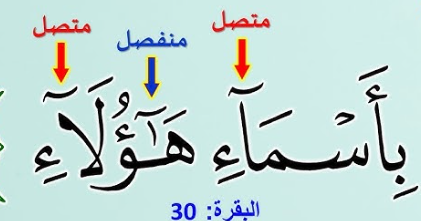
In most printed Tajweed Mushafs, this symbol appears in a distinct color (often blue or another contrasting color) to make it immediately visible to the reciter.
This symbol serves as a visual instruction: wherever you see it, you must extend that letter beyond two counts. It distinguishes madd muttasil from the natural two-count madd, ensuring even a student mid-recitation cannot miss the extension point.
In Mushafs without color-coding, students rely on recognizing the letter combination itself — a madd letter followed directly by hamzah within one word. Developing this pattern recognition is part of what our Tajweed for Beginners course at Buruj Academy trains from the earliest lessons.
Book Your FREE Trial Lesson to Begin Your Tajweed Journey
Read also: Madd Lazim: Types, Rules, and Quranic Examples
Madd Muttasil vs Madd Munfasil: What Is the Difference?
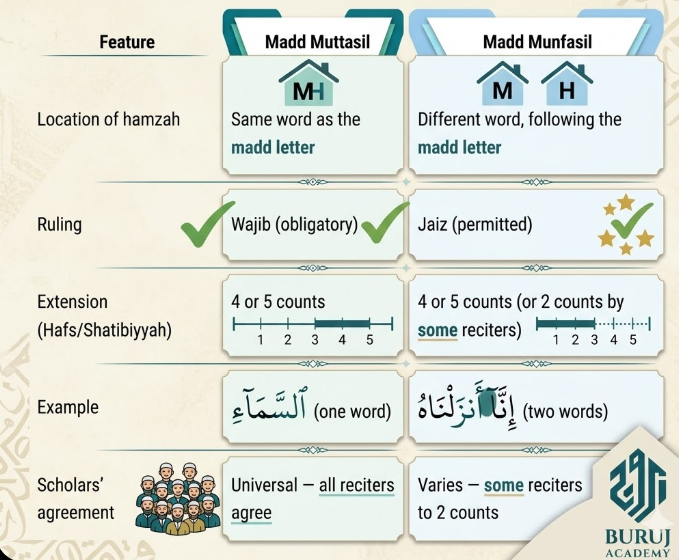
The critical distinction is the word boundary. In madd muttasil, the hamzah is locked inside the same word — inseparable from the madd letter. In madd munfasil, the madd letter ends one word and the hamzah begins the next.
Why Does the Word Boundary Change the Ruling?
Classical Tajweed scholars — including Imam Ibn al-Jazari in his foundational works — explained that the word boundary in madd munfasil means the hamzah is structurally less “bound” to the madd letter.
When pausing at the end of the first word, the hamzah disappears entirely, which gave early reciters grounds for shortening the extension.
No such option exists in madd muttasil, because the hamzah never separates from its word regardless of pausing or continuing.
This is one of the points where understanding the reasoning behind Tajweed rules makes a genuine difference.
Students who grasp the pause-logic immediately understand why muttasil is obligatory and munfasil is permitted. If you want to build this kind of rule comprehension, our guide on Tajweed rules and recitation explains the broader framework clearly.
Discover the Buruj Academy Difference
Step into our virtual classrooms and see how our expert instructors make learning Quran and Arabic intuitive and clear. We focus on overcoming the specific hurdles non-native speakers face, building your confidence and connection with the Quran.
How Many Counts for Madd Muttasil Under Hafs ‘an ‘Asim?
Under the narration of Hafs ‘an ‘Asim via the Shatibiyyah — the narration used by the vast majority of Muslims globally — madd muttasil is extended four or five counts. Four counts (four harakaat) is the more widely practiced and more commonly transmitted option among instructors teaching this narration.
Five counts is also valid and transmitted. Some instructors teach both and allow students to settle on one for consistency within a single recitation session — mixing counts within the same recitation sitting is generally discouraged for stylistic uniformity.
What Happens When the Hamzah Is at the End of the Word?
When the hamzah comes at the very end of the word — making it a word-final hamzah — and you choose to pause (waqf) on that word, an additional extension of six counts becomes permissible. This is specific to word-final hamzah positions.
Examples include pausing on يَشَاءُ:
ذَٰلِكَ فَضْلُ اللَّهِ يُؤْتِيهِ مَن يَشَاءُ
Dhālika faḍlullāhi yu’tīhi man yashā’u
“That is the bounty of Allah; He gives it to whom He wills.” (Al-Jumu’ah 62:4)
When pausing on يَشَاءُ, the hamzah is at the word’s end — four, five, or six counts are all valid.
The table below clarifies the extension options:
| Recitation Situation | Valid Extension Counts |
| Continuing (wasl) — any position | 4 or 5 counts |
| Pausing (waqf) — hamzah NOT at word end | N/A (you would not pause mid-word) |
| Pausing (waqf) — hamzah AT word end | 4, 5, or 6 counts |
How Madd Muttasil Connects to Your Broader Tajweed Learning
Madd muttasil does not exist in isolation — it belongs to the same system of rules that governs madd munfasil, madd ‘arid lil-sukun, and madd lazim. Understanding how these rules relate to each other is what separates a student who has memorized rule names from one who recites with genuine accuracy.
For students building their Tajweed foundations, our Tajweed for beginners guide provides the systematic entry point.
If you are also working on related rules like ghunnah and its interaction with letter-level rules, the complete guide to ghunnah on our blog covers it in depth.
And for those connecting Tajweed to their Quran reading confidence more broadly, our step-by-step guide to reading Quran with Tajweed is a practical next read.
In our experience, students who treat madd rules as a connected system — rather than isolated facts — correct their recitation errors two to three times faster than those who study each rule in isolation.
Excel in Your Quranic Studies
Join Buruj Academy and master the Quran with our structured, professional curriculum.
Book Your Free TrialMaster Madd Muttasil with Buruj Academy’s Expert Tajweed Instructors
Madd muttasil is an obligatory rule that every reciter must apply correctly — and correct application comes from trained hearing, not just rule memorization.
At Buruj Academy, our Online Tajweed Classes are led by Ijazah-certified instructors and Al-Azhar University graduates with 12+ years of experience teaching non-Arabic speakers. We use the Buruj Method — sound-before-rules — so your ear learns madd muttasil before your mind labels it.
- Personalized 1-on-1 online sessions
- Flexible scheduling for any timezone
- Real-time recitation correction
- Proven progression from beginner to advanced
Join a supportive learning environment tailored to your pace and lifestyle. Start your journey toward excellence by enrolling in one of our specialized tracks:
- Online Tajweed Classes
- Tajweed Classes for Beginners
- Tajweed Classes for Adults
- Tajweed Classes for Sisters
- Tajweed Classes for Kids
- Advanced Tajweed Course
- Amli Tajweed Course (Practical Application)
Ready to transform your recitation? book your free assessment and start your path to Tajweed mastery today!
Frequently Asked Questions About Madd Muttasil
What Is Madd Muttasil in Simple Terms?
Madd muttasil is a Tajweed rule that requires extending a madd letter — alif, waw, or ya — when it is immediately followed by a hamzah inside the same word. The extension is obligatory at four or five counts under Hafs ‘an ‘Asim, making it one of the most consistently applied madd rules in all Quran recitations.
Why Is Madd Muttasil Called Wajib While Madd Munfasil Is Called Jaiz?
Madd muttasil is wajib because all recitation narrations agree on extending it — no narration permits shortening it to two counts. Madd munfasil is jaiz because some reciters, like Ibn Kathir and Abu Ja’far, transmitted it with only two counts. The word boundary between the madd letter and the hamzah in munfasil created scholarly permission for shortening.
What Is the Difference Between Madd Muttasil and Madd Munfasil?
In madd muttasil, the madd letter and the hamzah are inside the same word — they are inseparable. In madd munfasil, the madd letter ends one word and the hamzah begins the next word. This word boundary changes the ruling: muttasil is obligatory, munfasil is permitted. Both typically extend four or five counts under Hafs ‘an ‘Asim.
How Do I Identify Madd Muttasil in the Quran?
Look for any of the three madd letters (alif after fathah, waw after dammah, ya after kasrah) followed directly by a hamzah — and confirm both are within one word. In Tajweed Mushafs, the small curved symbol above the madd letter marks the extension point. Common examples include السَّمَاءِ, جَاءَ, سُوءِ, and الْمُسِيءُ.
Can Madd Muttasil Be Six Counts?
Yes — but only when pausing (waqf) on a word where the hamzah falls at the very end. In that specific case, four, five, or six counts are all valid under Hafs ‘an ‘Asim. During continuous recitation (wasl), only four or five counts apply. Extending to six counts during wasl is not transmitted and should be avoided.