 Quran
Quran

| Key Takeaways |
| The ten Qirat are distinct, authenticated recitation styles transmitted through unbroken chains of transmission (sanad) from the Prophet ﷺ. |
| Hafs ‘an ‘Asim is the most widely used Qirat globally, making it the recommended starting point for non-Arabic speaking students. |
| Learning any Qirat requires mastering foundational Tajweed rules first, as each style applies those rules with specific variations. |
| Each Qirat is defined by a Rawi (transmitter) whose name follows the Imam — for example, Hafs and Shu’bah both transmit from Asim. |
| Studying Qirat under a certified instructor with a connected sanad is an Islamic requirement, not merely a pedagogical preference. |
Millions of Muslims recite the Quran daily yet remain unaware that the revelation was transmitted through multiple authenticated recitation styles — each one valid, each one prophetically documented. These styles are the Qirat, and their differences are not errors or regional variations; they are divinely preserved diversity within the text.
To recite Quran with Qirat means learning one or more of these authenticated styles under a qualified instructor who holds an unbroken chain of transmission.
The process is structured, sequential, and deeply rewarding — and it begins with understanding what Qirat actually are before a single verse is practiced.
Table of Contents:
1. Understand What the Ten Qirat Are Before You Begin Practicing Them
The ten Qirat are ten distinct, mutually authenticated systems of Quranic recitation, each traced through an unbroken sanad (chain of transmission) back to the Prophet Muhammad ﷺ.
The ten Qirat differ in areas including vowel length, letter pronunciation, certain word forms, and specific Tajweed applications — but every one of them preserves the same divine meaning without contradiction.
These are not dialects or cultural preferences. They are precisely documented scholarly traditions, each named after a Quranic Imam and transmitted by two Rawis (narrators):
These ten represent the Mutawatir recitations — transmitted by so many reliable chains that error or fabrication is impossible.
2. Start with Hafs ‘an ‘Asim to Build a Foundation You Can Expand From
Hafs ‘an ‘Asim is the Qirat you almost certainly already use. It is the dominant recitation style across the Arab world, South Asia, and most of the Muslim West — the style printed in the standard Uthmani Mushaf and recited in Makkah and Madinah.
Beginning here is not a shortcut; it is the methodologically correct entry point for learning any additional Qirat.
In our work at Buruj Academy, we consistently observe that students who attempt a secondary Qirat — such as Warsh or Qalun — without first consolidating their Hafs recitation develop layered confusion between the two systems. The foundation must be solid before the variations can be distinguished with precision.
If you are not yet confident in your Hafs recitation, begin with our Quran Recitation course to establish the baseline accuracy every Qirat requires.
What “solid foundation” means practically:
- Consistent application of Madd rules (obligatory, natural, and permissible lengthening)
- Accurate Ghunnah on Noon and Meem Mushaddad
- Correct Waqf (stopping) and Ibtida’ (resumption) positions
- Reliable makharij for all 29 Arabic letters
Once these are stable in Hafs, advancing to a second Qirat becomes a matter of learning variations — not rebuilding from scratch. You can explore the fundamentals of Tajweed rules in our complete Tajweed guide for beginners before progressing further.
Book your first FREE recitation lesson
3. Learn the Differences Between Qirat Systems So You Know What Changes Between Them
The ten Qirat do not differ randomly. Their variations follow clear, documented categories — and knowing these categories helps you study systematically rather than memorizing differences verse by verse without understanding why they exist.
| Category of Variation | Example |
| Madd duration | Warsh recites certain Madds longer than Hafs |
| Hamzah treatment | Hamzah Qirat preserves strong Hamzah; others soften or omit it in specific positions |
| Vowel on specific words | Certain words carry Fathah in Hafs and Kasrah in another Qirat |
| Ra’ tafkhim / tarqiq | Rules governing thick and thin Ra’ vary between recitations |
| Sakt (brief pause) | Specific positions in Hafs include Sakt absent in other Qirat |
Understanding these categories means that when your instructor introduces a Warsh variation, you can immediately classify it: “This is a Madd difference” or “This is a Hamzah rule.” That classification dramatically accelerates retention.
Our detailed breakdown of Idgham rules in Tajweed provides further grounding in one of the most variable areas across Qirat systems.
4. Choose Your Target Qirat Based on Purpose, Geography, and Accessibility
After Hafs, the most commonly studied Qirat among non-Arabic speakers are Warsh ‘an Nafi’, Qalun ‘an Nafi’, and Shu’bah ‘an ‘Asim. Your choice should be guided by clear criteria — not simply by which name sounds most familiar.
Warsh ‘an Nafi’ is predominant across North and West Africa, Morocco, Algeria, Tunisia, Libya, and parts of Sub-Saharan Africa. If your community, heritage, or family background connects to these regions, Warsh is the natural choice.
Qalun ‘an Nafi’ is used in Tunisia and Libya alongside Warsh, and is often studied as a companion to Warsh since both transmit from Imam Nafi’.
Shu’bah ‘an ‘Asim transmits from the same Imam as Hafs, making the transition particularly manageable for Hafs-trained students. The structural familiarity reduces cognitive load significantly.
Duri ‘an Abu ‘Amr remains important across parts of Sudan and East Africa and is the subject of growing scholarly interest among students pursuing multiple Qirat.
We recommend choosing purposefully — ideally with the guidance of an instructor — rather than selecting the most “exotic” sounding option. The Qirat you will practice consistently is always superior to one studied briefly and abandoned.
Excel in Your Quranic Studies
Join Buruj Academy and master the Quran with our structured, professional curriculum.
Book Your Free Trial5. Secure a Qualified Instructor with a Verified Sanad Before Beginning Any Qirat
This step is not optional, and it is not merely practical advice — it carries a documented scholarly ruling. The Qirat cannot be learned from books, recordings, or apps alone. They must be transmitted from a living, qualified reciter to a student through direct oral instruction and correction.
The sanad — the unbroken chain of transmission from student to teacher stretching back to the Prophet ﷺ — is what makes a Qirat valid. A reciter without sanad is not practicing a Qirat; they are imitating a style.
When evaluating a potential instructor, confirm:
- They hold an Ijazah in the specific Qirat you wish to learn
- Their sanad is connected and can be traced
- They are capable of correcting your recitation in real time, not merely demonstrating the correct version
- They have experience teaching the Qirat to non-native Arabic speakers
At Buruj Academy, our Online Qirat Course connects students with Ijazah-certified instructors who hold authenticated chains of transmission in multiple Qirat.
Book your FREE trial lesson in your path to reciting with Qiraat

6. Study the Usul of Your Chosen Qirat Before Practicing Individual Verses
Every Qirat has its Usul — its foundational governing principles that apply consistently throughout the entire Quran in that recitation. These are not random exceptions; they are systematic rules that define the Qirat’s character.
For Warsh ‘an Nafi’, the Usul include:
- Naql: Moving the vowel of a Hamzah to the preceding sukoon-bearing letter in specific positions
- Tashil: Softening the second of two consecutive Hamzahs
- Ibdal: Substituting Hamzah with a long vowel letter in defined contexts
- Extended Madd: Warsh applies the lengthened Madd al-Muttasil to six counts as standard
- Thick Ra’ rules: Warsh applies Tafkhim (thickness) in positions where Hafs uses Tarqiq
Learning the Usul first means that when you encounter any verse in Warsh, you apply a known system — not isolated memorized exceptions. This is the approach our instructors at Buruj Academy apply through the Buruj Method: system before verse, principle before practice.
Read also: Best Quran Reciters to Learn Quran
Our teachers are Al-Azhar University graduates with 12+ years of experience teaching non-Arabic speakers — combining scholarly credentials with practical teaching expertise.
Book a FREE trial session with one of Buruj’s Azhari Quran tutors

The same logic applies to our foundational Tajweed teaching — rules are always taught as systems, never as isolated memorizations.
Discover the Buruj Academy Difference
Step into our virtual classrooms and see how our expert instructors make learning Quran and Arabic intuitive and clear. We focus on overcoming the specific hurdles non-native speakers face, building your confidence and connection with the Quran.
7. Practice Each Qirat Variation in Isolation Before Combining with Your Primary Recitation
One of the most consistent challenges we observe with students learning a second Qirat is blending — unconsciously mixing the rules of two systems mid-recitation.
A student trained in Hafs who begins Warsh will frequently revert to Hafs Madd lengths or Hafs Ra’ rules when the recitation demands focused attention on meaning.
The solution is deliberate isolation practice:
- Dedicate separate sessions exclusively to the new Qirat — do not switch between systems within one sitting
- Begin with short, familiar surahs where meaning is already internalized, freeing cognitive capacity for rule application
- Record your recitation and review specifically for blend-points — moments where Hafs habits override Warsh rules
- Have your instructor flag every blend during lesson review, not just major errors
Short surahs from Juz ‘Amma are ideal for isolation practice. If you have not yet solidified these shorter surahs, our Juz 30 Memorization course builds the textual familiarity that makes Qirat practice significantly more efficient.
Book Your Kid’s First Session in Buruj’s Juz 30 Memorization Course
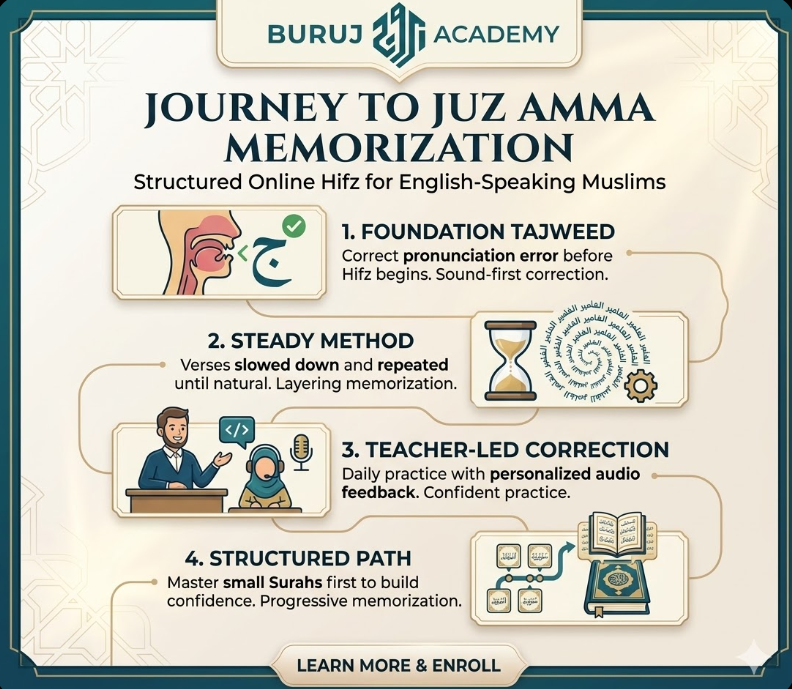
Understanding rules like Ghunnah and its applications in your primary Qirat before noting how they differ in a second system reinforces both simultaneously.
8. Use Authenticated Audio References Alongside Your Instructor’s Correction
Listening is a non-negotiable component of Qirat learning. The ear must be trained to recognize what the Qirat sounds like before the tongue can reproduce it accurately.
This is why the Prophet ﷺ received the Quran aurally from Jibril ﷺ, and why oral transmission has always been the validating mechanism of every Qirat.
Critical rule: Audio is a reference tool, not a replacement for instructor correction. Recording technology cannot hear your specific error, identify its cause, and provide targeted correction in real time. Your instructor remains the primary authority; audio sharpens your ear between sessions.
9. Progress Through the Quran Systematically Under Instructor Supervision to Earn Your Ijazah
The ultimate validation of Qirat mastery is the Ijazah — the scholarly certification confirming that a qualified reciter has heard your complete recitation, verified your accuracy, and connected your sanad to theirs. Without this, Qirat study remains personal enrichment rather than authenticated transmission.
The pathway to Ijazah in any Qirat follows this progression:
- Tajweed consolidation — confirmed by your instructor before Qirat-specific training begins
- Usul mastery — all foundational rules of the Qirat applied consistently
- Partial recitation review — instructor supervises recitation of selected portions and corrects blend points
- Complete Quran recitation — student recites the full Quran under the Ijazah-holding instructor
- Certification — instructor grants Ijazah and connects the student’s name to the sanad
This process requires patience, consistency, and reliable scheduling. In our experience, non-Arabic speaking adults working with Buruj Academy’s Online Ijazah Course who maintain three sessions per week typically require 18–36 months to complete a single Qirat Ijazah — depending on their starting level and consistency.
If Ijazah is your goal, explore our Ijazah program for a structured pathway taught by Ijazah-certified instructors with verified sanad.
Book your FREE trial lesson in your path to Ijazah
Read also: 7 Types of Recitation of the Quran
Master Quranic Recitation with Buruj Academy’s Certified Qirat Instructors
Reciting Quran with authentic Qirat requires more than motivation — it requires the right teacher, the right method, and verified transmission.
Buruj Academy offers:
- Ijazah-certified instructors and Al-Azhar University graduates with connected sanad in multiple Qirat
- 12+ years teaching non-Arabic speakers across the globe
- The Buruj Method: sound before rules, system before verse, consistency before speed
- Personalized 1-on-1 sessions with flexible 24/7 scheduling
- Real-time correction and structured progression from foundational Tajweed to full Qirat Ijazah
Book your free trial lesson today and take the first authenticated step in your Qirat learning with qualified instructors who hold the chains of transmission your recitation deserves.
Take the next step in your learning journey today by enrolling in one of our specialized programs:
- Online Quran Classes
- Online Quran Classes for Beginners
- Online Quran Classes for Adults
- Online Quran Classes for Ladies
- Online Quran Classes for Kids
- Quran Reading Course
- Quran Recitation Course
- Online Ijazah Course
- Online Qirat Course
Don’t wait to transform your relationship with the Holy Quran. Join our global community of students and book your free evaluation session now!
Excel in Your Quranic Studies
Join Buruj Academy and master the Quran with our structured, professional curriculum.
Book Your Free TrialConclusion
Reciting the Quran with Qirat is one of the most profound ways to deepen your relationship with the divine text — engaging with it not just as a reader, but as a transmitter of a living, unbroken scholarly tradition.
The nine steps above are not arbitrary; they reflect the same sequential logic through which scholars have transmitted these recitations across fourteen centuries.
Begin with what is correct, not what is quick. Secure a qualified instructor, learn the system before the verses, and protect the sanad. With the right guidance and consistent effort, authentic Qirat recitation is genuinely within reach — Insha’Allah.
Frequently Asked Questions About Reciting Quran with Qirat
What Is the Difference Between Qirat and Tajweed?
Tajweed refers to the rules of proper pronunciation applied during Quran recitation — governing letter sounds, vowel lengths, and articulation points. Qirat refers to the ten authenticated recitation systems, each with its own set of rules built on Tajweed foundations. Every Qirat requires Tajweed; Tajweed itself is not specific to any single Qirat.
How Many Qirat Are There and Are They All Valid?
There are ten authenticated Qirat, all transmitted through Mutawatir (mass-transmitted) chains back to the Prophet ﷺ. All ten are valid and authentically preserved. Beyond these ten, there are also Shadh (irregular) recitations that scholars do not consider part of the authenticated Mutawatir tradition and are not used in standard worship.
Can I Learn a Second Qirat Without an Instructor?
No — and this is a matter of scholarly consensus, not merely practical advice. The Qirat are defined by oral transmission through a connected sanad. Studying from books or recordings alone produces a recitation style without authenticated chain, which is not a Qirat in the technical Islamic sense. A qualified, Ijazah-holding instructor is required for valid transmission.
How Long Does It Take to Learn Warsh ‘an Nafi’ After Hafs?
For a student with solid Hafs mastery, learning the Usul of Warsh typically requires three to six months of consistent study before independent application across the Quran becomes reliable. Full Ijazah certification in Warsh generally requires 18–30 months of structured study, depending on session frequency and starting level.
Is Qirat Study Suitable for Beginners?
Qirat study is not recommended as a starting point. Beginners should first establish reading fluency, then foundational Tajweed, and then consolidate their primary Qirat — typically Hafs — before introducing a second system. Attempting Qirat too early creates layered confusion that is difficult to correct later. A structured Quran reading course is the appropriate entry point for those starting from the beginning.