 Quran
Quran

| Key Takeaways |
| Sheikh Abdul Basit Abdus Samad’s Mujawwad recitation remains the gold standard for learning proper Tajweed articulation and melodic rules. |
| Sheikh Mahmoud Khalil Al-Husary recorded a dedicated Mu’allim (teaching) recitation specifically designed for students learning Quran pronunciation. |
| Egyptian reciters dominate classical Tajweed pedagogy, while Saudi reciters like Sudais are preferred for Hafs recitation fluency training. |
| Listening to certified reciters daily — even 10 minutes — measurably accelerates Tajweed rule internalization before formal rule study begins. |
| The best reciter for memorization differs from the best reciter for Tajweed learning — matching the reciter to your goal matters significantly. |
Choosing the right reciter to listen to is one of the most underestimated decisions a Quran student makes. The voice you train your ear on shapes how you internalize Makharij, Ghunnah length, Madd duration, and the overall musicality of proper recitation.
The best Quran reciters for learning are those whose pronunciation is technically precise, whose pace is controlled enough for ear-training, and whose recitation style aligns with the Hafs ‘an ‘Asim narration — the most widely taught and verified transmission worldwide.
Below, we present a carefully verified list of the top 10 best quran reciters in the world, organized to serve your learning goals.
Table of Contents:
1. Sheikh Mahmoud Khalil Al-Husary — The Teacher of Reciters
Sheikh Mahmoud Khalil Al-Husary (1917–1980) is, without question, the most pedagogically valuable reciter for students beginning their Tajweed study.
Sheikh Al-Husary recorded three distinct recitation styles: Mujawwad (beautified), Murattal (measured), and — most importantly — his Mu’allim (teaching) recitation, in which he pauses after each phrase to allow students to repeat. This format was designed explicitly for Quran learners.
Al-Husary served as the head of the Quran Recitation Committee at Al-Azhar and received Egypt’s State Prize for his contributions to Quranic sciences.
His Murattal recitation is characterized by deliberate, unhurried articulation — every Makhraj is distinct, every Ghunnah measured precisely.
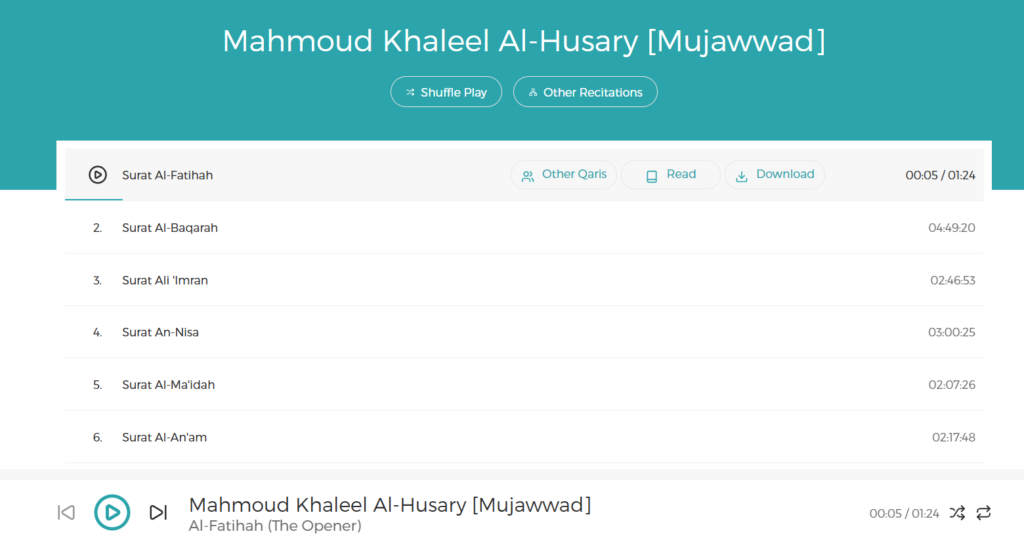
We consistently recommend Al-Husary to beginners at Buruj Academy before introducing any other reciter, because his pace allows the ear to register individual letter sounds rather than melodic patterns. You can listen to Sheikh Al-Husary’s Mujawwad recitation here.
| Recitation Style | Best Used For |
| Mu’allim (Teaching) | Beginner repetition training |
| Murattal | Tajweed rule ear-training |
| Mujawwad | Advanced melodic study |
Students in our Tajweed for Beginners course who struggle with heavy and light letter distinctions consistently find Al-Husary’s recitation easier to imitate precisely.
Book Your FREE Trial Lesson to Begin Your Tajweed Journey
2. Sheikh Abdul Basit Abdus Samad — The Voice Standard for Tajweed Mastery
Sheikh Abdul Basit Abdus Samad (1927–1988) is universally recognized among Tajweed scholars as possessing one of the most technically precise and naturally gifted voices in recorded Quranic history.
His Mujawwad recitation showcases every Sifah (letter attribute) at its fullest expression — Tafkhim, Tarqiq, Qalqalah, and Madd timings are all performed with unmistakable clarity.
His Murattal recitation, while less ornamented, is equally valuable for students learning to apply Tajweed rules in live recitation.
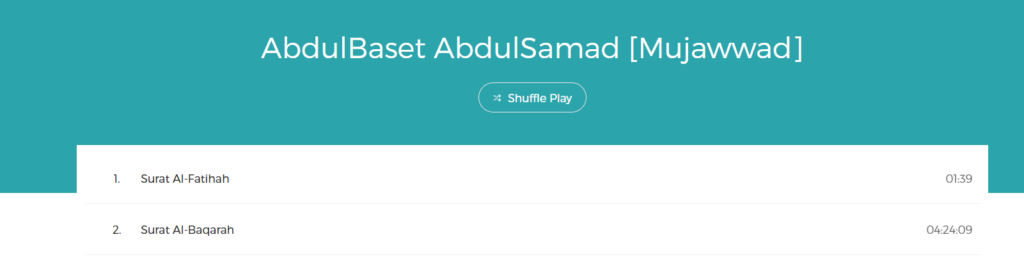
Many students in our sessions find that modeling their recitation on Abdul Basit accelerates their Makharij precision faster than rules-based instruction alone. His recitation is available at Quranicaudio.com— Sheikh Abdul Basit.
3. Sheikh Minshawi — The Balanced Choice for Both Tajweed and Memorization
Sheikh Mohamed Siddiq Al-Minshawi (1920–1969) occupies a unique position on any serious reciter list. His voice carries a warm, measured quality that sits between Al-Husary’s academic precision and Abdul Basit’s dramatic expressiveness.
This balance makes him exceptionally well-suited for students pursuing both Tajweed refinement and Quran memorization.
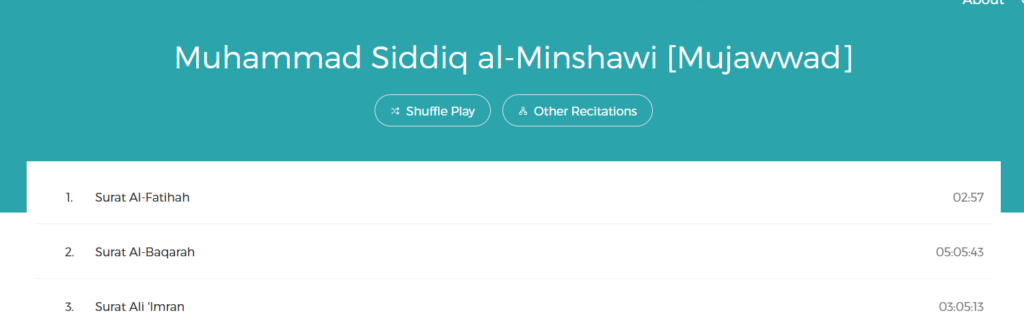
Al-Minshawi also recorded a Mu’allim-style recitation, making his voice accessible as a teaching tool. His Ghunnah application is particularly clear, which benefits students working through Ghunnah and its rules. You can access his recitation at Quranicaudio.com — Sheikh Minshawi.
4. Sheikh Ali Abdur-Rahman Al-Huthaify — The Saudi Standard for Madinah Recitation
Sheikh Ali Abdur-Rahman Al-Huthaify has served as an Imam of Masjid An-Nabawi in Madinah for decades. His recitation style is clear, melodically moderate, and deeply consistent — qualities that make him among the most recommended Saudi reciters for students training their ears on Hafs recitation outside the Egyptian school.
His voice is particularly well-suited for students who find the Egyptian Mujawwad style too ornate for early-stage learning.
The Madinah school of recitation represented by Al-Huthaify emphasizes steady Madd timings and clean Waqf (stopping) positions — both areas where beginners commonly need support. Listen at Quranicaudio.com — Sheikh Al-Huthaify.
Read also: Is Listening to the Quran the Same as Reading It?
5. Sheikh Abdur-Rahman As-Sudais
Sheikh Abdur-Rahman As-Sudais, chief Imam of Masjid Al-Haram in Makkah, is one of the most recognized voices in the Muslim world. His recitation combines melodic richness with technical Tajweed adherence, making him one of the most followed among famous Saudi Quran reciters globally.
For students working on fluency and listening comprehension — particularly those in the intermediate stage — As-Sudais provides an excellent model. His pace in Murattal recitation is confident without being rushed.
His recitation is accessible at Quranicaudio — Sheikh As-Sudais.
Students preparing for Quran recitation courses often build their ear on As-Sudais before transitioning to more technically demanding Egyptian styles.
Excel in Your Quranic Studies
Join Buruj Academy and master the Quran with our structured, professional curriculum.
Book Your Free TrialBook your first FREE recitation lesson

6. Sheikh Saud Ash-Shuraym
Sheikh Saud Ash-Shuraym, also an Imam of Masjid Al-Haram, is frequently paired with As-Sudais in Ramadan Tarawih recitations. His individual recitation style is distinguished by exceptional clarity of Makharij and a measured, controlled pace that remains accessible to intermediate students.
Among famous Saudi Quran reciters, Ash-Shuraym is particularly valued for his articulation of heavy letters (Tafkhim) and his consistent Ikhfa application.
Listen at Quranicaudio — Sheikh Ash-Shuraym.
7. Sheikh Mishary Rashid Alafasy
Sheikh Mishary Rashid Alafasy (Kuwait) holds an Ijazah in multiple Qira’at and has become one of the most widely listened-to contemporary reciters worldwide. His voice has a distinctive melodic quality that many students find deeply motivating for Quran memorization practice.
Among students pursuing Hifz, Alafasy ranks consistently as one of the best reciters for Quran memorization — his steady rhythm makes verse boundaries clear, which supports the chunking technique central to retention.
His Murattal recitation avoids the complexity of Mujawwad ornamentation, making it easier to loop and memorize. Access his recitation at Quranicaudio.
Discover the Buruj Academy Difference
Step into our virtual classrooms and see how our expert instructors make learning Quran and Arabic intuitive and clear. We focus on overcoming the specific hurdles non-native speakers face, building your confidence and connection with the Quran.
| Goal | Recommended Reciter |
| Tajweed rule ear-training | Al-Husary (Mu’allim) |
| Makhraj precision modeling | Abdul Basit (Murattal) |
| Memorization rhythm support | Alafasy or Minshawi |
| Saudi school fluency | As-Sudais or Ash-Shuraym |
| Madinah recitation standard | Al-Huthaify |
8. Sheikh Ibrahim Al-Akhdar
Sheikh Ibrahim Al-Akhdar served as a reciter at Masjid An-Nabawi and is less widely known outside scholarly circles — yet his recitation is technically exemplary. Among students specifically studying Makharij al-Huruf, Al-Akhdar’s articulation of throat letters (Huruf al-Halq) is considered a model of clarity.
His recitation pace is deliberate without being labored, and his voice possesses a natural evenness that supports close listening analysis.
Advanced students preparing for Ijazah certification benefit from studying his letter-level precision alongside the Egyptian classical school. His recitation is available at Quranicaudio.
Read also: How to Learn to Read the Quran?
9. Sheikh Hani Ar-Rifai
Sheikh Hani Ar-Rifai (Saudi Arabia) brings a contemporary, clean recitation style that non-Arabic speaking students frequently find easier to follow than classical Mujawwad styles.
His Murattal recitation is measured, melodically accessible, and technically sound in its Tajweed application.
For students just beginning to read the Quran for the first time or transitioning from Noorani Qaida to full Quran reading, Ar-Rifai’s pace provides a comfortable bridge.
His Ghunnah durations and Idgham applications are clearly distinguishable, making him especially useful for students working through Idgham rules in Tajweed. Listen at Quranicaudio.
10. Sheikh Nasser Al-Qatami
Sheikh Nasser Al-Qatami (Kuwait) has gained significant recognition in recent years for his deeply moving recitation style combined with reliable Tajweed accuracy.
His recitation is particularly suited for students who use extended listening — during commutes, household tasks, or evening review — as part of their Quran memorization schedule.
Al-Qatami’s voice carries an emotional quality that supports the reflective dimension of Quran recitation without sacrificing technical precision.
Students we work with who struggle to maintain daily listening habits find his style sustains attention more naturally than strictly academic recitation styles.
His recitation is available at Quranicaudio.
How to Use This Quran Reciters List Effectively?
The most common mistake students make is switching reciters frequently, which trains the ear inconsistently. We recommend selecting one primary reciter matched to your current learning goal and listening to that voice daily for a minimum of four to six weeks before assessing whether to continue or adjust.
| Stage | Primary Reciter | Secondary (Optional) |
| Complete Beginner | Al-Husary (Mu’allim) | Minshawi (Mu’allim) |
| Building Tajweed Ear | Abdul Basit (Murattal) | Al-Husary (Murattal) |
| Memorization Phase | Alafasy or Minshawi | Al-Qatami |
| Fluency & Confidence | As-Sudais or Ash-Shuraym | Ar-Rifai |
| Advanced / Ijazah Prep | Abdul Basit (Mujawwad) | Al-Akhdar |
Students in our Online Quran Recitation course receive personalized reciter recommendations based on their current level assessment — because the right voice at the wrong stage can either accelerate or hinder progress significantly.
Start Your Recitation Training with Buruj Academy’s Expert Instructors
Listening to great reciters builds your ear — but guided recitation practice with a qualified instructor builds your skill.
Buruj Academy’s Online Quran Recitation course combines systematic listening training with live correction from Ijazah-certified instructors and Al-Azhar University graduates with 12+ years teaching non-Arabic speakers.
Our instructors use the Buruj Method — sound-before-rules — ensuring your ear is trained on correct Makharij and Sifat before formal rule study begins.
Sessions are personalized, 1-on-1, and scheduled flexibly around your life.
Book your free trial lesson and begin reciting with the precision and beauty these reciters model.
Take the next step in your learning journey today by enrolling in one of our specialized programs:
- Online Quran Classes
- Online Quran Classes for Beginners
- Online Quran Classes for Adults
- Online Quran Classes for Ladies
- Online Quran Classes for Kids
- Quran Reading Course
- Quran Recitation Course
- Online Ijazah Course
- Online Qirat Course
Don’t wait to transform your relationship with the Holy Quran. Join our global community of students and book your free evaluation session now!
Excel in Your Quranic Studies
Join Buruj Academy and master the Quran with our structured, professional curriculum.
Book Your Free TrialConclusion
The reciters on this list represent the most pedagogically reliable voices for Quran students at every stage — from Al-Husary’s teaching-format recitation for absolute beginners to Abdul Basit’s Mujawwad for advanced Tajweed study. What matters is not simply finding a beautiful voice, but matching the right reciter to your specific learning goal.
Consistent daily listening, paired with structured practice under a qualified instructor, produces measurable results. Alhamdulillah, these recordings are among the greatest gifts available to today’s Quran students — use them with intention and purpose.
Frequently Asked Questions About the Best Quran Reciters to Learn Quran
Who Is the Best Reciter for Quran Memorization?
Sheikh Mishary Rashid Alafasy and Sheikh Minshawi are consistently recommended as the best reciters for Quran memorization. Their steady rhythmic pace makes verse boundaries clear and easy to loop during review. Both are available in Murattal style, which avoids melodic complexity that can distract during active memorization sessions.
What Is the Difference Between Mujawwad and Murattal Recitation?
Mujawwad is a fully ornamented, performance-style recitation applying all melodic and Tajweed rules at their most expressive level. Murattal is measured, steady recitation focused on correct Tajweed without extended melodic elaboration. For learning, Murattal is generally more practical; Mujawwad is ideal for advanced ear-training and melodic modeling.
Are Egyptian Quran Reciters Better Than Saudi Reciters for Learning?
Egyptian reciters like Al-Husary and Abdul Basit are widely considered superior for Tajweed precision training due to the classical Egyptian school’s rigorous emphasis on Makharij and Sifat. Saudi reciters like As-Sudais and Ash-Shuraym are excellent for fluency training and accessible listening. Both traditions follow Hafs ‘an ‘Asim and are pedagogically valid.
How Many Minutes Per Day Should I Listen to Quran Reciters?
In our instructors’ experience at Buruj Academy, 15–20 minutes of focused daily listening — where the student follows along with the Mushaf — produces measurable improvement in Tajweed internalization within four to six weeks. Passive background listening provides spiritual benefit but contributes less to technical pronunciation development.
Which Reciter Should a Complete Beginner Start With?
Sheikh Mahmoud Khalil Al-Husary’s Mu’allim (teaching) recitation is the strongest starting point for complete beginners. Its pause-and-repeat format was specifically designed for students, its pace allows clear letter recognition, and Al-Husary’s Makharij precision establishes correct phonetic habits from the earliest stage of learning.