 Quran
Quran

| Key Takeaways |
| Listening to Quran with intention and presence of heart earns confirmed reward in Islamic scholarship. |
| Reading Quran aloud earns reward per letter — at minimum ten good deeds per letter recited from the Mushaf. |
| Scholars differ on which is superior, but the strongest position recommends combining both practices regularly. |
| Ibn Baz stated that a sincere, attentive listener shares in the reward of the one reciting the Quran. |
| Listening via recordings, radio, or phone counts as valid Quran listening and earns reward according to scholars. |
Many Muslims who cannot yet read Arabic fluently ask one question more than almost any other: does playing a Quran recitation and listening attentively earn the same reward as reading directly from the Mushaf?
Both reading and listening to the Quran are confirmed acts of worship with great reward established in the Quran and Sunnah. Scholars agree that listening earns real, substantial reward. Whether that reward equals or differs from reading is a question of scholarly discussion — and the wisest position is to practice both.
Table of Contents:
Is Listening to Quran the Same as Reading It?
Both listening to the Quran and reading the Quran carry great reward, and Islamic scholars agree neither should be abandoned in favor of the other.
Listening to the Quran is a rewarded act of worship, but it is not identical to reading. Reading the Quran from the Mushaf earns a minimum of ten good deeds per letter recited, as established in an authentic hadith. Listening earns multiplied reward as well, but the mechanisms differ.
The Prophet ﷺ himself loved to listen to the Quran recited by others. In an authentic narration recorded in both Sahih al-Bukhari and Sahih Muslim, he asked Abdullah ibn Mas’ud رضي الله عنه to recite Surah An-Nisa for him.
Ibn Mas’ud said: “Shall I recite to you while it was revealed to you?”
The Prophet ﷺ replied: “I love to hear it from someone other than myself.” He listened until his eyes filled with tears. This establishes beyond doubt that listening is a beloved and recommended act in Islam.
For those who want to deepen their Quran reading alongside their listening practice, Buruj Academy’s Quran Reading course provides structured, step-by-step instruction from Al-Azhar-trained instructors who specialize in teaching non-Arabic speakers from complete beginner level.
Book your Free trial lesson and start reading the Quran

What Is the Reward for Listening to Quran According to Hadith?
The reward for listening is established in an authentic hadith reported by Abu Hurayrah رضي الله عنه, recorded by Imam Ahmad in his Musnad, that the Prophet ﷺ said:
“Whoever listens to a single verse from the Book of Allah ﷻ receives a multiplied good deed, and whoever recites it, it will be a light for him on the Day of Judgment.”
This hadith draws a clear distinction: the listener receives multiplied hasanat (good deeds), while the reciter receives both hasanat per letter and a specific light on the Day of Judgment. Both outcomes are extraordinary.
Neither negates the other, and this is precisely why scholars advise combining both practices rather than relying on one alone.
What Did the Scholars Say About the Reward of Listening to Quran?
Scholars across the generations confirmed that attentive listening to the Quran earns genuine and significant reward. Their positions differ only in the comparative question of which is greater — reading or listening.
Does Listening Equal Reading in Reward?
Sheikh Ibn Baz رحمه الله gave a direct and encouraging answer to this question. He stated: “We hope for you reward in that, and that it is like the reciter — because the listener is like the reciter. The one who listens is a partner of the one who reads. If he listens with a sincere intention, with sincerity, seeking benefit — we hope for him the same reward as the reciter.”
Sheikh Ibn Baz went further to say that the listener may even receive greater reward if his listening is marked by greater sincerity and longing for Allah’s reward.
Which Is Superior — Reading the Quran or Listening to the Quran?
Scholars differed on this, and their disagreement is legitimate and well-grounded.
| Position | Reasoning | Scholars Who Held It |
| Reading is superior | More explicit texts praise recitation; each letter carries ten rewards | Majority scholarly view |
| Listening is superior | Enables deeper contemplation; the listener’s mind is freer to reflect | Some scholars; implied by Imam Nawawi |
| Both are equal in reward for the sincere | Hadith establishes equal partnership between reader and listener | Ibn Baz and others |
Imam Nawawi commented in his Sharh Sahih Muslim that the Prophet’s ﷺ request for Ibn Mas’ud to recite to him suggests listening enables “deeper understanding and reflection than reading oneself.”
This is because the reader is occupied with pronunciation and rules, while the listener’s heart is free to absorb meaning fully.
Does the Quranic Command to Listen Apply to Recordings as Well?
Yes, contemporary scholars confirm that listening via recordings, radio, television, or phone achieves the same ruling and reward as listening to a live reciter — provided the listener engages with presence of heart, intention, and attentiveness. The medium does not diminish the act.
Allah ﷻ commands in Surah Al-A’raf:
وَإِذَا قُرِئَ الْقُرْآنُ فَاسْتَمِعُوا لَهُ وَأَنْصِتُوا لَعَلَّكُمْ تُرْحَمُونَ
Wa-idhā quri’al-Qur’ānu fastami’ū lahu wa-anṣitū la’allakum turḥamūn
“And when the Quran is recited, listen to it and pay attention that you may receive mercy.” (Al-A’raf 7:204)
Imam al-Tabari explained in his Jami’ al-Bayan that this verse commands believers to direct their hearing and maintain silence so they may understand the verses, reflect on their admonitions, and be covered by the mercy of Allah ﷻ.
Imam al-Layth added that mercy reaches the listener of Quran faster than anyone else, because the word la’alla (perhaps/that you may) when used by Allah carries the force of certainty.
Read also: Best Quran Reciters to Learn Quran
What Is the Difference Between Listening and Reading Quran in Practice?
Understanding the practical distinctions helps Muslims make informed, balanced choices about how they engage with the Quran daily.
| Practice | What Earns Reward | Additional Spiritual Benefit |
| Reading from Mushaf | Ten good deeds per letter at minimum | Engages eyes, tongue, and heart simultaneously |
| Reading from memory | Ten good deeds per letter | Strengthens memorization and connection |
| Listening attentively | Multiplied good deeds per verse | Frees mind for deeper reflection and contemplation |
| Listening while distracted | Reduced reward; does not fulfill the command fully | Little to no contemplative benefit |
The key condition for earning full reward in listening is husn al-istima’ — proper, attentive listening. This means directing the ears to the recitation, quieting distractions, and engaging the heart.
Background Quran playing without attention is a different matter, and scholars generally advise against treating the Quran as background noise.
In our experience at Buruj Academy, students who listen to recitation alongside their reading practice — particularly recordings by skilled reciters — develop stronger tajweed instincts far more quickly than those who only study rules.
The ear trains the tongue in ways that abstract instruction alone cannot achieve.
Excel in Your Quranic Studies
Join Buruj Academy and master the Quran with our structured, professional curriculum.
Book Your Free TrialHow Did the Companions of the Prophet Practice Listening to Quran?
The Sahabah رضوان الله عليهم did not consider reading and listening to be competing acts. They combined both as a regular community practice. Imam Nawawi records in his Al-Tibyan fi Adab Hamalat al-Quran that when the Companions gathered, they would ask one among them to recite while the rest listened in silence and contemplation.
This practice shows that listening to a skilled reciter was considered a meaningful act of worship in its own right — not a lesser substitute for personal recitation.
The Prophet ﷺ himself established this by stopping near Abu Musa al-Ash’ari رضي الله عنه one night while he was reciting, listening without announcing his presence, and later telling him:
“You have been given a beautiful voice like the beautiful voices of the family of Dawud.”
This hadith is recorded in both Sahih al-Bukhari and Sahih Muslim.
For Muslims wanting to experience Quran recitation at its most beautiful and precise level, Buruj Academy’s Quran Recitation course trains students in beautifying their recitation under Ijazah-certified instructors — so that both the reader and those who listen may benefit fully.
Book your first FREE recitation lesson

How Should a Muslim Balance Reading and Listening to Quran?
The balanced approach recommended by scholars is to practice both regularly, according to ability.
For Those Who Can Read Arabic
Those who can read should maintain a daily wird (portion) from the Mushaf, reading with contemplation and proper tajweed. They should also make time to listen to skilled reciters, allowing the ear to deepen their understanding and refine their pronunciation.
Our Buruj’s Azhari Quran tutors consistently recommend pairing your daily reading portion with listening to the same passage recited by a master — this dual engagement produces measurable improvement in both comprehension and recitation quality.
Discover the Buruj Academy Difference
Step into our virtual classrooms and see how our expert instructors make learning Quran and Arabic intuitive and clear. We focus on overcoming the specific hurdles non-native speakers face, building your confidence and connection with the Quran.
For Those Who Cannot Yet Read Arabic
The principle al-maysur la yasqutu bil-ma’sur — “the possible is not abandoned because of the impossible” — applies directly here. A person who cannot yet read Arabic is not excused from all engagement with the Quran. What is within their ability — listening with full attention and intention — remains obligatory upon them as an act of worship.
Allah ﷻ states:
فَاتَّقُوا اللَّهَ مَا اسْتَطَعْتُمْ
“Fear Allah as much as you are able.” (At-Taghabun 64:16)
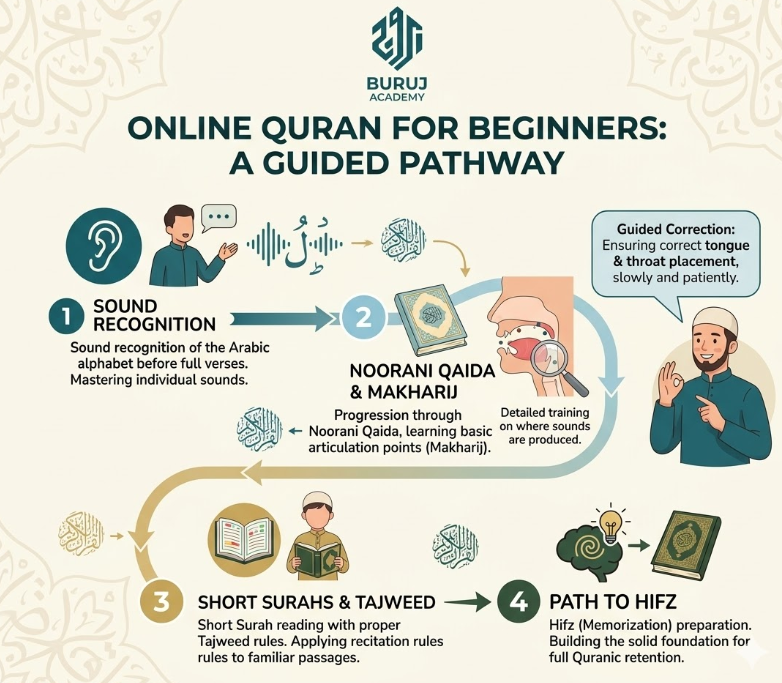
For those working toward reading ability, Buruj Academy’s Quran course for beginners builds Arabic reading from zero using the Buruj Method — Sound-before-rules, Patience-before-performance — so that students move from listener to reader in a structured, proven path.
Begin Learning Quran With a FREE Trial Lesson
What Conditions Make Quran Listening Rewarding?
Not all listening earns equal reward. Scholars identify specific conditions that determine the spiritual value of the act.
| Condition | Description |
| Sincere Intention (Niyyah) | Listening specifically to seek reward from Allah ﷻ, not merely for enjoyment |
| Attentiveness (Husn al-Istima’) | Directing the ears and quieting mental distraction |
| Presence of Heart (Hudur al-Qalb) | Engaging emotionally and intellectually with what is heard |
| Silence (Insat) | Ceasing speech and other activities that interrupt focus |
| Following along mentally | Reflecting on the meaning, even without full understanding of Arabic |
When these conditions are met, the listener fulfills the Quranic command in Surah Al-A’raf and earns the reward described in the hadith of Imam Ahmad. When these conditions are absent — particularly intention and attentiveness — the spiritual benefit diminishes significantly.
To develop the ability to understand what you are listening to, Buruj Academy’s Quranic Arabic classes teach classical Arabic grammar and vocabulary specifically oriented toward Quran comprehension, guided by Al-Azhar University graduates with deep expertise in Quranic linguistics.
Read also: How to Learn to Read the Quran?
Start Your Quran Journey with Buruj Academy’s Expert Instructors
Whether your engagement with the Quran is through reading, listening, or both, the goal is the same: to strengthen your connection with the words of Allah ﷻ and earn His mercy. Both paths are open, both are rewarded, and both benefit from expert guidance.
At Buruj Academy, our Al-Azhar University graduates and Ijazah-certified instructors bring 12+ years of experience teaching non-Arabic speakers across the globe. We offer:
- Personalized 1-on-1 online sessions with flexible 24/7 scheduling
- The Buruj Method: Sound-before-rules, Patience-before-performance
- Courses from complete beginner reading to advanced recitation and memorization
- Real-time feedback and individualized correction in every session
Book your free trial lesson today and take the first step toward reading, reciting, and understanding the Quran with confidence, Insha’Allah.
Take the next step in your learning journey today by enrolling in one of our specialized programs:
- Online Quran Classes
- Online Quran Classes for Beginners
- Online Quran Classes for Adults
- Online Quran Classes for Ladies
- Online Quran Classes for Kids
- Quran Reading Course
- Quran Recitation Course
- Online Ijazah Course
- Online Qirat Course
Don’t wait to transform your relationship with the Holy Quran. Join our global community of students and book your free evaluation session now!
Excel in Your Quranic Studies
Join Buruj Academy and master the Quran with our structured, professional curriculum.
Book Your Free TrialConclusion
Reading and listening to the Quran are both acts of worship — distinct in form, complementary in practice, and immense in reward. Reading earns ten good deeds per letter at minimum, while attentive listening earns multiplied reward and, according to Ibn Baz and others, may equal the reader’s reward when accompanied by sincere intention.
The wisest approach is not to choose between them, but to build both into your daily life. Read when you can, listen when you must, and pursue the ability to understand what you hear.
The Quran was revealed to be recited, reflected upon, and lived — and every sincere moment you spend with it brings you closer to the mercy of Allah ﷻ.
Frequently Asked Questions About Listening to Quran
Does Listening to Quran While Sleeping Count as Worship?
Listening to Quran while sleeping does not earn the reward of active listening, because the conditions of attentiveness and presence of heart cannot be met during sleep. However, falling asleep while recitation plays is not disrespectful. Reward requires conscious, intentional engagement with the recitation during wakefulness.
Is It Permissible to Play Quran in the Background While Working?
Scholars advise against using Quran as background noise during tasks that prevent proper attention. The Quranic command is to listen and be silent. If you are in a task that allows you to listen attentively, it is permitted and rewarded. If the Quran is simply playing without your attention, it is better to pause it out of respect.
Does Listening to Quran on YouTube or Spotify Count?
Yes. Scholars confirm that the medium of listening does not affect the ruling or reward. Listening through a phone, tablet, YouTube, radio, or any other device counts as valid Quran listening, provided the listener engages with proper attentiveness and intention. The source of the sound does not diminish the act of worship.
Can Listening to Quran Help Me Learn to Read It Faster?
Listening to skilled reciters significantly accelerates reading development. At Buruj Academy, we observe that students who listen regularly to their lesson material between sessions develop stronger pronunciation instincts and faster letter-recognition than those who only practice during sessions. Listening trains the ear, and the ear trains the tongue.
Is There a Recommended Daily Amount of Quran to Listen To?
Classical scholars recommended that every Muslim maintain a daily wird — a consistent personal portion — with the Quran, whether through reading or listening. There is no fixed minimum, but consistency matters more than quantity. Even five to ten minutes of attentive daily listening, maintained over months, produces meaningful spiritual and comprehension benefit. For a structured reading approach, see our guide on how to memorize Quran faster.