 Quran
Quran

| Key Takeaways |
| Arabic letters have 28 distinct shapes that change form depending on their position within a word. |
| The Noorani Qaida system teaches Arabic phonetics in a structured sequence before introducing full Quranic text. |
| Short vowel marks (Harakat) — Fatha, Kasra, and Damma — determine how every Arabic letter is pronounced. |
| Consistent 15–20 minute daily sessions outperform longer, irregular study in building Arabic reading fluency. |
| A qualified teacher corrects mispronunciation at the foundational stage, preventing errors from becoming permanent habits. |
Many non-Arabic speaking Muslims spend years wanting to read the Quran in Arabic but feel intimidated by the script, the sounds, and the rules. That feeling of distance from Allah’s words is real — and it deserves a real, structured answer.
Reading the Quran in Arabic starts with mastering 28 letters, learning how short vowels shape pronunciation, and building reading fluency through a structured phonetic system before approaching full Quranic text.
With the right method and consistent practice, most beginners read basic Quranic Arabic within three to four months.
Table of Contents:
1. Learn the Arabic Alphabet Before Trying to Read the Quran
To read the Quran in Arabic, your first task is mastering the 28 Arabic letters and their correct pronunciation. This is non-negotiable — skipping the alphabet and jumping directly into Quranic text creates pronunciation habits that take years to correct.
Each Arabic letter has a specific point of articulation (makhraj) — a precise location in the mouth, throat, or lips where the sound originates.
The letters ع (Ayn) and غ (Ghayn), for example, are produced deep in the throat, while ب (Ba) is a bilabial sound formed at the lips. These distinctions matter greatly in Quranic recitation.
How Arabic Letters Change Shape in a Word
Arabic is a connected script, meaning most letters change form depending on whether they appear at the beginning, middle, or end of a word — or in isolation.
| Letter | Isolated | Initial | Medial | Final |
| Ba (ب) | ب | بـ | ـبـ | ـب |
| Ayn (ع) | ع | عـ | ـعـ | ـع |
| Meem (م) | م | مـ | ـمـ | ـم |
| Ha (ه) | ه | هـ | ـهـ | ـه |
Understanding these four positional forms is essential before you can recognize letters inside Quranic words.
We spend the first two weeks of our Quran Reading Course on this single skill alone — because letter recognition at speed is what makes fluent reading possible.
Read Arabic fluently with a free Buruj trial
2. Start with the Noorani Qaida, Not the Quran Directly
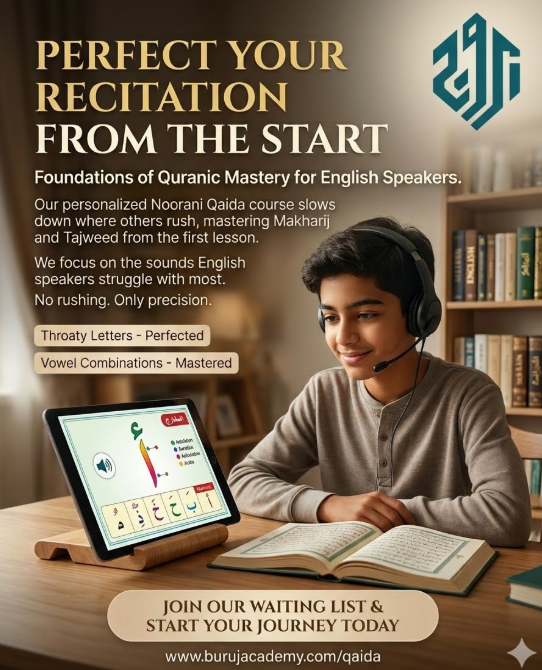
The Noorani Qaida is a structured phonetic primer developed specifically to teach Arabic reading to non-native speakers. It introduces letters, vowel marks, and connected letter groups in a carefully sequenced progression — building the reading skill systematically before you encounter Quranic verses.
This approach is grounded in sound pedagogy: you learn the components of the language before applying them to sacred text.
In our experience at Buruj Academy, students who begin with the Noorani Qaida read their first Quranic words with far greater accuracy than those who attempt to memorize Quranic verses before mastering letter-sound correspondences.
Buruj Academy’s Noorani Qaida Online Course guides beginners through this exact sequence, with Al-Azhar-trained instructors correcting phonetic errors in real time during 1-on-1 sessions. If you are starting from zero, this is where your Quran reading begins.
Book your FREE trial lesson in the Noorani Qaida course
3. Master the Harakat (Short Vowel Marks) That Give Every Letter Its Sound
Arabic letters are consonants. What makes them pronounceable in the Quran is the system of Harakat — diacritical marks written above or below each letter that indicate the vowel sound attached to it.
There are three primary short vowel marks every beginner must learn:
| Harakat | Arabic Symbol | Sound | Example |
| Fatha | َ | Short “a” sound | بَ = “ba” |
| Kasra | ِ | Short “i” sound | بِ = “bi” |
| Damma | ُ | Short “u” sound | بُ = “bu” |
| Sukoon | ْ | No vowel — letter stops | بْ = “b” |
| Shadda | ّ | Letter is doubled | بّ = “bb” |
Beyond these, the Tanwin marks add a nasal “n” sound to the end of a vowel — Fathatayn ( ً ), Kasratayn ( ٍ ), and Dammatayn ( ٌ ). Understanding Harakat turns the Arabic script from a foreign visual puzzle into a fully readable phonetic system.
4. Learn How to Pronounce Arabic Sounds That Do Not Exist in English
Several Arabic letters have no English equivalent. Attempting to substitute English sounds for these letters is one of the most common errors we correct among new students — and it directly affects the meaning and validity of Quranic recitation.
The following letters require deliberate phonetic training:
- ع (Ayn): A voiced pharyngeal fricative produced by constricting the throat — has no English counterpart
- غ (Ghayn): A voiced velar fricative, similar to a French “r” but deeper
- خ (Kha): A voiceless velar fricative, like the “ch” in the German word “Bach”
- ح (Ha): A voiceless pharyngeal fricative — a breathy, throat-based “h” distinct from the English “h”
- ق (Qaf): Produced at the very back of the mouth (uvula) — heavier than English “k”
We recommend listening to a qualified reciter pronounce each letter in isolation before attempting to repeat it.
The ears must train before the mouth can follow. Our guide on makharij al-huruf covers every articulation point in detail for those who want to go deeper.
Discover the Buruj Academy Difference
Step into our virtual classrooms and see how our expert instructors make learning Quran and Arabic intuitive and clear. We focus on overcoming the specific hurdles non-native speakers face, building your confidence and connection with the Quran.
5. Practice Reading Connected Letters Before Full Words
Once you know isolated letters and their vowel combinations, the next step is reading connected letter groups — strings of two, three, and four letters joined together into syllabic units.
This is how the Noorani Qaida progresses, and it mirrors how children learn to read in any language: sounds → syllables → words → sentences.
A practical daily practice sequence at this stage looks like this:
- Read 5–10 two-letter combinations aloud (e.g., بَسَ، كَتَ، مَلَ)
- Move to three-letter combinations with mixed vowels
- Introduce Sukoon (vowel-less letters) into the combinations
- Practice until each combination reads automatically without hesitation
Speed should never be the goal at this stage. Accuracy and automaticity are the targets. When a student can read a new combination correctly without pausing to decode each letter, they are ready to advance.
Read also: How to Learn Quranic Arabic?
6. Begin Tajweed Basics — Even at the Beginner Stage
Tajweed is the science of Quranic recitation rules — governing how each letter is pronounced, how long vowels are held, and how adjacent letters interact. Many beginners believe Tajweed is advanced. In reality, foundational Tajweed rules apply from the very first word of the Quran.
The three rules every beginner must know before reading the Quran aloud:
A. Ghunnah (Nasal Sound)
When Noon or Meem carry a Shadda ( نّ / مّ ), a nasal resonance held for two counts is obligatory. This is not optional decoration — it is part of correct recitation. Our detailed guide on Ghunnah explains this rule fully.
B. Madd Asli (Natural Prolongation)
Alif after Fatha, Waw after Damma, and Ya after Kasra each extend the vowel for two counts naturally. This occurs in virtually every line of the Quran. See our article on Madd Asli for examples drawn directly from Quranic text.
Excel in Your Quranic Studies
Join Buruj Academy and master the Quran with our structured, professional curriculum.
Book Your Free TrialC. Qalqalah (Echo Sound)
The five letters ق ط ب ج د produce a slight echo bounce when they carry Sukoon. This is an obligatory characteristic — reading these letters flat changes the sound of the recitation. Our Qalqalah letters guide explains how to produce this sound correctly.
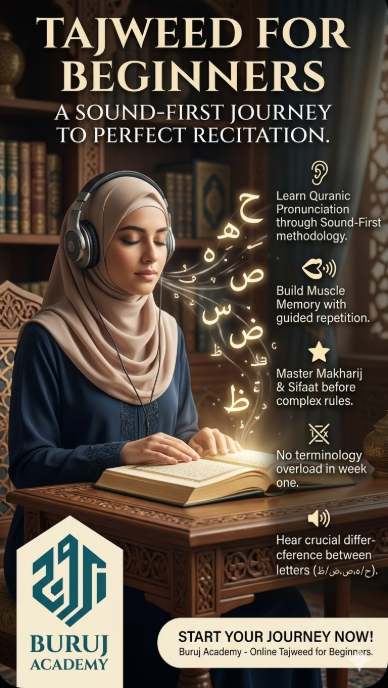
Buruj Academy’s Tajweed for Beginners course introduces these foundational rules systematically, with Ijazah-certified instructors providing real-time correction during every session.
Book Your FREE Trial Lesson to Begin Your Tajweed Journey
7. Understand the Rules of Stopping and Continuing (Waqf and Ibtida)
Waqf means stopping during recitation; Ibtida means resuming after a stop. In the Quran, specific symbols are printed above the text to guide the reciter on when stopping is preferred, permitted, or prohibited.
Reading without awareness of Waqf rules often results in inadvertent changes to meaning.
Signs in Quran Reading: A Summary Reference
| Symbol | Arabic Term | Meaning | Stop Allowed? | Continue Allowed? |
| مـ | Waqf Lazim | Obligatory stop | Obligatory | Prohibited |
| لا | Waqf Mamnu’ | Prohibited stop | Prohibited | Obligatory |
| صلي | Al-Wasl Awla | Continue preferred | Permissible | Preferred |
| قلي | Al-Waqf Awla | Stop preferred | Preferred | Permissible |
| ج | Waqf Ja’iz | Free choice | Permissible | Permissible |
| ۛ ۛ | Waqf Mu’anaqah | Stop at one of two | At one only | Required past the other |
For students building their Tajweed foundation, our detailed guide on Tajweed for beginners covers the phonetic rules that complement these Waqf symbols.
These symbols are printed directly in the Uthmani-script Mushaf, which is the standard Quran used by non-Arabic speakers worldwide.
Learning to read these symbols alongside the letters is part of reading the Quran in Arabic correctly.
Example of Waqf Lazim in the Quran
A well-known example occurs in Surah Al-An’am (6:36):
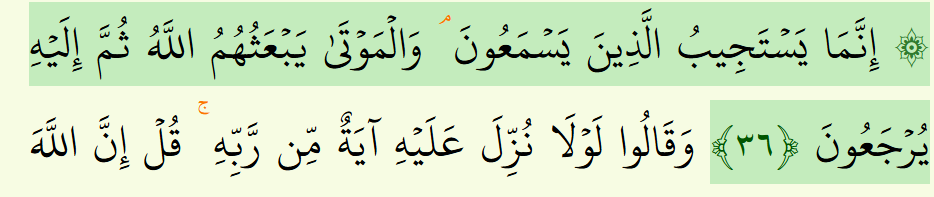
Innamā yastajību alladhīna yasmaʿūna — wal-mawtā yabʿathuhumu Allāh
“Only those who hear will respond. But the dead – Allah will resurrect them” (Al-An’am 6:36)
Without the mandatory stop, a reader might continue and unintentionally connect “those who hear” with “the dead” — implying the dead respond, which reverses the verse’s meaning entirely. The (مـ) prevents this misreading.
For a thorough introduction to recitation rules, our guide to reading the Quran for the first time walks through this in accessible detail.
8. Listen to a Qualified Reciter Daily and Imitate What You Hear
The Quran was revealed as an oral tradition and was transmitted orally from teacher to student across fourteen centuries. Reading the rules from a book without hearing correct recitation is like learning to play the piano from a text description of music.
We recommend listening to Sheikh Mahmoud Khalil Al-Husary‘s recitation of the Hafs ‘an ‘Asim narration — his style is clear, measured, and pedagogically excellent for learners. His recitation is available for free at tanzil.net, which also displays the Arabic text simultaneously.
Daily listening practice should be active, not passive. Select a short Surah — begin with Surah Al-Fatiha — and:
- Listen to the complete recitation once without attempting to read
- Listen again while following the Arabic text
- Repeat each verse aloud immediately after the reciter
- Record yourself and compare your recitation to the original
This imitation method accelerates pronunciation accuracy faster than any rule memorization alone.

9. Begin Reading Short Surahs with a Teacher Correcting You in Real Time
When you can read connected Arabic text with Harakat fluently, it is time to begin the Quran itself — starting with Juz 30, the final section of the Quran, which contains the shortest Surahs. These Surahs are brief, phonetically manageable, and recited frequently in daily prayer, giving you immediate practical reward for your effort.
Begin with:
- Surah Al-Fatiha (7 verses) — recited in every unit of prayer
- Surah Al-Ikhlas (4 verses) — the clearest declaration of Tawhid
- Surah Al-Falaq (5 verses) — protection from external harm
- Surah An-Nas (6 verses) — protection from internal whispers
Reading with a teacher at this stage is not optional. A qualified instructor hears errors you cannot hear yourself — particularly makhraj mistakes, incorrect Madd lengths, and missed Ghunnah. Self-study at this stage allows errors to calcify into permanent habits.
Our Quran Reading Course pairs students with Al-Azhar-trained instructors who provide immediate, verse-by-verse correction with patience and expertise built from 12+ years of teaching non-Arabic speakers.
Read Arabic fluently with a free Buruj trial
10. Build a Daily Reading Habit That Fits Your Real Life
Consistent daily practice, even in small amounts, produces faster and more durable results than long, irregular sessions.
The brain consolidates phonetic skills during rest — which means practicing for 20 minutes every day is neurologically superior to a two-hour session once a week.
A practical daily schedule for a beginner:
| Time | Activity | Duration |
| Morning | Review yesterday’s letters or verses | 5 minutes |
| Afternoon | Learn new material with teacher or course | 15 minutes |
| Evening | Listen to a reciter reading today’s portion | 10 minutes |
| Before sleep | Repeat new verses aloud from memory | 5 minutes |
This 35-minute daily structure is achievable for working adults and parents. For a deeper look at how to build a sustainable Quran learning schedule, our Quran memorization schedule guide — while focused on Hifz — contains scheduling principles directly applicable to reading practice.
Read also: Basic Quranic Arabic Grammar
Start Reading the Quran in Arabic with Buruj Academy’s Expert Instructors
Reading the Quran in Arabic correctly requires structured guidance, accurate phonetic training, and consistent expert feedback — all available through Buruj Academy.
Buruj Academy’s Quran Reading Course provides:
- Al-Azhar University graduates and Ijazah-certified instructors with 12+ years of experience
- The Buruj Method: Sound-before-rules, ensuring correct pronunciation before Tajweed rules are introduced
- Personalized 1-on-1 online sessions with flexible 24/7 scheduling
- Real-time pronunciation correction from the very first lesson
- A structured progression from alphabet to fluent Quranic reading
Book your free trial lesson today and read your first Quranic verses with a qualified teacher by your side.
Take the next step in your learning journey today by enrolling in one of our specialized programs:
- Online Quran Classes
- Online Quran Classes for Beginners
- Online Quran Classes for Adults
- Online Quran Classes for Ladies
- Online Quran Classes for Kids
- Quran Reading Course
- Quran Recitation Course
- Online Ijazah Course
- Online Qirat Course
Don’t wait to transform your relationship with the Holy Quran. Join our global community of students and book your free evaluation session now!
Excel in Your Quranic Studies
Join Buruj Academy and master the Quran with our structured, professional curriculum.
Book Your Free TrialConclusion
Reading the Quran in Arabic is not a matter of talent — it is a matter of method. The steps above reflect what structured, phonetics-first Quranic education has proven effective for non-Arabic speakers across decades of real teaching experience.
Begin with the alphabet, build through the Noorani Qaida, layer in foundational Tajweed rules, and read with a qualified teacher from the earliest possible stage.
Insha’Allah, the effort you invest in reading Allah’s words correctly is itself an act of worship — and every letter carries its own reward. The path is clear; the commitment is yours to make.
Frequently Asked Questions About How to Read the Quran in Arabic
How Long Does It Take a Complete Beginner to Read the Quran in Arabic?
Most non-Arabic speaking adults who study consistently — 20 minutes daily with a qualified teacher — can read basic Quranic Arabic within three to four months. Reaching fluent, Tajweed-accurate recitation typically requires six to twelve months of structured study, depending on consistency, natural aptitude, and the quality of instruction received.
Can I Learn to Read the Quran in Arabic Without Knowing the Arabic Language?
Yes. Reading the Quran in Arabic is a phonetic skill — you are learning to decode and pronounce a script, not to understand the language grammatically. Millions of non-Arabic speakers recite the Quran beautifully without speaking Arabic conversationally. Quranic comprehension is a separate, deeper study that can be pursued later through Quranic Arabic classes.
Is the Noorani Qaida Necessary, or Can I Start Directly from the Quran?
The Noorani Qaida is strongly recommended for all beginners. Starting directly from the Quran without phonetic foundations leads to mispronunciation errors that become extremely difficult to correct later. The Qaida builds the sound-recognition and decoding skills that make Quranic reading accurate and sustainable from the beginning.
What Is the Easiest Surah to Start Reading in Arabic?
Surah Al-Ikhlas (112:1–4) is widely considered the most accessible starting point — it contains four short verses, uses common letter patterns, and is among the most frequently recited Surahs in daily prayer. Surah Al-Fatiha is equally important to learn early, as it is recited in every unit of Salah.
Do I Need a Teacher to Learn to Read the Quran in Arabic, or Can I Self-Study?
A teacher is not technically required to begin — but it is strongly recommended. Self-study through apps or videos cannot provide real-time correction for makhraj errors and Tajweed mistakes. A qualified instructor catches and corrects errors before they become habits. For non-Arabic speakers especially, the investment in structured instruction dramatically reduces the total time needed to reach accurate recitation.