 Tajweed

| Key Takeaways |
| Tafkheem (heaviness) applies permanently to 7 letters known as Huroof al-Isti’laa: خ ص ض غ ط ق ظ, with no exceptions. |
| The 5 ranks of Tafkheem depend on a letter’s vowel — open with Alif receives the highest rank; kasrah receives the lowest. |
| Raa is pronounced heavily when maftuhah, madmumah, or saakinah after fathah or dhammah, and lightly when maksoorah or after original kasrah. |
| Laam is always light except in the word “Allah” (and “Allahumma”) preceded by a fathah or dhammah. |
| Alif al-Madd carries no independent ruling — it follows the heaviness or lightness of the letter immediately before it. |
Every student of Quranic recitation eventually faces a moment of honest confusion: why does the same Arabic letter sound fuller and deeper in one word, yet thinner and lighter in another? That shift is not random — it is one of Tajweed’s most precisely governed categories.
Heavy and light letters in Tajweed — known as Tafkheem (تفخيم) and Tarqeeq (ترقيق) — determine whether a letter is pronounced with weight and resonance or with a thin, refined sound. Mastering this distinction is what separates technically correct recitation from genuinely beautiful recitation.
What Do Tafkheem and Tarqeeq Mean in Tajweed?
Tafkheem literally means “fattening” or “thickening.” In Tajweed terminology, it refers to pronouncing a letter with fullness at its articulation point — the sound emerges heavy, rounded, and strong. Its synonym in classical scholarship is Taghleedh (تغليظ), though scholars typically use Taghleedh specifically when discussing the Laam of the word “Allah.”
Tarqeeq is the direct opposite — it means “thinning.” A letter pronounced with Tarqeeq is light, narrow, and refined at its articulation point. The sound does not carry the same resonance or roundedness as a heavy letter.
Understanding both is non-negotiable for any student serious about learning Tajweed. Without this distinction, heavy letters collapse into light ones, distorting the very phonetic architecture of Quranic Arabic.
Read also: Tanween in Arabic: Meaning, Types, Signs, and Tajweed Rules Explained
What Are the 7 Heavy Letters in Arabic Tajweed (Huroof al-Isti’laa)?
The seven heavy letters in Tajweed — called Huroof al-Isti’laa (حروف الاستعلاء), meaning “letters of elevation” — are permanently pronounced with Tafkheem. Classical scholars memorized them through the mnemonic phrase of Ibn al-Jazari: خُصَّ ضَغْطٍ قِظْ.
Those seven letters are:
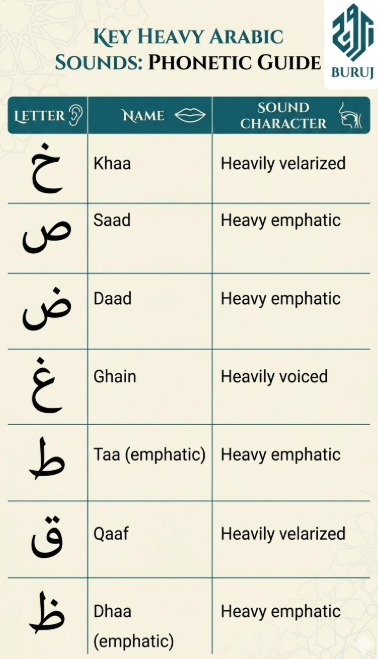
These letters are always heavy — no condition changes that ruling. Whether they carry a fathah, dhammah, kasrah, or sukoon, they never become light. This is what makes them the simplest category to learn: they are unconditional.
At Buruj Academy, our Online Tajweed Classes begin Tafkheem and Tarqeeq training by drilling these seven letters in isolation before students ever encounter the conditional rules of Raa and Laam. This sequence — sound before rule — is foundational to the Buruj Method.
Book Your FREE Trial Lesson to Begin Your Tajweed Journey

What Are the 5 Ranks of Tafkheem and How Do They Work?
Not all heavy letters carry the same degree of heaviness. Classical Tajweed scholarship establishes five ranked levels of Tafkheem, ordered from strongest to lightest:
| Rank | Condition | Example |
| 1st (Highest) | Letter is open (fathah) followed by Alif al-Madd | الطَّامَّة، الضَّالِّين |
| 2nd | Letter carries fathah, no following Alif | طَبَعَ، ضَرَبَ، قَتَلَ |
| 3rd | Letter carries dhammah (with or without following Waaw) | قُلْ، طُوبَى، ضُرِبَ |
| 4th | Letter is saakin (carries sukoon) | أَطْوَارًا، اضْرِبْ، وَاصْبِرْ |
| 5th (Lowest) | Letter carries kasrah | يَطَعْ، ضِيَاء، قِيلَ |
This ranking matters in live recitation. When a student reaches a word like الطَّامَّة in Surah Al-Qaariah, the Taa should carry the fullest possible heaviness — deeper than when it appears with a kasrah as in طِفْلًا.
The difference is subtle but audible, and it is precisely what our Ijazah-certified instructors train students to feel rather than simply memorize.
Book a FREE trial session with one of Buruj’s Azhari Quran tutors

How to Pronounce Heavy Letters in Tajweed Correctly
Pronouncing heavy letters correctly requires understanding what physically changes in the mouth. When articulating a Tafkheem letter, the back of the tongue rises toward the roof of the mouth (the soft palate), producing a fuller, more resonant sound. The lips naturally round slightly, and the voice carries more weight.
A common mistake we observe in students at Buruj Academy — especially those with English as their native language — is applying Tafkheem only to the letter itself while immediately softening the vowel that follows it. The heaviness must carry through the entire syllable, including the vowel sound after the letter.
Tafkheem in Connected Recitation
In continuous recitation, the heaviness of an Isti’laa letter also affects the Alif al-Madd that follows it. So in الضَّالِّينَ, the Alif between Daad and Laam is pronounced heavily — not because Alif is heavy, but because it follows a heavy letter. We address this under Alif al-Madd rulings in detail below.
Excel in Your Quranic Studies
Join Buruj Academy and master the Quran with our structured, professional curriculum.
Book Your Free TrialHow Many Light Letters Are in Arabic Tajweed?
All Arabic letters that are not among the seven Huroof al-Isti’laa are — by default — light letters. That means 22 letters carry permanent Tarqeeq, with three notable exceptions that can shift between heavy and light: Raa (ر), Laam (ل), and Alif al-Madd (ا).
The 22 permanently light letters include familiar letters like Baa, Taa, Jiim, Haa, Daal, Raa (in certain conditions), Zain, Seen, Sheen, Ain, Faa, Kaaf, Laam (in most cases), Miim, Noon, Haa, Waaw, and Yaa.
For students building their foundational Tajweed understanding, our guide to Tajweed for beginners covers these letter categories in accessible detail alongside the core rules of recitation.
Read also: Shaddah in Arabic and Tajweed: Meaning, Rules, and Quranic Examples
What Are the Tafkheem and Tarqeeq Rules for the Letter Raa?
Raa is the most condition-dependent letter in all of Tafkheem and Tarqeeq. It carries three possible states: always heavy, always light, or permissible either way. This is why we dedicate significant classroom time to Raa before moving to Laam.
When Is Raa Pronounced with Tafkheem?
Raa is pronounced heavily in seven conditions:
1. Raa carries a dhammah: نَصْرُ اللَّهِ — An-Nasr 110:1
2. Raa carries a fathah: رَابِيَةً — Al-Haqqah 69:10
3. Raa is saakin after a fathah: بَرْدًا وَسَلَامًا — Al-Anbiya 21:69
4. Raa is saakin after a dhammah: زُرْتُمُ الْمَقَابِرَ — At-Takathur 102:2
5. Raa is saakin after another saakin letter preceded by fathah or dhammah: لَيْلَةُ الْقَدْرِ — Al-Qadr 97:2 — the Raa here is preceded by saakin Daal, which is itself preceded by fathah on Qaaf, so Raa is heavy.
6. Raa is saakin after an incidental kasrah (kasrah aarid): This occurs when a kasrah is introduced to break two consecutive saakin letters, as in لِمَنِ ارْتَضَى — Al-Anbiya 21:28. The kasrah before Raa is incidental, not original, so Raa remains heavy.
7. Raa is saakin after an original kasrah, but followed by a connected Isti’laa letter that is not maksoor: As in قِرْطَاس and مِرْصَاد — the kasrah before Raa is original, but the Isti’laa letter (Taa and Saad respectively) follows directly in the same word and carries no kasrah of its own, overriding the lightening effect.
When Is Raa Pronounced with Tarqeeq?
Raa is pronounced lightly in five conditions:
1. Raa carries a kasrah: رِزْقًا لِّلْعِبَادِ — Qaaf 50:11
2. Raa is saakin after an original kasrah within the same word, with no following connected Isti’laa letter: As in فِرْعَوْن and الْفِرْدَوْس — the kasrah before Raa is original, and no Isti’laa letter interrupts.
3. Raa is saakin at the end of a word, after another saakin letter preceded by a kasrah (in waqf only): As in الذِّكْر and السِّحْر — the Raa here stops on a saakin Raa, after saakin Kaaf or Haa, with the preceding vowel being a kasrah on the Dhal or Seen.
4. Raa is saakin in pause position after a saakin Yaa: As in قَدِير and نَذِير in waqf — the Yaa before Raa is naturally a letter of softness (Leen), reinforcing the lightening of Raa.
5. Raa is saakin after an original kasrah, but the following Isti’laa letter is in a separate word: As in أَنْ أَنذِرْ قَوْمَكَ — Nuh 71:1 — the Qaaf is in a different word, so it does not override the lightening effect of the original kasrah before Raa.
When Are Both Tafkheem and Tarqeeq Permitted for Raa?
Two specific cases permit either ruling:
Case 1: Raa is saakin after an original kasrah, followed by a connected Isti’laa letter that itself carries a kasrah. The only word where this applies in the standard recitation of Hafs is فِرْقٍ in Surah Ash-Shu’araa [26:63]. Those who consider the kasrah of the Isti’laa letter a softening factor choose Tarqeeq; those who consider the Isti’laa letter a strengthening barrier choose Tafkheem.
Case 2: Pausing on certain words ending in saakin Raa, where a saakin Isti’laa letter (specifically Daad or Taa al-musta’liyah) separates the Raa from a preceding kasrah — such as مِصْر and الْقِطْر. The preferred position in this case is Tafkheem for مِصْر and Tarqeeq for الْقِطْر, in light of the connected form and original ruling.
Excel in Your Quranic Studies
Join Buruj Academy and master the Quran with our structured, professional curriculum.
Book Your Free TrialWhat Are the Tafkheem and Tarqeeq Rules for the Letter Laam?
Laam follows a far simpler system than Raa. The governing principle is this: Laam is always light except in the word “Allah” (الله) and “Allahumma” (اللهم) when preceded by a fathah or dhammah.
When Is the Laam of “Allah” Pronounced Heavily?
The Laam of the word الله (and اللهم) is pronounced with Tafkheem — called Taghleedh in this context — when the word is preceded by:
- A fathah: as in وَعَلَى اللَّهِ — Aal Imran 3:122
- A dhammah: as in نَصْرُ اللَّهِ — An-Nasr 110:1
When Is the Laam of “Allah” Pronounced Lightly?
The Laam of الله is light when preceded by a kasrah — whether that kasrah is:
- Original: as in بِاللَّهِ
- Incidental (aarid): as in قُلْ هُوَ اللَّهُ أَحَدٌ اللَّهُ الصَّمَدُ — Al-Ikhlas 112:1-2 — the second “Allah” here carries light Laam in Wasl because the preceding word “Ahadun” ends with tanwin that generates an incidental kasrah to break the sukoon.
Similarly, قُلِ اللَّهُمَّ carries a light Laam in “Allahumma” because the Laam of قُلْ receives an incidental kasrah before it.
Is Laam Ever Heavy Outside the Word “Allah”?
No. Every other Laam in the Quran — regardless of what follows it — is pronounced lightly. This includes cases where a Laam is immediately followed by a heavy letter, such as وَلْيَتَلَطَّفْ — Al-Kahf 18:19 — where the Laam must remain firmly light despite the Tafkheem of the Taa that follows.
This is a point our instructors address directly with students, because the ear naturally wants to “absorb” the heaviness of a neighboring letter. Maintaining light Laam before heavy letters requires deliberate practice. If you are building this skill systematically, our Tajweed Course for Beginners dedicates focused drilling sessions to exactly this challenge.
Book Your FREE Trial Lesson to Begin Your Tajweed Journey

How Does Alif al-Madd Follow Tafkheem and Tarqeeq?
Alif al-Madd (the long Alif vowel ا) carries no independent ruling in Tafkheem or Tarqeeq. It is fully governed by the letter that precedes it.
| Preceding Letter | Effect on Following Alif |
| Light letter (Tarqeeq) | Alif is pronounced lightly — as in تِجَارَة, الأَنْهَار |
| Heavy letter (Tafkheem) | Alif is pronounced heavily — as in الطَّامَّة, الضَّالِّين, الظَّالِمِين |
This principle explains why students who correctly heavy-ize the Saad in الضَّالِّين must carry that heaviness into the Alif that follows — the Alif cannot be neutralized independently.
The same principle extends to the Ghunnah (nasal resonance) when it occurs before a heavy letter. If the nasal resonance of a Noon or Miim is followed by an Isti’laa letter, the Ghunnah itself takes on a heavier color. For a full treatment of Ghunnah’s interaction with surrounding letters, see our complete guide to Ghunnah rules.
Discover the Buruj Academy Difference
Step into our virtual classrooms and see how our expert instructors make learning Quran and Arabic intuitive and clear. We focus on overcoming the specific hurdles non-native speakers face, building your confidence and connection with the Quran.
How Tafkheem and Tarqeeq Connect to Other Tajweed Rules
Tafkheem and Tarqeeq do not exist in isolation — they interact with several other Tajweed rules students learn alongside them.
Qalqalah letters (ق ط ب ج د) include two Isti’laa letters (Qaaf and Taa al-musta’liyah). When these letters produce their characteristic echo sound in Qalqalah, that echo must carry the heaviness of Tafkheem — it cannot be thin. Students who have studied our detailed guide to Qalqalah letters will recognize how the two rules layer together.
Similarly, Idgham scenarios involving heavy letters require students to maintain the Tafkheem of the assimilated letter even as it merges into what follows. Our resource on Idgham rules in Tajweed addresses the specific cases where this interaction matters most.
For students beginning their full Tajweed journey, our essential Tajweed rules guide places Tafkheem and Tarqeeq within the broader map of what needs to be learned and in what sequence.
Excel in Your Quranic Studies
Join Buruj Academy and master the Quran with our structured, professional curriculum.
Book Your Free TrialMaster Quranic Recitation with Buruj Academy’s Expert Tajweed Instructors
Tafkheem and Tarqeeq represent one of the most nuanced areas of Tajweed — and one of the most rewarding to master. Correct heaviness and lightness bring the Quran’s phonetic beauty to life in every recitation.
Buruj Academy’s Online Tajweed Classes are led by Al-Azhar University graduates and Ijazah-certified instructors with 12+ years of experience teaching non-Arabic speakers. Through the Buruj Method — sound before rules, consistency before speed — students move from mechanical rule memorization to confident live application.
Our personalized 1-on-1 online sessions offer flexible 24/7 scheduling and real-time pronunciation correction. Whether you are starting from scratch with our Tajweed Course for Beginners or refining advanced recitation, we build a customized learning plan for your level and goals.
Join a supportive learning environment tailored to your pace and lifestyle. Start your journey toward excellence by enrolling in one of our specialized tracks:
- Online Tajweed Classes
- Tajweed Classes for Beginners
- Tajweed Classes for Adults
- Tajweed Classes for Sisters
- Tajweed Classes for Kids
- Advanced Tajweed Course
- Amli Tajweed Course (Practical Application)
Book your free trial lesson today at Buruj Academy and recite with confidence, accuracy, and beauty — insha’Allah.
Frequently Asked Questions About Heavy and Light Letters in Tajweed
What Is the Difference Between Tafkheem and Tarqeeq in Simple Terms?
Tafkheem means pronouncing a letter with heaviness and fullness — the back of the tongue rises, and the sound becomes round and resonant. Tarqeeq means pronouncing a letter with lightness and thinness — the sound stays narrow and refined. The seven Isti’laa letters are always heavy; all other letters are light unless they are Raa or Laam under specific conditions.
How Many Heavy Letters Are There in Arabic Tajweed?
There are seven permanently heavy letters in Arabic Tajweed, known as Huroof al-Isti’laa. They are: خ ص ض غ ط ق ظ, remembered through the classical phrase خُصَّ ضَغْطٍ قِظْ. These seven are always pronounced with Tafkheem regardless of their vowel or position in a word.
Is the Letter Raa Always Heavy or Always Light in Tajweed?
Raa is neither permanently heavy nor permanently light — its ruling depends entirely on its vowel and surrounding letters. It is heavy when maftuhah, madmumah, or saakin after fathah or dhammah. It is light when maksoorahh or saakin after an original kasrah (with no following connected Isti’laa letter). A small number of cases permit both rulings.
When Is the Laam in “Allah” Pronounced with Tafkheem?
The Laam of الله is pronounced heavily (Taghleedh) only when the word is preceded by a fathah or a dhammah. When preceded by a kasrah — whether original or incidental — the Laam is light. In all other Arabic words, Laam is always light without exception, regardless of what letters surround it.
Why Does Alif al-Madd Have No Independent Tafkheem or Tarqeeq Ruling?
Alif al-Madd is a pure elongation sound with no consonantal weight of its own. Its pronunciation is entirely dependent on the letter that precedes it. If the preceding letter is heavy, the Alif elongation is heavy; if the preceding letter is light, the Alif is light. This makes Alif al-Madd the only letter in Tajweed with a fully borrowed ruling.