 Arabic

| Key Takeaways |
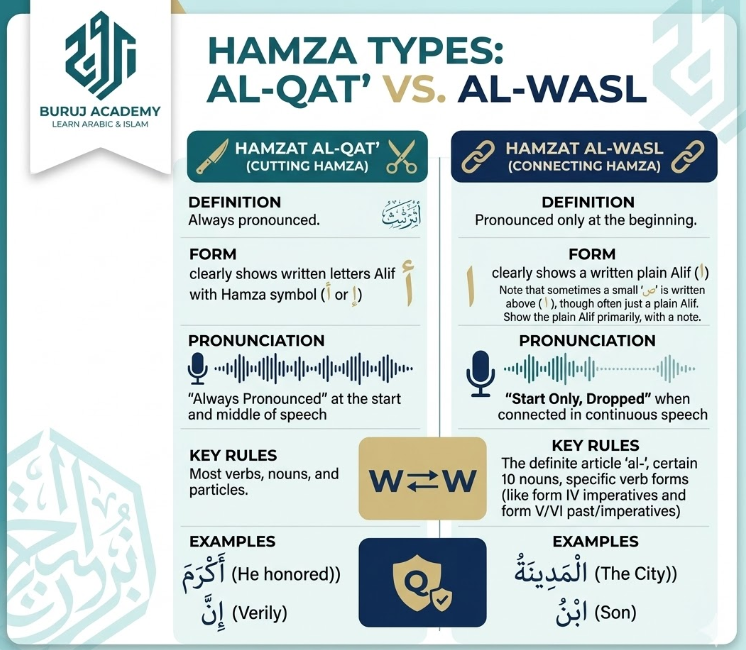
| Hamza has two types: hamzat al-qat’ (always pronounced) and hamzat al-wasl (dropped when connecting words). |
| Hamzat al-wasl appears at the beginning of definite articles, verb forms, and certain nouns, and is silent in continuous recitation. |
| Hamzat al-qat’ carries a small symbol resembling the top of the letter ʿayn (ء) and is always articulated, whether starting or continuing. |
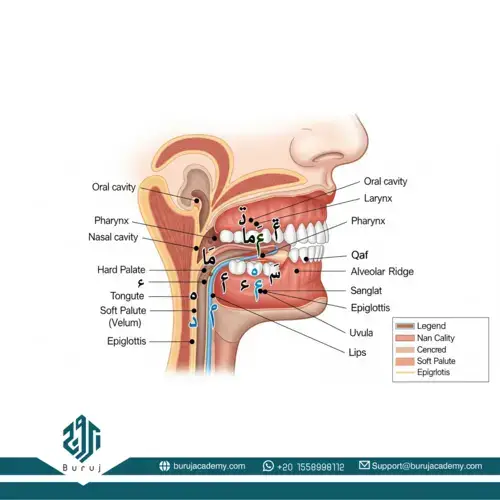
| Hamza is articulated from the deepest point of the throat (aqsa al-halq) and classified as a strong (shadid), voiced (majhur) letter. |
| Common errors include tafkhim (over-emphasis), qalqalah (echoing), and dropping hamzat al-qat’ — all of which distort Quranic meaning. |
Every student of Quranic recitation eventually reaches the same moment of confusion: two words both begin with what looks like an alif, yet one requires a firm, deliberate sound and the other disappears entirely in flowing recitation. That gap between written form and spoken reality is where hamza becomes one of the most misunderstood letters in Tajweed.
Hamza has two fundamental types in Arabic: hamzat al-qat’ (the cutting hamza), which is always pronounced clearly regardless of position, and hamzat al-wasl (the connective hamza), which is voiced only at the start of recitation and drops entirely when words are joined. Mastering this distinction is not optional — it directly affects both the accuracy and meaning of your Quranic recitation.
What Is Hamza?
Hamza is an Arabic sound articulated from aqsa al-halq — the deepest and furthest point of the throat from the mouth.
What Is Hamza in Tajweed?
Hamza is classified in classical Tajweed science as both shadid (a stop consonant) and majhur (voiced), meaning air flow is completely blocked at the articulation point and then released with full vocal cord engagement.
In our Online Tajweed Classes at Buruj Academy, students are always introduced to hamza through its physical sensation first. A correctly produced hamza creates a distinct compression and release at the base of the throat — distinct from any other Arabic letter.
Ijazah-certified instructors trained in makharij consistently observe that non-Arabic speakers tend to approximate hamza with a glottal stop familiar from their native language, which is close but not identical to the full Arabic makhraj.
Book Your FREE Trial Lesson to Begin Your Tajweed Journey

Understanding hamza’s articulation point prevents two of the most common errors we see: mispronouncing it too far forward in the throat, or confusing it with the letter ‘ayn, which shares the same general region but has a completely different production mechanism.
How Is Hamza Written in Arabic and in the Quran?
Hamza appears in several written forms depending on its position in a word and the surrounding vowels. It may appear:
| Written Form | Position | Example |
| ء (on the line) | Stand-alone or after long vowel | مساء |
| أ (above alif) | Word-initial with fatha or damma | أَكْبَر، أُمَّة |
| إ (below alif) | Word-initial with kasra | إِنَّا |
| ؤ (on waw) | Medial with damma before/on it | يُؤْمِن |
| ئ (on ya’) | Medial with kasra before/on it | بِئْرٌ |
Each written form follows specific Arabic orthographic rules. The sound, however, remains the same — always articulated from aqsa al-halq.
Master the Arabic Language
Join our expert-led courses and build a strong foundation in Classical and Modern Arabic.
Get Your Free TrialRead also: Laam Rules in Tajweed: A Complete Guide to All Five Types
What Are the Two Main Types of Hamza in Arabic?
The two types of hamza in Arabic are hamzat al-qat’ and hamzat al-wasl. Hamzat al-qat’ is an original, root-level letter that must always be pronounced, in both isolated reading and connected speech. Hamzat al-wasl is a supplementary hamza added to enable pronunciation of an otherwise vowelless initial consonant — and it vanishes in continuous recitation once the preceding word provides a vowel bridge.
This distinction matters profoundly in Tajweed because confusing the two types can cause a student to either drop a sound that must be present or force a sound that should be silent — both of which constitute recitation errors according to classical Tajweed scholarship.
1. Hamzat al-Qat’: The Hamza That Is Always Pronounced
Hamzat al-qat’ is the original hamza, present in the root structure of the word itself. It is always articulated — whether you begin recitation with that word or arrive at it mid-sentence.
Its written marker is a small symbol resembling the upper portion of the letter ʿayn (ء), written above or below the alif depending on the vowel.
Example of Hamzat al-Qat’ from the Quran:
أَعُوذُ بِاللَّهِ مِنَ الشَّيْطَانِ الرَّجِيمِ
A’ūdhu billāhi min ash-shayṭāni r-rajīm
The hamza in أَعُوذُ is hamzat al-qat’. It is pronounced clearly whether you begin recitation here or arrive at this phrase mid-reading.
Where Does Hamzat al-Qat’ Appear?
Hamzat al-qat’ appears consistently across these categories:
| Category | Example | Meaning |
| Most verb forms beginning with hamza | أَكَلَ | He ate |
| Pronouns | أَنَا، أَنْتَ | I, You |
| Connective particles | أَوْ، إِنَّ | Or, Indeed |
| Many nouns | أَرْضٌ، أُمٌّ | Earth, Mother |
| All forms of the hamza of interruption | أَلَا، أَلَمْ | Verily, Did not? |
The rule is straightforward: if the hamza belongs to the root letters (الأحرف الأصلية) of the word, it is hamzat al-qat’ — always pronounce it.
Master the Arabic Language
Join our expert-led courses and build a strong foundation in Classical and Modern Arabic.
Get Your Free Trial2. Hamzat al-Wasl: The Hamza That Disappears in Connected Recitation
Hamzat al-wasl is a supplementary hamza added to the beginning of a word that would otherwise start with a sukoon (vowelless consonant).
Arabic phonology does not permit starting a word on a sukoon, so hamzat al-wasl provides the entry point. Once a connecting vowel is available from the preceding word, it is no longer needed — and it drops entirely.
Hamzat al-wasl has no written symbol in the standard Uthmani mushaf. When it appears at the beginning of a recitation unit, it is given a vowel (fatha, kasra, or damma depending on the word type). When it follows another word in continuous recitation, it disappears and the preceding word’s final vowel connects directly to the first root letter.
Example from the Quran:
ٱقْرَأْ بِٱسْمِ رَبِّكَ
Iqra’ bismi rabbik
“Read in the name of your Lord.” (Al-‘Alaq 96:1)
The ٱ in ٱسْمِ is hamzat al-wasl. When reciting بِٱسْمِ after a preceding word, the ba’ connects directly to the sin — the hamza is silent. When starting recitation at اِسْمِ in isolation, it is pronounced with kasra.
In our Tajweed sessions at Buruj Academy, this is the rule that produces the most “aha” moments for students. Once they understand why بِسْمِ اللَّهِ is not pronounced with a hamza between the mim of بِسْمِ and the lam of اللَّهِ, connected recitation begins to flow far more naturally.
Where Does Hamzat al-Wasl Appear?
| Category | Specific Cases |
| Definite article | ال (al-) in all its forms |
| Command forms of Form I verbs | اُكْتُبْ (write!), اِذْهَبْ (go!) |
| Specific verb patterns (Forms VII–X) | اِنْطَلَقَ، اِسْتَغْفَرَ |
| Specific nouns | اِسْمٌ، اِبْنٌ، اِمْرُؤٌ، اِبْنَةٌ |
| The word اِثْنَانِ (two) | Both forms |
Scholars of Tajweed and Arabic grammar enumerate these categories in detail. The most reliable way to identify hamzat al-wasl in the Quran is through a verified mushaf with the Uthmani script, which uses the small صـ (for صِلة/wasl) marker or a specific orthographic convention for hamzat al-wasl.
Discover the Buruj Academy Difference
Step into our virtual classrooms and see how our expert instructors make learning Quran and Arabic intuitive and clear. We focus on overcoming the specific hurdles non-native speakers face, building your confidence and connection with the Quran.
What Is the Hamza Meaning in Quran Recitation?
The significance of hamza in the Quran goes beyond phonetics — it carries direct semantic weight. Misreading or dropping hamzat al-qat’ can alter the meaning of a word entirely.
For example, confusing أَنزَلَ (He revealed) with نَزَلَ (He descended) by dropping the hamza changes both the subject and the grammatical structure of a Quranic statement.
This is precisely why scholars of Tajweed classify errors involving hamza into two categories: lahn jali (clear error) — which changes meaning and is sinful in prayer — and lahn khafi (subtle error) — which is a technical imprecision. Dropping hamzat al-qat’ or mispronouncing it consistently falls into the first category when it distorts meaning.
For those beginning this study, our Tajweed for Beginners guide provides the broader framework within which hamza rules sit alongside rules of madd, noon sakinah, and meem sakinah.
Read also: Rules of Raa in Tajweed: Tafkheem, Tarqeeq, and Everything in Between
Hamza Pronunciation: Common Errors and How to Correct Them
Hamza pronunciation is one of the areas where we see the widest variation among students arriving at Buruj Academy from English-speaking backgrounds. The errors are consistent and correctable — but only with proper instruction.
Tafkhim of Hamza (Incorrect Heaviness)
Some students pronounce hamza with a heavy, “thick” quality — particularly when it appears near letters of tafkhim such as ط, ص, or ق, or near the Divine Name الله. Hamza is always muraqqaq (light/thin) regardless of its neighbors. It never takes on the heaviness of surrounding letters.
Qalqalah of Hamza (Incorrect Echoing)
Hamza is a shadid (stop) letter, which leads some students to apply qalqalah — the slight echo required for the five qalqalah letters (ق، ط، ب، ج، د). This is a clear error. Hamza does not belong to the qalqalah group. A silent hamza (hamza sakina) must be held with complete stillness — no echo, no release bounce. You can read more about the precise mechanics of qalqalah letters and why hamza is deliberately excluded.
Dropping Hamzat al-Qat’ (Under-Articulation)
In rapid recitation, non-Arabic speakers frequently drop hamzat al-qat’ at the beginning of words — particularly when arriving at them mid-sentence. The fix is returning to slow, deliberate recitation with a teacher present who can identify exactly which words are losing the hamza. Buruj Academy’s Tajweed Classes for Beginners use real-time correction during recitation practice — the most effective method for eliminating this error.
Book Your FREE Trial Lesson to Begin Your Tajweed Journey

Confusing Hamzat al-Wasl for Hamzat al-Qat’ (Over-Articulation)
The reverse error also occurs: students who learn about hamza pronunciation become overly cautious and begin pronouncing hamzat al-wasl in connected recitation. This makes recitation sound halting and unnatural. The solution is deliberate drilling of connected phrases — starting with بسم الله and الحمد لله — until the elision becomes automatic.
Hamza Softening (Takhfif al-Hamza): Ibdal, Naql, and Tasihl
Classical Tajweed scholarship identifies multiple methods for takhfif al-hamza (softening hamza) — techniques used by specific transmitters to ease pronunciation. While these methods are not part of the Hafs ‘an ‘Asim recitation that most students worldwide follow, understanding them enriches your knowledge of Quranic recitation science.
| Method | Definition | Example | Used By |
| Ibdal | Replace hamza with a long vowel matching the preceding vowel | يُومِن | Warsh, Hamza |
| Naql | Transfer hamza’s vowel to the preceding sukoon, then drop hamza | قَدَافْلَحَ | Warsh |
| Tasihl | Pronounce hamza between itself and the matching long vowel | أَأَنذَرْتَهُمْ — second hamza softened | Some qira’at |
For students following Hafs ‘an ‘Asim — which includes the vast majority of students at Buruj Academy — tahqiq (full, clear articulation of hamza) is the standard. Understanding takhfif methods, however, helps students studying Tajweed rules more broadly appreciate the breadth of classical recitation scholarship.
Master the Arabic Language
Join our expert-led courses and build a strong foundation in Classical and Modern Arabic.
Get Your Free TrialMaster Hamza Pronunciation with Buruj Academy’s Expert Instructors
Hamza is one of the most technically demanding letters in Tajweed — and one of the most rewarding to master correctly. Getting it right requires precise makhraj work, rule knowledge, and consistent correction from a qualified teacher.
At Buruj Academy, our Online Tajweed Classes are taught by Ijazah-certified instructors and Al-Azhar University graduates with 12+ years of experience teaching non-Arabic speakers globally. We use the Buruj Method — training the ear and mouth before introducing rules — so that correct hamza becomes physical habit, not just memorized information.
Begin your transformation today by choosing the path that fits your goals:
- Online Arabic Classes (General & Comprehensive)
- Arabic Course for Beginners
- Arabic Alphabet Learning Course
- Online Arabic Classes for Kids
- Arabic Classes for Adults
- Arabic Grammar Course (Nahw & Sarf)
- Intermediate Arabic Course (B1/B2)
- Arabic Speaking Course (Conversational Fluency)
- Arabic Reading Course (Literary Excellence)
- Learn Arabic Writing Course (Calligraphy & Composition)
Every session is 1-on-1 with flexible scheduling. Book your free trial lesson today and let our instructors correct your hamza from the very first session.
Frequently Asked Questions About Hamza Types in Arabic
What Is the Difference Between Hamzat al-Qat’ and Hamzat al-Wasl?
Hamzat al-qat’ is an original root letter, always pronounced whether starting or continuing recitation, and marked with the symbol ء. Hamzat al-wasl is supplementary, used only to begin recitation on a vowelless consonant, and drops completely in connected speech. Every instance of أَ / إِ / أُ in the Quran needs to be identified as one or the other.
How Do I Know Which Type of Hamza I Am Reading?
The most reliable method for Hafs students is using a verified Uthmani mushaf and consulting a Tajweed teacher. As a general rule: if the hamza belongs to the word’s root letters, it is hamzat al-qat’. If the word is a definite article, a Form I command verb, or select nouns like اِسْم and اِبْن, it is hamzat al-wasl.
Is Hamza One of the Qalqalah Letters?
No. Hamza is not among the five qalqalah letters (ق، ط، ب، ج، د). Although hamza is classified as shadid (a complete stop), qalqalah is a specific sifa belonging only to those five letters. Applying qalqalah to hamza is a Tajweed error. When hamza is sakin (vowelless), it must be held still with no echo or bounce.
What Happens to Hamzat al-Wasl at the Beginning of a Recitation?
When hamzat al-wasl starts a recitation unit — meaning you begin reading there — it is given a vowel. Nouns and the definite article receive kasra. Form I command verbs receive a vowel that matches the middle root letter’s vowel pattern. This starting vowel is temporary: it disappears the moment the word is connected to what precedes it.
Why Do Some Reciters Pronounce Hamza Differently Than Others?
Different Quranic transmitters (ruwat) have legitimate variations in hamza pronunciation. Warsh ‘an Nafi’ and Hamza al-Kufi both use takhfif (softening) methods including ibdal and naql that alter how hamza sounds. Students following Hafs ‘an ‘Asim use tahqiq — full, clear articulation — as the standard. These differences are documented in classical Tajweed scholarship and represent authentic Quranic transmission, not errors. Learn more about the rules governing connected recitation in our guide on how to read Quran with Tajweed.