 Arabic
Funding your Arabic language education has never been more achievable for motivated non-native learners. Across Saudi Arabia, Oman, the United States, and Yemen, governments and academic institutions actively sponsor learners who want to master Arabic — not just study it.
The right scholarship can mean the difference between waiting another year and immersing yourself in a structured, expert-led environment where fluency accelerates dramatically.
Table of Contents:
What Are Arabic Language Study Scholarships and Who Can Apply?
Arabic language study scholarships are funded programs — covering tuition, accommodation, stipends, or all three — specifically designed to enable non-native speakers to study Arabic in formal academic settings.
Most programs target learners whose mother tongue is not Arabic and who show genuine motivation to achieve measurable proficiency.
Eligibility varies significantly. Some programs, such as the Critical Language Scholarship (CLS) and CASA Fellowships, are restricted to U.S. citizens or permanent residents enrolled in accredited degree programs.
Others — like Hadhramaut University’s scholarship and Qatar University’s program — are open to all nationalities, making them accessible to learners from the UK, Europe, South Asia, and beyond.
At Buruj Academy, we work with students every day who are actively preparing to qualify for these programs.
Many begin with our Online Arabic Classes to build the foundational proficiency that scholarship applications and placement tests require.
The stronger your baseline, the more competitive your application becomes — and the more you benefit from an immersive program once you arrive.
Book your FREE Arabic trial online Arabic class at Buruj

Which Fully Funded Arabic Language Scholarships Are Currently Available?
Several verified, fully funded programs are actively accepting or periodically opening applications for non-native Arabic learners. Here are the most significant ones confirmed.
1. The Critical Language Scholarship (CLS) — Arabic Track
The Critical Language Scholarship is part of a U.S. government effort to expand the number of Americans studying and mastering languages critical to national security and economic prosperity.
It is a fully funded 8–10-week overseas language and cultural immersion program for undergraduate and graduate students at every level.
Applicants must be U.S. citizens or nationals, enrolled in a U.S. degree-granting program, and at least 18 years of age by May 15, 2026. Undergraduate applicants must complete at least one full year of study before the program begins.
The CLS Arabic track places students at carefully selected host institutions across the Arab world. It covers program fees, housing, and intensive daily instruction — typically 25+ hours per week. Apply via: clscholarship.org/languages/arabic
2. The CASA Fellowship — Advanced Arabic in Amman, Cairo, or Morocco
CASA I, II, and III offer advanced level training in Arabic language and culture, as well as research support, to qualified American students and faculty at the Qasid Arabic Institute in Amman, Jordan and the Arab American Language Institute in Morocco. CASA Fellowships cover tuition for courses and a modest monthly stipend.
CASA I offers a 9-month advanced level Fellowship program in Arabic language and culture to qualified American undergrad and graduate students. CASA II offers a semester-long research support Fellowship for doctoral students in MENA Studies. The application requires all applicants to take the ACTFL exam for Reading, Listening, and Oral proficiency.
Applicants must be U.S. citizens or permanent residents and should have a minimum of 3 years of formal instruction in Arabic prior to joining CASA.
3. The SALAM Program — Fully Funded Intensive Arabic in Oman
SALAM is a fully funded intensive Arabic language scholarship program. SALAM is held at the Sultan Qaboos College for Teaching Arabic Language to Non-native Speakers in Manah, Oman. The program allows students to gain a deeper knowledge of Arabic while becoming familiar with Omani history and culture.
Eligibility requires U.S. citizenship, enrollment in a degree-seeking program, and completion of four semesters of university-level Arabic coursework.
It is administered by the National Council on U.S.-Arab Relations. Monitor the official site at ncusar.org for annual application windows.
Arabic Language Scholarships Open to All Nationalities
Not every scholarship requires a U.S. passport. These programs are confirmed open to international learners regardless of nationality.
1. Hadhramaut University — Full Scholarship for Non-Native Speakers
Hadhramaut University Language Centre, in partnership with Nahd Developmental Foundation, offers free scholarships for international students to join the program “Arabic Language for Non-Native Speakers.” The scholarship covers tuition fees and university accommodation and is open to all nationalities.
The program is designed to develop linguistic proficiency across all key skills — listening, speaking, reading, and writing — alongside a deep understanding of Arab and Islamic culture.
This is one of the few fully funded programs worldwide that covers both tuition and housing for international students with no nationality restriction.
Applications are submitted through the university’s official portal at: hu.edu.ye
2. The King Salman Global Academy — Abjad Center, Riyadh
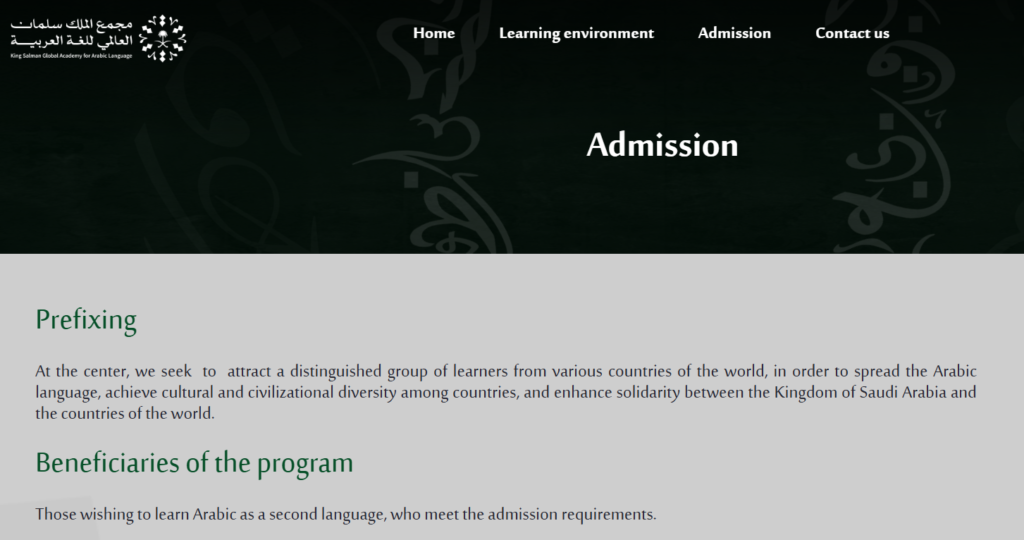
The King Salman Global Academy for the Arabic Language accepts applications for its Arabic program for non-native speakers at the Abjad Center in Riyadh. The program follows an advanced academic methodology and offers four levels, each lasting two months, for a total of eight months and 160 instructional hours per level, averaging 20 hours per week.
The first edition attracted more than 16,140 applicants from 162 nationalities, with more than 130 students from 34 nationalities accepted. Admission is competitive and the program is fully funded by the Saudi government.
Visit https://arabiccenter.ksaa.gov.sa/en/admission for application cycles.
3. Qatar University — Arabic for Non-Native Speakers Program
Qatar University’s Arabic for Non-Native Speakers Center offers certificates of completion to international students whose mother tongue is not Arabic. The scholarship covers full tuition fees.
This program is open to all nationalities except Arabic-speaking countries and offers structured instruction with a direct stipend to support living costs.
Read also: The Best Place to Learn Arabic
How Do You Choose the Right Arabic Scholarship for Your Level?
The answer depends on your current Arabic proficiency, nationality, and learning goals. Choosing the wrong program — one that exceeds or falls below your actual level — is a common and costly mistake we see students make.
| Scholarship | Funding Level | Nationality | Level Required | Duration |
| Critical Language Scholarship (CLS) | Full | U.S. only | Beginner–Advanced | 8–10 weeks |
| CASA Fellowship I | Tuition + stipend | U.S. only | Advanced (3+ years) | 9 months |
| SALAM Program | Full | U.S. only | Intermediate+ | Summer |
| Hadhramaut University | Full (tuition + housing) | All nationalities | Beginner–Intermediate | Academic year |
| King Salman Academy (Abjad) | Full | All nationalities | Beginner–Intermediate | 8 months |
| Qatar University | Tuition + $2,000/month | All nationalities (non-Arabic) | Varies | Varies |
In our experience at Buruj Academy, students who try to apply for advanced programs — like CASA — without first building systematic grammar knowledge consistently underperform on the ACTFL exam requirement.
A focused period of structured study with our Arabic Grammar Course before applying makes a measurable difference in placement scores.
Understand the Arabic Grammar with Buruj’s free trial lesson
How Can You Strengthen Your Arabic Scholarship Application?
The most important thing scholarship committees evaluate — beyond academic credentials — is demonstrable Arabic engagement. Many students apply with vague interest. The ones who succeed show a track record of deliberate, consistent study.
Here is what strengthens an application across all the programs listed above.
1. Build a Measurable Proficiency Record
Standardized testing matters. The ACTFL (American Council on the Teaching of Foreign Languages) exam is required by CASA and referenced by several other programs. A strong ACTFL score — particularly in Oral Proficiency — dramatically improves your standing.
If you are just starting to learn Arabic and are aiming for a scholarship within one to two years, begin structured instruction now.
Master the Arabic Language
Join our expert-led courses and build a strong foundation in Classical and Modern Arabic.
Get Your Free Trial2. Demonstrate Real Motivation Beyond the Classroom
Scholarship committees reward purpose-driven learners. If your motivation involves Quranic Arabic, Islamic studies, professional translation, or regional development, say so clearly in your application essay. Generic statements about “loving the culture” do not stand out. Specificity does.
Buruj Academy’s Arabic Speaking Course helps students develop the real-time fluency and conversational confidence that oral proficiency interviews — required by CASA and several other programs — directly test. Knowing the grammar is not enough; you need to be able to speak naturally under interview conditions.
Book your free trial to start speaking Arabic fluently

3. Start Earlier Than You Think You Need To
In our team’s experience working with students who later pursue formal scholarship programs, those who begin structured Arabic instruction at least 12 months before applying are far better positioned than those who start 3 months out.
Language acquisition is cumulative — there are no meaningful shortcuts. If you are considering any of these programs for the next cycle, the time to begin is now.
Understanding how long it genuinely takes to learn Arabic — with realistic expectations — helps you set a timeline that actually works. Alhamdulillah, many of our students have reached intermediate proficiency within 12–18 months of consistent 1-on-1 instruction.
Read also: Summer Arabic Programs
Discover the Buruj Academy Difference
Step into our virtual classrooms and see how our expert instructors make learning Quran and Arabic intuitive and clear. We focus on overcoming the specific hurdles non-native speakers face, building your confidence and connection with the Quran.
Start Your Arabic Foundation with Buruj Academy’s Expert-Led Courses
Scholarships reward preparation. Whether your goal is passing the ACTFL exam for CASA, building the reading fluency Qatar University expects, or simply arriving at Hadhramaut University ready to engage — every program above rewards students who come in with a real foundation.
Buruj Academy’s courses are taught by Al-Azhar University graduates with 12+ years of experience teaching non-native speakers, using our Context-before-abstraction method that builds functional Arabic from day one — not just rule memorization.
Our Arabic for Beginners course is the right starting point for those with no formal Arabic background, while our Arabic Grammar Course serves intermediate learners preparing for placement assessments.
All sessions are 1-on-1, fully flexible, and backed by Ijazah-certified instructors who understand exactly where non-native speakers struggle.
Book your free trial lesson and let us help you get scholarship-ready.
Begin your transformation today by choosing the path that fits your goals:
- Online Arabic Classes (General & Comprehensive)
- Arabic Course for Beginners
- Arabic Alphabet Learning Course
- Online Arabic Classes for Kids
- Arabic Classes for Adults
- Arabic Grammar Course (Nahw & Sarf)
- Intermediate Arabic Course (B1/B2)
- Arabic Speaking Course (Conversational Fluency)
- Arabic Reading Course (Literary Excellence)
- Learn Arabic Writing Course (Calligraphy & Composition)
Ready to speak with confidence? Join the global community at Buruj Academy and book your free placement interview today!
Master the Arabic Language
Join our expert-led courses and build a strong foundation in Classical and Modern Arabic.
Get Your Free TrialRead also:An Introduction to the Arabic Language
Conclusion
Arabic language study scholarships are a genuine, achievable pathway — but only for those who prepare deliberately. The programs above, from fully funded government initiatives in Saudi Arabia and Oman to competitive fellowship programs for American students in Amman and Cairo, all share one selection principle: they reward learners who already show real commitment to the language.
Whether you start with our Online Arabic Classes or explore foundational resources like our guide on Arabic grammar for beginners, the best time to begin is always now. Insha’Allah, with consistent effort, the right scholarship will follow.
Frequently Asked Questions About Arabic Language Study Scholarships
Are There Arabic Language Scholarships Available to Non-Americans?
Yes. Several programs accept applicants from all nationalities. Hadhramaut University’s fully funded scholarship for non-native Arabic speakers is open globally, as is the King Salman Global Academy’s Abjad Center program in Riyadh, which has accepted students from over 160 nationalities. Qatar University’s Arabic for Non-Native Speakers program also accepts international students from non-Arabic-speaking countries and includes a monthly living allowance.
What Arabic Level Do I Need to Apply for the CASA Fellowship?
Applicants to CASA programs must be U.S. citizens or permanent residents and should have a minimum of 3 years of formal instruction in Arabic prior to joining. CASA I is designed for advanced learners, and all applicants must take the ACTFL exam in reading, listening, and oral proficiency. Students at intermediate level should focus on structured grammar and speaking development first.
Does the Critical Language Scholarship Require Prior Arabic Knowledge?
The Critical Language Scholarship is open to students at every level of language learning, from beginners to advanced. You do not need prior Arabic study to apply for the CLS Arabic track, though more experienced applicants may be placed in more intensive sections upon arrival in the host country.