 Arabic
| Key Takeaways |
| Noorani Qaida teaches Arabic letter shapes, sounds, and joining rules through repetition before children attempt full words. |
| Children typically progress through the 4 main Qaida stages in 4–8 months with consistent 15–20 minute daily sessions. |
| Letters change shape depending on position: isolated, initial, medial, or final, which is the most common early confusion point. |
| Harakat (short vowel marks) — Fatha, Kasra, and Damma — must be mastered before children move to joined-letter reading. |
| Daily short sessions with visual repetition outperform long, infrequent sessions for building lasting letter recognition in young learners. |
Your child stares at the page, sounding out ب then ت then ث — three letters that look almost identical except for a dot or two. This is the exact moment where most young Arabic learners either build confidence or start dreading lesson time.
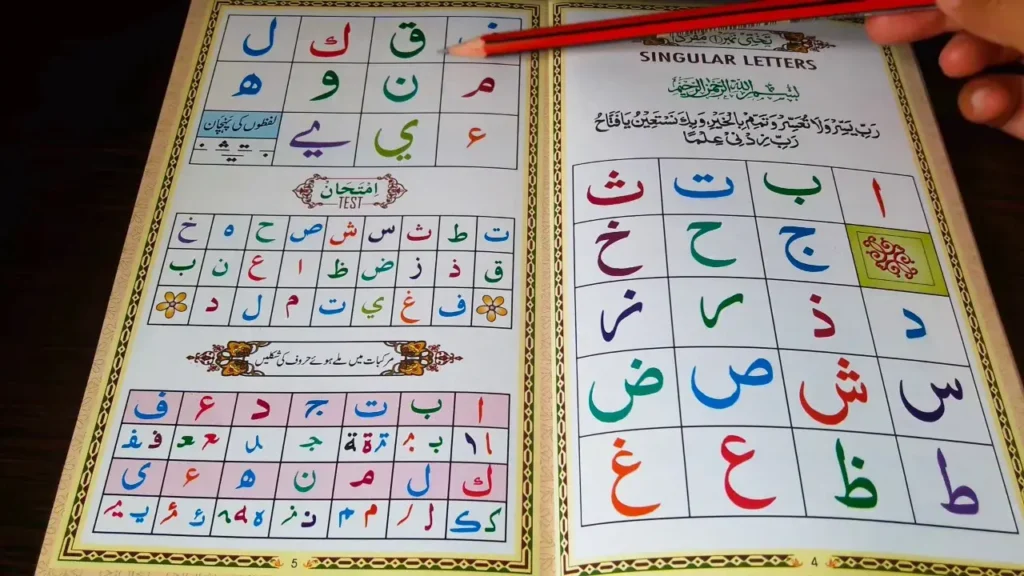
The Noorani Qaida is a structured beginner’s method for teaching children Arabic letter shapes, sounds, and joining patterns before they read connected words or sentences.
It works by isolating each skill — letter recognition, then vowel marks, then joining — so children build reading fluency in manageable stages rather than guessing at whole words too early.
Table of Contents:
What Is the Noorani Qaida and Why Does It Matter for Kids?
The Noorani Qaida is a foundational primer that breaks Arabic reading into small, sequential lessons — starting with individual letter shapes and ending with fluent joined-word reading.
It exists specifically because Arabic script behaves differently from Latin script, and children need a system built for that difference.
Unlike English, where letters mostly keep one shape, Arabic letters change form depending on where they sit in a word. In our sessions, this is the single biggest source of early frustration for kids who’ve only ever learned a fixed alphabet.
The Qaida solves this by teaching shape recognition before word recognition. A child who has drilled that ع looks different at the start, middle, and end of a word won’t freeze the first time they meet it inside a real sentence.
This matters beyond pronunciation. Strong letter-shape recognition is also the skill children later lean on for broader Arabic reading for kids, general literacy, and vocabulary building. Skipping this stage tends to show up later as slow, effortful reading rather than natural fluency.
Buruj Academy’s Noorani Qaida for kids course structures this exact progression, using visual aids, songs, and repetition games so letter drilling doesn’t feel like rote memorization to a 6-year-old.
Sign up your kid for a free Noorani Qaida lesson

How Are Arabic Letters Structured?
Arabic has 28 letters, and most of them shift shape depending on whether they stand alone or connect to a letter before or after them — a feature that has no real English equivalent. Understanding this positional system is the first real hurdle in Noorani Qaida, and it’s worth slowing down for.
Each letter can appear in up to four forms: isolated, initial (start of a word), medial (middle of a word), and final (end of a word). A letter like ب looks noticeably different in each position, even though it’s still “the same letter” to a native reader.
The Four Positions Arabic Letter Can Take
Here’s how one letter — ب (Baa) — shifts across all four positions:
| Position | Shape | Example Word | Where It Sits |
| Isolated | ب | ب (alone) | Standalone, not connected |
| Initial | بـ | بَيت (bayt = house) | Start of the word |
| Medial | ـبـ | السبت (Al-Sabt = saturday) | Middle of the word |
| Final | ـب | كَتَب (kataba = he wrote) | End of the word |
A child doesn’t need to memorize grammar rules to internalize this — they need repeated visual exposure until the pattern becomes automatic. That’s the entire logic behind Qaida drilling.
Why This Confuses Kids More Than Adults Assume
In our experience, non-Arabic speaking children under 8 rarely struggle with the concept of shape-shifting letters — they struggle when too many new letters are introduced before the first few are automatic. Slowing the pace, not adding more explanation, is usually the actual fix.
We also notice a specific pattern: kids often try to “shortcut” by memorizing whole-word shapes instead of individual letters. It works temporarily, then collapses once they meet an unfamiliar word using the same letters in a different arrangement.
What Are Harakat and How Do They Control Arabic Pronunciation?
Harakat are the short vowel marks placed above or below Arabic letters that tell the reader exactly how to pronounce each consonant, and Noorani Qaida cannot be taught without them. Without harakat, a bare Arabic letter has no defined vowel sound at all.
There are three primary short vowel marks children must master before touching joined-letter reading: Fatha, Kasra, and Damma. Each changes the sound of the same base letter completely.
The Three Essential Harakat
| Harakat Mark | Symbol | Sound Produced | Example |
| Fatha | A small diagonal line above the letter | Short “a” sound | بَ (ba) |
| Kasra | A small diagonal line below the letter | Short “i” sound | بِ (bi) |
| Damma | A small curl above the letter | Short “u” sound | بُ (bu) |
Once a child can instantly read ب with all three marks without pausing to think, they’re ready for the next Qaida stage — not before.
The Sukoon and Why It’s Different From the Other Marks
There’s a fourth mark that behaves opposite to the three above: the Sukoon, a small circle placed above a letter to show it carries no vowel sound at all. A letter with Sukoon is pronounced as a hard stop — for example, بْ makes a clipped “b” sound with no vowel attached.
Children often confuse Sukoon with “the letter being silent,” which isn’t accurate — the consonant sound is still fully pronounced, it simply isn’t followed by a vowel. Correcting this distinction early prevents a habit that’s genuinely difficult to undo later.
For families building vocabulary alongside letter drilling, our guide on Arabic words for kids pairs well here, since real words reinforce harakat patterns naturally.
Read also: The Four Seasons in Arabic for Kids
Discover the Buruj Academy Difference
Step into our virtual classrooms and see how our expert instructors make learning Quran and Arabic intuitive and clear. We focus on overcoming the specific hurdles non-native speakers face, building your confidence and connection with the Quran.
Master the Arabic Language
Join our expert-led courses and build a strong foundation in Classical and Modern Arabic.
Get Your Free TrialWhat Are the Core Stages of the Noorani Qaida Method?
Noorani Qaida progresses through four sequential stages: individual letter recognition, harakat application, letter joining, and connected-word reading — and each stage must be solid before advancing to the next. Skipping ahead is the most common reason children stall out mid-way through the primer.
Stage One — Isolated Arabic Letter Recognition
The child learns to instantly name and recognize all 28 letters in their standalone form, with no vowel marks attached yet. This stage is pure shape-and-sound memorization, usually taking several weeks of short daily sessions.
We’ve found flashcards and letter-tracing worksheets work better here than digital apps alone, because the physical act of tracing reinforces shape memory for young children specifically.
Stage Two — Arabic Letters With Harakat
Once shapes are automatic, children apply the three short vowels (and Sukoon) to each letter, drilling combinations like بَ، بِ، بُ، بْ until the sound-to-symbol connection is instant rather than calculated.
Stage Three — Two and Three-Letter Joining
This stage introduces connected letters — where a child sees, for the first time, how individual shapes link together into small clusters like بَت or كَتَب. This is where the positional shape-shifting from earlier finally clicks into practical use.
Stage Four — Full Arabic Word and Sentence Reading
The final stage moves into complete words and short phrases, applying everything from the earlier stages simultaneously — shape recognition, harakat, and joining — without conscious effort.
| Stage | Focus | Typical Duration |
| 1 | Isolated letters | 3–5 weeks |
| 2 | Harakat application | 3–4 weeks |
| 3 | Letter joining | 4–6 weeks |
| 4 | Full word reading | 6–10 weeks |
These durations vary by child, age, and session consistency — treat them as general guidance rather than a fixed schedule.
A 4-year-old and a 9-year-old will not move through these stages at the same pace, and that’s expected.
Buruj Academy’s online Arabic classes for kids build this exact four-stage sequence into a structured curriculum, with instructors trained specifically to recognize when a child needs more repetition versus when they’re ready to advance.
Book a FREE Arabic trial for your child

What Practical Exercises Help Kids Practice Noorani Qaida at Home?
Short, varied, low-pressure exercises reinforce Qaida learning far better than long single-format drills, and rotating between 3–4 exercise types keeps a child engaged across a 15–20 minute session. Below are exercises that map directly onto the four stages above.
1. Arabic Letter Hunt Exercise
Write 10 letters on index cards and scatter them face-up. Call out a letter name; the child races to find and hold it up. This reinforces Stage One shape recognition through active recall rather than passive reading.
2. Harakat Sound Match
Show a single letter three times, each with a different harakat mark, and have the child say the sound out loud for each one before you reveal if they’re correct. This isolates Stage Two skills without the distraction of joining or full words.
Read also: Arabic Reading Paragraphs for Kids
3. Shape-Shift Spotting
Print a short word and ask your child to circle where the same letter appears in its initial, medial, or final form. This directly targets the positional confusion discussed earlier and works well as a Stage Three or Four warm-up.
4. Trace and Say
Have the child trace a letter with their finger (or pencil) while saying its name and sound simultaneously. Combining physical motion with vocalization creates a stronger memory anchor than silent tracing alone.
Practice Table for a Sample Week
| Day | Exercise | Focus Stage |
| Monday | Letter Hunt | Stage 1 |
| Tuesday | Trace and Say | Stage 1–2 |
| Wednesday | Harakat Sound Match | Stage 2 |
| Thursday | Shape-Shift Spotting | Stage 3 |
| Friday | Short word reading aloud | Stage 4 |
Rotate exercises rather than repeating the same one daily — variety keeps young learners from associating Qaida practice with monotony, which is one of the fastest ways to lose engagement at this age.
Pairing these drills with Arabic games for kids or short Arabic stories for kids once Stage Four begins gives children a genuine reward for the earlier repetitive stages — they finally get to use the skill.
Learn Arabic Foundations the Right Way With Buruj Academy
Strong Arabic literacy starts with exactly the letter-and-sound foundation this guide covers — and getting that foundation right the first time saves months of correcting bad habits later.
Buruj Academy’s Noorani Qaida for kids course delivers this four-stage method through Al-Azhar University graduate instructors with 12+ years teaching non-Arabic speaking children specifically.
Sessions follow the Buruj Method’s context-before-abstraction approach, use age-appropriate visual aids and repetition games, and adapt pacing to your child’s actual progress rather than a fixed calendar.
Instructors give real-time correction on letter shapes and harakat as your child reads aloud, catching habits before they set in.
Book a free trial lesson and see how your child responds to structured, patient instruction.
Enroll your child in one of our specialized, kid-friendly tracks today:
- Online Quran Classes for Kids
- Tajweed Classes for Kids
- Hifz Classes for Kids
- Online Arabic Classes for Kids
- Quranic Arabic Course for Kids
- Noorani Qaida Course for Kids
- Islamic Studies Classes for Kids
Ready to watch your child grow in knowledge and character? Join the Buruj Academy family and book a free trial session for your child today!
Master the Arabic Language
Join our expert-led courses and build a strong foundation in Classical and Modern Arabic.
Get Your Free TrialConclusion
Learning to read Arabic isn’t about memorizing an alphabet chart — it’s about building automatic recognition of shapes, sounds, and positions until reading stops feeling like decoding. The Noorani Qaida exists precisely because this process needs structure, not shortcuts.
Children who move through letter recognition, harakat, joining, and full-word reading in sequence build a foundation that holds up under real reading later. Rushing any single stage tends to resurface as hesitation or guesswork months down the line.
With consistent short sessions and the right mix of visual, physical, and auditory practice, most children move from first letter to confident short-word reading well within a school year.
Read also: Arabic Reading Practice for Kids
Frequently Asked Questions About Noorani Qaida for Kids
What Age Should a Child Start Learning Noorani Qaida?
Most children begin around age 4–6, once they can sit for a short focused session and recognize basic shape differences. There’s no strict cutoff — older children and even teens starting from zero follow the same four-stage sequence successfully.
How Long Does It Take a Child to Finish the Noorani Qaida?
With consistent 15–20 minute daily sessions, most children complete all four stages in roughly 4–8 months. Pace depends heavily on age, session consistency, and how much repetition a specific child needs at each stage.
Is Noorani Qaida the Same as Learning the Arabic Alphabet?
They overlap but aren’t identical — the Arabic alphabet is the 28 letters themselves, while Noorani Qaida is the teaching method that sequences letter recognition, harakat, and joining into a structured reading system.
Does My Child Need to Learn Noorani Qaida Before Quran Reading?
Yes — Noorani Qaida builds the letter and harakat foundation required before attempting Quranic text, since Quran reading assumes instant letter-and-vowel recognition. Skipping this stage typically leads to slow, effortful Quran reading later.
Can Noorani Qaida Be Taught Without a Tutor?
It’s possible with disciplined home practice, but most parents find a structured tutor catches shape and pronunciation errors early that are hard to self-correct. A qualified instructor also paces the four stages to the child’s actual readiness rather than a fixed timeline.
Related Articles
Arabic