 Arabic
| Key Takeaways |
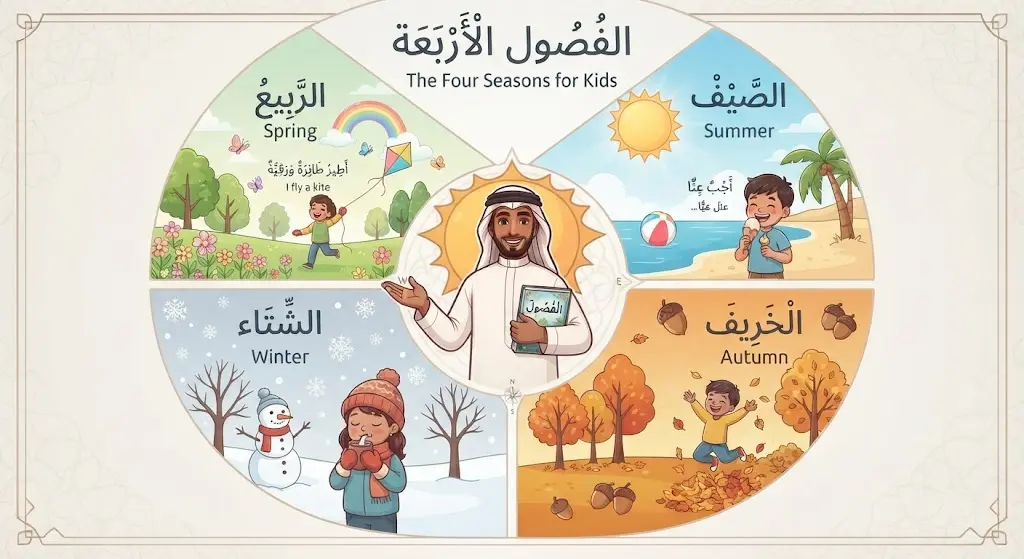
| The four seasons in Arabic are الرَّبِيع (spring), الصَّيْف (summer), الخَرِيف (autumn), and الشِّتَاء (winter). |
| All four season names are masculine nouns in Arabic, which affects how adjectives and verbs pair with them. |
| Children learn season Arabic vocabulary fastest through weather words, clothing items, and simple sentence patterns tied to each season. |
| Seasonal Arabic vocabulary connects directly to numbers, colors, and basic sentence structure that kids already practice. |
| Repetition through songs, flashcards, and matching games builds long-term retention better than memorization drills alone. |
Learning the seasons in Arabic gives kids a natural, everyday vocabulary set they can use immediately — talking about weather, clothes, and holidays.
The four seasons in Arabic are الرَّبِيع (ar-rabee’, spring), الصَّيْف (as-sayf, summer), الخَرِيف (al-khareef, autumn), and الشِّتَاء (ash-shitaa’, winter).
Each word pairs naturally with weather and clothing vocabulary, making seasons one of the easiest topics for young learners to practice in real conversation.
Table of Contents:
What Are the Four Seasons Called in Arabic?
The four seasons in Arabic are الرَّبِيع (spring), الصَّيْف (summer), الخَرِيف (autumn/fall), and الشِّتَاء (winter). Each name is a masculine noun, and together they form the phrase فُصُول السَّنَة (fusool as-sanah), meaning “the seasons of the year.”
Kids benefit from learning all four together as a set before breaking them apart individually.
In our online Arabic classes for kids at Buruj Academy, we’ve noticed young learners retain seasonal vocabulary far faster when they see the words grouped visually — a wheel, a calendar, or a simple table — rather than a plain list.
Book a FREE Arabic trial for your child

The word فَصْل (fasl) itself means “season,” so فَصْل الشِّتَاء literally translates to “the season of winter.”
| Arabic | Transliteration | English | Gender |
| الرَّبِيع | ar-rabee’ | Spring | Masculine |
| الصَّيْف | as-sayf | Summer | Masculine |
| الخَرِيف | al-khareef | Autumn / Fall | Masculine |
| الشِّتَاء | ash-shitaa’ | Winter | Masculine |
Since all four season words are masculine, adjectives describing them must also take the masculine form — a detail we cover further in our masculine and feminine nouns in Arabic guide.
Practice Exercise: Match the Season
Ask your child to match each Arabic word to its picture (sun, falling leaves, snowflake, flowers):
- الشِّتَاء — ______
- الرَّبِيع — ______
- الصَّيْف — ______
- الخَرِيف — ______
How Do You Say “My Favorite Season” in Arabic?
“My favorite season” in Arabic is فَصْلِي المُفَضَّل, pronounced fasli al-mufaddal. This simple phrase lets kids express a personal opinion using vocabulary they already recognize, turning passive knowledge into active speech within one lesson.
Once a child knows the four season names, this phrase becomes a natural bridge into full sentences.
For example: فَصْلِي المُفَضَّل هُوَ الصَّيْف (“My favorite season is summer”). We often ask young students this question directly during lessons, and it consistently produces the most enthusiastic, unprompted responses of the entire unit.
This pattern connects to broader sentence-building skills covered in our guide on Arabic sentence structure for beginners, where subject-predicate order follows the same logic.
Read also: Arabic Dictionary for Kids
Sample Sentences for Kids to Practice
| Arabic Sentence | Transliteration | English Meaning |
| فَصْلِي المُفَضَّل هُوَ الرَّبِيع | Fasli al-mufaddal huwa ar-rabee’ | My favorite season is spring |
| أُحِبُّ الشِّتَاء | Uhibbu ash-shitaa’ | I love winter |
| الصَّيْفُ حَارٌّ جِدًّا | As-sayfu haarrun jiddan | Summer is very hot |
| الخَرِيفُ جَمِيلٌ | Al-khareefu jameel | Autumn is beautiful |
Have your child pick one sentence, replace the season word, and say it aloud three times — repetition at the sentence level builds fluency faster than isolated vocabulary drills.
Discover the Buruj Academy Difference
Step into our virtual classrooms and see how our expert instructors make learning Quran and Arabic intuitive and clear. We focus on overcoming the specific hurdles non-native speakers face, building your confidence and connection with the Quran.
Master the Arabic Language
Join our expert-led courses and build a strong foundation in Classical and Modern Arabic.
Get Your Free TrialWhat Weather Words Go with Each Arabic Season?
Each Arabic season pairs with specific weather vocabulary that kids can learn as a matched set: حَارّ (hot) with summer, بَارِد (cold) with winter, مُمْطِر (rainy) with autumn or spring, and مُعْتَدِل (mild) with spring.
Teaching weather and season words together doubles the vocabulary retained per lesson.
Weather words give the seasons life beyond a memorized list. A child who knows الجَوُّ حَارٌّ فِي الصَّيْف (“the weather is hot in summer”) is applying grammar, vocabulary, and real-world logic simultaneously.
We’ve found that pairing each season with exactly one weather word and one clothing word — rather than five at once — keeps the lesson from overwhelming younger children.
| Season | Weather Word | Transliteration | Meaning |
| الصَّيْف | حَارّ | haarr | Hot |
| الشِّتَاء | بَارِد | baarid | Cold |
| الرَّبِيع | مُعْتَدِل | mu’tadil | Mild |
| الخَرِيف | مُمْطِر | mumtir | Rainy |
Building Full Weather Sentences in Arabic
The pattern الجَوُّ + [weather word] + فِي + [season] works for any combination. For example: الجَوُّ بَارِدٌ فِي الشِّتَاء (“The weather is cold in winter”).
Kids can build four full sentences just by rotating the season and weather word — a simple, repeatable drill that mirrors the structures taught in our Arabic present tense lesson.
Which Clothes Are Worn in Each Arabic Season?
Clothing vocabulary naturally pairs with seasons and gives kids a second practical use for the words beyond weather talk. Winter calls for مِعْطَف (coat) and قُفَّازَات (gloves), while summer calls for قُبَّعَة (hat) and نَظَّارَات شَمْسِيَّة (sunglasses) — concrete, visual nouns young learners retain easily.
This category works especially well for visual and kinesthetic learners. Ask your child to draw or point to what they’d wear in each season while saying the Arabic word aloud — connecting the physical object to the sound reinforces memory far more than a written list alone.
| Season | Clothing Item | Transliteration |
| الشِّتَاء | مِعْطَف (coat) | mi’taf |
| الشِّتَاء | قُفَّازَات (gloves) | quffazat |
| الصَّيْف | قُبَّعَة (hat) | qubba’ah |
| الرَّبِيع | مِظَلَّة (umbrella) | mizallah |
Clothing nouns also introduce plural forms naturally, a topic expanded in our dual nouns in Arabic article for families ready to go further.
Read also: Fruits in Arabic
Practice Exercise: Dress for the Season
Give your child four season cards and eight clothing-item cards (two per season). Ask them to sort clothing items under the correct season while naming each item in Arabic aloud.
How Can Kids Practice Seasonal Arabic Vocabulary at Home?
Kids retain seasons vocabulary best through short, repeated, multi-sensory activities rather than long single sessions.
Flashcard sorting, seasonal song repetition, drawing exercises, and simple question-and-answer routines each reinforce the same four words from a different angle, strengthening recall across contexts.
We recommend rotating through two or three activity types per week rather than repeating one method daily.
A child who sings a seasons song on Monday, sorts flashcards on Wednesday, and answers “what’s your favorite season” on Friday encounters the vocabulary three distinct ways — this variety is a core principle behind the Buruj Method’s context-before-abstraction approach to teaching Arabic vocabulary in general, detailed further in our guide on mastering Arabic vocabulary.
Five-Minute Daily Drill
- Show a season flashcard; child says the Arabic word.
- Child names one weather word for that season.
- Child names one clothing item for that season.
- Repeat for all four seasons, rotating order each day.
This drill takes under five minutes and covers vocabulary, weather, and clothing together — reinforcing everything taught in the sections above in a single short routine.
Building Confidence Through Consistent Arabic Practice
Learning seasons vocabulary is a small but meaningful step toward Arabic fluency for kids. Buruj Academy’s online Arabic classes for kids use the same context-before-abstraction approach shown here, connecting new words to real objects, weather, and daily conversation rather than isolated memorization.
Our instructors, trained specifically in child-friendly pedagogy, guide each learner through age-appropriate vocabulary building at their own pace.
With Al-Azhar-trained instructors and flexible 1-on-1 scheduling, your child gets personalized correction and steady encouragement rather than a rigid, one-size-fits-all curriculum.
Ready to help your child build real Arabic vocabulary with expert guidance?
Book a free trial lesson with Buruj Academy today and see the difference structured, engaging instruction makes.
Enroll your child in one of our specialized, kid-friendly tracks today:
- Online Quran Classes for Kids
- Tajweed Classes for Kids
- Hifz Classes for Kids
- Online Arabic Classes for Kids
- Quranic Arabic Course for Kids
- Noorani Qaida Course for Kids
- Islamic Studies Classes for Kids
Ready to watch your child grow in knowledge and character? Join the Buruj Academy family and book a free trial session for your child today!
Master the Arabic Language
Join our expert-led courses and build a strong foundation in Classical and Modern Arabic.
Get Your Free TrialConclusion
The four Arabic season names — الرَّبِيع, الصَّيْف, الخَرِيف, and الشِّتَاء — open the door to weather talk, clothing vocabulary, and personal expression for young Arabic learners. Pairing each season with matching weather and clothing words, then reinforcing everything through short daily drills, turns four isolated nouns into a functional vocabulary set.
Consistency matters more than intensity here. A five-minute daily routine, repeated across a few weeks, builds retention that a single long lesson never could.
Read also: Arabic Reading Paragraphs for Kids
Frequently Asked Questions About Seasons in Arabic for Kids
What Is the Arabic Word for “Season”?
The Arabic word for “season” is فَصْل (fasl). The plural form, فُصُول (fusool), is used in the phrase فُصُول السَّنَة (“the seasons of the year”), which refers to all four seasons together as a complete set.
Are Arabic Season Names Masculine or Feminine?
All four Arabic season names — الرَّبِيع, الصَّيْف, الخَرِيف, and الشِّتَاء — are masculine nouns. This means any adjective describing a season, such as “beautiful” or “hot,” must also take the masculine grammatical form.
What Age Should Kids Start Learning Arabic Seasons Vocabulary?
Children as young as four or five can begin learning seasons vocabulary through pictures, songs, and simple matching games. Full sentence construction using season words typically develops once a child has basic Arabic sentence structure skills, often around age six or seven.
How Do You Say “Happy Spring” or Similar Seasonal Greetings in Arabic?
There isn’t one fixed traditional greeting for each season in Modern Standard Arabic the way some cultures use seasonal phrases. Instead, children typically express seasonal enthusiasm through simple sentences like أُحِبُّ الرَّبِيع (“I love spring”), which reinforces both vocabulary and basic sentence structure at once.