 Arabic
| Key Takeaways |
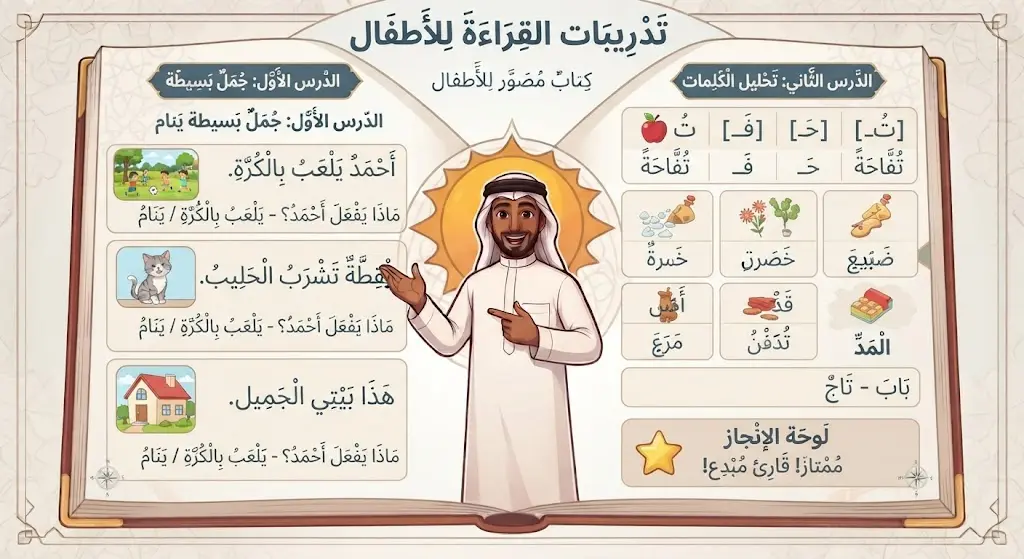
| Arabic reading for kids builds through three stages: letter shape recognition, letter-sound connection, then blending letters into words. |
| Children learning Arabic script benefit most from 10–15 minute daily sessions rather than longer, infrequent practice blocks. |
| The most common early mistake is confusing letters that share a base shape but differ only by dot placement, like ب, ت, and ث. |
| Arabic is written right to left, and reversing this direction is the single most frequent habit non-Arabic-speaking children develop. |
| Consistent short-word practice after letter mastery prevents the common plateau where kids know letters but cannot read connected text. |
Many parents reach a frustrating point where their child can name every Arabic letter perfectly on a flashcard, yet freezes the moment those same letters appear connected inside a real word.
Arabic reading practice for kids works best when it moves through three distinct stages: isolated letter recognition, letter-sound pairing, and connected-word blending.
Each stage needs dedicated, repeated practice before moving to the next, and skipping ahead is the root cause of most reading struggles we encounter with young learners.
Table of Contents:
What Are the Stages of Teaching a Child to Read Arabic?
Teaching a child to read Arabic follows three sequential stages: recognizing isolated letter shapes, connecting each shape to its sound, and blending letters into complete words. Skipping or rushing any stage creates gaps that surface later as reading hesitation or guessing.
Stage one focuses purely on shape recognition — can the child pick out ب from a row of similar letters without saying a sound yet?
Stage two attaches sound to shape, so the child sees ب and immediately produces its sound aloud.
Stage three is where true reading begins: blending sounds together so ب + ا + ب becomes باب (door), read as one flowing word rather than three separate letters.
In our sessions at Buruj Academy, children who struggle later with reading fluency almost always share one pattern — they were pushed into blending words before shape recognition was fully automatic.
A child who still pauses to think “is that a ب or a ت” cannot simultaneously focus on blending sounds smoothly.
How Long Should Each Stage Take?
Most children need roughly two to three weeks on shape recognition before moving to sound pairing, and another two to three weeks blending simple two-and three-letter words.
These are general ranges, not fixed rules, since every child progresses differently based on age and prior exposure to Arabic sounds at home.
Children who hear Arabic spoken regularly at home often move through sound-pairing faster, since the sounds are already familiar.
Children with no prior exposure may need extra weeks purely on distinguishing similar-sounding letters like ح and ه before adding the reading layer on top.
How Can Parents Practice the Arabic Alphabet with Their Child at Home?
Parents can practice the Arabic alphabet at home using three rotating activities: shape-sorting games, sound-matching drills, and daily letter-tracing in short five-minute bursts.
The goal is repeated, low-pressure exposure rather than long study sessions that exhaust a child’s attention span.
A simple and effective home activity is the “letter hunt.” Write five to six Arabic letters on separate cards, scatter them around a room, and ask your child to bring you the letter that makes a specific sound.
This turns passive recognition into an active, physical task children genuinely enjoy.
A Sample Weekly Home Reading Practice for Kids
| Day | Activity | Time |
| Saturday | Letter-shape sorting game | 10 minutes |
| Sunday | Sound-matching flashcards | 10 minutes |
| Monday | Trace 3 new letters | 10 minutes |
| Tuesday | Review previous letters | 10 minutes |
| Wednesday | Letter hunt game | 15 minutes |
| Thursday | Simple word blending | 10 minutes |
| Friday | Rest or free reading | Optional |
This rhythm keeps practice consistent without becoming a chore. Short, frequent sessions outperform occasional long ones because young children retain new letter shapes best through spaced repetition rather than single intense study blocks.
For families wanting structured support alongside home practice, our Online Arabic Classes for Kids pair a certified instructor with age-appropriate pacing, so home practice reinforces rather than replaces guided instruction.
Book a FREE Arabic trial for your child

Which Arabic Letters Are Hardest for Kids to Distinguish?
The hardest Arabic letters for children to distinguish are those sharing an identical base shape and differing only in dot count or position, such as ب, ت, and ث, or ج, ح, and خ. These “look-alike families” cause the majority of early reading confusion.
Because Arabic script relies heavily on diacritical dots to differentiate otherwise identical shapes, children who rush past careful shape observation frequently swap these letters when reading independently.
Isolating each family for dedicated practice resolves this far faster than mixed alphabet review.
The Main Look-Alike Letter Families
| Base Shape | Letters in Family | What Differs |
| Bowl with tail | ب – ت – ث | Dot count: 1 below, 2 above, 3 above |
| Hook shape | ج – ح – خ | Dot below, no dot, dot above |
| Small loop | س – ش | No dots vs. 3 dots above |
| Rounded curve | ص – ض | No dot vs. 1 dot above |
| Straight stem | ط – ظ | No dot vs. 1 dot above |
We recommend practicing each family in isolation for several days before mixing them into general review. A child who masters the ب-ت-ث family completely, then moves to ج-ح-خ, builds accuracy far faster than a child drilling all five families simultaneously.
Explore this in depth in learning the Arabic alphabet for kids, which breaks down each letter group with visual anchors children respond to well.
What Practice Exercises Help Kids Move from Letters to Words?
Kids move from individual letters to full words through guided blending exercises, starting with two-letter combinations before advancing to three-letter simple words.
The bridge exercise is sounding out each letter slowly, then repeating the same letters faster until they merge into one smooth sound.
Begin with two-letter blends using short vowel marks, since these carry the least cognitive load. بَ (ba), تَ (ta), and مَ (ma) let a child practice the blending motion itself before word meaning adds complexity.
Read also: Arabic Noorani Qaida for Kids
Practice Exercise: Two-Letter Blending Table
| Letters | Sounds Out As | Blended Reading |
| بَ | “b” + “a” | ba |
| تِ | “t” + “i” | ti |
| مُ | “m” + “u” | mu |
| نَ | “n” + “a” | na |
Practice Exercise: Simple Three-Letter Words
Once two-letter blending feels automatic, move to short real words your child can connect to meaning immediately.
- بَيْت (bayt) — house
- قَلَم (qalam) — pen
- كِتَاب (kitab) — book
- شَمْس (shams) — sun
Have your child read each word aloud three times across three separate days rather than ten times in one sitting. In our experience, this spaced repetition pattern builds stronger long-term recognition than repetition crammed into a single session.
This progression connects directly with Arabic sentences for kids, which extends the same blending skill into full simple sentences once single words feel comfortable.
How Do Kids Practice Reading Full Arabic Paragraphs?
Kids move into full paragraph reading only after single-word reading feels comfortable and automatic, since paragraphs demand sustained right-to-left tracking across multiple connected words.
The jump from isolated words to paragraphs should feel like a small step, not a leap, built from vocabulary the child already recognizes.
Start with paragraphs built almost entirely from words your child has already practiced individually. This keeps the challenge focused on connected reading and eye-tracking rather than introducing new vocabulary and new blending skills at the same time.
Sample Practice Paragraph in Arabic
هَذَا بَيْتٌ كَبِيرٌ. فِي البَيْتِ قَلَمٌ وَكِتَابٌ. الوَلَدُ يَقْرَأُ الكِتَابَ فِي البَيْتِ.
Hatha baytun kabir. Fi al-bayti qalamun wa kitab. Al-waladu yaqra’u al-kitaba fi al-bayti.
“This is a big house. In the house is a pen and a book. The boy reads the book in the house.”
This paragraph reuses بَيْت, قَلَم, and كِتَاب from the earlier word-blending practice, so your child is applying familiar words in a new connected context rather than decoding new vocabulary.
Discover the Buruj Academy Difference
Step into our virtual classrooms and see how our expert instructors make learning Quran and Arabic intuitive and clear. We focus on overcoming the specific hurdles non-native speakers face, building your confidence and connection with the Quran.
Master the Arabic Language
Join our expert-led courses and build a strong foundation in Classical and Modern Arabic.
Get Your Free TrialThree-Step Paragraph Reading Method
Step one — read the paragraph aloud yourself first, tracking each word with your finger, so your child hears correct pacing and pronunciation before attempting it independently.
Step two — have your child read the same paragraph aloud, pointing to each word as they go, while you gently correct direction or pronunciation without interrupting the flow too often.
Step three — ask one or two simple comprehension questions afterward, such as “what did the boy read?” This confirms your child is processing meaning, not simply sounding out shapes without understanding.
Read also: Arabic Vowels for Kids
Common Paragraph-Reading Practice
| Practice Focus | What to Watch For | Correction Approach |
| Right-to-left tracking | Child’s eyes jumping to the wrong word | Use a finger or ruler as a visual guide |
| Word spacing | Merging two separate words into one | Pause briefly at each word boundary |
| Sentence-ending fatigue | Rushing or mumbling the final word | Break long paragraphs into two shorter ones |
| Comprehension | Reading correctly but missing meaning | Ask a simple question after each paragraph |
We consistently find that children who read the same short paragraph across three separate days build noticeably more fluency than children who read three different paragraphs once each.
Repetition at the paragraph level cements the connected-reading skill in a way that constant novelty does not.
For families ready to build on this skill with guided feedback, our Arabic Reading Course gives children structured paragraph practice with real-time correction from instructors trained specifically for young non-native readers.
Read Arabic fluently with a free Buruj trial
How Do You Keep a Child Motivated During Arabic Reading Practice?
Keeping a child motivated during Arabic reading practice depends on visible progress markers, genuine praise for effort rather than only correct answers, and rotating game-based formats so practice never feels repetitive. Motivation drops fastest when sessions feel identical day after day.
A simple progress chart where your child colors in a box after each completed practice session gives tangible proof of advancement, which matters enormously to young learners who cannot yet judge their own improvement abstractly.
Motivation Techniques That Work During Arabic Reading Practice for Kids
- Sticker or coloring progress charts — visual proof of consistency builds intrinsic motivation over time
- “Teach it back” moments — ask your child to teach a sibling or parent a letter they just learned
- Short celebration rituals — a small acknowledgment after finishing a family of letters, not just perfect performance
- Letter-of-the-day surprises — connecting a new letter to a favorite object starting with that sound
We consistently observe that children who explain a letter back to someone else retain it significantly better than children who only receive instruction passively.
This “teach it back” approach also reveals gaps in understanding before they become entrenched habits.
For structured motivation built into a full curriculum, our Online Arabic Classes use built-in progression milestones so children see concrete advancement session by session, guided by instructors trained specifically for young learners.
Book your FREE Arabic trial online Arabic class at Buruj

What Common Mistakes Do Non-Arabic-Speaking Kids Make While Learning to Read?
The most common mistake non-Arabic-speaking kids make is attempting to read Arabic left to right out of habit from their native language, since Arabic is read right to left.
This directional confusion causes children to skip or misread the first letter of nearly every word initially.
A second frequent mistake involves ignoring short vowel marks entirely, since they sit above or below letters rather than inline like Latin vowels.
Children accustomed to reading English often glance past these marks completely, leading to mispronounced words even when letter recognition itself is strong.
Three Corrective Strategies
For directional confusion, physically place a colored sticker or dot at the starting point (right side) of each practice line, giving children a consistent visual anchor until the right-to-left habit becomes automatic.
For skipped vowel marks, cover the letter itself temporarily and have your child identify only the vowel mark first, before reading the full letter-plus-vowel combination together.
For rushed guessing, slow the pace deliberately by having your child point to each letter with a finger while sounding it out, which prevents the eye from jumping ahead and guessing based on word shape alone.
Our guide on Arabic pronunciation covers vowel mark accuracy in more depth, including audio-based correction techniques that work well alongside the finger-tracking method above.
Read also: Daily Routine for Kids in Arabic
Build Your Child’s Arabic Reading Foundation with Buruj Academy
Consistent, structured practice turns Arabic reading from an intimidating script into a manageable skill your child builds week by week. Buruj Academy’s instructors bring this same structured approach into live, personalized instruction.
Buruj Academy’s Online Arabic Classes for Kids use age-appropriate gamification and the context-before-abstraction method, guided by Al-Azhar University graduates with 12+ years of experience teaching non-Arabic-speaking children.
Each child receives a Personalized Learning Plan matched to their exact stage, whether shape recognition, sound-pairing, or word blending.
Sessions run 1-on-1 with flexible 24/7 scheduling and real-time pronunciation correction from instructors trained specifically in child pedagogy.
Ready to see this structured approach in action?
Book a free trial lesson and let our instructors assess exactly which stage your child is ready for.
Enroll your child in one of our specialized, kid-friendly tracks today:
- Online Quran Classes for Kids
- Tajweed Classes for Kids
- Hifz Classes for Kids
- Online Arabic Classes for Kids
- Quranic Arabic Course for Kids
- Noorani Qaida Course for Kids
- Islamic Studies Classes for Kids
Ready to watch your child grow in knowledge and character? Join the Buruj Academy family and book a free trial session for your child today!
Master the Arabic Language
Join our expert-led courses and build a strong foundation in Classical and Modern Arabic.
Get Your Free TrialConclusion
Teaching a child to read Arabic is less about talent and more about sequence — shape before sound, sound before blending, and short consistent sessions over long infrequent ones. The letter families, motivation techniques, and correction strategies above give parents a practical framework rather than guesswork.
Progress in Arabic reading rarely looks linear, and plateaus are a normal part of the process rather than a sign something is wrong. With patient, structured repetition, connected reading eventually clicks, often faster than parents expect once the right-to-left habit and vowel-mark attention become automatic.
Frequently Asked Questions About Arabic Reading Practice for Kids
What Age Should a Child Start Learning to Read Arabic?
Most children can begin foundational Arabic letter recognition around age four to five, once they can sit for short structured activities. Full reading fluency typically develops gradually between ages six and nine, depending on consistency of practice and prior exposure to Arabic sounds at home.
How Long Does It Take a Child to Learn to Read Arabic?
With consistent 10–15 minute daily practice, most children move through letter recognition and sound-pairing within four to six weeks, then reach basic word blending within another six to eight weeks. Full sentence reading typically takes several months of steady practice beyond that point.
Is It Necessary to Know Arabic to Teach a Child at Home?
Parents do not need fluency in Arabic to support home practice effectively, since structured activities like letter-sorting games and progress charts require only basic letter familiarity. However, pairing home practice with a qualified instructor ensures pronunciation accuracy that parents without Arabic background cannot fully verify themselves.