 Arabic
| Key Takeaways |
| A child’s daily routine in Arabic covers roughly 20–25 core action words spanning morning, school, and evening. |
| Present-tense verbs conjugated for “I” (أنا) form the foundation before children need any other verb tense. |
| Visual routine charts paired with spoken repetition help children retain daily routine vocabulary within 2–3 weeks. |
| Morning, meal, and bedtime moments offer natural, low-pressure repetition opportunities without formal lesson time. |
| Sentence-based practice, not isolated word lists, builds the confidence children need to describe their day aloud. |
Every morning brings the same five minutes: waking up, brushing teeth, getting dressed. These repeated moments are actually a hidden vocabulary goldmine for children learning Arabic.
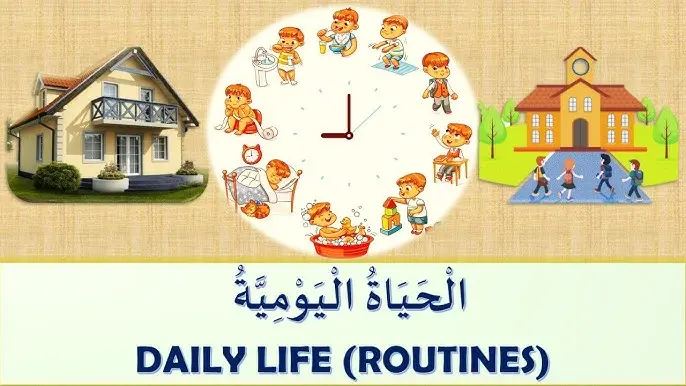
A child’s daily routine in Arabic centers on around 20 present-tense action words — from أستيقظ (I wake up) to أنام (I sleep) — practiced through repetition, not memorization drills.
Table of Contents:
What Does a Child’s Daily Routine Look Like in Arabic?
A daily routine in Arabic for kids breaks into three natural blocks: morning actions, school and midday activities, and evening wind-down. Each block uses simple present-tense verbs conjugated for “I,” since children describe their own actions before anyone else’s.
This structure mirrors how children actually experience their day — not as abstract vocabulary, but as a sequence of things that happen to them, one after another.
In our sessions at Buruj Academy, we’ve noticed that children under age 7 retain routine vocabulary fastest when it’s taught in this exact sequence — morning, then school, then evening — rather than as a randomized word list. The chronological order gives their memory something to hang each word on.
Why Does Sequence Matter More Than Word Count for Young Learners?
Children don’t memorize Arabic vocabulary the way adults do — through flashcards and repetition drills. They memorize through story and sequence, the same way they remember the plot of a favorite book.
A routine taught out of order (dinner before breakfast, sleep before waking) breaks that natural memory hook and forces the child to rely on rote recall instead.
Once the sequence matches real life, the words attach themselves to lived experience. That’s why we always teach وقت الاستيقاظ (wake-up time) before وقت النوم (bedtime) — never the reverse — even in a single lesson covering both.
Building strong routine vocabulary works best alongside consistent Arabic sentence practice for kids, since a word only becomes usable once a child can slot it into a full sentence.
Morning Routine Vocabulary Every Arabic Learner Needs First
The morning routine introduces the first six to eight action words a child needs: waking up, washing, dressing, and eating breakfast. These verbs use the present-tense “I” form, which stays consistent across nearly every routine phrase a child will learn.
Morning vocabulary works well as a starting point because children experience it identically every single day, giving maximum repetition with minimal teaching effort.
| Arabic | Transliteration | English |
| أَسْتَيْقِظُ | Astayqizu | I wake up |
| أَغْسِلُ وَجْهِي | Aghsilu wajhi | I wash my face |
| أُنَظِّفُ أَسْنَانِي | Unazzifu asnani | I brush my teeth |
| أَرْتَدِي مَلَابِسِي | Artadi malabisi | I get dressed |
| أَتَنَاوَلُ الفُطُورَ | Atanawalu al-futoor | I eat breakfast |
Note how every verb begins with the letter أ (alif) — this is the standard present-tense “I” prefix in Arabic, and once a child recognizes this pattern, new verbs become far easier to decode independently.
How to Practice Morning Vocabulary Through Real Actions?
Physical movement locks vocabulary into memory far more effectively than sitting and repeating words. When a child physically mimes brushing their teeth while saying أُنَظِّفُ أَسْنَانِي, the word attaches to muscle memory alongside sound memory.
Try this two-minute morning drill: as your child does each real action, say the matching phrase together before they move to the next step. Within a week, most children start saying the phrase unprompted, before you say it first.
This mirrors the approach used in our Online Arabic Classes for Kids at Buruj Academy, where instructors pair every new verb with a physical gesture or real object — a method rooted in the Buruj Method’s context-before-abstraction principle.
Book a FREE Arabic trial for your child

School and Midday Routine Words for Kids
Midday routine vocabulary covers school departure, classroom activities, and lunch — words a child uses to describe the busiest, most structured part of their day. These phrases introduce location words (to school, to the classroom) alongside action verbs.
Unlike morning vocabulary, midday phrases often need a destination noun attached, giving children their first taste of simple sentence-building beyond a single verb.
| Arabic | Transliteration | English |
| أَذْهَبُ إِلَى المَدْرَسَةِ | Adhhabu ila al-madrasa | I go to school |
| أَجْلِسُ فِي الفَصْلِ | Ajlisu fil-fasl | I sit in the classroom |
| أَتَعَلَّمُ دُرُوسِي | Ata’allamu durusi | I learn my lessons |
| أَتَنَاوَلُ الغَدَاءَ | Atanawalu al-ghadaa | I eat lunch |
| أَلْعَبُ مَعَ أَصْدِقَائِي | Al’abu ma’a asdiqa’i | I play with my friends |
Each of these phrases pairs naturally with the preposition إِلَى (to) or فِي (in), giving children early, low-stakes exposure to how Arabic prepositions connect verbs to places.
Read also: Arabic Noorani Qaida for Kids
Common Mistakes Children Make with Midday Routine Verbs
Students learning أَذْهَبُ (I go) almost always drop the ending vowel sound at first, saying something closer to “adhhab” instead of the fuller “adhhabu.” This isn’t a serious error, but left uncorrected early, it becomes a harder habit to break later.
We’ve found the simplest fix is exaggerating the final “u” sound slightly when modeling the word — not correcting the child directly, just modeling it clearly enough that their ear catches the difference on repetition.
Parents building this stage of vocabulary often benefit from pairing it with broader Arabic vocabulary-building strategies, since midday routine words connect directly to classroom and social vocabulary a child will need soon after.
Discover the Buruj Academy Difference
Step into our virtual classrooms and see how our expert instructors make learning Quran and Arabic intuitive and clear. We focus on overcoming the specific hurdles non-native speakers face, building your confidence and connection with the Quran.
Master the Arabic Language
Join our expert-led courses and build a strong foundation in Classical and Modern Arabic.
Get Your Free TrialEvening and Bedtime Routine Vocabulary for Children
Evening routine vocabulary covers dinner, family time, and the wind-down toward sleep — phrases that pair naturally with Islamic phrases like الحَمْدُ لِلَّهِ after meals.
These words tend to carry more emotional weight than morning vocabulary, since bedtime routines often include closeness with a parent.
Because evening routines happen in a calmer, slower setting, they’re often the easiest block for children to retain, even before morning vocabulary fully sets in.
| Arabic | Transliteration | English |
| أَتَنَاوَلُ العَشَاءَ | Atanawalu al-‘ashaa | I eat dinner |
| أُشَاهِدُ التِّلْفَازَ | Ushahidu at-tilfaz | I watch TV |
| أَقْرَأُ كِتَابًا | Aqra’u kitaban | I read a book |
| أَرْتَدِي بِيجَامَتِي | Artadi bijamati | I put on my pajamas |
| أَنَامُ | Anamu | I sleep |
Building an Evening Vocabulary Ritual Children Actually Look Forward To
Bedtime is the one part of the day where a child is naturally still, unhurried, and receptive — which makes it the ideal setting for slower, more reflective Arabic practice than the rushed morning routine allows.
In our experience, families who narrate the bedtime routine together in Arabic — even just five phrases, spoken slowly — see stronger long-term retention than families who only practice during formal lesson time.
The goal isn’t a perfect recitation. It’s association: Arabic becomes linked to warmth, closeness, and safety, which keeps a child motivated to keep learning long after this specific vocabulary list is mastered.
Read also: Arabic Reading Practice for Kids
How Can Parents Build a Visual Daily Routine Chart in Arabic?
A visual daily routine chart in Arabic pairs each vocabulary phrase with a simple picture or icon, arranged in the order a child’s day actually unfolds. This turns abstract vocabulary into a physical reference a child can point to independently, without needing an adult to prompt every word.
Charts work especially well for children who are visual learners or who benefit from predictable, structured daily sequences.
Materials Needed for a Simple Routine Chart
Building a chart requires almost nothing: a poster board or laminated sheet, printed or hand-drawn icons for each activity, and the Arabic phrase written clearly beneath each image. Velcro-backed icons work well if you want the chart to double as a reusable checklist.
Write each phrase with full diacritical marks (tashkeel) at first — أَسْتَيْقِظُ rather than استيقظ — since young readers rely heavily on these marks before they can read unvoweled Arabic confidently.
Step-by-Step Chart Assembly
Start by listing the child’s actual routine in order, not a generic template — every family’s morning looks slightly different, and the chart should reflect real life.
Match each real-life step to its Arabic phrase from the tables above, then attach or draw a simple icon beside each one.
Place the finished chart at the child’s eye level, ideally near the door or bathroom mirror where the routine naturally happens.
Encourage your child to point and say the phrase aloud each time they complete that part of their routine, rather than reading it silently.
Practice Exercises to Reinforce Daily Routine Vocabulary for Kids
Active practice exercises turn passive vocabulary recognition into confident, spontaneous use — the actual goal of learning routine phrases in the first place.
The exercises below use the vocabulary from all three routine blocks covered above.
Each exercise takes under ten minutes and requires no additional materials beyond what’s already in the tables in this guide.
Exercise One: Fill in the Missing Word
Read the sentence aloud, pausing at the blank for your child to supply the missing Arabic word from memory.
- أَنَا _____ فِي السَّاعَةِ السَّابِعَةِ. (I wake up at seven o’clock.)
- أَنَا _____ إِلَى المَدْرَسَةِ. (I go to school.)
- أَنَا _____ العَشَاءَ مَعَ عَائِلَتِي. (I eat dinner with my family.)
Exercise Two: Sequence the Day
Write the five routine phrases below on separate cards, mix them up, and ask your child to arrange them in the correct daily order before reading them aloud.
- أَتَنَاوَلُ الغَدَاءَ (I eat lunch)
- أَسْتَيْقِظُ (I wake up)
- أَنَامُ (I sleep)
- أَذْهَبُ إِلَى المَدْرَسَةِ (I go to school)
- أَتَنَاوَلُ العَشَاءَ (I eat dinner)
Exercise Three: Describe Your Own Day
Ask your child to say three sentences describing their actual day so far, using only the vocabulary from this guide. This exercise reveals which words have truly become usable versus which still need more repetition.
This kind of active recall practice connects directly to broader Arabic present tense structures, since every routine verb in this guide uses the same present-tense conjugation pattern children will meet again throughout their Arabic learning.
Read also: Arabic Vowels for Kids
Teach Your Child Daily Routine Arabic with Buruj Academy’s Expert Instructors
Learning daily routine vocabulary builds real, usable Arabic — but structured guidance turns scattered word lists into lasting fluency. Buruj Academy’s Online Arabic Classes for Kids provide exactly that structure.
Our Ijazah-certified instructors and Al-Azhar University graduates bring 12+ years of experience teaching non-Arabic speaking children worldwide.
The Buruj Method’s context-before-abstraction approach means every verb your child learns connects to something real in their day.
Sessions are personalized to your child’s age and pace, with real-time correction from patient, child-focused teachers. Flexible scheduling fits busy family routines, wherever you’re located.
Book your child’s free Arabic trial lesson today.
Enroll your child in one of our specialized, kid-friendly tracks today:
- Online Quran Classes for Kids
- Tajweed Classes for Kids
- Hifz Classes for Kids
- Online Arabic Classes for Kids
- Quranic Arabic Course for Kids
- Noorani Qaida Course for Kids
- Islamic Studies Classes for Kids
Ready to watch your child grow in knowledge and character? Join the Buruj Academy family and book a free trial session for your child today!
Master the Arabic Language
Join our expert-led courses and build a strong foundation in Classical and Modern Arabic.
Get Your Free TrialConclusion
Teaching a child their daily routine in Arabic works best when vocabulary follows the natural rhythm of morning, school, and evening — not a randomized word list. The words in this guide cover the full arc of a child’s day, from أَسْتَيْقِظُ to أَنَامُ, giving parents a complete, ready-to-use starting point.
Consistency matters more than volume here. A few phrases repeated daily during real routine moments will outperform an entire vocabulary list studied once and forgotten. Insha’Allah, with steady practice woven into everyday life, your child’s Arabic will grow as naturally as the routine itself.
Frequently Asked Questions About Daily Routine Vocabulary for Kids in Arabic
What Age Should a Child Start Learning Daily Routine Vocabulary in Arabic?
Children as young as 3–4 can begin learning simple routine phrases like أَسْتَيْقِظُ (I wake up) through repetition and physical gesture. Formal reading of the Arabic script typically works better starting around age 5–6.
How Many Arabic Words Should a Child Learn for Their Daily Routine?
A complete daily routine vocabulary set typically includes 15–20 core action words spanning morning, midday, and evening. Mastering these fully before adding new vocabulary builds a stronger foundation than learning many words superficially.
Should Daily Routine Phrases Include Diacritical Marks (Tashkeel) for Kids?
Yes, young Arabic learners benefit significantly from full tashkeel marks on every routine phrase. These marks guide correct pronunciation and vowel sounds until a child develops enough reading fluency to recognize unvoweled words confidently.
Can Daily Routine Vocabulary Help with Later Quranic Arabic Learning?
Yes, present-tense verb patterns learned through daily routine vocabulary directly transfer to Quranic Arabic grammar structures children encounter later, since Arabic verb conjugation patterns remain consistent across everyday and classical contexts.
How Long Does It Take for a Child to Memorize Daily Routine Vocabulary?
Most children retain a full set of daily routine vocabulary within 2–3 weeks when practiced consistently during real routine moments. Retention speed varies by age, prior exposure to Arabic, and how frequently the vocabulary is reinforced at home.