 Arabic
| Key Takeaways |
| An effective Arabic picture dictionary for kids pairs each image with the printed Arabic word and its English meaning together. |
| Vocabulary organized by categories like family, colors, animals, and food helps children retain new Arabic words meaningfully. |
| Most children recognize single Arabic words by age four, while independent dictionary lookup develops around age seven or eight. |
| Printed dictionaries suit children under seven best, while digital versions add audio pronunciation useful for ages eight and older. |
| Daily five to ten minute practice sessions build stronger retention than one long weekly study session for most children. |
Parents often hand a child an Arabic word list and watch it get memorized then forgotten within days. A picture dictionary changes that pattern by anchoring each new word to an image the child can actually recall.
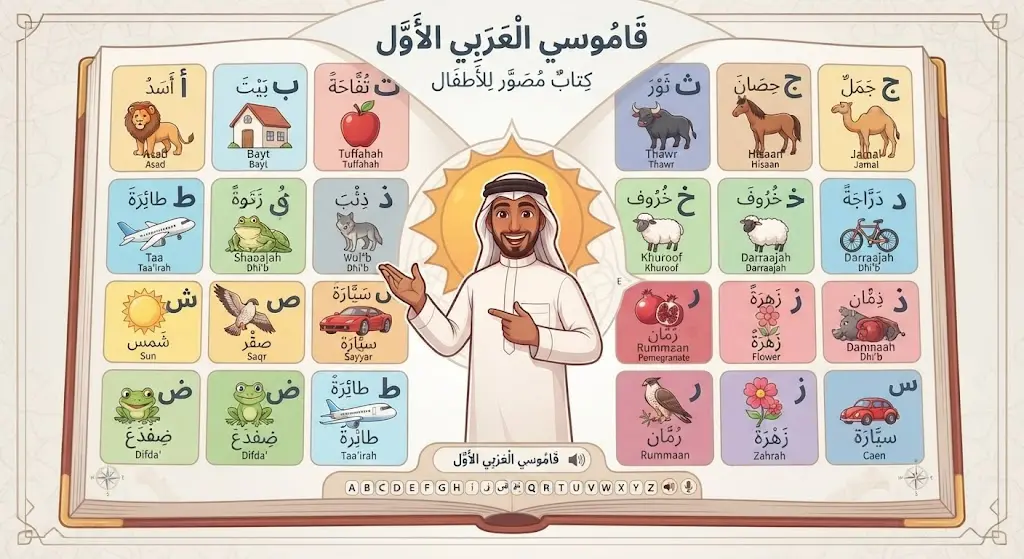
An Arabic dictionary for kids works best as a picture dictionary organized by everyday categories like family, colors, animals, and food, pairing each Arabic word with its transliteration and English meaning so children connect sound, script, and image together.
Table of Contents:
What Should Parents Look for in an Arabic Picture Dictionary for Kids?
The best Arabic picture dictionary for kids pairs three elements on every page: the Arabic word in clear script, its transliteration, and a simple image a child recognizes instantly. Look for vocabulary grouped by theme rather than strict alphabetical order, since young learners retain related words like family members or animals far more easily together.
In our lessons with young beginners at Buruj Academy, we consistently notice that children point to the picture before they attempt to say the word, which is exactly the order a good dictionary should support rather than fight against.
This is why structured lessons matter alongside any dictionary a family buys. Buruj Academy’s Online Arabic Classes for Kids course pairs picture vocabulary with a real instructor correcting pronunciation live, something no printed page alone can do.
Book a FREE Arabic trial for your child

Children Learn Arabic Words Faster When Pictures Sound and Repetition Work Together
Vocabulary sticks when a child hears the word, sees a matching picture, and repeats it aloud in the same short moment. This three step link between sound, image, and speech is why picture dictionaries outperform plain word lists for young Arabic learners.
This pattern matches how our Arabic words for kids resource is structured, moving from single nouns toward short two word pairings before full sentences begin. Multi-sensory repetition, where the same word is seen, heard, and spoken across several short sessions, consistently outperforms a single long study period.
Our deeper guide on mastering Arabic vocabulary covers spaced repetition techniques that pair well with dictionary practice. Reviewing a word after one day, then three days, then a week tends to move it from short term recall into lasting vocabulary a child can retrieve without prompting.
A List of the Best Arabic Picture Dictionaries for Kids
Several Arabic picture dictionaries are available for families who want a printed reference at home. The options below vary in word count, age range, and format, so the right pick depends on a child’s current level and how independently they already read.
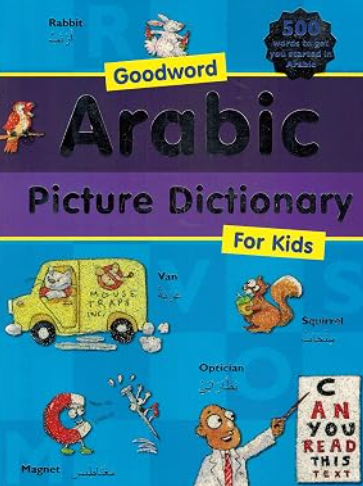
1. Goodword Arabic Picture Dictionary for Kids
The Goodword Arabic Picture Dictionary for Kids includes over 500 commonly used Arabic words, each paired with an English definition and a colorful illustration of a familiar object or scene.
It works well as a first reference book for children who are just beginning to connect Arabic vocabulary to everyday objects.
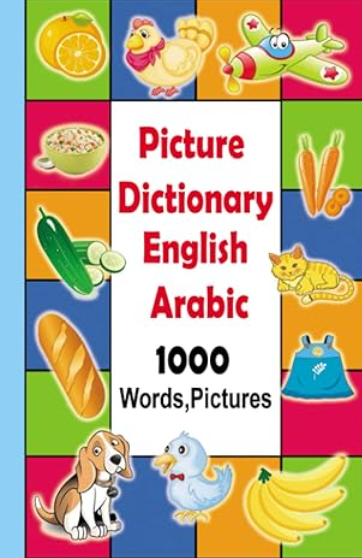
2. Picture Dictionary English-Arabic: 1000 Words, Pictures for Kids
With 1,000 words and matching pictures, Picture Dictionary English-Arabic covers a wider net of categories including colors, shapes, animals, opposites, food, clothes, and time, plus an Arabic index at the back for looking words up in either direction.
The larger word count suits children who have outgrown a beginner-level dictionary and are ready for broader vocabulary.
3. Arabic Picture Dictionary for Kids: 500 Essential Words (Ages 4-8)
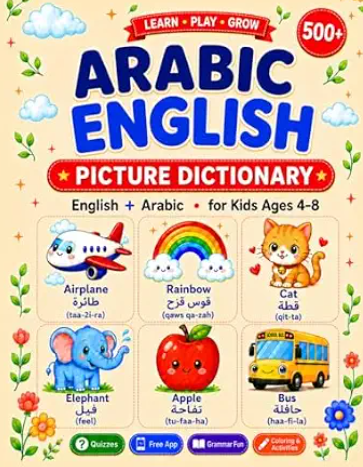
Built specifically for ages four to eight, Arabic Picture Dictionary for Kids: 500 Essential Words organizes 500 words across 61 categories and adds phonetic pronunciation, an alphabet chart, simple sentence patterns, picture quizzes, and coloring pages.
Families who want built-in practice activities alongside vocabulary, rather than a picture list alone, will find this format closer to a workbook than a reference book.
Read also: Fruits in Arabic
4. Children’s Illustrated Arabic Dictionary (Hippocrene Books)
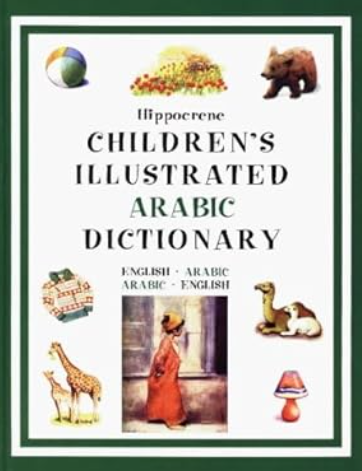
This Children’s Illustrated Arabic Dictionary (Hippocrene Books) bidirectional English-Arabic and Arabic-English dictionary is intended for a slightly older reading age than most picture dictionaries on this list.
It suits children who already recognize the Arabic alphabet and are ready to practice looking words up independently in either language.
Discover the Buruj Academy Difference
Step into our virtual classrooms and see how our expert instructors make learning Quran and Arabic intuitive and clear. We focus on overcoming the specific hurdles non-native speakers face, building your confidence and connection with the Quran.
Master the Arabic Language
Join our expert-led courses and build a strong foundation in Classical and Modern Arabic.
Get Your Free Trial5. My First 152 Words in Arabic: Bilingual Visual Dictionary
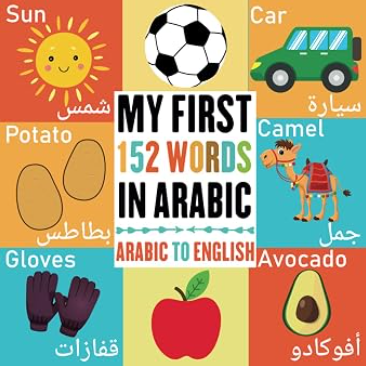
Aimed at toddlers and younger children, My First 152 Words in Arabic dictionary keeps the word count intentionally small and pairs each entry with a large, attractive picture.
Its shorter list makes it a gentler starting point than a 500 or 1,000 word dictionary for a child just beginning to learn Arabic vocabulary.
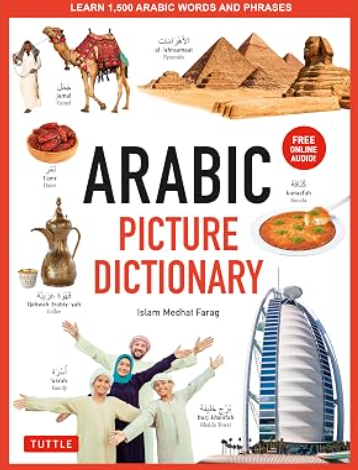
6. Arabic Picture Dictionary: Learn 1,500 Arabic Words and Phrases
Arabic Picture Dictionary: Learn 1,500 Arabic Words is the most advanced option on this list, built for learners ready to move past single-word vocabulary into phrases, with online audio pronunciation included. It suits older children in the 10 to 12 range, or families studying alongside their child, more than early beginners.
Read also: The Four Seasons in Arabic for Kids
Which Vocabulary Categories Should a Children’s Arabic Dictionary Cover First?
A children’s Arabic dictionary should begin with categories tied to daily life: family members, colors, numbers, animals, and common objects around the house.
These five groups give a child immediate opportunities to use new words in real conversation rather than memorizing vocabulary that stays abstract.
| Category | Arabic Word | Transliteration | English Meaning |
| Family | أم | umm | mother |
| Family | أب | ab | father |
| Colors | أحمر | ahmar | red |
| Colors | أزرق | azraq | blue |
| Animals | قطة | qitta | cat |
| Animals | أسد | asad | lion |
| Food | تفاحة | tuffaha | apple |
| Numbers | واحد | wahid | one |
Each category above appears in nearly every printed or digital Arabic picture dictionary for kids, and grouping practice this way helps children build small clusters of related meaning instead of one long, undifferentiated list.
Our Arabic words for kids guide expands each of these categories with additional examples, and once numbers feel comfortable, Arabic numbers for kids walks through counting from one to ten with the same picture based method.
Should Parents Choose a Digital or Printed Arabic Dictionary for Their Child?
Digital Arabic dictionaries for kids typically include audio pronunciation and interactive quizzes, while printed picture dictionaries offer a distraction free page a child can hold, point to, and revisit without a screen.
Neither format is inherently better; the right choice depends on the child’s age and attention span.
| Feature | Printed Dictionary | Digital Dictionary |
| Audio pronunciation | Not included | Usually included |
| Screen time | None | Required |
| Portability | Heavier, fixed | Lightweight, app based |
| Distraction risk | Low | Higher (notifications, other apps) |
| Best for | Ages 4 to 7, early readers | Ages 8 to 12, independent learners |
Many families end up using both formats side by side rather than choosing one permanently. A printed dictionary works well for quiet at-home practice, while a digital version can travel in the car or fill short waiting periods.
Whichever format a family chooses, letter recognition still comes first. Buruj Academy’s Arabic Alphabet Learning course builds that foundation before dictionary use becomes independent, since a child who cannot yet recognize letters will lean entirely on transliteration and pictures rather than the Arabic script itself.
Get a free trial now in Buruj’s Alphabet course
What Age Should a Child Start Using an Arabic Dictionary?
Most children can begin recognizing single Arabic words from picture cues around age four, matching sounds to simple images like animals or colors. Independent dictionary use, where a child looks up an unfamiliar word without help, typically develops closer to age seven or eight.
| Age Range | What Children Can Typically Do |
| 4 to 6 | Point to pictures and repeat single words aloud |
| 7 to 9 | Look up familiar categories independently, read short labels |
| 10 to 12 | Use alphabetically organized dictionaries, connect words into short sentences |
A helpful rule of thumb for parents: if a child can already recognize the Arabic alphabet reliably, dictionary independence tends to follow within a few months of regular practice rather than years.
By the upper end of that range, vocabulary naturally starts combining into short phrases.
Our guide to Arabic sentences for kids shows how dictionary level nouns and adjectives can be strung together once a child has a working vocabulary of fifty to a hundred words.
Read also: Arabic Reading Paragraphs for Kids
Learn Real Arabic Vocabulary with Buruj Academy’s Online Arabic Classes for Kids
A dictionary gives a child a starting list of words; a real teacher turns that list into language they can actually use.
Buruj Academy’s Online Arabic Classes for Kids course is taught by Al-Azhar University graduates with 12+ years of experience teaching non-Arabic speakers, using the Buruj Method’s context-before-abstraction approach so vocabulary is learned inside real sentences, not isolated flashcards.
Sessions are personalized 1-on-1, scheduled around your family’s routine, with real-time pronunciation correction no app or printed page can offer.
Book a free trial lesson and watch how quickly picture dictionary words become confident spoken Arabic, insha’Allah.
Enroll your child in one of our specialized, kid-friendly tracks today:
- Online Quran Classes for Kids
- Tajweed Classes for Kids
- Hifz Classes for Kids
- Online Arabic Classes for Kids
- Quranic Arabic Course for Kids
- Noorani Qaida Course for Kids
- Islamic Studies Classes for Kids
Ready to watch your child grow in knowledge and character? Join the Buruj Academy family and book a free trial session for your child today!
Master the Arabic Language
Join our expert-led courses and build a strong foundation in Classical and Modern Arabic.
Get Your Free TrialConclusion
A good Arabic dictionary for kids does more than translate words; it gives a child a reliable bridge between what they see and what they can say. Picture based vocabulary, sorted by everyday categories and practiced for a few minutes daily, builds retention that isolated word lists rarely achieve.
The dictionary itself is only the starting tool. What turns those pages into real spoken Arabic is consistent practice at home, paired where possible with an instructor who can hear a child’s pronunciation and correct it in the moment.
Frequently Asked Questions About Arabic Dictionaries for Kids
What Age Is Best to Start an Arabic Picture Dictionary for Kids?
Most children can begin using a simple Arabic picture dictionary around age four, starting with single word recognition tied to familiar images like animals or colors. Independent lookup skills, where a child searches for an unfamiliar word alone, typically develop between ages seven and nine as reading confidence grows.
Should an Arabic Dictionary for Kids Include Transliteration or Only Arabic Script?
A children’s Arabic dictionary works best with all three elements present: Arabic script, transliteration, and English meaning. Transliteration helps beginners approximate pronunciation before script recognition is solid, while gradually relying less on it as the child’s Arabic letter reading improves supports long term fluency.
How Many New Arabic Words Should a Child Learn Per Week from a Dictionary?
Five to ten new words per week, practiced daily in short sessions, works better for most children than learning twenty words once and never reviewing them. Consistent, low volume repetition builds stronger long term retention than occasional high volume study, especially for children under age eight.