 Arabic
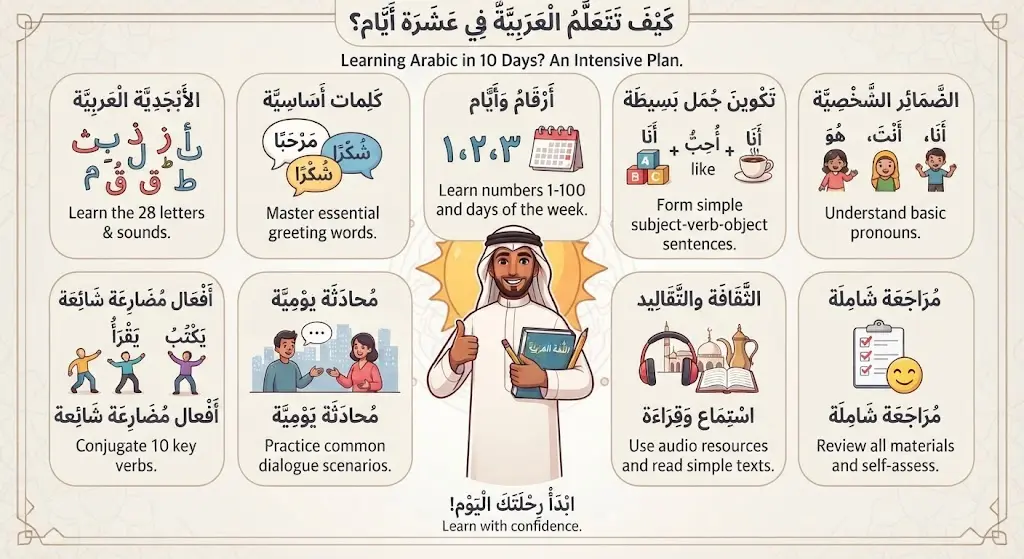
Most beginners open an Arabic textbook, see the script running right to left, and close it within minutes. The fear is real, but it is also fixable with the right daily structure.
Learning Arabic in 10 days means building a working foundation, not full fluency: alphabet mastery, phonetic reading, roughly fifty practical words, and simple sentence construction. This guide breaks that foundation into ten daily steps you can follow starting today.
Table of Contents:
Step 1: Master the Arabic Alphabet and Its Short Vowels in the First Day of the 10 Days Plan
The Arabic alphabet contains 28 letters plus three short vowel markers — fatha, kasra, and damma — that sit above or below each letter to indicate its sound. Mastering these two layers together, rather than memorizing letters in isolation, is the single fastest path to reading Arabic within your first day.
Most self-taught learners skip the short vowels entirely because printed Arabic often omits them. That shortcut backfires quickly, since every word you memorize later depends on knowing which vowel sound belongs to which letter.
Grouping letters by shared shape speeds this up considerably. Several Arabic letters share an identical base form and differ only by the number and placement of dots above or below them.
| Shared Base Shape | Letters in the Group | What Distinguishes Each |
| Vertical stroke with dip | ب ت ث | One dot below, two dots above, three dots above |
| Rounded body with tail | ج ح خ | One dot below, no dot, one dot above |
| Small loop shape | س ش | No dots, three dots above |
At Buruj Academy, our teaching philosophy for Arabic follows a context-before-abstraction approach, meaning letters are practiced inside real words rather than as disconnected symbols.
Our Arabic Alphabet Learning Course builds this exact foundation with instructor-guided pronunciation from day one. You can also review the complete Arabic alphabet breakdown for a deeper reference.
Exercise: Write each letter from the table above five times, saying its sound aloud each time you write it.
Get a free trial now in Buruj’s Alphabet course
Step 2: Practice Writing Each Arabic Letter in Its Four Connected Forms
Arabic is a cursive script, meaning most letters change shape depending on whether they appear at the start, middle, or end of a word, or stand alone. Learning only the isolated form — the version shown in alphabet charts — leaves beginners unable to recognize the same letter once it connects to others.
In our beginner sessions at Buruj Academy, the most common early mistake we observe is students memorizing a letter’s isolated shape perfectly, then failing to recognize that same letter mid-word.
This gap closes quickly once students physically write each form rather than only reading it.
The letter ب (baa) illustrates this well: it looks different in isolation, at the start of a word, in the middle, and at the end, yet its sound never changes.
Why Connected Forms Matter More Than Memorizing Shapes
Twenty-two of the 28 Arabic letters connect on both sides within a word. Six letters only connect to the letter before them, which creates natural visual breaks that experienced readers use to identify word boundaries quickly.
Reviewing detailed Arabic pronunciation guidance alongside handwriting practice reinforces sound and shape together, which is far more effective than practicing either skill alone.
Exercise: Pick three letters and write out their isolated, initial, medial, and final forms from memory before checking a reference chart.
Step 3: Memorize Ten Essential Arabic Greetings for Real Conversations
Greetings give beginners immediate, usable Arabic within the first three days, since they require no grammar knowledge and get reinforced constantly through repetition. Ten core greetings cover the vast majority of everyday social exchanges a beginner will encounter.
Practicing greetings out loud, rather than only reading them silently, trains your ear to recognize the rhythm and stress patterns unique to Arabic speech.
| Arabic | Transliteration | Meaning |
| مرحبا | marhaban | Hello |
| السلام عليكم | as-salamu alaykum | Peace be upon you |
| صباح الخير | sabah al-khayr | Good morning |
| كيف حالك | kayfa haluka | How are you (to a male) |
| اسمي… | ismi… | My name is… |
| شكرا | shukran | Thank you |
| من فضلك | min fadlik | Please |
| مع السلامة | ma’a as-salama | Goodbye |
Say each phrase aloud three times before moving to the next, focusing on matching the transliteration’s stress pattern rather than reading it flatly.
Step 4: Build a Core Vocabulary Around Objects and Needs You Use Daily
Vocabulary sticks fastest when it connects to objects and actions you actually encounter each day, rather than random word lists disconnected from your routine. Grouping words by category — home, food, and time — gives your memory logical anchors instead of isolated facts.
Twenty well-chosen words across these three categories give beginners enough raw material to start recognizing patterns in how Arabic builds meaning.
Grouping Vocabulary by Category Speeds Retention
Learners who study fifteen unrelated words in one sitting typically retain far fewer than learners who study the same number grouped by theme.
This is a pattern we consistently reinforce in our Arabic for Beginners course, where vocabulary is introduced alongside the letters that form each word.
Reviewing structured Arabic vocabulary techniques can help you extend this list well beyond your first ten days.
Exercise: Choose five household objects around you right now and look up their Arabic names, writing each one down by hand.
Begin learning Arabic at Buruj with a FREE trial lesson

Step 5: Learn Arabic Personal Pronouns Before Attempting Full Sentences
Arabic personal pronouns must be mastered before sentence building begins, because verb conjugations change directly based on which pronoun is used.
Skipping this step forces beginners to memorize entire sentences by rote instead of understanding how they are constructed.
Six core pronouns cover almost every conversational sentence a beginner will need during their first ten days of study.
| Pronoun | Arabic | Transliteration |
| I | أنا | ana |
| You (m.) | أنتَ | anta |
| You (f.) | أنتِ | anti |
| He | هو | huwa |
| She | هي | hiya |
| We | نحن | nahnu |
Notice that male and female forms of “you” differ in Arabic, a distinction English does not make.
This gender agreement pattern repeats throughout Arabic grammar, so establishing it early prevents confusion later.
Exercise: Cover the transliteration column and try recalling all six pronouns from the Arabic script alone.
Read also: Clothes in Arabic
Discover the Buruj Academy Difference
Step into our virtual classrooms and see how our expert instructors make learning Quran and Arabic intuitive and clear. We focus on overcoming the specific hurdles non-native speakers face, building your confidence and connection with the Quran.
Master the Arabic Language
Join our expert-led courses and build a strong foundation in Classical and Modern Arabic.
Get Your Free TrialStep 6: Construct Simple Arabic Sentences Using the Subject-Predicate Pattern
The nominal sentence, or jumla ismiyya, lets beginners build grammatically correct Arabic sentences without needing any verb conjugation knowledge. This sentence type simply places a subject next to a descriptive word or noun, similar to saying “I student” instead of “I am a student.”
Arabic omits the verb “to be” in the present tense entirely, which often surprises English speakers expecting an equivalent word.
Combining a pronoun from the previous step with a noun produces an immediately usable sentence: أنا طالب (ana talib) means “I am a student,” with no additional grammar required. Reviewing Arabic sentence structure in more depth will help solidify this pattern before moving to verbal sentences.
Exercise: Build three nominal sentences using pronouns from Step 5 and any noun you have already learned.
Step 7: Add Present-Tense Verbs to Describe Daily Actions in Arabic
Present-tense verbs let beginners describe daily actions, moving beyond static description into functional communication. Arabic present-tense verbs attach a prefix that changes based on the subject, directly connecting back to the pronouns mastered in Step 5.
Five common verbs cover a wide range of daily statements a beginner needs during early conversations.
The verb “to write” demonstrates this clearly: أنا أكتب (ana aktubu) means “I write,” while هو يكتب (huwa yaktubu) means “he writes.” Notice the prefix changes from أ to ي depending on the subject.
Our Arabic Grammar Course at Buruj Academy walks students through these conjugation patterns systematically, with real-time correction from instructors experienced in teaching non-native speakers.
You can also explore the Arabic present tense for a complete conjugation reference.
Exercise: Conjugate the verb “to write” for all six pronouns from Step 5 without looking at a reference.
Understand the Arabic Grammar with Buruj’s free trial lesson
Step 8: Practice the Eight Most Useful Arabic Question Words for Daily Conversation
Question words transform passive vocabulary into active conversation, since every real exchange eventually requires asking something. Eight core question words cover nearly every question a beginner will need during their first ten days.
| Question Word | Arabic | Meaning |
| What | ما / ماذا | ma / madha |
| Who | من | man |
| Where | أين | ayna |
| When | متى | mata |
| How | كيف | kayfa |
| Why | لماذا | limadha |
Arabic uses ما before nouns and ماذا before verbs, a distinction that becomes automatic with repeated practice rather than memorized as an abstract rule.
Our Arabic Speaking Course gives students structured conversation practice specifically built around these question patterns, closing the gap between recognizing a word and using it naturally.
Exercise: Write three questions using different question words, then answer them yourself using sentence patterns from Steps 6 and 7.
Book your free trial to start speaking Arabic fluently

Read also: Seasons and Weather in Arabic
Step 9: Read Short Vowelled Sentences to Strengthen Recognition and Fluency
Reading short, fully vowelled sentences builds the recognition speed that separates beginners from confident readers. Vowelled text — Arabic with all fatha, kasra, and damma markers included — removes the guesswork that trips up learners reading unvowelled text too early.
Reading ten short sentences daily, even slowly, trains your eyes to recognize letter combinations as complete words rather than sounding out every letter individually.
Reviewing basic Arabic words with pronunciation alongside your reading practice reinforces correct sound-to-symbol mapping while you build speed.
Exercise: Read the nominal sentences you built in Step 6 aloud five times each, gradually increasing your pace without sacrificing pronunciation accuracy.
Step 10: Review Everything You Learned Using Active Recall Techniques
Active recall — testing yourself without looking at reference material — cements everything learned across the previous nine days far more effectively than passive rereading. Beginners who skip a structured review day typically forget forty percent or more of new vocabulary within a week.
Testing pronouns, greetings, and question words together, rather than reviewing each category separately, mirrors how real conversation actually mixes these elements.
A realistic checkpoint after ten focused days includes confident alphabet recognition, phonetic reading ability, and roughly fifty actively practiced words and phrases. Reaching genuine conversational fluency requires continued, structured study well beyond this first sprint.
Exercise: Without any reference material, write five sentences combining pronouns, a question word, and vocabulary from earlier steps.
Continue Your Arabic Progress with Buruj Academy’s Online Classes
Ten days builds the essential foundation — alphabet, core vocabulary, and simple sentences — but real fluency develops through consistent, guided practice beyond that point. Buruj Academy’s online Arabic classes continue exactly where this plan leaves off.
Our instructors are Al-Azhar University graduates with 12+ years teaching non-Arabic speakers worldwide.
Every session follows the Buruj Method’s context-before-abstraction approach, paired with personalized learning plans, flexible 24/7 scheduling, and real-time pronunciation correction.
Book a free trial lesson and start building on your ten-day foundation with a qualified instructor today.
Begin your transformation today by choosing the path that fits your goals:
- Online Arabic Classes (General & Comprehensive)
- Arabic Course for Beginners
- Arabic Alphabet Learning Course
- Online Arabic Classes for Kids
- Arabic Classes for Adults
- Arabic Grammar Course (Nahw & Sarf)
- Intermediate Arabic Course (B1/B2)
- Arabic Speaking Course (Conversational Fluency)
- Arabic Reading Course (Literary Excellence)
- Learn Arabic Writing Course (Calligraphy & Composition)
Ready to speak with confidence? Join the global community at Buruj Academy and book your free placement interview today!
Master the Arabic Language
Join our expert-led courses and build a strong foundation in Classical and Modern Arabic.
Get Your Free TrialConclusion
Ten days will not make anyone fluent in Arabic, but it can absolutely build a working foundation that most self-taught learners never reach on their own. Alphabet recognition, phonetic reading, and roughly fifty practical words form a launchpad rather than a finish line.
The learners who progress fastest treat these ten days as the beginning of a consistent daily habit, not a one-time sprint. Structured guidance from an experienced instructor turns that early momentum into lasting fluency.
Read also: Arabic Days of the Week
Frequently Asked Questions About Learning Arabic in 10 Days
Can Complete Beginners Learn Arabic in 10 Days?
Complete beginners can realistically master the alphabet, basic pronunciation, and roughly fifty essential words and phrases within 10 days. Full conversational fluency requires months of consistent practice beyond this foundational sprint, so treat this plan as a strong starting point.
Is It Possible to Learn Arabic in 10 Days for Free?
Free resources such as printable alphabet charts, pronunciation videos, and vocabulary lists can support most of this 10-day plan at no cost. Structured feedback from a qualified instructor, however, significantly speeds up correct pronunciation and grammar habits.
How Many Arabic Words Can a Beginner Realistically Learn in 10 Days?
Beginners following a focused daily plan typically learn and actively practice around fifty core words and phrases across greetings, objects, pronouns, and questions. This estimate reflects consistent daily practice rather than passive study or occasional review sessions.
What Should Beginners Study After Completing This 10-Day Plan?
After this foundation, beginners should focus on expanding vocabulary, mastering additional verb tenses, and practicing speaking with a qualified instructor. Reviewing how long it typically takes to learn Arabic can help set realistic expectations for your continued progress.