 Arabic
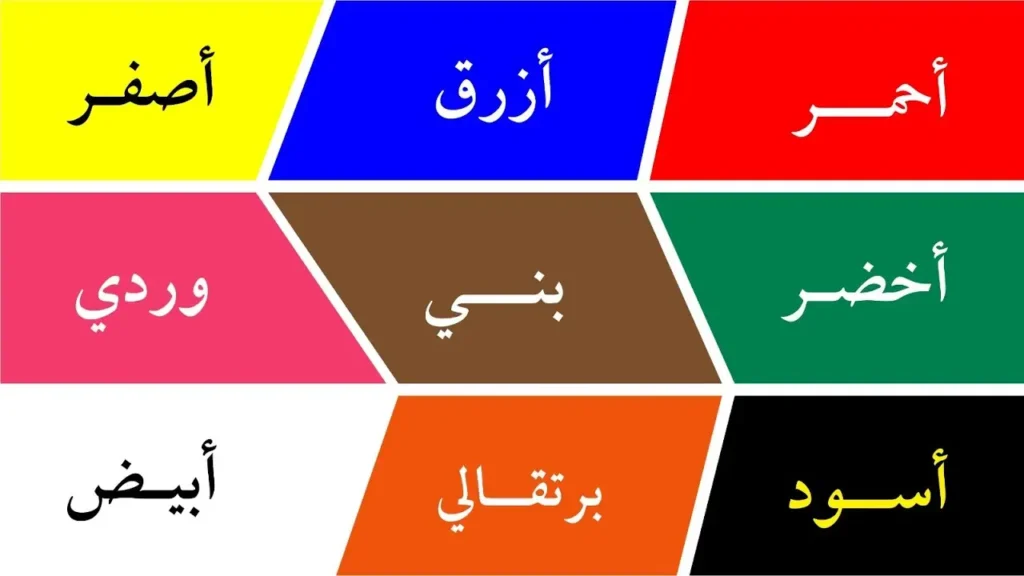
Learning colors in Arabic feels different from learning them in English, because Arabic colors are adjectives that must match the gender of the noun they describe.
A student pointing at a red car and a red apple in Arabic will actually use two different words for “red” — and that single detail trips up more beginners than any other part of Arabic vocabulary.
Arabic colors in Egyptian Arabic and Modern Standard Arabic mostly share the same seven core color words, but each color has a masculine form and a feminine form. Getting this masculine-feminine pattern right from day one prevents years of habitual mistakes later.
Table of Contents:
What Are the Basic Colors in Arabic?
The basic colors in Arabic follow a special irregular pattern called أَفْعَل (af’al), not the regular adjective pattern most students learn first. This means colors like أَحْمَر (red) and أَزْرَق (blue) shift their internal vowels for the feminine form instead of simply adding an ending.
In our sessions at Buruj Academy, this is the single most common stumbling block for adult beginners moving from basic adjectives to colors.
| Color | Masculine | Feminine | Transliteration (M / F) |
| Red | أَحْمَر | حَمْرَاء | Aḥmar / Ḥamrā’ |
| Blue | أَزْرَق | زَرْقَاء | Azraq / Zarqā’ |
| Yellow | أَصْفَر | صَفْرَاء | Aṣfar / Ṣafrā’ |
| Green | أَخْضَر | خَضْرَاء | Akhḍar / Khaḍrā’ |
| Black | أَسْوَد | سَوْدَاء | Aswad / Sawdā’ |
| White | أَبْيَض | بَيْضَاء | Abyaḍ / Bayḍā’ |
Notice that the feminine forms almost always end in اء (alif-hamza), a pattern unique to this group of adjectives and one that rarely appears elsewhere in Arabic grammar.
Students who memorize this ending as a single unit, rather than as separate letters, tend to recall it far more reliably during live conversation.
Because this pattern behaves like other masculine and feminine nouns in Arabic, reviewing that foundational grammar first makes colors click faster.
Our Online Arabic Classes introduce this pattern early, using real objects rather than abstract grammar tables, so the sound becomes automatic before the rule is even named.
Book your FREE Arabic trial online Arabic class at Buruj

How Does Arabic Grammar Decide Which Color Form to Use?
The choice between masculine and feminine color forms depends entirely on the gender of the noun being described, not on anything about the color itself. A masculine noun like كِتَاب (book) always pairs with the masculine color form.
For example, كِتَابٌ أَحْمَرُ means “a red book,” while سَيَّارَةٌ حَمْرَاءُ means “a red car” — same color, two completely different words, because كِتَاب is masculine and سَيَّارَة is feminine.
This mirrors the agreement pattern used throughout Arabic descriptive sentences, which is why students who have already studied Arabic sentence structure tend to grasp color agreement noticeably faster than complete beginners.
1. Red in Arabic: Masculine and Feminine Forms with Examples
Red in Arabic is أَحْمَر (aḥmar) for masculine nouns and حَمْرَاء (ḥamrā’) for feminine nouns, both derived from the same three-letter root ح-م-ر. This root also connects to related words like حُمْرَة, meaning “redness” or “blush.”
Masculine Example: الْبَابُ أَحْمَرُ Al-bābu aḥmar “The door is red.”
Feminine Example: الْوَرْدَةُ حَمْرَاءُ Al-wardatu ḥamrā’ “The flower is red.”
In Egyptian Arabic, pronunciation softens slightly but the words stay recognizable: أَحْمَر is still said “aḥmar,” while حَمْرَة sometimes replaces the more formal حَمْرَاء in casual speech, especially in phrases like بِنْت حَمْرَة (a fair-skinned or “red-toned” girl, a common colloquial description).
2. Blue and Green in Arabic
Blue in Arabic is أَزْرَق (azraq) masculine and زَرْقَاء (zarqā’) feminine, while green is أَخْضَر (akhḍar) masculine and خَضْرَاء (khaḍrā’) feminine — two colors students routinely mix up because their masculine forms both start with a hamza-vowel-consonant pattern.
We have noticed that students who struggle with this pair almost always benefit from anchoring each word to a strong visual: sky for blue, grass for green, rather than drilling the words in isolation.
| Color | Masculine | Feminine | Common Association |
| Blue | أَزْرَق | زَرْقَاء | السَّمَاء (the sky) |
| Green | أَخْضَر | خَضْرَاء | العُشْب (the grass) |
Example Sentence (Blue): السَّمَاءُ زَرْقَاءُ As-samā’u zarqā’ “The sky is blue.”
Example Sentence (Green): الْعُشْبُ أَخْضَرُ Al-‘ushbu akhḍar “The grass is green.”
Read also: Animals in Arabic
3. Yellow in Arabic and Its Everyday Uses
Yellow in Arabic is أَصْفَر (aṣfar) for masculine nouns and صَفْرَاء (ṣafrā’) for feminine nouns, and it appears constantly in daily vocabulary — from الشَّمْس الصَّفْرَاء (the yellow sun, poetically) to الْمَوْز الْأَصْفَر (the yellow banana).
Interestingly, أَصْفَر also carries a secondary meaning in some classical contexts related to paleness, so context always determines whether the word describes the color itself or a person’s complexion.
4. Black and White in Arabic
Black in Arabic is أَسْوَد (aswad) masculine and سَوْدَاء (sawdā’) feminine, while white is أَبْيَض (abyaḍ) masculine and بَيْضَاء (bayḍā’) feminine — typically the very first color pair taught because of their high frequency in clothing and object descriptions.
These two colors also show up constantly in idiomatic Arabic expressions, which makes them worth mastering beyond simple description.
| Color | Masculine | Feminine | Idiomatic Use |
| Black | أَسْوَد | سَوْدَاء | يَوْم أَسْوَد (a black/bad day) |
| White | أَبْيَض | بَيْضَاء | قَلْب أَبْيَض (a pure/white heart) |
Practice Exercise: Cover the Arabic column and try producing both the masculine and feminine forms for black and white from memory, then check your answers against the table above.
5. Brown in Arabic
Brown in Arabic uses بُنِّي (bunni) / بُنِّيَّة (bunniyya) for objects like furniture, chocolate, or clothing.
This distinction rarely appears in beginner textbooks, yet native speakers apply it instinctively, which is exactly the kind of nuance that separates textbook Arabic from natural, lived Arabic.
Discover the Buruj Academy Difference
Step into our virtual classrooms and see how our expert instructors make learning Quran and Arabic intuitive and clear. We focus on overcoming the specific hurdles non-native speakers face, building your confidence and connection with the Quran.
Master the Arabic Language
Join our expert-led courses and build a strong foundation in Classical and Modern Arabic.
Get Your Free TrialColors in Egyptian Arabic
Colors in Egyptian Arabic use largely the same root words as Modern Standard Arabic, but pronunciation shifts and a few colloquial shortcuts appear in daily speech. The formal حَمْرَاء, for instance, is frequently softened to just “ḥamra” in casual Cairo dialect.
| Color (MSA) | Egyptian Colloquial Shift |
| أَحْمَر (aḥmar) | Same, but softer vowel: “aḥmar” |
| أَزْرَق (azraq) | Sometimes “azra'” (glottal stop replaces ق) |
| أَصْفَر (aṣfar) | Same pronunciation, high frequency in daily use |
| أَخْضَر (akhḍar) | Same pronunciation, common in food descriptions |
The core takeaway for learners: Egyptian Arabic colors are not a separate vocabulary set to memorize twice.
They are the same words spoken with regional pronunciation habits, so mastering Modern Standard Arabic colors first gives learners a head start in any dialect.
Because dialect shifts like the ق-to-glottal-stop pattern also affect many other words, students benefit from studying Arabic pronunciation as a complementary skill alongside vocabulary building.
Building Shade and Compound Colors in Arabic
Arabic builds shade variations by placing a descriptive word directly after the base color rather than creating an entirely new word, similar to how English says “sky blue” or “dark green.” The most common modifiers are فَاتِح (light) and غَامِق (dark).
Examples:
- أَزْرَق فَاتِح (azraq fātiḥ) — light blue
- أَخْضَر غَامِق (akhḍar ghāmiq) — dark green
- أَحْمَر فَاتِح (aḥmar fātiḥ) — light red / pink-ish red
These modifiers stay in their base masculine form regardless of the noun’s gender in casual speech, though formal MSA technically still applies gender agreement to the base color word itself — a nuance our Online Arabic Classes for Adults instructors clarify early to prevent confusion later.
Book your free Arabic trial lesson at Buruj

Practice Table: Match the Color to the Object
| Object | Arabic Noun Gender | Correct Color Form |
| الْقَمِيص (the shirt) | Masculine | أَبْيَض |
| الْحَقِيبَة (the bag) | Feminine | سَوْدَاء |
| الْبَيْت (the house) | Masculine | أَصْفَر |
| الشَّجَرَة (the tree) | Feminine | خَضْرَاء |
Read also: Body Parts in Arabic
How Do You Say Colors in Arabic Names and Common Phrases?
Arabic colors names appear constantly beyond simple description — in idioms, proper nouns, and everyday expressions that carry cultural weight beyond their literal meaning. الْبَحْر الْأَحْمَر (the Red Sea) and الْبَحْر الْأَسْوَد أَبْيَض (Black and White Sea nicknames used informally) are two well-known geographic examples.
Color-based expressions also carry emotional and descriptive nuance: قَلْبُهُ أَبْيَض (literally “his heart is white”) describes someone kind and pure-hearted, while يَوْمٌ أَسْوَد (a black day) describes a difficult or unlucky day.
Mastering these phrases requires solid footing in common words in Arabic more broadly, since color idioms often combine with vocabulary students encounter in entirely unrelated lessons.
Master Arabic Colors and Beyond with Buruj Academy’s Personalized Classes
Understanding Arabic colors unlocks confident, natural description — a skill that touches nearly every real conversation, from shopping to storytelling. Mastering the masculine-feminine pattern here builds grammar instincts that carry into every future Arabic lesson.
At Buruj Academy, our online Arabic classes use the context-before-abstraction method, teaching vocabulary like colors through meaningful, real-world practice rather than isolated word lists.
Guided by instructors with 12+ years of experience teaching non-Arabic speakers, students build lasting fluency instincts.
Our Al-Azhar-trained teachers offer:
- Personalized 1-on-1 sessions tailored to your pace and goals
- Real-time pronunciation correction as you practice
- Flexible 24/7 scheduling for students worldwide
- A clear progression path from basic vocabulary to natural fluency
Book a free trial lesson with Buruj Academy today and start building Arabic instincts that last.
Begin your transformation today by choosing the path that fits your goals:
- Online Arabic Classes (General & Comprehensive)
- Arabic Course for Beginners
- Arabic Alphabet Learning Course
- Online Arabic Classes for Kids
- Arabic Classes for Adults
- Arabic Grammar Course (Nahw & Sarf)
- Intermediate Arabic Course (B1/B2)
- Arabic Speaking Course (Conversational Fluency)
- Arabic Reading Course (Literary Excellence)
- Learn Arabic Writing Course (Calligraphy & Composition)
Ready to speak with confidence? Join the global community at Buruj Academy and book your free placement interview today!
Master the Arabic Language
Join our expert-led courses and build a strong foundation in Classical and Modern Arabic.
Get Your Free TrialConclusion
Arabic colors carry more grammatical weight than most learners expect, since every color word shifts to match the gender of what it describes. Once that masculine-feminine pattern feels natural, colors stop being a memorization task and become an instinctive part of speaking.
From the irregular أَفْعَل pattern of the seven basic colors to the everyday pronunciation habits found in Egyptian Arabic, consistent practice with real objects turns abstract rules into confident, natural expression.
Read also: Directions in Arabic
Frequently Asked Questions About Arabic Colors
How Do You Say “Yellow” in Arabic?
Yellow in Arabic is أَصْفَر (aṣfar) for masculine nouns and صَفْرَاء (ṣafrā’) for feminine nouns. Both forms share the same three-letter root and follow the same irregular pattern as the other six basic Arabic colors, ending in اء for feminine agreement.
Are Colors in Egyptian Arabic Different from Modern Standard Arabic?
Colors in Egyptian Arabic use the same root words as Modern Standard Arabic, with only pronunciation and casual shortcuts differing. Learning the formal MSA color forms first gives students a strong foundation that transfers directly into everyday Egyptian conversation.
Why Do Arabic Colors Have Masculine and Feminine Forms?
Arabic colors change form because adjectives in Arabic must grammatically agree with the gender of the noun they describe. This agreement rule applies throughout Arabic grammar, not just to colors, making it a foundational concept worth mastering early.
What Is the Easiest Way to Memorize Arabic Color Pairs?
Pairing each masculine and feminine color form with a real, visual object—like associating أَزْرَق and زَرْقَاء with the sky—helps learners retain both forms together. Practicing the pair aloud with example sentences builds faster recall than memorizing isolated word lists.
Do All Arabic Colors Follow the Same Grammar Pattern?
The basic colors (red, blue, yellow, green, black, and white) follow the irregular أَفْعَل pattern with internal vowel shifts.